Listen to this Post
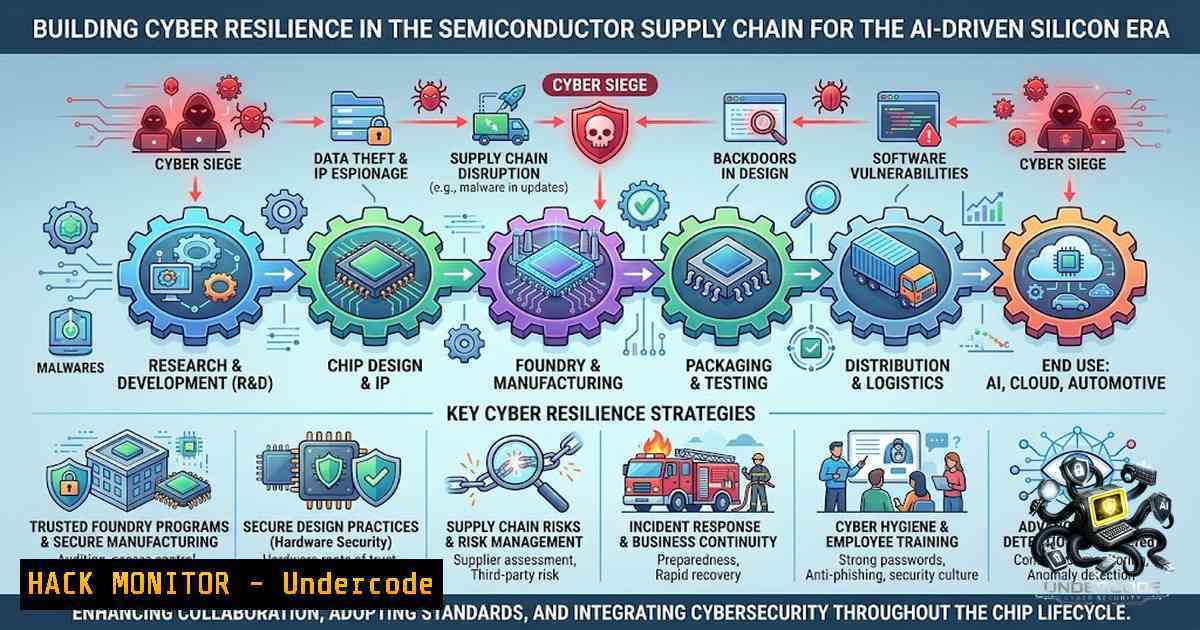
Introduction:
As artificial intelligence accelerates the next wave of semiconductor innovation, the industry faces an unprecedented convergence of opportunity and risk. The global semiconductor ecosystem—spanning design, fabrication, packaging, and distribution—has become a prime target for sophisticated cyber adversaries seeking to disrupt production, steal intellectual property, and compromise trusted supply chains. With the 2026 Semiconductor Network Summit bringing together policymakers and industry leaders in Taiwan, the time is now to examine the technical frameworks, security controls, and operational practices essential for hardening the semiconductor supply chain against emerging threats in the AI era.
Learning Objectives:
- Understand the cybersecurity threat landscape facing modern semiconductor fabrication and supply chain operations
- Master practical implementation of SEMI E187 equipment security standards and NIST-based security frameworks
- Learn to assess and mitigate vulnerabilities in silicon photonics, quantum computing interfaces, and AI accelerator hardware
- Develop hands-on skills for securing semiconductor manufacturing systems across Linux and Windows environments
You Should Know:
- Hardening Semiconductor Fab Infrastructure: SEMI E187 Compliance and Beyond
The semiconductor industry has established SEMI E187 as the foundational cybersecurity standard for wafer fab equipment. This standard defines baseline security requirements for equipment running Microsoft Windows or Linux operating systems, excluding PLC and SCADA systems connected through sensor networks. Implementation requires a defense-in-depth approach that addresses both IT and OT environments.
Step-by-Step Guide: Implementing SEMI E187 Baseline Security
Step 1: Asset Inventory and Risk Assessment
Begin by cataloging all semiconductor manufacturing equipment, identifying operating systems, network interfaces, and third-party software dependencies. The NIST Cybersecurity Framework 2.0 provides guidance across six activity areas: Govern, Identify, Protect, Detect, Respond, and Recover.
Step 2: Operating System Hardening
For Linux-based fab equipment, implement the following security controls:
 Disable unnecessary services
systemctl list-unit-files --type=service --state=enabled
systemctl disable [unnecessary-service]

Implement mandatory access control
apt-get install apparmor-utils
aa-enforce /etc/apparmor.d/

Configure audit logging
auditctl -w /etc/passwd -p wa -k identity_changes
auditctl -w /var/log/ -p wa -k log_monitoring

Harden SSH configuration
sed -i 's/PermitRootLogin yes/PermitRootLogin no/' /etc/ssh/sshd_config
sed -i 's/PasswordAuthentication yes/PasswordAuthentication no/' /etc/ssh/sshd_config
systemctl restart sshd
For Windows-based fab equipment:
 Disable unnecessary services
Get-Service | Where-Object {$<em>.StartType -eq "Automatic" -and $</em>.Status -eq "Running"}
Stop-Service [unnecessary-service]
Set-Service [unnecessary-service] -StartupType Disabled

Configure Windows Defender and firewall
Set-MpPreference -DisableRealtimeMonitoring $false
Set-MpPreference -SignatureUpdateInterval 8
New-1etFirewallRule -DisplayName "Block All Inbound" -Direction Inbound -Action Block

Enable advanced auditing
auditpol /set /subcategory:"Logon" /success:enable /failure:enable
auditpol /set /subcategory:"Object Access" /success:enable /failure:enable
Step 3: Remote Access Control
Implement strict remote access policies with multi-factor authentication. Verify all remote access practices and maintain continuous visibility into third-party controls.
Step 4: Continuous Monitoring
Deploy Security Information and Event Management (SIEM) solutions tailored for semiconductor environments. Establish baseline behavioral patterns for equipment and alert on anomalies.
2. Securing the Silicon Photonics and Quantum Ecosystem
Silicon photonics (SiPh) enables energy-efficient optical computation for AI hardware accelerators, but integrating SiPh with electronic sub-systems introduces new security vulnerabilities that cannot be addressed using existing hardware security solutions. These vulnerabilities include denial-of-service attacks, data leakage, and reliability compromises throughout the SiPh supply chain.
Step-by-Step Guide: Mitigating Silicon Photonics Security Risks
Step 1: Supply Chain Verification
Implement cryptographic provenance frameworks for photonic integrated circuits (PICs). Blockchain-enabled provenance can provide early visibility into chiplet inventory and enhance transparency across the supply chain.
Step 2: Hardware Trojan Detection
Deploy frameworks like SerIOS for enhancing hardware security in optoelectronic systems. Monitor for thermal fault injection attacks that can compromise optical neural network accelerators.
Step 3: Post-Quantum Cryptography Preparation
The advancement of quantum computing poses significant threats to classical cryptographic algorithms. Prepare for “harvest now, decrypt later” (HNDL) attacks by implementing NIST-standardized post-quantum cryptography (PQC) algorithms published in 2024.
Step 4: Quantum-Safe Key Management
Implement quantum key distribution (QKD) for physics-based security or deploy PQC algorithms believed resistant to quantum attacks. BTQ and ITRI are currently collaborating to validate QCIM quantum secure chips in silicon, combining advanced cryptography with compute-in-memory semiconductor technology.
Verification Commands:
 Check for OpenSSL post-quantum algorithm support
openssl list -kem-algorithms | grep -i "kyber|dilithium|falcon|sphincs"

Verify cryptographic library versions
openssl version -a
dpkg -l | grep -E "openssl|libssl"

Monitor for side-channel indicators
perf stat -e cycles,instructions,cache-misses ./quantum_sensitive_application
 Windows: Check cryptographic provider configuration
Get-TlsCipherSuite | Select-Object Name, Exchange, Cipher, Hash
Get-ChildItem -Path Cert:\LocalMachine\My | ForEach-Object { $_.Thumbprint }
3. Cyber Resilience for the Semiconductor Supply Chain
Strengthening supply chain security is no longer optional given the semiconductor industry’s heavy reliance on third-party tools and services. The Standardized Semiconductor Cybersecurity Assessment (SSCA) introduces a common question bank focused on three critical domains: Cyber Resilience, IP Protection, and Product Security.
Step-by-Step Guide: Building Supply Chain Cyber Resilience
Step 1: Supplier Maturity Assessments
Conduct structured supply chain security programs including supplier maturity assessments and clear requirements for secure development. Conduct documented cyber supply chain risk assessments at least annually.
Step 2: IP Protection Implementation
Implement data-centric encryption and backup of critical design data. Establish clear roles for execution of data destruction and related activities.
Step 3: Incident Response Planning
Develop and test incident response plans that involve suppliers and third parties to identify potential weaknesses across the supply chain. Establish continuous security awareness training programs.
Step 4: Supply Chain Visibility
Implement continuous visibility into third-party controls. Deploy blockchain-based provenance frameworks for enhanced transparency.
Linux Supply Chain Security Verification:
 Verify package integrity
debsums -a | grep -v "OK"
rpm -Va

Check for unexpected binaries in system paths
find /bin /usr/bin /sbin /usr/sbin -type f -exec file {} \; | grep -E "ELF.executable"

Audit system for unauthorized changes
aide --check
tripwire --check

Monitor for unauthorized network connections
ss -tunap | grep -E "ESTABLISHED|LISTEN"
lsof -i -1 -P
Windows Supply Chain Verification:
 Verify digital signatures on critical system files
Get-AuthenticodeSignature -FilePath C:\Windows\System32.dll | Where-Object {$_.Status -1e "Valid"}

Check for unauthorized startup programs
Get-CimInstance Win32_StartupCommand | Select-Object Name, Command, Location

Audit Windows update status
Get-WindowsUpdateLog
Get-HotFix | Sort-Object InstalledOn -Descending | Select-Object -First 20

Monitor for suspicious scheduled tasks
Get-ScheduledTask | Where-Object {$_.State -1e "Disabled"} | Select-Object TaskName, State
4. AI Robotics Chip Security: Protecting Next-Generation Hardware
AI robotics chips face unique security challenges including side-channel attacks, fault injection, hardware Trojans, and physical tampering. Recent vulnerabilities discovered in widely-used processors like the Rockchip RK3588—employed in robotics, AI computing platforms, and industrial systems—demonstrate the critical need for robust chip-level security.
Step-by-Step Guide: Securing AI Robotics Chips
Step 1: Side-Channel Attack Mitigation
Implement constant-time cryptographic operations and add noise to power consumption patterns. Deploy tamper-resistant security features in microelectronic design.
Step 2: Fault Injection Protection
Design circuits with redundancy and error detection. Monitor for glitching attacks that introduce brief failures in internal logic element states.
Step 3: Supply Chain Verification
Implement hardware root of trust with secure boot. Verify chip provenance and detect potential backdoored components.
Step 4: AI Framework Security
Regularly update AI frameworks and apply security patches. Critical vulnerabilities (CVE-2025-32210) in robotics frameworks like Nvidia Isaac Lab require immediate attention.
Security Verification Commands:
 Verify secure boot status (Linux)
mokutil --sb-state
dmesg | grep -i "secure boot"

Check for kernel vulnerabilities
uname -r
grep -i "vulnerability" /proc/cpuinfo

Monitor for hardware-level anomalies
ras-mc-ctl --status
edac-util --status

Validate cryptographic key storage
keyctl show
 Windows: Check for vulnerable drivers
Get-WindowsDriver -Online | Where-Object {$<em>.BootCritical -eq $true}
Get-WmiObject Win32_PnPSignedDriver | Where-Object {$</em>.IsSigned -eq $false}

Verify secure boot state
Confirm-SecureBootUEFI

Check for suspicious kernel modules
Get-WindowsOptionalFeature -Online | Where-Object {$_.State -eq "Enabled"}
5. Cloud Hardening for Semiconductor Design and Collaboration
Semiconductor design increasingly relies on cloud-based EDA tools and collaborative platforms. Protecting intellectual property in multi-tenant cloud environments requires comprehensive security controls.
Step-by-Step Guide: Cloud Security Hardening
Step 1: Identity and Access Management
Implement zero-trust architecture with least-privilege access. Enforce multi-factor authentication for all cloud resources.
Step 2: Data Encryption
Encrypt all design data at rest and in transit. Implement customer-managed encryption keys for sensitive IP.
Step 3: Network Segmentation
Use virtual private clouds with strict security group rules. Implement network segmentation between development, test, and production environments.
Step 4: Continuous Compliance Monitoring
Deploy cloud security posture management tools. Automate compliance checks against industry standards and regulatory requirements.
AWS Security Verification:
 Check IAM policies for overly permissive roles
aws iam list-roles --query 'Roles[?contains(Policies, ``)]'

Verify S3 bucket permissions
aws s3api get-bucket-acl --bucket [bucket-1ame]
aws s3api get-bucket-policy --bucket [bucket-1ame]

Check security group rules
aws ec2 describe-security-groups --query 'SecurityGroups[].IpPermissions'
Azure Security Verification:
 Check Azure AD conditional access policies
Get-AzureADMSConditionalAccessPolicy | Where-Object {$_.State -1e "enabled"}

Verify storage account encryption
Get-AzStorageAccount | Select-Object StorageAccountName, EnableHttpsTrafficOnly

Check network security group rules
Get-AzNetworkSecurityGroup | ForEach-Object { Get-AzNetworkSecurityRuleConfig -1etworkSecurityGroup $_ }
6. API Security for Semiconductor Ecosystems
Modern semiconductor supply chains rely on APIs for design collaboration, manufacturing data exchange, and supply chain visibility. Securing these APIs is critical to preventing data breaches and unauthorized access.
Step-by-Step Guide: API Security Implementation
Step 1: Authentication and Authorization
Implement OAuth 2.0 with PKCE for machine-to-machine communication. Use API keys with strict rotation policies.
Step 2: Input Validation
Validate all API inputs against strict schemas. Implement rate limiting to prevent denial-of-service attacks.
Step 3: Encryption and Logging
Enforce TLS 1.3 for all API traffic. Log all API requests with correlation IDs for audit and forensic purposes.
Step 4: Security Testing
Conduct regular penetration testing of APIs. Implement automated vulnerability scanning in CI/CD pipelines.
API Security Verification Commands:
 Test API endpoints for common vulnerabilities
curl -X GET "https://api.semiconductor.com/v1/designs" -H "Authorization: Bearer [bash]" -v

Check for exposed API documentation
curl -X GET "https://api.semiconductor.com/v1/swagger.json" -v

Test for rate limiting
for i in {1..100}; do curl -s -o /dev/null -w "%{http_code}\n" "https://api.semiconductor.com/v1/health"; done | sort | uniq -c

Verify TLS configuration
openssl s_client -connect api.semiconductor.com:443 -tls1_3
 Windows: Test API security headers
Invoke-WebRequest -Uri "https://api.semiconductor.com/v1/designs" -Headers @{Authorization="Bearer [bash]"} | Select-Object Headers

Check for missing security headers
$response = Invoke-WebRequest -Uri "https://api.semiconductor.com/v1/health"
$response.Headers["Strict-Transport-Security"]
$response.Headers["Content-Security-Policy"]
$response.Headers["X-Content-Type-Options"]
What Undercode Say:
- Key Takeaway 1: The semiconductor supply chain faces unprecedented cyber threats that require a fundamental shift from reactive security to proactive resilience. SEMI E187 and SSCA frameworks provide essential baselines, but organizations must go beyond compliance to implement defense-in-depth across IT, OT, and supply chain ecosystems.
-
Key Takeaway 2: Emerging technologies—silicon photonics, quantum computing, and AI accelerators—introduce new attack surfaces that demand specialized security expertise. Post-quantum cryptography is not a 2035 problem; “harvest now, decrypt later” attacks are already occurring, and organizations must begin migrating to quantum-resistant algorithms today.
Analysis: The convergence of AI-driven semiconductor innovation with escalating cyber threats creates both unprecedented challenges and opportunities. As ITRI’s collaboration with BTQ on quantum-secure chips demonstrates, Taiwan’s semiconductor ecosystem is positioning itself as a leader in hardware-level security innovation. The SECPAAS cybersecurity service platform and SEMI E187 implementation provide practical frameworks for industry adoption. However, the semiconductor industry must address the human factor through continuous security awareness training, as many breaches still originate from social engineering and insider threats. The 2026 Semiconductor Network Summit represents a critical opportunity for global collaboration on these challenges, but the technical work of hardening systems, verifying supply chains, and implementing post-quantum cryptography must begin now. Organizations that delay will find themselves vulnerable to increasingly sophisticated adversaries capable of compromising the very foundation of modern technology—the silicon that powers our digital world.
Prediction:
- -1 Quantum Threats Will Materialize Faster Than Expected: The timeline for quantum computers capable of breaking RSA and ECC encryption continues to accelerate. Organizations that delay post-quantum cryptography migration will face catastrophic data breaches as adversaries execute “harvest now, decrypt later” attacks on semiconductor IP and design data.
-
-1 Supply Chain Attacks Will Increase in Sophistication: As semiconductor manufacturing becomes more distributed and complex, attackers will increasingly target third-party suppliers and design tools. The chiplet ecosystem introduces new vectors for hardware Trojan insertion that current verification methodologies may not detect.
-
+1 AI-Powered Security Will Transform Semiconductor Defense: Machine learning algorithms will enable real-time anomaly detection in fab operations and supply chain monitoring, dramatically reducing incident response times and preventing production disruptions.
-
+1 Standardization Will Drive Security Maturity: The adoption of SEMI E187, SSCA, and other industry standards will create a security baseline that raises the entire ecosystem’s resilience. Taiwan’s SECPAAS initiative will serve as a model for other regions seeking to strengthen semiconductor cybersecurity.
-
+1 Post-Quantum Chips Will Become a Competitive Advantage: Organizations investing in quantum-secure semiconductor technologies today will gain significant market differentiation and customer trust as quantum threats become mainstream concerns.
▶️ Related Video (82% Match):
https://www.youtube.com/watch?v=4bJ4FK2eVMQ
🎯Let’s Practice For Free:
🎓 Live Courses & Certifications:
Join Undercode Academy for Verified Certifications
🚀 Request a Custom Project:
Secure, high-velocity infrastructure and disruptive technological engineering. Contact our engineering team for high-tier development and proprietary systems:
[email protected]
💎 Smart Architecture | 🛡️ Secure by Design | ⭐ Trusted by Thousands
IT/Security Reporter URL:
Reported By: Semiconductor Ai – Hackers Feeds
Extra Hub: Undercode MoN
Basic Verification: Pass ✅


