Listen to this Post
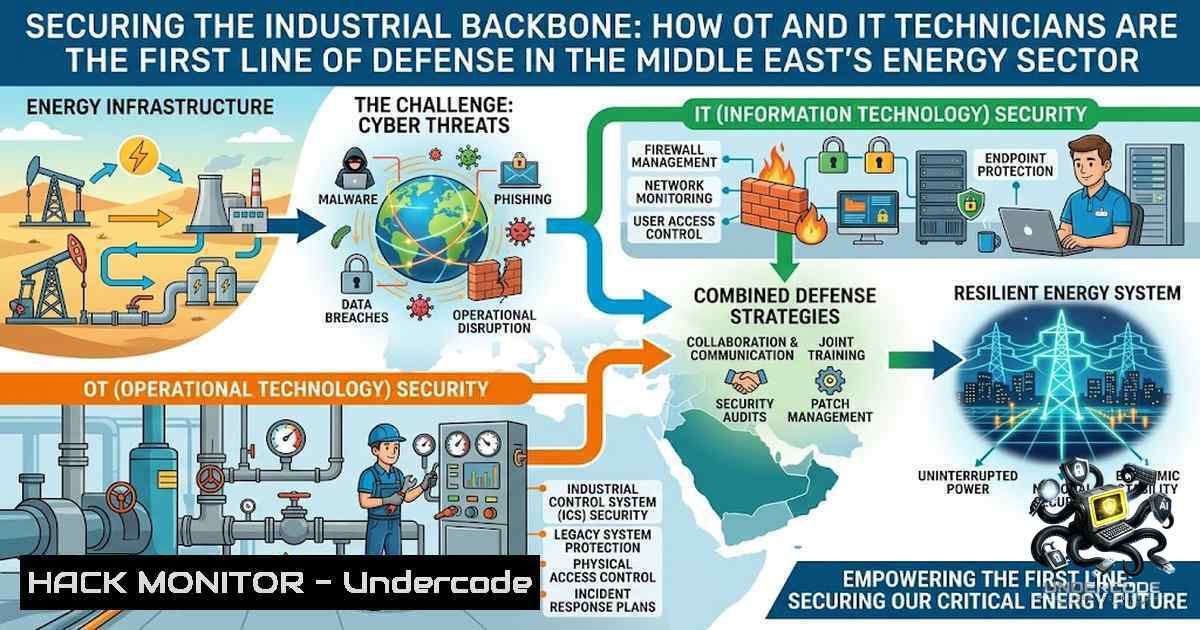
Introduction
As the Middle East accelerates its digital transformation in energy and utilities, the convergence of Operational Technology (OT) and Information Technology (IT) has created unprecedented cybersecurity challenges. Madre Integrated Engineering’s recent hiring drive for Civil, Instrument, and Mechanical Technicians in Raslafan, Qatar, highlights a critical industry reality: industrial maintenance personnel are now the frontline defenders against cyber-physical threats. These technicians, equipped with expertise in control systems, predictive maintenance, and safety protocols, represent the human firewall protecting critical infrastructure from evolving cyberattacks targeting SCADA systems, PLCs, and industrial IoT (IIoT) devices.
Learning Objectives
- Understand the intersection of OT/IT security in power generation, desalination, and oil & gas sectors
- Master essential Linux and Windows commands for industrial system monitoring and hardening
- Implement API security best practices for industrial control systems (ICS)
- Learn vulnerability assessment and mitigation techniques for PLCs and smart sensors
- Apply cloud hardening strategies for hybrid industrial environments
You Should Know
- OT/IT Convergence: Hardening Industrial Control Systems (ICS) for Cyber Resilience
The technicians Madre Integrated is hiring will manage systems that are increasingly targeted by sophisticated adversaries. Understanding how to secure these environments begins with recognizing that traditional IT security measures must be adapted for OT’s unique requirements—where availability and safety take precedence over confidentiality.
Step‑by‑step guide: Securing PLC and SCADA Communication
Linux Commands for ICS Monitoring:
 Monitor network interfaces for unusual traffic patterns on industrial networks
sudo tcpdump -i eth0 -1 -vvv port 502  Modbus TCP traffic
sudo tcpdump -i eth1 -1 -vvv port 44818  CIP/ENIP traffic

Check for unauthorized connections to PLCs
sudo netstat -tunap | grep -E '502|44818|2222'

Implement rate limiting for Modbus requests (using iptables)
sudo iptables -A INPUT -p tcp --dport 502 -m conntrack --ctstate NEW -m limit --limit 60/min --limit-burst 10 -j ACCEPT
sudo iptables -A INPUT -p tcp --dport 502 -j DROP
Windows Commands for ICS Security:
 Check for insecure services running on industrial workstations
Get-Service -1ame modbus, opc, dcom

Implement Windows Firewall rules for industrial protocols
New-1etFirewallRule -DisplayName "Block unauthorized Modbus" -Direction Inbound -Protocol TCP -LocalPort 502 -Action Block

Audit user accounts with access to OT systems
Get-LocalUser | Where-Object {$_.Enabled -eq $true}
Configuring Secure PLC Access:
- Disable all unused protocols and services on PLCs
- Implement role-based access control (RBAC) for engineering workstations
- Use encrypted protocols (e.g., OPC UA with security) instead of plaintext Modbus
- Deploy network segmentation using VLANs to isolate OT from corporate IT
- Enable logging and auditing on all PLCs and HMIs
-
Instrument Calibration and Data Integrity: Preventing Man-in-the-Middle Attacks
Instrument Technicians at Madre Integrated will calibrate sensors, transmitters, and analyzers—equipment that can be manipulated by attackers to cause false readings, potentially leading to catastrophic failures. Data integrity is paramount; a compromised sensor can feed malicious data into control loops.
Verifying Sensor Data Integrity with Command-Line Tools:
Linux:
 Monitor serial communication for anomalies (used by many industrial sensors)
sudo stty -F /dev/ttyUSB0 9600 cs8 -cstopb -parenb
sudo cat /dev/ttyUSB0 | tee -a sensor_data.log

Calculate checksums to verify data integrity
md5sum sensor_data_2026_06_21.csv
sha256sum calibration_report.pdf

Compare against known-good hashes
diff <(cat known_good_checksums.txt) <(sha256sum .data)
Windows:
 Use CertUtil to verify file integrity
Get-FileHash -Path .\calibration_log.dat -Algorithm SHA256

Monitor COM ports for unauthorized access
Get-WmiObject -Class Win32_SerialPort | Select-Object DeviceID, Name, Description
Best Practices:
- Implement secure time synchronization (NTP over TLS) to prevent timestamp manipulation
- Use digital signatures for calibration certificates and software updates
- Deploy intrusion detection systems (IDS) monitoring sensor data patterns
- Regularly audit calibration logs for unusual deviations
- Implement physical security for access to sensor terminals
- The Role of Artificial Intelligence in Predictive Maintenance and Anomaly Detection
The mechanical and civil technicians Madre Integrated is seeking will benefit from AI-driven predictive maintenance, but these systems introduce new attack surfaces—AI models can be poisoned, and the data they rely on can be manipulated.
Implementing AI-Based Monitoring:
Linux Setup for ML-Based Anomaly Detection:
 Install Python and required packages for ML monitoring
sudo apt-get update && sudo apt-get install python3-pip
pip3 install pandas numpy scikit-learn tensorflow

Create a virtual environment for industrial AI
python3 -m venv industrial_ai
source industrial_ai/bin/activate

Sample script for vibration analysis using ML
python3 -c "
import pandas as pd
from sklearn.ensemble import IsolationForest
import numpy as np

Load vibration data (example)
data = pd.read_csv('vibration_data.csv')
model = IsolationForest(contamination=0.1)
model.fit(data[['frequency', 'amplitude']])
predictions = model.predict(data[['frequency', 'amplitude']])
data['anomaly'] = predictions
data.to_csv('anomaly_results.csv')
"
Windows PowerShell for AI Log Analysis:
 Install Python and ML libraries via Chocolatey
choco install python -y
python -m pip install pandas scikit-learn

Use Windows Event Log for anomaly detection
Get-WinEvent -LogName System -MaxEvents 1000 |
Where-Object {$_.LevelDisplayName -eq "Error"} |
Export-Csv -Path errors.csv

Run a simple Python script for pattern recognition
python detect_anomalies.py --input errors.csv --output report.json
Security Implications:
- AI models used for predictive maintenance are prime targets for adversarial attacks
- Ensure model training data is from trusted, validated sources
- Implement model validation and versioning to detect tampering
- Use homomorphic encryption for sensitive industrial data in the cloud
- Securing API Integrations in Smart Factories and Power Plants
Modern industrial environments rely on APIs for data exchange between CMMS, ERP, and control systems. Madre Integrated’s technicians working with SAP/CMMS must understand API security fundamentals to prevent exploitation.
API Security Assessment Tools:
Linux:
 Use OWASP ZAP for API security testing
sudo apt-get install zaproxy
zap-cli quick-scan -s all -o api_scan_report.html https://industrial-api.energy.gov

Test for API authentication vulnerabilities
sudo apt-get install nikto
nikto -h https://industrial-api.energy.gov -ssl -output api_vulnerabilities.txt

Check for exposed API keys in code
grep -r "api_key" /path/to/codebase/
Windows:
 Use Postman's Newman for API testing automation
npm install -g newman
newman run industrial_api_collection.json -e qa_environment.json --reporters json

PowerShell script to check API version and security headers
$response = Invoke-WebRequest -Uri "https://industrial-api.energy.gov/api/v1/status"
$response.Headers["Server"]
$response.Headers["X-Frame-Options"]
API Hardening Checklist:
- Implement OAuth 2.0 or OpenID Connect for API authentication
- Rate limit API endpoints to prevent brute force attacks
- Validate and sanitize all API inputs (SQL injection prevention)
4. Use API gateways with built-in security features
5. Encrypt all API communications with TLS 1.3
- Implement API versioning to manage deprecated endpoints securely
- Log all API requests and monitor for unusual patterns
5. Cloud Hardening for Hybrid Industrial Environments
As industrial companies adopt cloud-based monitoring and analytics, securing hybrid environments is critical. The technicians at Madre Integrated will likely interact with cloud dashboards storing sensitive operational data.
Cloud Security Configuration Examples:
AWS CLI (Linux/Windows):
 Configure AWS CLI with MFA
aws configure set mfa_serial arn:aws:iam::123456789012:mfa/user

Enforce encryption for S3 buckets containing sensor data
aws s3api put-bucket-encryption --bucket industrial-sensor-data --server-side-encryption-configuration '{"Rules":[{"ApplyServerSideEncryptionByDefault":{"SSEAlgorithm":"AES256"}}]}'

Enable CloudTrail for industrial account
aws cloudtrail create-trail --1ame IndustrialTrail --s3-bucket-1ame industrial-logs
aws cloudtrail start-logging --1ame IndustrialTrail
Azure CLI:
 Enable Azure Security Center for IoT
az security iot-solution create --resource-group IndustrialRG --solution-1ame IoTProtection

Configure Azure Key Vault for certificates
az keyvault create --1ame IndustrialKeyVault --resource-group IndustrialRG
az keyvault certificate create --vault-1ame IndustrialKeyVault -1 PLC-Cert -p @policy.json
Best Practices:
- Use zero-trust architecture for cloud-OT connections
- Implement cloud security posture management (CSPM) for continuous monitoring
- Enforce least-privilege access for all cloud resources
- Enable backup and disaster recovery with immutable storage
- Conduct regular cloud security assessments (penetration testing)
What Undercode Say
Key Takeaway 1: The convergence of OT and IT demands a new breed of technicians who possess both engineering and cybersecurity skills. Madre Integrated’s recruitment highlights this shift—technicians must now be proficient in digital systems, calibration tools, and industrial protocols while understanding cyber-risks to these systems.
Key Takeaway 2: Industrial cybersecurity is not just about technology but about people and processes. The emphasis on HSE procedures, PTW systems, and certifications in First Aid, CPR, and H₂S demonstrates that a holistic approach to safety—physical and digital—is essential in power and utility sectors.
Key Takeaway 3: The Raslafan project in Qatar represents a microcosm of global energy transition challenges. As the Middle East invests in smart grids and renewable energy, the demand for skilled technicians with cybersecurity awareness will skyrocket. Organizations must invest in continuous training to bridge the OT-IT gap.
Key Takeaway 4: Predictive maintenance driven by AI is a double-edged sword. While it improves efficiency and reduces downtime, it also introduces vulnerabilities through data poisoning and model manipulation. Technicians must understand the data lifecycle and implement robust validation mechanisms.
Key Takeaway 5: API security is often overlooked in industrial environments. As more systems become interconnected via APIs, attackers can exploit insecure endpoints to gain unauthorized access or exfiltrate sensitive operational data. Hardening APIs should be a priority.
Analysis: The job requirements listed by Madre Integrated—knowledge of ASTM standards, SAP/CMMS, P&ID interpretation, and maintenance planning—suggest a mature industrial operation, but the lack of explicit cybersecurity certifications (e.g., IEC 62443, CISSP, or GICSP) is concerning. Organizations should consider integrating cybersecurity training into routine professional development. Furthermore, the geographical concentration in Raslafan, Qatar, indicates the strategic importance of the energy sector in the Gulf region. As geopolitical tensions rise, securing critical infrastructure becomes paramount. Investing in OT cybersecurity will not only protect assets but also enhance the resilience of national economies. The integration of AI and cloud technologies in industrial settings is inevitable, but it must be approached with caution—balancing innovation with robust security measures. Finally, the emphasis on “Immediate Joining” suggests a skills shortage that needs to be addressed through targeted upskilling and international talent recruitment.
Prediction
-P: The integration of AI-driven predictive maintenance will reduce unplanned downtime in Qatari power plants by up to 30% over the next five years, creating more efficient and resilient energy infrastructure.
-P: The Middle East’s investment in OT cybersecurity will position it as a global leader in secure industrial automation, attracting multinational partnerships and technology transfers.
-1: The skills gap in OT-IT convergence will lead to increased cyber incidents in the region, potentially causing operational disruptions and financial losses unless training programs are significantly expanded.
-1: The reliance on cloud-based monitoring without adequate security measures could expose sensitive industrial data to nation-state cyber espionage campaigns, threatening national security.
-P: The adoption of zero-trust architectures in industrial environments will become a standard practice by 2028, driven by regulatory requirements and the need for enhanced operational resilience.
-P: Technicians with dual expertise in engineering and cybersecurity will command premium salaries, leading to a competitive talent market across the Gulf Cooperation Council (GCC) countries.
▶️ Related Video (66% Match):
🎯Let’s Practice For Free:
🎓 Live Courses & Certifications:
Join Undercode Academy for Verified Certifications
🚀 Request a Custom Project:
Secure, high-velocity infrastructure and disruptive technological engineering. Contact our engineering team for high-tier development and proprietary systems:
[email protected]
💎 Smart Architecture | 🛡️ Secure by Design | ⭐ Trusted by Thousands
IT/Security Reporter URL:
Reported By: The Talent – Hackers Feeds
Extra Hub: Undercode MoN
Basic Verification: Pass ✅


