Listen to this Post
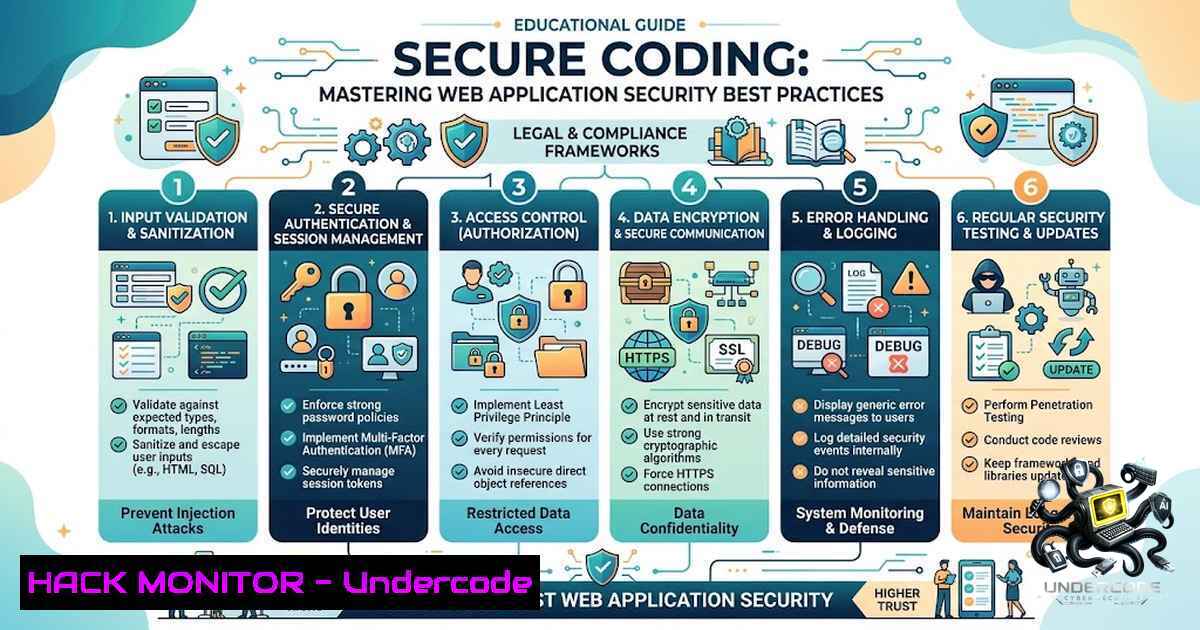
Introduction:
In today’s threat landscape, web applications are prime targets for cybercriminals, with vulnerabilities like SQL injection, cross-site scripting (XSS), and cross-site request forgery (CSRF) consistently ranking among the OWASP Top 10 security risks. As organizations increasingly rely on digital platforms to store sensitive data and conduct business, ensuring application security has become paramount. Secure coding practices—integrating security controls throughout the software development lifecycle—are no longer optional but a fundamental requirement for protecting user data, maintaining compliance, and safeguarding organizational assets.
Learning Objectives & Secrets:
- Objective 1: Identify and mitigate SQL injection vulnerabilities by implementing parameterized queries and prepared statements across all database interactions, ensuring user input is treated as data rather than executable code.
-
Objective 2 (Secret Tip): Prevent XSS attacks through context-aware output encoding—not just HTML encoding—but also JavaScript, URL, and attribute encoding depending on where data is rendered. Combine this with Content Security Policy (CSP) headers for defense-in-depth.
-
Objective 3 (Secret Tip): Defeat CSRF attacks by implementing synchronizer token patterns (anti-CSRF tokens) on all state-changing requests, combined with SameSite cookie attributes (Lax or Strict) to prevent cross-site request forgery.
You Should Know:
1. SQL Injection: Exploitation and Prevention
SQL injection occurs when untrusted user input is embedded directly into SQL statements without proper sanitization. Attackers can exploit this by submitting crafted inputs like `’ OR ‘1’=’1` to manipulate database queries and retrieve unauthorized data.
Step-by-Step Guide:
- Detection (Linux/Kali): Use `sqlmap` to identify SQL injection vulnerabilities:
sqlmap -u "http://example.com/vuln.php?id=1" --level=3 --risk=3
SqlMap is an open-source penetration testing tool that automates SQL injection detection and exploitation.
-
Detection (Windows): Download SqlMap from GitHub, extract to
C:\sqlmap, and run:python sqlmap.py -u "http://example.com/vuln.php?id=1" --batch
-
Prevention (Python – Parameterized Queries):
import sqlite3 conn = sqlite3.connect("db.sqlite") cursor = conn.cursor() UNSAFE - String concatenation cursor.execute(f"SELECT FROM users WHERE id = {user_id}") SAFE - Parameterized query cursor.execute("SELECT FROM users WHERE id = ?", (user_id,)) -
Prevention (Java – Prepared Statements):
PreparedStatement stmt = conn.prepareStatement("SELECT FROM users WHERE id = ?"); stmt.setInt(1, userId); ResultSet rs = stmt.executeQuery(); -
Prevention (PHP – PDO):
$stmt = $pdo->prepare("SELECT FROM users WHERE id = :id"); $stmt->execute(['id' => $userId]); -
Mitigation Strategy: Apply the principle of least privilege to database accounts—application accounts should only have the minimum permissions required. Disable dangerous features like `INTO OUTFILE` for web-accessible directories.
2. Cross-Site Scripting (XSS): Types and Defense
XSS enables attackers to inject malicious scripts into web pages viewed by other users, leading to session hijacking, credential theft, and malware distribution. XSS attacks are broadly categorized into Reflected XSS (input immediately returned by the server), Stored XSS (malicious code permanently stored in the database), and DOM-based XSS (client-side manipulation).
Step-by-Step Guide:
- Detection (Manual): Test input fields with payloads like `` and observe if the script executes.
-
Detection (Automated – Linux): Use `nikto` or `zap-cli` for basic XSS scanning:
nikto -h http://example.com
-
Prevention – Output Encoding (JavaScript):
// UNSAFE - Direct insertion document.getElementById('output').innerHTML = userInput; // SAFE - Text content document.getElementById('output').textContent = userInput; -
Prevention – Output Encoding (Java/JSP): Use JSTL’s `escapeXml` function in every expression:
<c:out value="${userInput}" escapeXml="true" /> -
Prevention – Content Security Policy (CSP): Configure CSP headers to restrict script sources:
Apache .htaccess
Header set Content-Security-Policy "default-src 'self'; script-src 'self' https://trusted-cdn.com"
-
Prevention – Framework-Specific: Modern frameworks like React, Angular, and Vue provide auto-escaping features, but developers must avoid dangerous methods like React’s `dangerouslySetInnerHTML` without sanitization.
- Cross-Site Request Forgery (CSRF): Attack Vectors and Mitigation
CSRF tricks a logged-in user’s browser into sending forged requests to a vulnerable application. This can lead to unauthorized transactions, account compromise, and data manipulation.
Step-by-Step Guide:
- Detection: Check if state-changing requests (POST, PUT, DELETE) lack anti-CSRF tokens or origin/referer validation.
-
Prevention – Synchronizer Token Pattern:
<!-- HTML form with CSRF token --></p></li> </ul> <form method="POST" action="/transfer"> <input type="hidden" name="csrf_token" value="${session.csrfToken}"> <input type="text" name="amount"> <button type="submit">Transfer</button> </form> <p>- Prevention – SameSite Cookies (Node.js/Express):
app.use(session({ secret: 'your-secret', cookie: { sameSite: 'strict', // or 'lax' secure: true, httpOnly: true } })); -
Prevention – Custom Request Headers: For APIs, require custom headers (e.g.,
X-Requested-With: XMLHttpRequest) that browsers don’t include in cross-origin requests. -
Prevention – Origin/Referer Validation: Validate the `Origin` and `Referer` headers on the server-side for sensitive operations.
-
Mitigation Strategy: Use the `SameSite` cookie attribute—the single most effective modern mitigation—which tells the browser not to send cookies on cross-site requests. Never change the state of an application using GET requests.
4. Secure Authentication and Session Management
Weak authentication and session management remain critical vulnerabilities. Attackers exploit predictable session IDs, insecure password storage, and missing multi-factor authentication (MFA) to impersonate users.
Step-by-Step Guide:
- Password Storage (Python – bcrypt):
import bcrypt
Hashing
hashed = bcrypt.hashpw(password.encode(), bcrypt.gensalt())
Verification
if bcrypt.checkpw(password.encode(), hashed):
print("Password matches")
Use slow, salted hashing algorithms like bcrypt, scrypt, or Argon2—never unsalted SHA-256.
-
Session Security (Java):
// Invalidate session on logout session.invalidate(); // Set secure cookie flags Cookie cookie = new Cookie("JSESSIONID", session.getId()); cookie.setHttpOnly(true); cookie.setSecure(true); cookie.setPath("/"); response.addCookie(cookie); -
Session Security (Node.js): Set `HttpOnly` and `Secure` flags, and use long, random session tokens transmitted only over HTTPS.
-
Rate Limiting (Nginx): Protect against brute force attacks:
limit_req_zone $binary_remote_addr zone=login:10m rate=5r/m; location /login { limit_req zone=login burst=10 nodelay; } -
Multi-Factor Authentication (MFA): Implement adaptive MFA using TOTP (e.g., Google Authenticator) or WebAuthn for critical actions.
5. API Security and Secure Error Handling
APIs are increasingly targeted by attackers. Insecure APIs can expose sensitive data, allow unauthorized access, and lead to data breaches.
Step-by-Step Guide:
- API Security – JWT (Python):
import jwt Generate token token = jwt.encode({'user_id': 123, 'exp': datetime.utcnow() + timedelta(hours=1)}, 'secret_key', algorithm='HS256') Verify token try: payload = jwt.decode(token, 'secret_key', algorithms=['HS256']) except jwt.ExpiredSignatureError: Handle expired token -
API Security – Rate Limiting (Redis + Express):
const rateLimit = require('express-rate-limit'); const limiter = rateLimit({ windowMs: 15 60 1000, // 15 minutes max: 100 // limit each IP to 100 requests per windowMs }); app.use('/api/', limiter); -
Secure Error Handling: Return generic error messages to users (e.g., “Invalid credentials” instead of “User not found”) while logging detailed errors server-side. Never expose stack traces or sensitive data to end users.
-
Security Headers (Apache):
Header set X-Content-Type-Options "nosniff"
Header set X-Frame-Options "DENY"
Header set Strict-Transport-Security "max-age=31536000; includeSubDomains"
-
DevSecOps Integration: Integrate security into CI/CD pipelines using SAST (Static Application Security Testing) and DAST (Dynamic Application Security Testing) tools to catch vulnerabilities early.
6. OWASP Top 10 and Compliance
Understanding the OWASP Top 10 is essential for any developer or security professional. The 2025 list emphasizes supply chain security, broken access control, and cryptographic failures.
Step-by-Step Guide:
- Dependency Scanning (Linux):
OWASP Dependency-Check
dependency-check --scan ./project --format HTML --out report.html
-
Security Checklist: Implement input validation (server-side, allowlist-based), output encoding, parameterized queries, secure session management, and proper error handling.
-
Compliance: Align with standards like PCI-DSS, GDPR, and HIPAA by encrypting data at rest and in transit, implementing access controls, and maintaining audit logs.
What Undercode Say:
-
Key Takeaway 1: Secure coding is not a one-time activity but a continuous process integrated throughout the software development lifecycle—from design and coding to testing, deployment, and runtime monitoring.
-
Key Takeaway 2: No single security measure is sufficient. A defense-in-depth strategy combining input validation, output encoding, parameterized queries, secure session management, and security headers is essential to protect against the evolving threat landscape.
Analysis: The course “Secure Coding: Security Best Practices in Web Applications” offers a comprehensive, hands-on learning experience covering SQL injection, XSS, CSRF, OAuth, JWT, MFA, and API security. With over 11,000 students enrolled and 35.5 hours of video content, it provides practical, immediately applicable knowledge for developers, security professionals, and IT administrators. The inclusion of an AI bot for practice and reinforcement demonstrates a modern approach to cybersecurity education, bridging the gap between passive learning and real-world mastery. The course’s focus on OWASP Top 10 and compliance standards ensures learners are equipped to build resilient, industry-compliant applications.
Prediction:
- +1 The increasing emphasis on secure coding practices will drive wider adoption of DevSecOps, with security becoming an integral part of CI/CD pipelines, reducing the cost and impact of vulnerabilities.
-
+1 AI-powered coding assistants will increasingly incorporate security best practices, helping developers write secure code by default and reducing human error.
-
-1 The growing complexity of web applications and third-party dependencies will continue to expand the attack surface, making supply chain attacks a persistent and escalating threat.
-
-1 Despite increased awareness, many organizations will struggle to implement comprehensive secure coding practices due to skill gaps, legacy codebases, and pressure to deliver features quickly, leading to continued high-profile data breaches.
-
+1 Regulatory frameworks will increasingly mandate secure coding practices and software bills of materials (SBOMs), driving accountability and transparency in the software supply chain.
▶️ Related Video (92% Match):
https://www.youtube.com/watch?v=-GfSbk_VqSk
🎯Let’s Practice For Free:
🎓 Live Courses & Certifications:
Join Undercode Academy for Verified Certifications
🚀 Request a Custom Project:
Secure, high-velocity infrastructure and disruptive technological engineering. Contact our engineering team for high-tier development and proprietary systems:
[email protected]
💎 Smart Architecture | 🛡️ Secure by Design | ⭐ Trusted by ThousandsIT/Security Reporter URL:
Reported By: https://lnkd.in/p/e67GtgyC – Hackers Feeds
Extra Hub: Undercode MoN
Basic Verification: Pass ✅🔐JOIN OUR CYBER WORLD [ CVE News • HackMonitor • UndercodeNews ]
📢 Follow UndercodeTesting & Stay Tuned:
- Prevention – SameSite Cookies (Node.js/Express):


