Listen to this Post
Introduction:
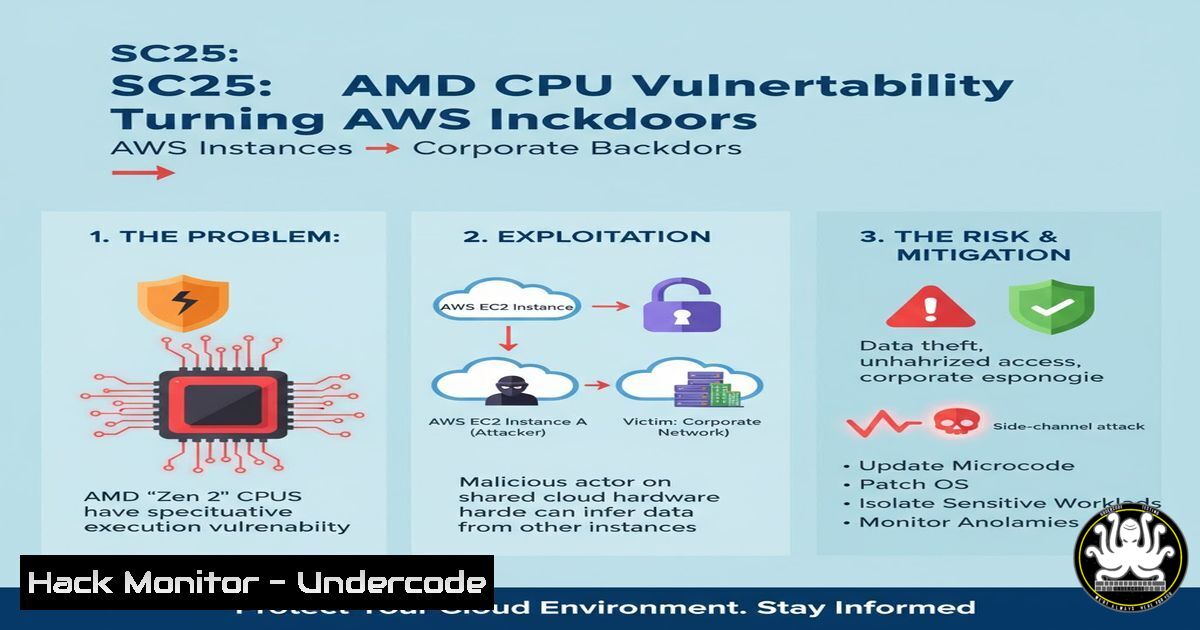
A newly disclosed speculative execution vulnerability, dubbed SC25, specifically targets AMD CPUs deployed in cloud environments like Amazon Web Services (AWS). This hardware-level flaw could allow a malicious actor to breach tenant isolation and exfiltrate sensitive data from other virtual machines running on the same physical host. This incident underscores the escalating threat landscape where cloud infrastructure itself becomes the attack vector, moving beyond application-layer flaws to fundamental hardware trust issues.
Learning Objectives:
- Understand the mechanism of the SC25 vulnerability and its specific impact on AMD-based EC2 instances.
- Learn how to identify if your AWS environment is potentially vulnerable to this cross-tenant data breach.
- Implement immediate mitigation strategies and hardening techniques to protect your cloud assets.
You Should Know:
- Demystifying the SC25 Vulnerability: A Technical Deep Dive
The SC25 vulnerability is a novel side-channel attack exploiting speculative execution, a performance feature in modern CPUs. Unlike previous variants like Spectre or Meltdown, SC25 appears to be uniquely optimized for AMD’s microarchitecture and the multi-tenant nature of cloud environments. When exploited, it allows an attacker with access to one EC2 instance on a physical server to potentially access memory allocated to other, completely isolated customer instances. This breaks the foundational security model of cloud computing.
Step-by-step guide explaining what this does and how to use it:
Step 1: The Setup. An attacker provisions a malicious EC2 instance on AWS. Their goal is to get this instance hosted on a physical server that also runs target victim instances.
Step 2: The Priming. The attacker runs a specially crafted program on their compromised instance. This program uses the SC25 technique to mistrain the CPU’s branch predictor.
Step 3: The Speculative Execution. The CPU is tricked into speculatively executing instructions that access memory regions outside the attacker’s permitted boundary—specifically, memory belonging to a neighboring VM.
Step 4: The Exfiltration. Although the CPU eventually corrects this unauthorized access, the side-effects remain in the cache. The attacker then uses a timing attack (e.g., Flush+Reload or Prime+Probe) to analyze cache timings and slowly reconstruct the sensitive data from the victim’s memory.
- Identifying Potentially Vulnerable Instances in Your AWS Estate
Your first line of defense is inventory and assessment. You must quickly identify all EC2 instances that are built on AMD-based instance families, as these are the primary targets for SC25.
Step-by-step guide explaining what this does and how to use it:
Step 1: Use AWS CLI for Inventory. The following command will list all your EC2 instances across all regions, filtering for AMD CPUs (e.g., AMD EPYC). This provides a comprehensive view of your potential attack surface.
for region in $(aws ec2 describe-regions --output text --query 'Regions[].RegionName'); do
echo "Checking region: $region"
aws ec2 describe-instances --region $region \
--query 'Reservations[].Instances[?contains(InstanceType, `a1` ) || contains(InstanceType, `m5a` ) || contains(InstanceType, `t3a` )]' \
--output table
done
Note: Adjust the instance families in the `contains` function based on AWS and AMD’s official advisory (e.g., m5a, t3a, r5a).
Step 2: Analyze CloudTrail Logs. Look for unauthorized `RunInstances` API calls that specifically request AMD instance types, which could indicate an attacker trying to position themselves in a vulnerable environment.
Step 3: Leverage AWS Security Hub. If enabled, Security Hub can aggregate findings from various services. Create custom insights to flag new or existing AMD instances for prioritization.
3. Immediate Mitigation: Isolating and Patching Your Workloads
While a full microcode update from AMD and AWS is pending, you must take proactive steps to reduce your risk exposure.
Step-by-step guide explaining what this does and how to use it:
Step 1: Migrate Critical Workloads. For your most sensitive workloads running on vulnerable AMD instance types, the most robust mitigation is to migrate them to non-affected instance families (e.g., Intel-based or AWS Graviton-based instances). Use AWS System Manager Automation documents to automate this migration with minimal downtime.
Step 2: Harden the Host OS. Apply the latest OS-level kernel patches as they become available. For Linux, this would involve updating the kernel to a version that contains the necessary mitigations.
 For Amazon Linux 2
sudo yum update kernel -y
sudo reboot

For Ubuntu
sudo apt update && sudo apt upgrade linux-aws -y
sudo reboot
Step 3: Restrict Instance Placement. Use AWS IAM Policies to control which instance types can be launched, preventing the accidental deployment of new vulnerable instances.
{
"Version": "2012-10-17",
"Statement": [
{
"Effect": "Deny",
"Action": "ec2:RunInstances",
"Resource": "arn:aws:ec2:::instance/",
"Condition": {
"StringLike": {
"ec2:InstanceType": [".a1", ".t3a", ".m5a", ".r5a"]
}
}
}
]
}
4. Advanced Hardening: Leveraging AWS Security Services
Go beyond basic patching by integrating native AWS security tools into your defense-in-depth strategy.
Step-by-step guide explaining what this does and how to use it:
Step 1: Implement Stricter Security Groups. Ensure your security groups are configured on a principle of least privilege. Inbound rules should not allow traffic from the entire VPC CIDR block unless absolutely necessary, limiting lateral movement.
Step 2: Deploy GuardDuty. Enable Amazon GuardDuty and ensure its findings for suspicious API activity or instance behavior are fed into a SIEM. GuardDuty may detect the reconnaissance phase of an attack leveraging SC25.
Step 3: Use VPC Endpoint Policies. For services interacting with S3 or other AWS services, use VPC Endpoints with restrictive policies. This prevents data exfiltration attempts from compromised instances that might try to send stolen data to an external S3 bucket controlled by the attacker.
- The Human Firewall: Training Your DevOps and SecOps Teams
Technology is only one part of the solution. Your teams must be prepared to respond.
Step-by-step guide explaining what this does and how to use it:
Step 1: Conduct Incident Response Tabletop Exercises. Run a simulated scenario where an attacker has exploited SC25 to steal data. The exercise should cover detection, isolation, eradication, and recovery phases.
Step 2: Update Cloud Security Training. Immediately incorporate modules on hardware vulnerabilities and cloud supply chain risks into your security awareness programs.
Step 3: Establish a Threat Intelligence Feed. Subscribe to official CVE feeds from AMD, AWS, and CERT organizations to ensure you receive timely notifications about emerging threats related to your cloud infrastructure.
What Undercode Say:
- The Shared Responsibility Model is Cracking. SC25 demonstrates that the “Security of the Cloud” (AWS’s responsibility) can directly impact “Security in the Cloud” (your responsibility). A flaw in their physical hardware can nullify your perfect application security.
- Re-evaluate Vendor Lock-in and Diversity. Over-reliance on a single CPU architecture or cloud provider is a strategic risk. A proactive strategy includes architectural diversity, such as maintaining the capability to run workloads on different CPU architectures (x86 vs. ARM) or even multi-cloud, to mitigate the impact of such targeted vulnerabilities.
Analysis: The SC25 vulnerability is a watershed moment for cloud security. It forces a paradigm shift from defending against software bugs to managing intrinsic hardware risks. While cloud providers will rush to patch their hypervisors and provide updated microcode, the window of exposure is critical. Organizations that have treated cloud security as purely an application-layer problem are now profoundly vulnerable. This event will accelerate the adoption of confidential computing technologies (like AWS Nitro Enclaves) that encrypt memory even at the hardware level, and it will make CPU architecture a first-class consideration in cloud procurement and risk assessments. The trust we place in the underlying silicon can no longer be implicit.
Prediction:
The successful exploitation of SC25 will catalyze a new arms race in cloud security. In the short term, we will see a surge in research focused on hardware vulnerabilities specific to other CPU architectures in cloud settings, such as ARM (Graviton) and Intel. Cloud providers will respond by making confidential computing features standard and more accessible, moving from a niche service to a default configuration for enterprise workloads. Within two years, we predict that compliance frameworks like PCI DSS and SOC 2 will introduce new controls mandating memory encryption for sensitive workloads, formally acknowledging hardware-level threats. Furthermore, this will give rise to new security SaaS offerings focused exclusively on detecting anomalous cross-VM side-channel activity, creating an entirely new sub-market within the cloud security ecosystem.
🎯Let’s Practice For Free:
IT/Security Reporter URL:
Reported By: Alexey6 Sc25 – Hackers Feeds
Extra Hub: Undercode MoN
Basic Verification: Pass ✅


