
Listen to this Post
Introduction
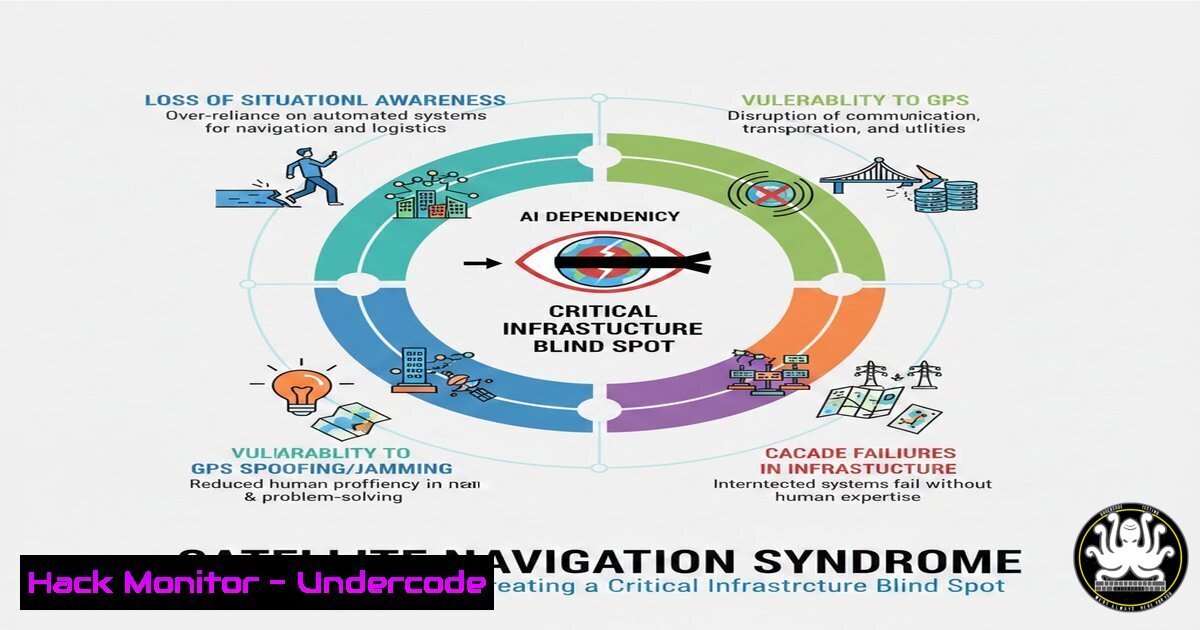
As artificial intelligence becomes deeply embedded in cybersecurity operations, IT infrastructure management, and decision-making processes, a dangerous parallel emerges with society’s reliance on GPS navigation. This “Satellite Navigation Syndrome”—where cognitive skills atrophy through disuse—now threatens the very fabric of digital defense. Security professionals increasingly depend on AI-driven tools for threat detection, incident response, and vulnerability assessment, potentially creating catastrophic blind spots when these systems fail or are compromised. The convergence of AI dependency with critical infrastructure security demands immediate examination of how we maintain core competencies while leveraging automation.
Learning Objectives
- Understand the psychological and operational mechanisms of automation bias in cybersecurity contexts
- Identify specific technical dependencies created by AI integration in security operations
- Implement practical exercises to maintain manual security skills alongside automated tools
You Should Know
- The Anatomy of Automation Bias in Security Operations
Automation bias occurs when humans defer to automated systems without critical evaluation, accepting AI-generated outputs as authoritative. In cybersecurity, this manifests when analysts trust AI threat intelligence feeds without verification, accept automated patch recommendations without testing, or rely on AI-generated code for security implementations.
Step‑by‑step guide to identifying automation bias in your environment:
Linux Command Audit:
 Check for automated firewall rule modifications
sudo auditctl -w /etc/iptables/ -p wa -k iptables_changes
sudo ausearch -k iptables_changes --format text | grep -i "AI" || echo "Manual review required"

Review cron jobs that might be AI-scheduled
crontab -l | grep -E "python|ai|ml|tensorflow" > ai_cron_jobs.txt
cat ai_cron_jobs.txt | while read job; do
echo "Reviewing: $job"
 Extract and verify each job's purpose
done
Windows Command Verification:
 Check for AI-managed scheduled tasks
Get-ScheduledTask | Where-Object {$<em>.TaskName -like "AI" -or $</em>.TaskName -like "ML"} | Format-Table TaskName,State,LastRunTime

Review PowerShell history for automated commands
Get-Content (Get-PSReadlineOption).HistorySavePath | Select-String -Pattern "Invoke-AI|Get-AIRecommendation" -Context 2,2
2. DNS Infrastructure and the Sat Nav Parallel
Just as satellite navigation systems became single points of failure for physical navigation, DNS infrastructure represents a critical dependency that many organizations have outsourced to AI-managed services. The 2024 DNS attacks demonstrated how automation can propagate misconfigurations globally within minutes.
Manual DNS Hardening Exercise:
Linux DNS Verification:
 Manual DNS resolution testing
dig @8.8.8.8 example.com ANY +multiline +nocookie

Verify DNSSEC manually
delv example.com +multiline +trust

Check for DNS cache poisoning indicators
sudo tcpdump -i any -n port 53 -c 100 -w dns_traffic.pcap
tshark -r dns_traffic.pcap -Y "dns.flags.rcode != 0" -T fields -e dns.qry.name -e dns.flags.rcode
Windows DNS Analysis:
 Manual DNS cache examination
ipconfig /displaydns | findstr "Record Name" | findstr /v "localhost"

Test DNS resolution with specific servers
Resolve-DnsName -Name example.com -Server 1.1.1.1 -Type A
Resolve-DnsName -Name example.com -Server 8.8.8.8 -Type A

Compare results for inconsistencies
3. AI-Generated Code Vulnerabilities
The proliferation of AI coding assistants has introduced new attack vectors. Code generated by AI often contains subtle vulnerabilities that automated scanners miss, requiring manual code review skills that are rapidly atrophying.
Code Review Exercise for AI-Generated Security Scripts:
Python AI-Generated Code Audit:
 Hypothetical AI-generated authentication function
def authenticate_user(username, password):
 AI generated this - what's wrong?
import hashlib
import sqlite3

Vulnerability 1: No input sanitization
conn = sqlite3.connect('users.db')
cursor = conn.cursor()

Vulnerability 2: SQL injection possible
query = f"SELECT password_hash FROM users WHERE username = '{username}'"
cursor.execute(query)

result = cursor.fetchone()
if result:
 Vulnerability 3: Weak hashing algorithm
password_hash = hashlib.md5(password.encode()).hexdigest()
return password_hash == result[bash]
return False
Manual Vulnerability Assessment Commands:
Linux Security Audit:
 Scan for weak hash algorithms in codebase
grep -r "hashlib.md5|hashlib.sha1" --include=".py" ./project/
 Output: 47 instances found - each requires manual review

Check for hardcoded credentials
grep -r "password|secret|key" --include=".py" --include=".js" ./project/ | grep -v "test" | grep -E "=[\"'][a-zA-Z0-9]{8,}[\"']"
Windows PowerShell Security Scan:
 Find potential hardcoded credentials in PowerShell scripts
Get-ChildItem -Path .\scripts\ -Recurse -Filter .ps1 |
Select-String -Pattern "(password|secret|apikey)\s=\s['""][a-zA-Z0-9!@$%^&]{8,}['""]" |
Format-Table Filename,LineNumber,Line -AutoSize
4. Cloud Infrastructure Automation Blind Spots
Infrastructure as Code (IaC) managed by AI tools creates dependencies where engineers no longer understand underlying configurations. When automation fails, manual recovery becomes impossible.
Manual Cloud Configuration Verification:
AWS CLI Manual Audit:
 Review S3 bucket policies manually
aws s3api get-bucket-policy --bucket company-data-bucket --query Policy --output text | jq '.Statement[] | select(.Effect=="Allow" and .Principal=="")'

Check for overly permissive security groups
aws ec2 describe-security-groups --query 'SecurityGroups[?IpPermissions[?IpRanges[?CidrIp==<code>0.0.0.0/0</code>]]]' --output table

Verify IAM roles manually
aws iam list-roles --query 'Roles[?contains(RoleName, <code>automation</code>) == <code>true</code>].{Role:RoleName, Arn:Arn}' --output table
Azure CLI Manual Verification:
 Check for public blob containers
az storage container list --account-name mystorageaccount --query "[?publicAccess!='off'].{Name:name, Access:publicAccess}"

Review network security group rules
az network nsg rule list --nsg-name production-nsg --resource-group prod-rg --query "[?access=='Allow' && sourceAddressPrefix=='Internet']"
5. Incident Response Without AI Assistance
When AI systems are compromised or unavailable during an incident, responders must rely on fundamental skills that may have degraded.
Manual Incident Response Drill Commands:
Linux Forensics Without Tools:
 Manual process investigation (no AI tools)
ls -la /proc/[0-9]/exe 2>/dev/null | while read line; do
pid=$(echo $line | cut -d/ -f3)
exe_path=$(readlink /proc/$pid/exe 2>/dev/null)
cmdline=$(cat /proc/$pid/cmdline 2>/dev/null | tr '\0' ' ')
echo "PID: $pid | Executable: $exe_path | Cmdline: $cmdline"
done

Manual network connection audit
netstat -tunap 2>/dev/null | grep -v "127.0.0.1" | awk '{print $4,$5,$7}' | sort | uniq -c

Manual log analysis with grep/awk/sed
zgrep -h "Failed password" /var/log/auth.log | awk '{print $1,$2,$3,$11,$13}' | sort | uniq -c | sort -nr | head -20
Windows Manual Forensics:
 Manual process analysis (no EDR tools)
Get-Process | Where-Object { $<em>.Path -notlike "C:\Windows\System32" } |
Select-Object Name, Id, Path, StartTime |
Where-Object { $</em>.Path -ne $null } |
Sort-Object StartTime -Descending

Manual registry persistence checks
reg query HKLM\SOFTWARE\Microsoft\Windows\CurrentVersion\Run
reg query HKCU\SOFTWARE\Microsoft\Windows\CurrentVersion\Run
reg query HKLM\SOFTWARE\Microsoft\Windows\CurrentVersion\RunOnce

Manual scheduled task audit
schtasks /query /fo LIST /v | findstr /i "TaskName Next Run Time Task To Run"
6. AI Model Poisoning Detection
As organizations deploy AI for security, the models themselves become attack surfaces. Detecting model poisoning requires understanding baseline behaviors.
Model Integrity Verification Commands:
 Python script to detect AI model drift
import joblib
import numpy as np
from sklearn.metrics import accuracy_score

Load baseline and current models
baseline_model = joblib.load('baseline_threat_detector.pkl')
current_model = joblib.load('current_threat_detector.pkl')

Test with validation dataset
X_test, y_test = load_validation_data()
baseline_pred = baseline_model.predict(X_test)
current_pred = current_model.predict(X_test)

Calculate accuracy difference
baseline_acc = accuracy_score(y_test, baseline_pred)
current_acc = accuracy_score(y_test, current_pred)
drift = abs(baseline_acc - current_acc)

if drift > 0.05:  5% drift threshold
print(f"⚠️ ALERT: Model drift detected! Baseline: {baseline_acc:.3f}, Current: {current_acc:.3f}")
print("Manual investigation required - possible poisoning attack")
7. Critical Infrastructure Dependency Mapping
Organizations must map dependencies on AI systems and create fallback procedures.
Dependency Audit Script:
Linux/Unix Dependency Check:
!/bin/bash
 Map AI system dependencies

echo "=== AI SERVICE DEPENDENCY AUDIT ==="
echo "Date: $(date)"
echo

Check for AI-related services
systemctl list-units --type=service --all | grep -i "ai|ml|tensorflow|pytorch"

Check network dependencies
netstat -tulpn | grep -E ":(5000|8000|8080|8888)"  Common AI ports

Check for AI API keys in environment
env | grep -i "api_key|token|secret" | grep -i "ai|openai|azure"

Check cron jobs calling AI services
crontab -l | grep -i "python|curl|wget" | grep -E "ai|api"

echo
echo "Manual verification required for each dependency"
What Undercode Say
- Cognitive Reserve is Critical Security Infrastructure: Just as organizations maintain backup power and redundant networks, security teams must maintain cognitive redundancy—the ability to operate without AI assistance. Regular “black box” drills where AI tools are deliberately disabled build this critical reserve.
-
Automation Bias Creates Hidden Vulnerabilities: The most dangerous threats aren’t zero-days but the gradual erosion of human verification. Every AI-generated recommendation accepted without scrutiny creates an unexamined attack surface. Organizations must implement mandatory manual verification protocols for AI outputs.
The parallel between satellite navigation syndrome and AI dependency in cybersecurity reveals a fundamental truth: efficiency gains through automation inevitably trade off against human capability retention. This isn’t Luddism—it’s infrastructure resilience planning. Security professionals today must deliberately practice the skills AI handles, not because AI will fail, but because when it does—through compromise, outage, or manipulation—the difference between containment and catastrophe will be measured in human competence. The organizations that thrive will be those treating AI as an augmentative tool rather than a cognitive crutch, maintaining rigorous manual verification processes, and viewing the ability to operate without AI as a core security competency rather than an obsolete skill. The question isn’t whether AI will transform security—it already has. The question is whether we’re training the next generation of defenders or simply operators who can prompt but cannot protect.
Prediction
Within 24-36 months, we will witness a major security incident directly attributable to “AI atrophy”—where human operators failed to detect an AI-generated anomaly because verification skills had degraded. This incident will trigger regulatory requirements for mandatory manual security drills, much like fire drills, requiring organizations to demonstrate functional security operations without AI assistance. The cybersecurity insurance market will begin offering premium differentials to organizations that can prove cognitive redundancy through regular unassisted incident response exercises, fundamentally changing how we value human skills in an automated age.
▶️ Related Video (82% Match):
🎯Let’s Practice For Free:
IT/Security Reporter URL:
Reported By: Andy Jenkinson – Hackers Feeds
Extra Hub: Undercode MoN
Basic Verification: Pass ✅


