
Listen to this Post
Introduction:
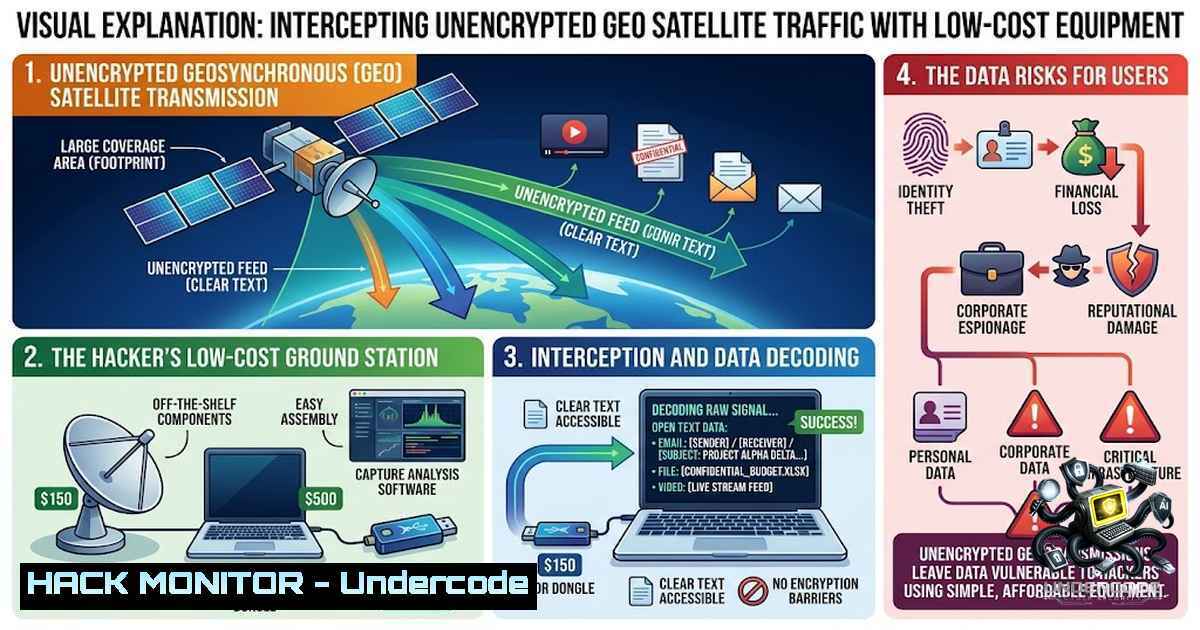
For decades, geostationary (GEO) satellites have been the backbone of global communications, enabling everything from in-flight Wi-Fi and maritime connectivity to cellular backhaul for remote GSM towers and critical industrial infrastructure. Because these systems orbit approximately 35,786 kilometers above Earth and broadcast across footprints that can cover nearly a third of the planet’s surface, many assume their traffic must be heavily protected. Yet recent academic research has exposed a startling reality: a significant portion of GEO satellite traffic is still transmitted completely in cleartext, and it can be intercepted with consumer-grade hardware costing less than $800. This article dissects the technical mechanisms behind satellite eavesdropping, explores the expanding attack surface of space-based infrastructure, and provides hands-on commands and mitigation strategies for security professionals.
Learning Objectives:
- Understand the technical architecture of GEO satellite communications and why encryption has been historically neglected for IP backhaul links.
- Learn how to build a passive interception station using affordable SDR hardware and open-source tools.
- Master Linux and Windows command-line techniques for capturing, decoding, and analyzing satellite RF signals.
- Identify real-world attack vectors including jamming, spoofing, and man-in-the-middle exploitation.
- Implement practical countermeasures to harden satellite-dependent infrastructure against interception and manipulation.
You Should Know:
- The $800 Interception Station: Building Your Passive GEO Sniffer
The most alarming revelation from recent research is not that satellites can be hacked—it is how cheaply and easily it can be done. Researchers from the University of California San Diego and the University of Maryland spent three years scanning traffic from 39 GEO satellites visible from California. Their analysis showed that roughly half of the observed signals carried cleartext IP traffic, including voice calls, SMS messages, in-flight Wi-Fi data, and even communications from mobile carriers and military operators.
The receiving setup is remarkably simple from an RF engineering perspective:
- A consumer satellite dish (standard DVB-S2 compatible)
- A roof mount and positioning motor
- A tuner card or USB-based SDR receiver (e.g., RTL-SDR, HackRF One, or TBS5927)
- Open-source software for blind scanning and signal decoding
Step‑by‑Step Guide: Setting Up an RTL-SDR Interception Station on Linux
Before proceeding, ensure you are operating within legal boundaries and only testing on authorized systems.
Step 1: Install the SDR toolchain on Kali Linux or Ubuntu
sudo apt-get update && sudo apt-get install gnuradio gr-osmosdr gqrx-sdr rtl-sdr
This installs GNU Radio, the Osmocom SDR driver, Gqrx spectrum analyzer, and the RTL-SDR utility suite.
Step 2: Verify your SDR dongle is functional
rtl_test -t
This command checks that your RTL-SDR device is properly connected and measures its frequency stability.
Step 3: Launch Gqrx to visualize the RF spectrum
gqrx
Configure the device to the target satellite’s downlink frequency (these are publicly available in transponder databases). Look for wideband FM or QPSK-modulated signals characteristic of data carriers.
Step 4: Capture raw IQ data from a specific frequency
rtl_sdr -f 1234567890 -s 2048000 -g 40 -1 10000000 capture.iq
This captures 10 million samples at 2.048 MS/s with a gain of 40 dB. Replace the frequency with your target’s downlink.
Step 5: Decode the signal using the “dontlookup” open-source tool
git clone https://github.com/robvk/dontlookup
cd dontlookup
python3 dontlookup.py -i capture.iq -f 1234567890
The `dontlookup` tool, developed by Rob VK8FOES, is an excellent one-stop-shop Python research tool for parsing IP data from unencrypted satellite links.
Step 6: Reconstruct network packets from raw captures
Researchers have written custom parsers to reconstruct network packets from raw satellite transmissions. For GSE (Generic Stream Encapsulation) traffic, you can use the Kaitai struct format description language to build a basic parser.
Windows Alternative: Easy BlindScan Pro is a popular tool for satellite blind scanning on Windows. It supports profile management, transponder export, signal analysis, and TCP/UDP streaming. It works with DVB-Cards that support RFScan, BLScan, IQScan, and SignalInfo features.
- Why Half of GEO Traffic Remains Unencrypted: The Economics of Insecurity
One would naturally assume that a medium broadcasting across thousands of kilometers would be encrypted by default. Interestingly, encryption has indeed been widely used for years to protect paid satellite television from piracy. Yet for many non-broadcast data channels—especially internal IP backhaul links—encryption has historically been neglected.
The reasons are primarily economic:
- Cost constraints: Manufacturers frequently rely on off-the-shelf components and limit computational resources to reduce weight and expense.
- Fragmented standards: Different vendors use proprietary protocols, modulation schemes, framing logic, and encapsulation layers.
- Legacy thinking: For backhaul, encryption levels vary from only 10% observed scrambling on the link layer to a mere 6% observed IPSec tunnels on network layers.
Step‑by‑Step Guide: Detecting Unencrypted Satellite Links Using Network Analysis
Step 1: Capture traffic from your SDR setup as described above.
Step 2: Use Wireshark to analyze the reconstructed pcap files.
wireshark captured_traffic.pcap
Look for plaintext protocols: HTTP, FTP, Telnet, SMTP, and unencrypted VoIP (SIP/RTP). Researchers observed T-Mobile calls and texts, in-flight Wi-Fi traffic, and even U.S. military communications in cleartext.
Step 3: Use tcpdump to filter for specific patterns.
tcpdump -r captured_traffic.pcap -A | grep -i "password|login|user|confidential"
Step 4: Identify the absence of IPsec or TLS handshakes.
If you see TCP SYN packets followed by plaintext data without TLS ClientHello or IKE/ESP packets, the link is unencrypted at the network layer.
- The Expanding Attack Surface: Jamming, Spoofing, and Beyond
Passive interception is just the beginning. With more advanced equipment, attackers can move to active exploitation:
- Jamming: Overpowering a legitimate signal with a stronger one. In 1986, “Captain Midnight” (John MacDougall) performed a classic jamming attack against HBO’s satellite broadcast, overpowering their signal with his own protest message.
- Spoofing: Injecting false data into a system. Navigation spoofing can trick a receiver into believing it is in an entirely different location—a technique demonstrated as early as 2012.
- Man-in-the-Middle (MITM): Intercepting, modifying, and retransmitting satellite communications.
Step‑by‑Step Guide: Simulating a Satellite Spoofing Attack (Ethical Lab Only)
Step 1: Set up a HackRF One or BladeRF as a transmit-capable SDR.
Step 2: Record a legitimate satellite signal.
hackrf_transfer -r legit_signal.iq -f 1234567890 -s 2000000
Step 3: Modify the IQ data to inject false GPS coordinates or commands (use GNU Radio Companion for signal processing).
Step 4: Transmit the spoofed signal.
hackrf_transfer -t spoofed_signal.iq -f 1234567890 -s 2000000 -a 1 -g 20
Note: An optimized jamming signal can cause a 50% error rate with attacker-to-victim ratios as low as -30dB, far less power than traditional jamming techniques.
4. Real-World Breaches: From Oxford to Ukraine
The vulnerabilities are not theoretical. In 2019, Oxford researcher James Pavur used equipment costing roughly $400—a modest antenna, coaxial cable, and a consumer-grade digital TV tuner—to intercept satellite communications used by maritime vessels. After filtering out signal noise, the recovered data included ship manifests, passport details, and financial information.
At Black Hat 2020, Pavur demonstrated satellite eavesdropping on in-flight passenger internet data, proving that commercial aviation is also exposed. His research argues that the infosec community must take a closer look at satellite broadband security.
In a more destructive example, Russia knocked out the ViaSat satellite infrastructure at the outset of the Ukraine war, disrupting communications across Ukraine and neighboring European countries. The KA-SAT AcidRain attack further demonstrated how satellite modems can be remotely wiped.
5. Defending the High Ground: Practical Mitigations
Organizations relying on GEO satellites must assume their traffic can be intercepted. The following countermeasures are essential:
Encryption at All Layers:
- Network layer: Deploy IPsec VPNs for all satellite backhaul traffic.
- Link layer: Use DVB-S2 with scrambling and encryption where available.
- Application layer: Mandate TLS 1.3 for all web traffic and SRTP for VoIP.
Step‑by‑Step Guide: Hardening a Satellite Link with IPsec (Linux StrongSwan)
Step 1: Install StrongSwan on both ground terminals.
sudo apt-get install strongswan strongswan-pki
Step 2: Generate certificates.
pki --gen --type rsa --size 4096 --outform pem > private/ca-key.pem
pki --self --ca --lifetime 3650 --in private/ca-key.pem --dn "CN=Satellite CA" --outform pem > cacerts/ca-cert.pem
Step 3: Configure IPsec tunnels in `/etc/ipsec.conf`.
conn satellite-link
left=192.168.1.1
leftcert=satellite-cert.pem
right=192.168.2.1
rightid="CN=ground-station"
auto=start
ike=aes256-sha256-modp2048
esp=aes256-sha256
Step 4: Restart IPsec.
sudo ipsec restart
Signal‑Layer Defenses:
- Multi-frequency receivers: Make jamming and spoofing significantly harder.
- Multi-constellation GNSS: Reduces reliance on a single vulnerable system.
- AI-based anomaly detection: Machine learning models can identify jamming and spoofing patterns in real-time.
What Undercode Say:
- Key Takeaway 1: The barrier to entry for satellite interception has collapsed. With approximately $800 in consumer hardware and open-source tools, passive eavesdropping on GEO satellite traffic is now accessible to technically curious enthusiasts—not just intelligence agencies. The “dontlookup” tool and RTL-SDR dongles have democratized RF reconnaissance.
-
Key Takeaway 2: The economics of insecurity drive this crisis. Encryption is neglected not because it is technically infeasible, but because manufacturers prioritize cost and weight over security. This is a classic market failure where the externalities of data leakage are not priced into satellite communication services.
-
Analysis: The satellite industry is at an inflection point. The rise of LEO constellations (Starlink, OneWeb) introduces new attack surfaces, while legacy GEO systems remain unpatched and unencrypted. The research from UCSD and UMD is a watershed moment—it provides concrete, empirical evidence that network-layer encryption protocols are absent on a massive scale. For security professionals, this means treating satellite links as untrusted networks and applying zero-trust principles. For policymakers, it demands regulatory mandates for encryption on all satellite-borne communications, particularly those carrying critical infrastructure and military data. The Captain Midnight incident of 1986 was a warning; the 2025 research is the confirmation that we have not learned the lesson.
Prediction:
-
+1 The democratization of satellite interception tools will accelerate the development of affordable, open-source encryption solutions for small satellite operators and remote ground stations, fostering a new market for “satellite security as a service.”
-
-1 Expect a wave of high-profile data breaches originating from intercepted satellite traffic over the next 18–24 months as threat actors operationalize the techniques published in recent academic research.
-
-1 Nation-state actors will increasingly weaponize satellite jamming and spoofing in hybrid warfare, as demonstrated in Ukraine, leading to cascading failures in power grids, maritime navigation, and emergency communications.
-
+1 The infosec community will respond with specialized satellite penetration testing frameworks and CTF challenges (e.g., HackTheBox’s SATCOM Security Essentials), creating new career pathways in space cybersecurity.
-
-1 Without regulatory intervention, the cost of securing satellite links will remain an externality, leaving critical infrastructure exposed until a catastrophic incident forces change—much like the wake-up call that followed the KA-SAT AcidRain attack.
▶️ Related Video (72% Match):
https://www.youtube.com/watch?v=1O3qYjKeHtQ
🎯Let’s Practice For Free:
🎓 Live Courses & Certifications:
Join Undercode Academy for Verified Certifications
🚀 Request a Custom Project:
Secure, high-velocity infrastructure and disruptive technological engineering. Contact our engineering team for high-tier development and proprietary systems:
[email protected]
💎 Smart Architecture | 🛡️ Secure by Design | ⭐ Trusted by Thousands
IT/Security Reporter URL:
Reported By: Aleborges Satellite – Hackers Feeds
Extra Hub: Undercode MoN
Basic Verification: Pass ✅


