Listen to this Post
Introduction
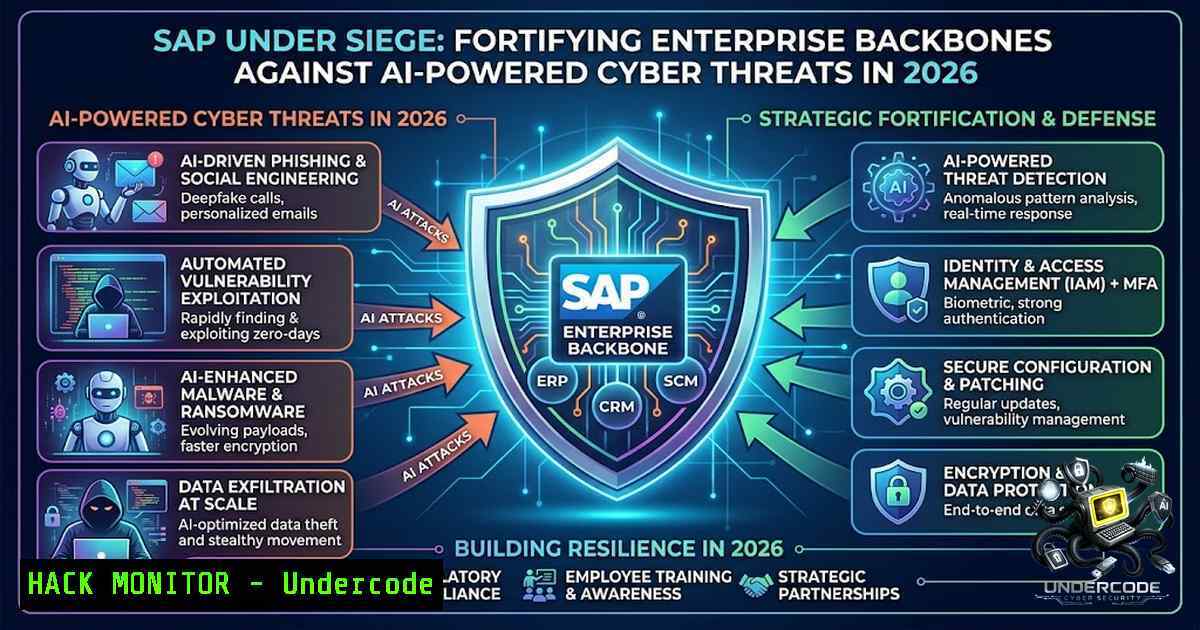
As the 17th Annual Billington CyberSecurity Summit convenes in Washington, D.C., from September 8–10, 2026, government and industry leaders are confronting an escalating reality: SAP systems—the digital nervous systems of federal agencies and global enterprises—have become prime targets for AI-enabled adversaries. With over 3,000 attendees and 300+ speakers expected, the summit’s theme, “Reducing Risk in an Age of AI-Enabled Threats,” underscores a critical inflection point. SecurityBridge, in partnership with Carahsoft, will showcase native SAP cybersecurity solutions at the event, addressing the urgent need for real-time threat detection, compliance automation, and cyber resilience built directly into SAP environments.
Learning Objectives
- Understand the AI Threat Landscape for SAP: Identify how threat actors leverage large language models (LLMs) and AI agents to automate vulnerability discovery, privilege escalation, and exploit execution against SAP systems.
- Master SAP Security Hardening Fundamentals: Apply platform-level hardening, access controls, and continuous monitoring to protect SAP S/4HANA, NetWeaver, and BTP environments.
- Implement Native SAP Threat Detection: Deploy SAP-1ative security platforms like SecurityBridge to forward enriched security data to SIEM/SOAR workflows and enable real-time incident response.
You Should Know
- The AI Attack Surface: How Adversaries Are Weaponizing Intelligence Against SAP
The cybersecurity community has witnessed a paradigm shift in 2026. Threat actors are no longer manually probing SAP systems; they are deploying general-purpose LLMs and security-focused AI models to automate complex attack chains. By issuing plain English prompts, adversaries can instruct AI agents to:
- Discover misconfigurations in SAP NetWeaver and S/4HANA
- Pivot across databases and application layers
- Execute critical exploits at machine speed, shrinking defender response windows from days to minutes
The SAP NetWeaver zero-day attack campaign (CVE-2025-31324) demonstrated how quickly AI can weaponize previously unknown vulnerabilities. SAP NetWeaver has emerged as the most exploited enterprise vulnerability of the year, with attackers using AI to decipher proprietary protocols and craft targeted exploits without prior SAP training.
Step-by-Step: Assessing Your AI-Exposed SAP Attack Surface
- Inventory all SAP interfaces exposed to the internet or internal untrusted networks:
– Use `sapcontrol` to list running instances: `sapcontrol -1r
– Review ICM (Internet Communication Manager) ports: `SMICM` transaction in SAP GUI
- Audit default credentials and weak authentication—AI agents excel at brute-forcing and guessing defaults:
-- ABAP: Query for users with default passwords
SELECT BNAME, UFLAG FROM USR02 WHERE UFLAG = '0' AND BNAME LIKE 'SAP%';
-
Scan for known vulnerable services using tools like
nmap:nmap -p 3200,3300,8000,44300,5xxxx <sap-host> -sV --script=sap-info
-
Enable comprehensive audit logging to detect AI-driven reconnaissance:
– Transaction `SM19` (Security Audit Log Configuration) — activate all security-relevant events
– Transaction `SM20` (Audit Log Analysis) — review daily for anomalies
2. Native SAP Security: Moving Beyond Perimeter Defenses
Traditional perimeter security—firewalls, WAFs, and network segmentation—is insufficient to protect SAP’s complex application-layer attack surface. SecurityBridge’s platform is built natively within SAP, eliminating the need for external integrations while providing unparalleled visibility into vulnerabilities, configuration risks, and real-time threats.
Key Native Security Capabilities:
- Risk-based authentication inside SAP with step-up MFA that triggers automatically for sensitive actions, without adding login friction for normal use
- Real-time SIEM integration that forwards enriched SAP security data as structured “Smart Data” to Microsoft Sentinel and other SIEM/SOAR platforms
- Continuous control monitoring with pre-built executive dashboards giving leadership real-time visibility into SAP risk posture, remediation, and compliance
Step-by-Step: Configuring SAP Native Security Controls
1. Enforce secure network protocols (SNC with TLS):
- In SAP GUI, configure SNC: `SAP System > Properties > SNC`
– Enable TLS for ICM: In transactionRZ10, set parameter `icm/server_port_= PROT=HTTPS,PORT=443XX`
2. Implement risk-based authentication (requires SecurityBridge or equivalent):
- Define sensitive transactions (e.g., `SU01` user admin, `SE38` code changes)
- Configure step-up MFA triggers based on transaction risk scores
3. Forward SAP logs to SIEM:
- Configure syslog forwarding from SAP: Transaction `SM50` → “Goto” → “System Log” → “Export”
- For SecurityBridge users: Enable the SIEM integration module to automatically structure and forward events
4. Validate critical configurations regularly:
 Linux: Check SAProuter security
saprouter -r -K -p <port> -R <access-list>
 Verify RFC destinations are secure
 Transaction SM59 — review all RFC connections for plaintext auth
3. SAP Platform Hardening: The 2026 Checklist
The 2026 SAP Security Assessment Checklist identifies six critical domains for managing risk across the entire SAP ecosystem. Organizations must prioritize:
- Platform and architecture hardening: Apply the latest SAP Security Notes and HotNews; validate S/4HANA and RISE baselines
- Patch and vulnerability management: Elevate SAP patching to business-critical status; deploy automated vulnerability scanning and patch-prioritization workflows
- Identity, access, and privilege controls: Audit and prune risky or unused authorization profiles; implement least-privilege models
- Monitoring, detection, and incident response: Ensure audit logs are enabled and retained; regularly review transport security and parameter settings
Step-by-Step: Hardening Your SAP Platform
- Apply SAP security patches monthly (SAP releases patches every second Tuesday):
– Download notes from SAP Service Marketplace
– Use transaction `SNOTE` to apply notes in a sandbox environment first
– Validate with transaction `SPAM` (Support Package Manager)
2. Disable unnecessary clients and default users:
 ABAP: Lock or delete unused clients
CALL FUNCTION 'RSCLIENT_DELETE' EXPORTING client = '800';
 Disable default users: SAP, DDIC, EARLYWATCH
3. Secure RFC connections:
- Review all RFC destinations in `SM59`
– Enforce SNC for all external RFCs - Remove unnecessary RFC trust relationships
- Harden the underlying OS (SUSE Linux Enterprise Server for SAP Applications):
Enforce least privilege
chmod 750 /usr/sap/<SID>/
Restrict network access with firewalld
firewall-cmd --permanent --add-rich-rule='rule family="ipv4" source address="<trusted-subnet>" port protocol="tcp" port="3200" accept'
Enable AppArmor for SAP processes
aa-enforce /etc/apparmor.d/usr.sap.
-
AI-Powered Defense: Leveraging Machine Learning to Counter Automated Threats
While AI amplifies offensive capabilities, it also empowers defenders. SecurityBridge’s AI capabilities are purpose-built for SAP, trained on more than a decade of SAP-1ative threat intelligence. These AI models:
- Detect anomalous user behavior and privilege elevation events in real time
- Prioritize vulnerabilities based on exploitability and business impact
- Automate compliance reporting and remediation workflows
Step-by-Step: Deploying AI-Powered SAP Threat Detection
1. Enable behavioral analytics:
- Configure baseline user activity profiles (transaction usage patterns, login times, data access)
- Set alert thresholds for deviations (e.g., user accessing 50+ transactions in 5 minutes)
2. Integrate threat intelligence feeds:
- Subscribe to SAP security notes and CVEs (e.g., CVE-2026-44744, CVE-2026-34260)
- Automate patch prioritization based on threat intelligence scoring
3. Implement “shift-left” security in SAP BTP:
- Embed security scans directly into developer IDEs and CI/CD pipelines
- Identify and remediate vulnerabilities in custom ABAP and BTP code before production deployment
4. Monitor for AI-generated attack patterns:
 Linux: Monitor for rapid failed login attempts (AI brute-forcing)
tail -f /usr/sap/<SID>/<instance>/work/dev_rd | grep -i "login failed"
 Windows: Use PowerShell to parse SAP event logs
Get-EventLog -LogName "SAP" -EntryType Error | Where-Object {$_.Message -match "RFC.unauthorized"}
- Cloud and RISE with SAP Security: Securing Hybrid Architectures
As organizations migrate to SAP RISE and SAP BTP, security must extend to cloud-1ative components. The 2026 checklist includes dedicated sections for cloud and RISE/BTP security. Key considerations:
- Network segmentation to limit access to SAP systems in hybrid environments
- Blockchain-based integrity verification for critical SAP transactions
- Multi-layer frameworks combining AI-powered threat intelligence, behavioral analytics, and application hardening
Step-by-Step: Securing SAP RISE and BTP Deployments
1. Configure SAP Cloud Logging service:
- Enable audit logging for all BTP subaccounts
- Forward logs to centralized SIEM
2. Implement zero-trust network access:
- Restrict SAP Cloud Connector to allowlist-based firewall rules
- Enforce TLS 1.3 for all cloud-to-on-premises communication
3. Deploy automated vulnerability scanning for cloud workloads:
 Using SAP Cloud ALM
 Schedule regular security scans via Cloud ALM REST API
curl -X POST https://<cloud-alm-instance>/api/v1/security-scans \
-H "Authorization: Bearer <token>" \
-d '{"scope":"all-subaccounts","schedule":"weekly"}'
4. Test backup and recovery plans regularly:
- Validate restore procedures in a non-production environment
- Document recovery time objectives (RTOs) for critical SAP modules
- Incident Response for SAP: Preparing for the Inevitable
Despite best efforts, breaches will occur. Organizations must have an SAP-specific incident response plan that accounts for AI-accelerated attacks. SecurityBridge’s platform enables:
- Real-time detection and alerting integrated with existing SOC workflows
- Automated containment actions (e.g., locking compromised user accounts, isolating affected systems)
- Forensic analysis with enriched business context
Step-by-Step: Building an SAP Incident Response Playbook
1. Define escalation paths:
- Tier 1: SOC analysts triage SAP alerts
- Tier 2: SAP Basis team investigates system-level anomalies
- Tier 3: SecurityBridge/SAP security specialists handle complex exploits
2. Create automated containment scripts:
 ABAP: Lock compromised user
CALL FUNCTION 'BAPI_USER_LOCK' EXPORTING username = 'COMPROMISED_USER';
 ABAP: Revoke critical authorizations
CALL FUNCTION 'BAPI_USER_AUTH_REVOKE' EXPORTING username = 'COMPROMISED_USER' role = 'SAP_ALL';
3. Integrate SAP alerts into SOAR platforms:
- Configure SecurityBridge to forward enriched alerts to SOAR
- Automate playbooks for common SAP threat scenarios (e.g., ransomware, data exfiltration, privilege escalation)
4. Conduct tabletop exercises:
- Simulate an AI-driven attack on SAP NetWeaver
- Practice using transaction `SM20` for forensic analysis
- Review and update the playbook quarterly
What Undercode Say
- AI is a double-edged sword: The same AI models that accelerate threat detection also empower adversaries to automate complex SAP attacks. Organizations must adopt AI-1ative defenses to keep pace.
-
SAP security can no longer be an afterthought: With SAP NetWeaver as the most exploited enterprise vulnerability of 2026, patching and hardening must be elevated to business-critical status.
-
Native security wins: External security tools lack the visibility required to protect SAP’s unique architecture. SAP-1ative platforms like SecurityBridge provide the 360° view needed to detect and respond to threats effectively.
-
The Billington summit is a must-attend: With over 300 speakers and 3,000 attendees, the 17th Annual Billington CyberSecurity Summit offers unparalleled access to government cybersecurity leaders and cutting-edge solutions. Register today: https://ow.ly/ob3L30sXMYP
-
Automation is survival: Defender response windows are shrinking. Automated vulnerability scanning, patch prioritization, and incident response are no longer optional—they are existential requirements.
Expected Output
Introduction: As AI-enabled threats accelerate the weaponization of enterprise vulnerabilities, SAP systems—the backbone of government and corporate operations—have become prime targets. The 17th Annual Billington CyberSecurity Summit (September 8–10, 2026, Washington, D.C.) convenes 3,000+ attendees and 300+ speakers to address this crisis, with SecurityBridge and Carahsoft showcasing native SAP cybersecurity solutions that deliver real-time threat detection, compliance automation, and cyber resilience.
What Undercode Say:
- AI-driven SAP attacks are no longer theoretical—they are happening now, with SAP NetWeaver emerging as the most exploited enterprise vulnerability of 2026. Defenders must deploy AI-1ative detection and automated response to counter machine-speed threats.
- Native SAP security platforms like SecurityBridge eliminate the visibility gaps that external tools cannot address, providing real-time risk posture, risk-based authentication, and seamless SIEM/SOAR integration.
- The 2026 SAP Security Checklist mandates six critical domains: platform hardening, patch management, access controls, monitoring, compliance, and cloud security. Organizations that fail to address all six will remain vulnerable.
Prediction
-1 The democratization of AI offensive capabilities will continue to lower the barrier to entry for SAP attackers, leading to a surge in ransomware and data exfiltration attempts against SAP systems through 2027.
-1 The SAP talent shortage will worsen as AI-driven attacks outpace the number of security professionals trained in SAP-specific defense, creating a critical skills gap in both public and private sectors.
+1 AI-1ative SAP security platforms will evolve to predict and preempt attacks before they execute, shifting the cybersecurity paradigm from reactive detection to proactive prevention.
+1 Government mandates for SAP security compliance (inspired by CISA directives and NIST frameworks) will drive widespread adoption of native security solutions, raising the baseline of enterprise protection.
-1 Zero-day exploitation windows will shrink from days to hours as AI models accelerate vulnerability research, forcing organizations to implement real-time patch deployment regardless of business disruption risks.
+1 The integration of blockchain-based integrity verification into SAP S/4HANA will provide an immutable audit trail, enhancing forensic capabilities and deterring sophisticated attackers.
-1 State-sponsored threat actors will weaponize AI to target SAP systems in critical infrastructure (energy, defense, healthcare), potentially causing physical-world impacts through supply chain disruptions.
+1 Collaborative initiatives like the Billington CyberSecurity Summit will foster information sharing between government and industry, accelerating the development of AI-defense countermeasures.
-1 The complexity of hybrid SAP RISE/BTP architectures will introduce new attack vectors, with misconfigured cloud connectors and API endpoints becoming primary entry points for adversaries.
+1 Organizations that adopt “shift-left” security—embedding vulnerability scanning into SAP development pipelines—will reduce production vulnerabilities by over 60%, setting a new standard for DevSecOps in enterprise applications.
▶️ Related Video (84% Match):
🎯Let’s Practice For Free:
🎓 Live Courses & Certifications:
Join Undercode Academy for Verified Certifications
🚀 Request a Custom Project:
Secure, high-velocity infrastructure and disruptive technological engineering. Contact our engineering team for high-tier development and proprietary systems:
[email protected]
💎 Smart Architecture | 🛡️ Secure by Design | ⭐ Trusted by Thousands
IT/Security Reporter URL:
Reported By: Cigi Shepard – Hackers Feeds
Extra Hub: Undercode MoN
Basic Verification: Pass ✅


