Listen to this Post
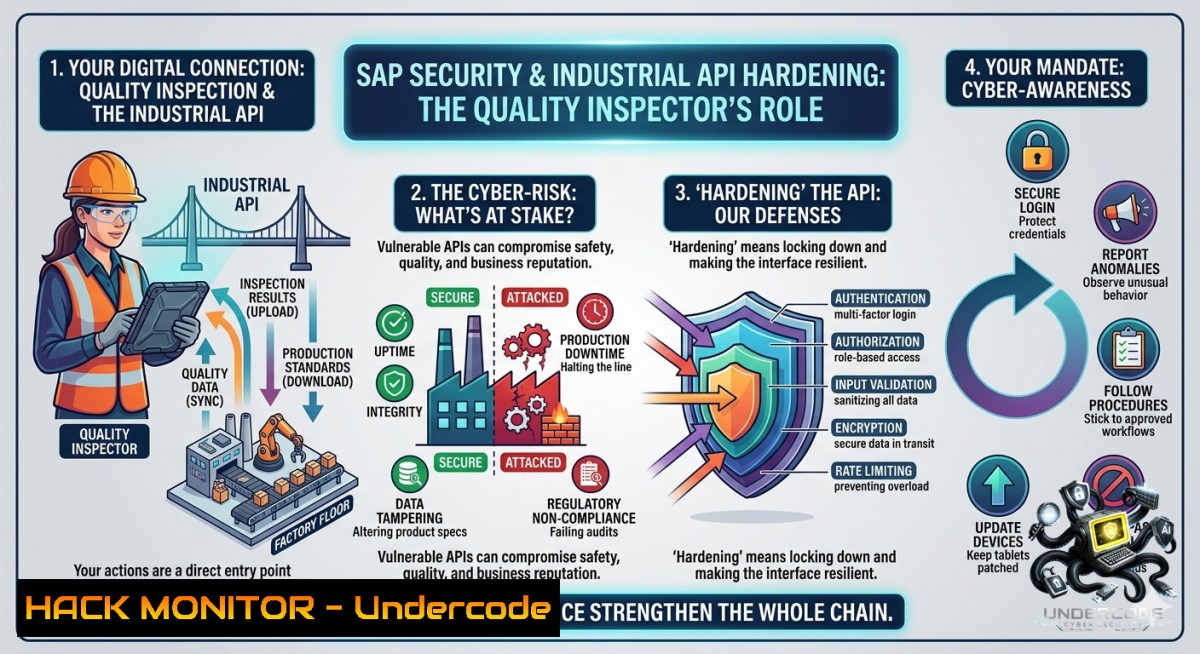
Introduction:
Quality inspection in aluminium, oil & gas, and steel manufacturing relies heavily on integrated systems like SAP (MM and QI modules) and adherence to international standards (ISO, BS, DIN, BIS). However, as industrial environments embrace IoT and connected valves, the same APIs that streamline inspection workflows become attack surfaces for ransomware and data exfiltration. Understanding how to secure SAP transactions and harden industrial APIs is no longer optional—it’s a critical competency for engineers and inspectors alike.
Learning Objectives:
- Implement SAP role-based access controls (RBAC) and audit MM/QI module transactions to prevent unauthorized quality record alterations.
- Harden industrial REST APIs and OPC-UA endpoints against injection attacks, using both Linux and Windows security tools.
- Deploy cloud hardening techniques for SAP data stored in AWS/Azure and mitigate common OT vulnerabilities like unauthenticated Modbus.
You Should Know:
- Securing SAP MM and QI Modules – Step‑by‑Step Audit & Hardening Guide
SAP’s Material Management (MM) and Quality Inspection (QI) modules store critical manufacturing data. Attackers often exploit excessive privileges or missing SAP Security Notes. This guide walks through a basic SAP security audit from an administrator’s perspective.
Step 1 – Review user authorizations using transaction SUIM
Log into SAP GUI, run SUIM. Navigate to “Users by Complex Selection Criteria” → “Users with Critical Authorizations”. Look for users holding `SAP_ALL` or `SAP_NEW` profiles outside of designated admin accounts.
Step 2 – Enable Security Audit Log (transaction SM19)
Set audit policy to log failed logon attempts, transaction start failures, and changes to user masters. Use `SM20` to review logs weekly.
Step 3 – Scan for missing SAP Security Notes
On a Linux jump server with `sapcontrol` installed:
sapcontrol -1r 00 -function GetSystemInstanceList
sapcontrol -1r 00 -function ABAPGetSystemSecurityInfo
For Windows (using PowerShell and SAP NWRFC SDK):
.\nwrfc.exe -ashost=sap-erp -sysnr=00 -client=100 -user=SEC_ADMIN -passwd= -function=RFCC_API_SYSTEM_SECURITY_INFO
Step 4 – Apply transport requests for critical patches
Download relevant SAP Security Notes (e.g., 3123395 for QI module injection). Use transaction `STMS` to import the transport into your development → quality → production pipeline.
Step 5 – Restrict RFC callbacks to trusted IPs
Edit `secinfo` and `reginfo` files (usually in /usr/sap/<SID>/DVEBMGS00/data/) to whitelist only internal IP ranges.
2. Hardening Industrial APIs (Valve & Inspection Endpoints)
Industrial valve technicians reference API 598, 6D, 6A for mechanical testing, but today’s smart valves expose REST APIs over Ethernet/IP. These APIs often lack proper authentication. Below is a step‑by‑step guide to test and secure an industrial API.
Prerequisites: Linux machine with curl, jq, and nmap. Windows users can use `curl.exe` and Postman.
Step 1 – Discover exposed API endpoints
Use `nmap` to find open ports 80, 443, 8080, 8443, and common industrial ports (44818 for CIP).
nmap -p 80,443,8080,8443,44818 -sV --open 192.168.1.0/24
Step 2 – Enumerate API documentation
Many industrial devices expose /swagger, /openapi.json, or /api-docs. Try:
curl -k https://192.168.1.100:8443/swagger/v1/swagger.json | jq '.paths | keys'
Step 3 – Test for missing authentication
Craft a request to a sensitive endpoint (e.g., reading valve test results):
curl -k -X GET "https://192.168.1.100:8443/api/v1/valve/598/test-results" -H "Accept: application/json"
If you receive data without any token or API key, authentication is missing.
Step 4 – Implement API gateway hardening (example using NGINX)
On a Linux edge gateway:
server {
listen 443 ssl;
location /api/ {
 Require client certificate or API key
if ($http_x_api_key !~ "^(expected-key)$") { return 401; }
proxy_pass http://valve-controller:8443;
}
}
Then enforce TLS 1.3 and disable weak ciphers.
3. Cloud Hardening for SAP & Industrial Data
Many companies now host SAP on AWS or Azure. Misconfigured storage buckets can leak quality inspection certificates and ISO documentation.
Step 1 – Enforce private ACLs on SAP file shares
Azure:
 Check blob public access
az storage container list --account-1ame sapdatalake --query "[?properties.publicAccess!='']"
 Set to private
az storage container set-permission --1ame qi-reports --public-access off
AWS S3:
aws s3api get-bucket-acl --bucket sap-quality-inspection
aws s3api put-bucket-acl --bucket sap-quality-inspection --acl private
Step 2 – Enable SAP HANA audit logging on cloud VMs
Linux (as `adm` user):
hdbsql -u SYSTEM -p <password> "ALTER SYSTEM ALTER CONFIGURATION ('indexserver.ini', 'SYSTEM') SET ('auditing', 'global_auditing_state') = 'true' WITH RECONFIGURE"
Step 3 – Monitor cloud IAM roles for SAP service accounts
Use AWS CloudTrail or Azure Monitor to detect unusual API calls from inspection workstations.
4. Vulnerability Exploitation & Mitigation in OT Environments
Industrial networks often run unpatched Modbus/TCP or OPC Classic. A simple Metasploit module can read holding registers from a PLC. Mitigation requires network segmentation and deep packet inspection.
Step 1 – Simulate Modbus enumeration (authorized testing only)
Linux with `nmap` script:
nmap --script modbus-discover -p 502 10.10.10.0/24
Step 2 – Deploy a Modbus/TCP firewall rule on Windows
Open ‘Windows Defender Firewall with Advanced Security’ → Inbound Rules → New Rule → Port → TCP 502 → Block the connection. Apply to OT VLAN interface.
Step 3 – Implement OPC UA reverse proxy with authentication
Use `opcua-commander` (Python) to force all OPC UA calls through a gateway that validates X.509 certificates.
- Recommended Training Courses for SAP & Industrial API Security
- SAP Security & Authorization Concepts (SAP Learning Hub – course SAPSEC)
- ICS/SCADA Cybersecurity (SANS ICS410 or Coursera’s “Industrial IoT Security”)
- API Security Architect (API Academy’s “API Security Hands‑On Lab”)
- Cloud Hardening for SAP on AWS (AWS Skill Builder – SAP on AWS Specialty)
- Practical OT Exploitation & Defense (INE’s eJPT track with industrial modules)
What Undercode Say:
- Key Takeaway 1: The job requirement “Strong knowledge of SAP (MM and QI modules)” directly implies the need for secure configuration—unchecked authorizations in SAP have led to real‑world production stoppages and falsified quality records.
- Key Takeaway 2: Industrial valve standards (API 598/6D/6A) now overlap with REST API security; many technicians overlook that a compromised valve API can be leveraged to forge test results or disable safety shutdowns.
Analysis (approx. 10 lines):
The shift toward Industry 4.0 means quality inspectors and valve technicians are no longer isolated from cyber risks. The same SAP system that stores inspection certificates also connects to external email gateways—a spear‑phishing attack on an inspector’s account could alter pass/fail records before final shipment. Meanwhile, smart valves exposing unauthenticated APIs over Ethernet/IP have been demonstrated to cause physical overpressure events. The comment from Firwansyah highlights hands‑on skills (dismantle, testing, troubleshooting), but without security awareness, those skills do not prevent a remote attacker from replaying a “testing passed” API call. Training courses like ICS410 or SAP Security are essential to bridge this gap. Organizations hiring for these roles should add “basic OT security hygiene” as a preferred qualification.
Prediction:
- -1 Unpatched SAP QI modules in aluminium and oil & gas will be targeted by ransomware groups within 18 months, leading to fraudulent quality certifications that pass regulatory audits but hide material defects.
- -1 The proliferation of low‑cost smart valves without built‑in API security will cause at least one major pipeline incident where an attacker manipulates valve test records to bypass pre‑commissioning checks.
- +1 Demand for cross‑training (SAP security + industrial API testing) will create a new “Cyber Quality Inspector” role, with salaries 30% higher than traditional inspectors by 2028.
▶️ Related Video (82% Match):
🎯Let’s Practice For Free:
🎓 Live Courses & Certifications:
Join Undercode Academy for Verified Certifications
🚀 Request a Custom Project:
Secure, high-velocity infrastructure and disruptive technological engineering. Contact our engineering team for high-tier development and proprietary systems:
[email protected]
💎 Smart Architecture | 🛡️ Secure by Design | ⭐ Trusted by Thousands
IT/Security Reporter URL:
Reported By: Urgent Hiring – Hackers Feeds
Extra Hub: Undercode MoN
Basic Verification: Pass ✅


