Listen to this Post
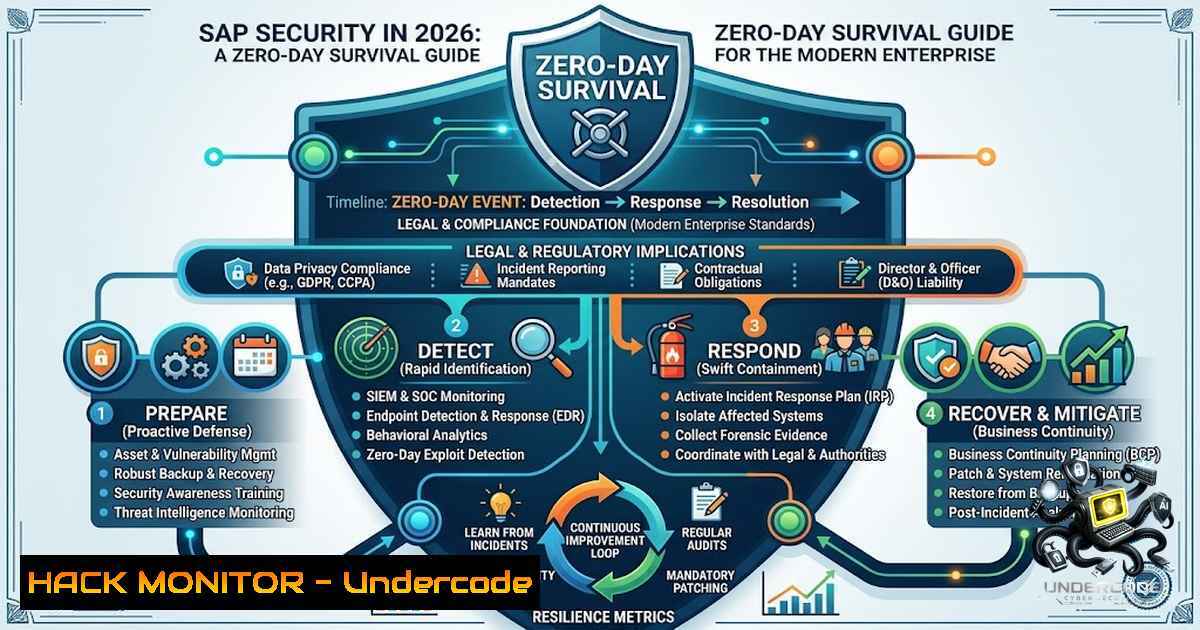
Introduction:
As the digital backbone for finance, supply chain, and human resources across the globe, SAP systems have become prime targets for sophisticated cyber adversaries. With the increasing adoption of cloud and hybrid infrastructures, the attack surface has expanded dramatically, exposing critical business data to threats ranging from ransomware to zero-day exploits. This article serves as a comprehensive field manual for security professionals, dissecting the current SAP threat landscape and providing actionable, step-by-step guidance to harden your SAP landscape against the most critical vulnerabilities of 2026.
Learning Objectives:
- Understand the architecture of modern SAP threats, including zero-day exploits and code injection vulnerabilities.
- Master the essential steps for patching, system hardening, and continuous vulnerability management in SAP S/4HANA and NetWeaver environments.
- Learn how to leverage open-source tools and AI-driven solutions for penetration testing and real-time threat detection.
- Navigate the shared responsibility model in RISE with SAP to secure your application layer effectively.
- Understanding the Attack Surface: The Anatomy of SAP Zero-Days
The sophistication of attacks targeting SAP systems has reached new heights. A prime example is the 2025 SAP NetWeaver zero-day (CVE-2025-31324 and CVE-2025-42999), which was mass-exploited to compromise hundreds of organizations. This vulnerability resides in an unauthenticated HTTP endpoint within the SAP NetWeaver Visual Composer Metadata Uploader.
Step‑by‑step guide to understanding and hunting for this exploit:
– Step 1: Understand the Flaw. The exploit works by sending a malicious serialized object to the vulnerable endpoint, triggering a deserialization flaw. This allows attackers to chain together existing code blocks (gadgets) to execute arbitrary remote commands.
– Step 2: Identify Indicators of Compromise (IOCs). Hunt for unauthorized deserialization events in your Java trace logs. Check the file system for dropped `.jsp` web shells, which attackers deploy to maintain persistent remote access.
– Step 3: Check for Post-Exploitation Activity. If compromised, attackers can download critical configuration files like `SecStore.properties` to extract database credentials or execute unauthorized SQL queries to manipulate core business data.
– Step 4: Apply the Patch. Apply the out-of-band SAP Security Note 3594142 to enforce authentication on the vulnerable HTTP endpoint.
2. The Critical Patch: CVE-2025-42957 in SAP S/4HANA
Discovered by SecurityBridge Threat Research Labs, CVE-2025-42957 is a critical ABAP code injection vulnerability in SAP S/4HANA with a CVSS score of 9.9. This flaw allows a low-privileged user to take complete control of the SAP system.
Step‑by‑step guide to mitigation:
- Step 1: Immediate Patching. Apply SAP’s security updates immediately using Notes 3627998 and 3633838.
- Step 2: Reduce Attack Surface. Implement SAP UCON to restrict RFC usage. Review and restrict access to authorization object `S_DMIS` with activity 02.
- Step 3: Monitor for IOCs. Watch for suspicious RFC calls, the creation of new admin users, or unexpected ABAP code changes.
- Step 4: Assume Breach. Given the low complexity of the attack, assume that any unpatched system may have been compromised. Hunt for indicators and enforce strict segmentation.
3. SAP Platform and Architecture Hardening
A proactive security posture begins with a hardened architecture to prevent unauthorized network access and lateral movement.
Step‑by‑step guide to a 2026 hardening baseline:
- Step 1: Validate Critical Configurations. Review and harden configurations for RFC, ICM, LDAP, SNC, and Web Dispatcher. Enforce SAProuter security and TLS for all communications.
- Step 2: Enforce Identity and Access Controls. This is non-1egotiable. Enforce Multi-Factor Authentication (MFA) for all administrative and remote access. Audit Segregation of Duties (SoD) to prevent any single user from having conflicting functions, such as both creating and approving a payment. Standardize role design during any transition from ECC to S/4HANA.
- Step 3: Document Everything. Maintain a complete and up-to-date inventory of all SAP systems and custom applications.
- Step 4: Implement the SAP Security Baseline Template. This is not optional; it defines the minimum configuration that must be implemented in productive landscapes.
4. Penetration Testing with Open-Source Tools
While commercial tools exist, open-source alternatives provide a cost-effective and flexible approach to SAP penetration testing.
Step‑by‑step guide to using essential open-source tools:
- Step 1: Network Discovery with Nmap. Replace the default `services` file (
/usr/share/nmap/on Linux) with a SAP-specific version from GitHub. Run Nmap to scan for SAP-specific services like SAP GUI, RFC Gateway, and SAPRouter. - Step 2: RFC Gateway Testing. Use Python scripts like `PyRFC` to detect exposed services and identify misconfigurations. For example, you can test for insecure ACL files in the RFC Gateway that allow for Remote Code Execution.
Example command to test for RCE
python SAPanonGWv1.py -t <target_ip> -p <port> -c whoami
- Step 3: Test for Known Exploits. Use scripts to test for vulnerabilities like 10KBlaze, which exploits misconfigured SAP Gateway and Message Server settings. The Metasploit SAP URL scanner and tools like `pysap` are also invaluable.
- Step 4: GUI-Based Auditing. Leverage OWASP SAPKiln, a GUI tool designed to empower security researchers in conducting efficient auditing and penetration testing of SAP systems through SAP Logon/GUI.
5. AI-Driven Security and Cloud Hardening
The integration of AI and cloud platforms introduces new security paradigms and risks.
Step‑by‑step guide to AI and cloud security:
- Step 1: Understand AI-Specific Risks. Be aware of threats like workflow hijacking, where attackers compromise RPA bots or machine learning models to alter procurement orders or redirect payments.
- Step 2: Implement AI-Powered Detection. Deploy AI-based tools that can respond to threats in real-time and predict abnormal actions for automated mitigation. Explore open-source projects like `sap-security-ai-detector` on GitHub, which uses machine learning for real-time threat identification.
- Step 3: Secure Cloud Deployments (AWS/Azure/GCP). Use private subnets, firewalls, and VPNs to restrict access. Regularly update SAP and OS security patches. Enable cloud logging and SIEM solutions to detect threats in real time.
- Step 4: Navigate the Shared Responsibility Model. In a RISE with SAP deployment, SAP manages the infrastructure (Security of the Cloud), but you retain 100% responsibility for securing everything inside your application—your data, user access, custom code, and configurations. Do not fall into the “assurance gap” of assuming SAP handles it all.
6. Monitoring, Detection, and Incident Response
Standard network monitoring tools lack visibility into the SAP application layer.
Step‑by‑step guide to building detection capabilities:
- Step 1: Enable SAP-Specific Threat Monitoring. Deploy dedicated threat detection and response capabilities to monitor for known vulnerabilities like CVE-2025-42957.
- Step 2: Integrate with SIEM/SOAR. Integrate SAP logs directly into your centralized Security Operations Center (SOC) platforms.
- Step 3: Conduct Regular Drills. Perform breach tabletop exercises and simulate data exfiltration attempts to test your incident response protocols.
- Step 4: Implement Virtual Patching. For vulnerabilities that cannot be patched immediately, use virtual patching as a compensating control to mitigate known security risks without applying vendor patches.
What Undercode Say:
- Key Takeaway 1: The era of assuming SAP security is “someone else’s problem” is over. The “assurance gap” in RISE with SAP is the single biggest risk, as customers retain 100% responsibility for their application layer.
- Key Takeaway 2: Proactive defense is the only defense. Relying on manual patching cycles leaves organizations exposed to known exploits that are being actively weaponized by sophisticated threat actors.
Analysis:
The SAP threat landscape in 2026 is characterized by a dangerous combination of highly critical vulnerabilities (CVSS 9.9) and a fundamental misunderstanding of security responsibilities in cloud transformations. The CVE-2025-42957 flaw is particularly insidious because it requires only low-level credentials to achieve full system compromise, making it a prime target for malicious insiders or attackers who have gained a foothold via phishing. Meanwhile, the RISE with SAP model, while offering immense business value, creates a false sense of security that leaves critical areas like user access, custom code, and application configurations completely unsecured if not actively managed by the customer. The solution is a multi-layered approach that combines relentless patch management, rigorous architecture hardening, continuous monitoring, and a clear-eyed understanding of where your responsibility lies.
Prediction:
- -1 As AI becomes more deeply integrated into SAP workflows, we will see a surge in “workflow hijacking” attacks that exploit AI models and RPA bots, bypassing traditional security controls. This will require a fundamental shift in how we define and enforce security policies.
- -1 The “assurance gap” in RISE with SAP will lead to a major, high-profile data breach within the next 18 months, forcing SAP and its customers to re-evaluate and clarify the shared responsibility model. This will act as a painful wake-up call for the industry.
- +1 The growing threat will accelerate the adoption of AI-powered, real-time threat detection and automated response systems within SAP environments, transforming cybersecurity from a reactive measure to a proactive, intelligent defense layer.
▶️ Related Video (84% Match):
🎯Let’s Practice For Free:
🎓 Live Courses & Certifications:
Join Undercode Academy for Verified Certifications
🚀 Request a Custom Project:
Secure, high-velocity infrastructure and disruptive technological engineering. Contact our engineering team for high-tier development and proprietary systems:
[email protected]
💎 Smart Architecture | 🛡️ Secure by Design | ⭐ Trusted by Thousands
IT/Security Reporter URL:
Reported By: Gmfaruk Sap – Hackers Feeds
Extra Hub: Undercode MoN
Basic Verification: Pass ✅


