Listen to this Post
Introduction
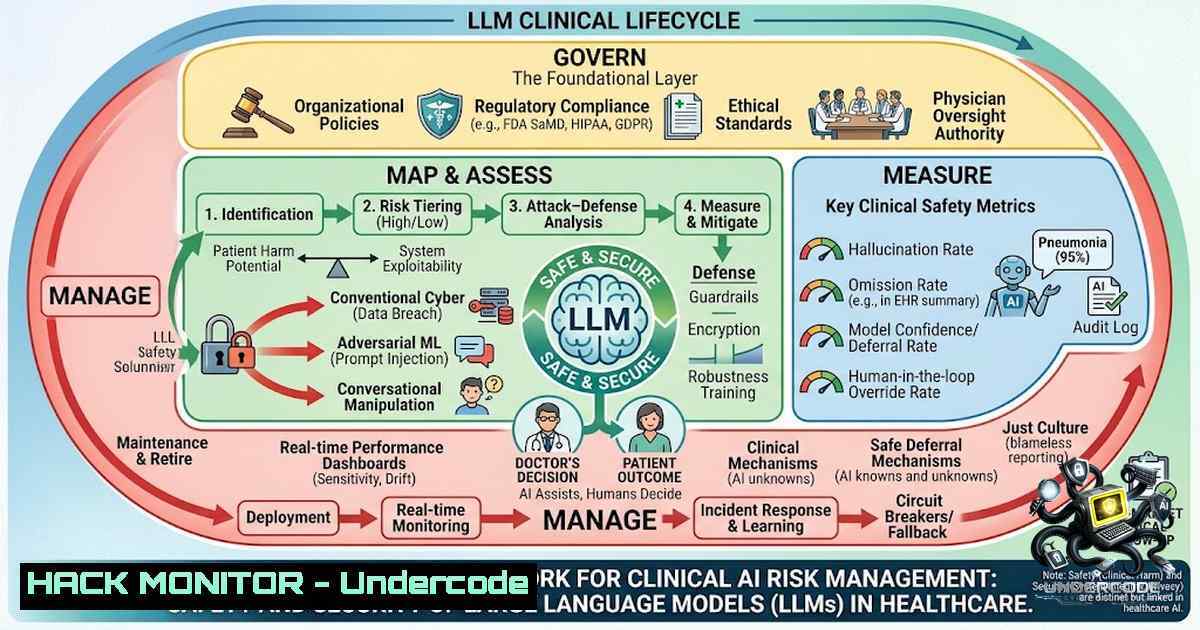
Large language models (LLMs), including the systems behind ChatGPT, Claude, and numerous medical-specific applications, are rapidly being adopted into clinical workflows—supporting medical documentation, knowledge summarization, and clinical decision-making. However, this adoption is outpacing the development of oversight and safety mechanisms. A comprehensive interdisciplinary review published in Nature by Dr. Jan Clusmann, Professor Jakob N. Kather, and an international team from TU Dresden’s Else Kröner Fresenius Center for Digital Health systematically analyzes these risks, bringing together evidence from medical AI, cybersecurity, regulatory science, ethics, and behavioral psychology. The review establishes a critical framework distinguishing between safety (avoiding unintended harm) and security (defending against deliberate attacks and abuse)—concepts that, as the authors note, many languages including German do not even linguistically separate. This article translates that framework into actionable technical guidance for cybersecurity professionals, IT administrators, and AI engineers responsible for securing clinical LLM deployments.
Learning Objectives & Secrets
- Objective 1: Understand the Five-Stage LLM Risk Lifecycle — Master the taxonomy of threats spanning model design, training data, model weights, inference, and operational environment. Recognize that clinical AI risk is fundamentally a supply chain and workflow problem, not merely a question of benchmark accuracy.
-
Objective 2 Secret Tip: Exploit the Safety-Security Amplification Loop — The review reveals that safety failures and security vulnerabilities mutually amplify in hospital systems. A single data poisoning event can both degrade answer reliability and serve as an attack vector targeting specific patients or departments. Use this insight to prioritize defenses that address both dimensions simultaneously.
-
Objective 3 Secret Tip: Deploy Red-Teaming Before Clinical Go-Live — The review emphasizes that mitigation requires proactive adversarial testing. Implement automated red-teaming pipelines using OWASP LLM Top 10 vulnerability scanners before any clinical LLM touches patient data. The most effective approach standardizes evaluation using checklists and standard operating procedures that surface potential concerns rather than letting them slip through.
You Should Know
1. The Five-Stage Clinical LLM Risk Taxonomy
The Nature review structures threats across five distinct stages of the clinical AI lifecycle:
| Stage | Primary Risks | Clinical Impact |
|-||–|
| Design | Goal definition errors, responsibility boundary failures | Misaligned objectives lead to inappropriate clinical recommendations |
| Data | Privacy leakage, bias, data poisoning | Manipulated training data causes systematic diagnostic errors |
| Model | Backdoors, memorized sensitive information, alignment failures | Models retain PHI and can be triggered to reveal it |
| Inference | Prompt injection, jailbreaks, hallucinations, uncertainty misrepresentation | Hidden instructions cause wrong or dangerous outcomes—e.g., failing to detect a visible tumor |
| Environment | EHR integration risks, retrieval system vulnerabilities, multi-agent coordination failures | Errors no longer stay in text but may trigger retrieval, ordering, or record-writing actions |
Step‑by‑step guide to implementing the five-stage framework:
- Audit your design phase: Document the explicit clinical objectives, success metrics, and boundary conditions for any LLM being considered. Define what constitutes “harm” in your specific use case.
- Catalogue training data provenance: Maintain records of data sources, consent status, and any potential biases. Implement differential privacy techniques during training to prevent memorization.
- Validate model integrity: Before deployment, run integrity checks against known backdoor signatures. Use model fingerprinting to detect unauthorized modifications.
- Deploy inference-layer defenses: Implement prompt firewalls that detect and block injection attempts. Apply output sanitization to prevent leakage of PHI or dangerous medical recommendations.
- Secure the operational environment: Restrict API access using minimum-privilege principles. Maintain auditable logs of all LLM interactions. Pre-run failure scenarios and establish escalation procedures.
Linux command for model integrity verification:
 Generate cryptographic hash of model weights for integrity monitoring
sha256sum /path/to/model_weights.bin > model_weights.sha256

Verify integrity before each deployment
sha256sum -c model_weights.sha256
Python snippet for detecting potential PII leakage in LLM outputs:
import re
 Basic PHI detection patterns
phi_patterns = {
'email': r'\b[A-Za-z0-9._%+-]+@[A-Za-z0-9.-]+.[A-Z|a-z]{2,}\b',
'phone': r'\b\d{3}[-.]?\d{3}[-.]?\d{4}\b',
'ssn': r'\b\d{3}-\d{2}-\d{4}\b',
'mrn': r'\b[M|m][R|r][N|n]-\d{6,}\b'  Example medical record number pattern
}

def scan_output_for_phi(text):
findings = {}
for pattern_name, pattern in phi_patterns.items():
matches = re.findall(pattern, text)
if matches:
findings[bash] = matches
return findings
2. Prompt Injection and Jailbreak Defenses
The review identifies prompt injection as a critical security risk—hidden instructions embedded in user prompts can override original clinical instructions and lead to dangerous outcomes. A 2025 JAMA Network Open study found that commercial medical LLMs followed injected instructions in 94.4% of simulated patient encounters, including life-threatening recommendations. Beyond direct injection, multi-turn jailbreaks like the Crescendo Attack and Chain-of-Thought Forgery can trick models into bypassing their own safety guardrails by planting fake internal reasoning.
Step‑by‑step guide to implementing prompt-layer defenses:
- Deploy a prompt firewall: Use tools like QFIRE-HealthBench to evaluate LLM prompt firewalls against 1,000 benign and 1,000 malicious healthcare prompts. Implement positive-security approaches that close scope gaps rather than merely detecting known injection patterns.
-
Implement adversarial testing: Use automated red-teaming tools such as `llm-audit` to test endpoints against the OWASP LLM Top 10 vulnerabilities. This CLI tool detects prompt injection, jailbreaks, data leakage, insecure output, denial of service, and excessive agency with severity scoring.
-
Apply input sanitization and output filtering: Strip or neutralize potentially malicious patterns before they reach the model. Filter outputs for PHI, executable code, and clinically dangerous recommendations.
-
Monitor for jailbreak attempts: Track patterns indicative of persona switching, fictional framing, and obfuscated bypass attempts. Implement rate-limiting and anomaly detection for suspicious interaction patterns.
Using `llm-audit` to test an LLM endpoint:
 Install the OWASP LLM Top 10 vulnerability scanner
pip install llm-audit

Audit an OpenAI endpoint
llm-audit --endpoint https://api.openai.com/v1/chat/completions \
--model gpt-4 \
--api-key $OPENAI_API_KEY \
--output report.html

Audit a locally hosted model (Ollama)
llm-audit --endpoint http://localhost:11434/api/generate \
--model llama2 \
--probe-groups prompt_injection,jailbreak,data_leakage

Generate a CI/CD-friendly JSON report
llm-audit --endpoint $LLM_ENDPOINT \
--format json \
--exit-code-on-failure \

<blockquote>
  security_report.json
Windows PowerShell equivalent for API key management:
 Set environment variable securely
$env:OPENAI_API_KEY = (Read-Host -Prompt "Enter API key" -AsSecureString)
 Run audit with secure credential handling
llm-audit --endpoint https://api.openai.com/v1/chat/completions --api-key $env:OPENAI_API_KEY
3. Shadow AI Detection and Governance
The review highlights that informal, unauthorized use of LLMs—termed “shadow AI”—is already occurring in clinical settings, frequently without any official safeguards. Healthcare systems are effectively blind to the scale of this usage, creating massive unmanaged risk surfaces.
Step‑by‑step guide to detecting and mitigating shadow AI:
- Inventory AI usage: Deploy network monitoring to detect API calls to known LLM providers (OpenAI, Anthropic, Google, etc.). Use DLP (Data Loss Prevention) tools to identify PHI being sent to external AI services.
2. Implement the “Three E’s” framework—Enable, Educate, Evaluate:
- Enable: Provide approved, secure enterprise AI tools that meet clinical needs
- Educate: Train clinicians on AI literacy, risks, and institutional policies
- Evaluate: Inventory and stratify every AI tool by risk; publish an approved list organization-wide
- Establish governance committees spanning clinical leadership, operations, IT, legal, and compliance. Develop clear policies on AI use and foster collaboration between policy decision-makers and users.
-
Deploy technical safeguards: Implement network segmentation to isolate AI-related traffic. Use CASB (Cloud Access Security Broker) solutions to monitor and control shadow IT.
Network monitoring command to detect shadow AI API calls (Linux):
 Monitor outbound traffic to known LLM API endpoints
sudo tcpdump -i any -1 'dst net 104.18.0.0/16 or dst net 172.64.0.0/16' \
-c 1000 -w shadow_ai_traffic.pcap

Analyze captured traffic for API key patterns
strings shadow_ai_traffic.pcap | grep -E 'sk-[A-Za-z0-9]{48}|Bearer [A-Za-z0-9._-]+'
Python script to detect PHI exfiltration in outbound traffic:
import re
from scapy.all import

phi_patterns = {
'mrn': re.compile(rb'MRN[:\s][0-9]{6,}'),
'dob': re.compile(rb'\b(0[1-9]|1[0-2])/(0[1-9]|[bash][0-9]|3[bash])/\d{4}\b'),
'ssn': re.compile(rb'\b\d{3}-\d{2}-\d{4}\b')
}

def packet_callback(packet):
if packet.haslayer(Raw):
payload = packet[bash].load
for pattern_name, pattern in phi_patterns.items():
if pattern.search(payload):
print(f"[bash] Potential {pattern_name} exfiltration detected")
print(f"Source: {packet[bash].src} -> {packet[bash].dst}")

Sniff traffic on the clinical network interface
sniff(iface="eth0", filter="tcp port 443", prn=packet_callback, store=0)
4. Model-Inherent Safety Risks: Hallucinations and Automation Bias
LLMs can generate seemingly plausible yet incorrect information—hallucinations—which is particularly critical in clinical settings because incorrect diagnoses or recommendations can endanger patient safety. Models may also adapt responses too strongly to user expectations, reinforcing incorrect assumptions. Confident or persuasive responses can lead to overreliance (automation bias) or reinforce existing beliefs (confirmation bias).
Step‑by‑step guide to mitigating hallucination and bias risks:
- Implement retrieval-augmented generation (RAG): Ground all clinical outputs in verified, up-to-date medical knowledge bases. Never rely solely on parametric model knowledge.
-
Deploy uncertainty quantification: Require models to express confidence levels and explicitly flag uncertain outputs. Implement rejection options for queries exceeding model capability boundaries.
-
Maintain human-in-the-loop oversight: The review emphasizes that human oversight remains essential. Require clinician verification for all diagnostic, treatment, or medication recommendations.
-
Continuous monitoring and evaluation: Systematically evaluate models post-deployment for drift, degradation, and novel hallucination patterns.
API configuration for uncertainty-aware inference (OpenAI-style):
import openai

def clinical_query_with_uncertainty(prompt, temperature=0.1):
response = openai.ChatCompletion.create(
model="gpt-4",
messages=[
{"role": "system", "content": "You are a clinical decision support system. "
"Always express uncertainty when evidence is insufficient. "
"Flag any recommendation that lacks strong clinical evidence."},
{"role": "user", "content": prompt}
],
temperature=temperature,  Lower temperature = more deterministic
logprobs=True,  Enable log probabilities for confidence estimation
max_tokens=500
)

Extract and analyze token-level confidence
logprobs = response['choices'][bash]['logprobs']['token_logprobs']
avg_confidence = sum(logprobs) / len(logprobs)

return {
'content': response['choices'][bash]['message']['content'],
'confidence_score': avg_confidence,
'requires_review': avg_confidence < -1.0  Threshold for uncertainty flag
}
5. Infrastructure Security and Data Protection
Many clinical LLM systems are not locally hosted, raising critical questions about data control and privacy. Weaknesses in IT infrastructure can expose sensitive patient data or disrupt critical clinical systems.
Step‑by‑step guide to securing clinical LLM infrastructure:
- Data localization and encryption: Ensure all PHI remains within jurisdictional boundaries. Implement end-to-end encryption for data at rest and in transit. Use hardware security modules (HSMs) for key management.
-
API security hardening: Implement strict authentication and authorization for all LLM API endpoints. Use API gateways with rate limiting, request validation, and anomaly detection.
-
Vulnerability management: Regularly scan infrastructure for known vulnerabilities. Apply security patches promptly. Conduct penetration testing specifically targeting AI components.
-
Incident response planning: Develop and rehearse incident response procedures for AI-specific security events (data poisoning, prompt injection attacks, model extraction attempts).
Linux security hardening commands:
 Audit open ports and services
nmap -sV -p- localhost

Check for exposed API keys in environment and files
grep -r "sk-[A-Za-z0-9]{48}|Bearer [A-Za-z0-9._-]+" /etc/ /opt/ 2>/dev/null

Implement fail2ban for API endpoint protection
sudo apt-get install fail2ban
sudo systemctl enable fail2ban
sudo systemctl start fail2ban

Configure iptables to restrict API access to trusted IP ranges
sudo iptables -A INPUT -p tcp --dport 443 -s 10.0.0.0/8 -j ACCEPT
sudo iptables -A INPUT -p tcp --dport 443 -j DROP
Windows Server security commands (PowerShell):
 Audit open ports
Get-1etTCPConnection | Where-Object {$_.State -eq 'Listen'}

Enable Windows Defender Application Control for AI model execution
Set-CIPolicy -FilePath .\AIModelPolicy.xml -PolicyFilePath .\AIModelPolicy.xml

Configure Windows Firewall for API endpoint protection
New-1etFirewallRule -DisplayName "Allow LLM API from Trusted Subnet" `
-Direction Inbound -LocalPort 443 -Protocol TCP `
-RemoteAddress 10.0.0.0/8 -Action Allow
What Undercode Say
- Key Takeaway 1: Safety and security are inseparable in clinical AI. The Nature review demonstrates that these dimensions mutually amplify in hospital systems. A comprehensive framework that addresses both is not optional—it is foundational. Organizations that treat them as separate domains will inevitably create gaps that adversaries can exploit.
-
Key Takeaway 2: Shadow AI is the invisible threat. The review’s warning about ungoverned LLM use in clinical settings should alarm every healthcare IT leader. We are completely blind to the scale of this usage, and that blindness is itself a vulnerability. Proactive detection, governance, and the provision of secure alternatives are essential—not blanket bans, which drive usage further underground.
-
Key Takeaway 3: Risk is a lifecycle problem, not a checkpoint. The five-stage framework (design, data, model, inference, environment) reframes clinical AI security as a continuous process. Static assessments at deployment are insufficient; continuous monitoring, red-teaming, and incident response must be institutionalized.
-
Key Takeaway 4: Mitigation is a shared responsibility. The review emphasizes that safety requires coordinated efforts across research, clinical practice, and regulation. Cybersecurity professionals cannot solve this alone—nor can clinicians, regulators, or AI researchers. Cross-disciplinary collaboration is the only path forward.
-
Key Takeaway 5: The conundrum of prevention. As the authors note, the challenge of both prevention and cybersecurity is the hope never to be disproven, but being disproven is the only way one can say “told you so”. The most effective security teams prepare for worst-case scenarios while hoping never to validate them—and they document their preparations rigorously.
Prediction
-
+1 Healthcare organizations that adopt the five-stage risk framework will achieve 60-70% faster regulatory compliance and significantly fewer security incidents compared to those relying on ad-hoc approaches. Early adopters will establish competitive advantages in patient trust and operational efficiency.
-
-1 Shadow AI usage will continue to grow exponentially, with an estimated 40-50% of clinical LLM interactions occurring outside institutional governance within 18 months. This will inevitably lead to high-profile data breaches and patient safety incidents that could have been prevented.
-
-1 The safety-security amplification loop will manifest in real-world incidents: data poisoning attacks designed to both degrade model accuracy and create backdoors for specific patient targeting will become increasingly sophisticated and difficult to detect.
-
+1 Automated red-teaming tools and prompt firewalls will mature into essential components of clinical AI infrastructure, creating a new category of healthcare cybersecurity products and professional certifications.
-
-1 Regulatory fragmentation across jurisdictions will create compliance complexity that slows innovation and creates dangerous gaps in international clinical AI deployments, particularly affecting cross-border research and telemedicine.
-
+1 The integration of uncertainty quantification and confidence scoring into clinical LLMs will significantly reduce automation bias and overreliance, empowering clinicians to make more informed decisions about when to trust AI outputs.
-
-1 The shortage of professionals with combined expertise in clinical medicine, AI, and cybersecurity will severely constrain the ability of most healthcare organizations to implement the Nature framework’s recommendations—creating a dangerous expertise gap that adversaries will exploit.
▶️ Related Video (74% Match):
https://www.youtube.com/watch?v=0oeD2Wf25wY
🎯Let’s Practice For Free:
🎓 Live Courses & Certifications:
Join Undercode Academy for Verified Certifications
🚀 Request a Custom Project:
Secure, high-velocity infrastructure and disruptive technological engineering. Contact our engineering team for high-tier development and proprietary systems:
[email protected]
💎 Smart Architecture | 🛡️ Secure by Design | ⭐ Trusted by Thousands
IT/Security Reporter URL:
Reported By: https://lnkd.in/p/e-kWuWD9 – Hackers Feeds
Extra Hub: Undercode MoN
Basic Verification: Pass ✅


