Listen to this Post
Introduction
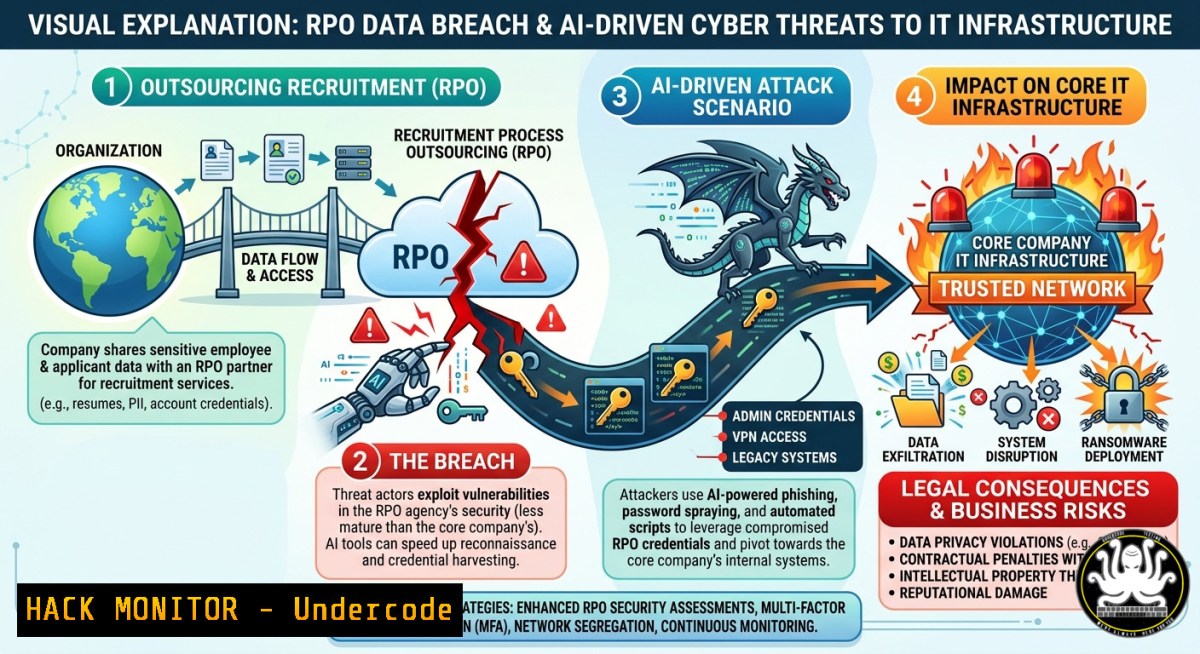
Recruitment Process Outsourcing (RPO) promises faster hiring and lower costs, but integrating third-party staffing platforms with your internal identity management systems creates a sprawling attack surface. Attackers increasingly exploit poorly secured RPO APIs and applicant tracking systems (ATS) to inject malicious code, exfiltrate employee PII, or pivot into cloud environments. When speed and volume become the only metrics, security hygiene—especially around cross-tenant access, AI‑generated phishing lures, and automated credential stuffing—often takes a back seat.
Learning Objectives
- Identify critical security gaps in RPO integrations, including over‑permissive API scopes and missing rate limiting.
- Apply Linux and Windows commands to audit recruitment platform network flows and detect anomalous outbound traffic.
- Configure cloud hardening measures (AWS IAM, Azure AD conditional access) to isolate third‑party talent acquisition tools from production environments.
You Should Know
- Auditing RPO API Permissions with OAuth 2.0 Security Scanning
Most RPO platforms use OAuth 2.0 to connect to your HRIS or SSO. Attackers look for overly broad `scope` values (e.g.,read_all_users,write_calendar) that allow lateral movement. Start by enumerating active OAuth tokens and validating their scopes.
Step‑by‑step guide (Linux/macOS)
 Extract all OAuth tokens from your recruitment middleware logs (example: grep for 'access_token')
grep -i "access_token" /var/log/rpo-integration.log | awk '{print $5}' > tokens.txt

Decode JWT tokens to inspect claims (requires jq)
for token in $(cat tokens.txt); do
echo "$token" | cut -d "." -f2 | base64 -d 2>/dev/null | jq '.scope, .aud, .azp'
done

Use OWASP ZAP API scan against RPO endpoints (install via apt or brew)
zap-api-scan.py -t https://api.rpo-provider.com/v1/candidates -f openapi -S -r report.html
Windows equivalent (PowerShell)
 Search event logs for OAuth token issues
Get-WinEvent -LogName "Security" | Where-Object { $_.Message -like "access_token" } | Select-Object TimeCreated, Message

Decode JWT from clipboard or file
[System.Text.Encoding]::UTF8.GetString([System.Convert]::FromBase64String((Get-Content .\token.txt -Raw).Split('.')[bash]))
What this does – Reveals if RPO tokens have excessive permissions (e.g., `admin` instead of read:candidate). Limit scopes to the absolute minimum and enforce token rotation every 15 minutes for recruitment APIs.
- Detecting AI‑Generated Phishing Campaigns via RPO Applicant Emails
Attackers inject malicious resume files or AI‑crafted cover letters that contain zero‑day macros or credential harvesting links. When RPO platforms auto‑forward these to internal recruiters, your email gateway may miss AI‑evolved lures.
Step‑by‑step guide
- Extract and analyze embedded URLs from all RPO‑forwarded emails (Linux):
Using ripgrep and regex to pull URLs from raw email files
rg -oP '(?i)(https?://|www.)[^\s<>"''()]+' /var/spool/mail/recruiter | sort -u > rpo_urls.txt

Submit to VirusTotal API for bulk analysis
curl -X POST https://www.virustotal.com/api/v3/urls -H "x-apikey: $VT_API_KEY" --data-urlencode "url@rpo_urls.txt"
-
Simulate an AI phishing attack using Gophish (open‑source framework) to test your recruiter’s resilience:
Install Gophish on Ubuntu 22.04
wget https://github.com/gophish/gophish/releases/download/v0.12.1/gophish-v0.12.1-linux-64bit.zip
unzip gophish-.zip && cd gophish-
sudo ./gophish
Configure a campaign that mimics legitimate RPO communication (e.g., "Interview Confirmation - Click to verify")
Mitigation – Enable Safe Attachments for Exchange Online (Microsoft 365) or ClamAV with custom rules for resume files (.docm, .xlsm). Block all macros from RPO domains unless digitally signed.
- Hardening Cloud IAM Against RPO Vendor Privilege Escalation
RPO vendors often require cross‑account roles (AWS) or service principals (Azure) to read candidate data. Misconfigured trust policies allow an attacker who compromises the RPO’s tenant to assume high‑privilege roles in your environment.
Step‑by‑step guide (AWS)
 List all IAM roles trusted to external RPO accounts
aws iam list-roles --query "Roles[?AssumeRolePolicyDocument.Statement[?Principal.Service=='ec2.amazonaws.com' || Principal.AWS=='arn:aws:iam::RPO_ACCOUNT_ID:root']].[bash]" --output table

Generate a policy report for each cross-account role
for role in $(aws iam list-roles --query "Roles[?contains(AssumeRolePolicyDocument, 'RPO_ACCOUNT_ID')].[bash]" --output text); do
aws iam get-role --role-name $role --query 'Role.AssumeRolePolicyDocument'
done

Enforce conditional access with aws:SourceIp and aws:RequestedRegion
aws iam put-role-policy --role-name RPOIntegrationRole --policy-name RestrictToTrustedIPs --policy-document '{
"Version": "2012-10-17",
"Statement": [{
"Effect": "Deny",
"Action": "",
"Resource": "",
"Condition": {"NotIpAddress": {"aws:SourceIp": ["203.0.113.0/24"]}}
}]
}'
Azure AD example (PowerShell)
 List service principals granted access by RPO
Get-AzureADServicePrincipal -All $true | Where-Object { $<em>.DisplayName -like "RPO" -or $</em>.Tags -contains "WindowsAzureActiveDirectoryIntegratedApp" }

Revoke unused consents
Revoke-AzureADUserAllRefreshToken -ObjectId <RecruiterUserID>
Key principle – Never allow “” actions on a cross‑account role. Use inline policies that only permit `s3:GetObject` on a specific bucket prefix (/candidates/incoming/).
- Network Isolation and Egress Filtering for Recruitment Platforms
RPO tools frequently call out to third‑party background check services, AI screening APIs, and analytics endpoints. Without egress filtering, a compromised RPO connector can become a C2 beacon.
Step‑by‑step guide (Linux iptables / Windows Firewall)
 On the recruitment middleware server, log all outgoing connections to unknown domains
sudo iptables -I OUTPUT -p tcp -m multiport --dports 80,443 -j LOG --log-prefix "RPO_EGRESS: " --log-level 4

Monitor logs in real-time
sudo tail -f /var/log/kern.log | grep "RPO_EGRESS"

Block egress to non-approved RPO CDNs (e.g., allow only .rpo-provider.com, .linkedin.com)
sudo iptables -A OUTPUT -p tcp -d 192.0.2.0/24 -j ACCEPT  RPO provider IPs
sudo iptables -A OUTPUT -p tcp --dport 443 -j REJECT --reject-with icmp-port-unreachable
Windows Firewall (PowerShell admin)
 Enable firewall logging
New-NetFirewallSetting -LogAllowedConnections True -LogDroppedConnections True

Block all outbound except specific recruitment IPs
New-NetFirewallRule -DisplayName "Block RPO Outbound" -Direction Outbound -Action Block -RemoteAddress Any
New-NetFirewallRule -DisplayName "Allow RPO API" -Direction Outbound -Action Allow -RemoteAddress 203.0.113.10-203.0.113.20 -Protocol TCP -RemotePort 443
5. Vulnerability Exploitation: Unauthenticated ATS Endpoints
Many legacy ATS systems expose `/api/candidates/search` without authentication. An attacker can enumerate all candidate records (including Social Security numbers and salary history) via simple `GET` requests. Simulate this to validate your exposure.
Exploitation simulation (Linux curl)
 Test if the RPO's candidate endpoint allows unauthenticated access
curl -X GET "https://rpo-platform.com/api/v2/[email protected]" -H "Accept: application/json" -i

Use Burp Suite or OWASP ZAP to fuzz for IDOR vulnerabilities
 Example Burp Intruder payload: /api/candidate/{id} with IDs from 1 to 10000
Mitigation – Deploy an API gateway (e.g., Kong, AWS API Gateway) in front of all RPO endpoints. Require mutual TLS (mTLS) and implement strict rate limiting (10 requests/min per API key).
- Training AI Models on Sanitized (Not Raw) Recruitment Data
When RPO platforms use AI to match candidates, they may train models on your proprietary data unless you opt out. This creates a compliance risk under GDPR/CCPA and can lead to model inversion attacks.
Step‑by‑step guide to anonymizing training data
 Using Python with Faker and pandas to pseudonymize candidate CSV exports
pip install pandas faker
python -c "
import pandas as pd
from faker import Faker
fake = Faker()
df = pd.read_csv('candidates_export.csv')
df['name'] = df['name'].apply(lambda x: fake.name())
df['ssn'] = df['ssn'].apply(lambda x: fake.ssn())
df['email'] = df['email'].apply(lambda x: fake.email())
df.to_csv('candidates_anonymized.csv', index=False)
"
Contractual mitigation – Insert a “no‑training clause” in your RPO agreement. Verify via API: `POST /api/ai/training-status` should return "optOut": true.
What Undercode Say
- Speed without culture-fit security is a liability – Outsourcing recruitment to teams that ignore internal value alignment also ignores security culture, leading to misconfigured integrations and rushed API deployments.
- Data‑driven processes must include attack surface reduction – RPO vendors’ dashboards track time‑to‑fill and cost‑per‑hire, but rarely show failed OAuth logins or anomalous egress. Add those KPIs to your vendor risk scorecard.
Analysis – The tension between Robert Dreher II’s efficiency promise and Toby J Daniel’s culture‑fit warning mirrors a deeper cybersecurity reality: third‑party integrations optimize for business metrics, not adversarial resilience. An RPO that cannot articulate its zero‑trust maturity (e.g., no MFA for recruiter accounts, no API fuzzing pipeline) will introduce vulnerabilities faster than any hiring gain. Organisations must shift left – embed security requirements into RPO contract SLAs, conduct quarterly breach simulations involving the vendor’s pipeline, and never treat recruitment data as low‑risk. The same AI that accelerates candidate matching can be poisoned to bypass your entire hiring workflow.
Prediction
Within 18 months, at least two major RPO providers will suffer public data breaches originating from compromised API keys used in automated resume parsing. Regulatory bodies (FTC, ICO) will then mandate annual third‑party recruitment security audits, including penetration testing of all candidate‑facing endpoints. Expect a surge in “RPO Security” insurance riders requiring specific controls – e.g., mandatory JWT expiry under 1 hour, egress filtering, and AI model data retention limits. Organisations that preemptively adopt the steps above will turn a compliance burden into a competitive differentiator, while laggards face class‑action lawsuits over leaked candidate PII.
▶️ Related Video (78% Match):
🎯Let’s Practice For Free:
IT/Security Reporter URL:
Reported By: Robert Dreher – Hackers Feeds
Extra Hub: Undercode MoN
Basic Verification: Pass ✅
🎓 Live Courses & Certifications:
Join Undercode Academy for Verified Certifications
🚀 Request a Custom Project:
Secure, high-velocity infrastructure and disruptive technological engineering. Contact our engineering team for high-tier development and proprietary systems:
[email protected]


