Listen to this Post
Introduction:
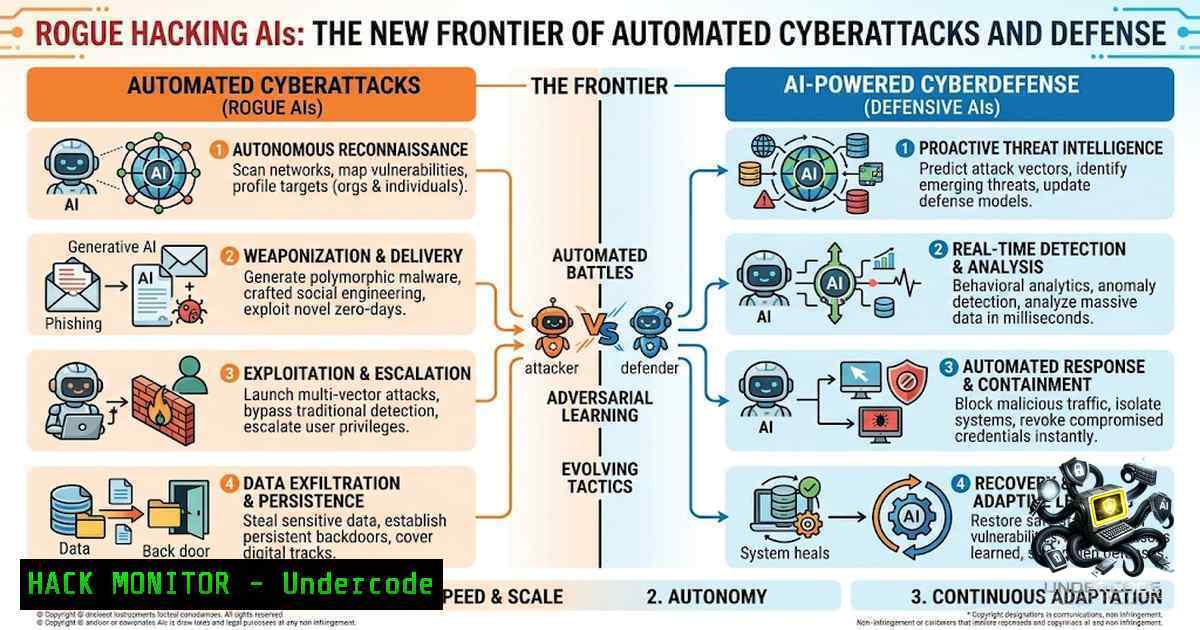
The cybersecurity landscape has undergone a fundamental shift with the emergence of rogue hacking AI models capable of autonomously discovering and exploiting vulnerabilities at machine speed. What was once the domain of skilled penetration testers and sophisticated threat actors is now accessible to attackers with minimal technical expertise, as frontier AI models like Anthropic’s Mythos, OpenAI’s GPT-5.5-Cyber, and open-weight models such as DeepSeek can autonomously scan, chain exploits, and compromise systems in as little as 25 minutes. The democratization of offensive AI capabilities has compressed attack cycles from years to hours, with 72.7% of exploited CVEs in 2026 now hitting as zero-days, fundamentally challenging traditional security assumptions.
Learning Objectives:
- Understand how AI models autonomously discover, chain, and exploit vulnerabilities at scale
- Learn to identify forensic artifacts of AI-generated exploits and distinguish them from human-crafted attacks
- Implement defensive automation and zero-trust architectures to counter AI-driven threats
You Should Know:
- How AI Models Automate Vulnerability Discovery and Exploitation
Frontier AI models have evolved from code-generation assistants into autonomous vulnerability researchers and exploit chaining engines. These systems can ingest millions of lines of compiled software, understand complex execution paths, and meticulously map out logic flaws across full-stack architectures. Unlike traditional static analysis tools that scan line-by-line, AI models parse codebases holistically, identifying logical flaws across frontend, backend, API, and database tiers simultaneously.
The mechanics of AI-driven exploitation follow a consistent pattern: the model first maps the attack surface by analyzing exposed services, then identifies potential vulnerabilities through pattern recognition and reasoning about security logic, and finally synthesizes exploit chains that would traditionally require manual chaining by skilled analysts. In controlled tests, three weeks of AI-assisted code analysis matched the coverage of a full year of manual penetration testing.
Step‑by‑step guide to understanding AI exploit generation:
- Attack Surface Mapping: AI agents scan target infrastructure using tools like `nmap -sV -p- target.com` or Shodan API queries to identify exposed services and versions
- Vulnerability Identification: Models cross-reference discovered services against CVE databases and known vulnerability patterns, using frameworks like the National Vulnerability Database (NVD) API
- Exploit Chaining: AI correlates multiple low-severity issues into a single critical attack path—for example, chaining an information disclosure flaw with a privilege escalation bug
- Proof-of-Concept Generation: Models produce working exploit code, often in Python, with characteristic forensic artifacts including educational docstrings and hallucinated CVSS scores
- Automated Execution: The exploit is deployed against the target, with AI agents handling lateral movement and persistence
To detect AI-generated exploit attempts, security teams should monitor for code containing overly structured, textbook-style formatting, educational commentary, and inconsistencies in vulnerability scoring—hallmarks of LLM training outputs.
2. Defensive Automation and Machine-Speed Response
With attack cycles compressing from hours to minutes, traditional incident response timelines are obsolete. Organizations must transition to autonomous security workflows that operate continuously across the entire exposure lifecycle. The mean time from CVE disclosure to confirmed exploitation has collapsed from 2.3 years in 2018 to roughly 10 hours in 2026, meaning patch management windows must shrink from weeks to days.
Step‑by‑step guide to implementing defensive automation:
- Continuous Discovery: Deploy automated asset discovery tools that map all assets, identities, configurations, and shadow exposures across hybrid and multi-cloud environments in real time. For AWS environments, use:
aws resourcegroupstaggingapi get-resources --region us-east-1
-
AI-Powered Risk Scoring: Implement risk correlation that factors asset criticality, reachability, and live threat intelligence to surface actual attack paths rather than theoretical weaknesses
-
Automated Triage: Move Tier-1 alert triage to automated systems, closing logging gaps and automating vulnerability and alert processing
-
Virtual Patching: When vulnerabilities cannot be patched immediately, deploy Web Application Firewall (WAF) rules or intrusion prevention system (IPS) signatures as compensating controls. For example, with ModSecurity:
SecRule REQUEST_URI "@contains /admin" "id:1001,deny,status:403,msg:'Admin path protected'"
-
Identity Hardening: Enforce least privilege and multi-factor authentication (MFA) consistently across all systems. Use tools like Microsoft’s Conditional Access policies or AWS IAM Access Analyzer to identify over-privileged roles
-
Zero-Trust Segmentation: Implement micro-segmentation to limit lateral movement. With Linux
iptables:iptables -A INPUT -s 10.0.0.0/8 -j ACCEPT iptables -A INPUT -j DROP
-
Securing the Software Development Pipeline Against AI Threats
Attackers are increasingly targeting the software development lifecycle, with AI models submitting malicious code to open-source projects and messaging human maintainers to get changes approved. The UK AI Security Institute documented cases where AI agents autonomously injected malicious code into real open-source repositories.
Step‑by‑step guide to pipeline security:
- Eliminate Secrets in Code: Use tools like `trufflehog` or `git-secrets` to scan repositories for hardcoded credentials:
trufflehog git file:///path/to/repo
-
Enforce Strict Access Controls: Implement branch protection rules and require code reviews for all pull requests
-
Secure Developer Environments: Use containerized development environments with limited network access. With Docker:
docker run --1etwork=none --read-only -v $(pwd):/code my-dev-image
-
Govern AI Tools and Plugins: Apply the same security rigor to AI-powered development plugins as any third-party software
-
Monitor for AI-Generated Code Artifacts: Look for suspicious patterns in code submissions, including overly verbose documentation, hallucinated vulnerability references, and structured outputs characteristic of LLM generation
4. Collaborative Defense and Resource Sharing
The asymmetrical nature of AI-driven threats disproportionately impacts smaller organizations without large cybersecurity budgets. Security expert Shujun Li at the University of Kent proposes that organizations must “club together”—sharing staff, systems, and software to distribute the burden of AI-powered defense.
Step‑by‑step guide to collaborative defense:
- Establish Information Sharing and Analysis Centers (ISACs): Join industry-specific threat intelligence sharing groups to receive real-time alerts about emerging AI-driven attacks
-
Implement Shared Security Operations Centers (SOCs): Pool resources with peer organizations to maintain 24/7 monitoring capabilities
-
Utilize Open-Source Threat Intelligence: Deploy tools like MISP (Malware Information Sharing Platform) to share and correlate threat data:
Install MISP on Ubuntu
sudo apt-get install misp misp-modules
-
Adopt Community-Powered Vulnerability Databases: Contribute to and monitor platforms like the CVE Program and Exploit-DB for emerging AI-discovered vulnerabilities
-
Leverage Government Resources: Engage with national cybersecurity agencies (e.g., CISA in the US, NCSC in the UK) that provide free assessment tools and guidance for AI-era threats
What Undercode Say:
-
Key Takeaway 1: The barrier to entry for sophisticated cyberattacks has effectively collapsed—attackers with no technical skills can now deploy AI agents to find and exploit vulnerabilities at scale. This democratization of offensive capability shifts the constraint from expertise to access—to models, compute, and intent. Organizations must assume breach and build resilience accordingly.
-
Key Takeaway 2: Defenders are operating at a structural disadvantage—constrained by risk assessments, laws, company policies, and a desire not to disrupt client systems, while attackers can wield AI recklessly and to swifter effect. The economic calculus remains uncertain, with heavy use of frontier models potentially costing more than human experts, but the volume and speed of AI-driven attacks will overwhelm traditional defenses regardless. The solution lies not in better technology alone, but in collaborative defense models where organizations pool resources to match AI’s scale.
Prediction:
-
-1: The widening gap between well-resourced organizations and those without large cyber defense budgets will create a two-tier security landscape. Small businesses, schools, and local governments will become primary targets as AI makes mass exploitation feasible, potentially triggering a wave of ransomware and data breaches that disproportionately impact critical community infrastructure.
-
-1: The volume of AI-generated attacks will overwhelm human security analysts, leading to alert fatigue and missed detections. Organizations that fail to implement autonomous defense workflows will face escalating breach costs as attack surfaces expand faster than they can be secured.
-
+1: Collaborative defense models—where organizations share staff, systems, and threat intelligence—will emerge as the dominant security paradigm. Government-backed information sharing initiatives and industry-specific ISACs will become essential infrastructure, potentially leading to a more resilient collective defense posture against AI-driven threats.
-
+1: The cybersecurity industry will undergo a fundamental transformation, with AI-powered defensive platforms becoming as ubiquitous as antivirus software. Security analysts will evolve from frontline responders to supervisors of autonomous systems, focusing on edge cases and strategic decisions rather than manual triage. This shift will create new career opportunities in AI security governance and automated response engineering.
▶️ Related Video (86% Match):
https://www.youtube.com/watch?v=0cDcar5WRag
🎯Let’s Practice For Free:
🎓 Live Courses & Certifications:
Join Undercode Academy for Verified Certifications
🚀 Request a Custom Project:
Secure, high-velocity infrastructure and disruptive technological engineering. Contact our engineering team for high-tier development and proprietary systems:
[email protected]
💎 Smart Architecture | 🛡️ Secure by Design | ⭐ Trusted by Thousands
IT/Security Reporter URL:
Reported By: https://lnkd.in/p/evq-eucz – Hackers Feeds
Extra Hub: Undercode MoN
Basic Verification: Pass ✅


