Listen to this Post
Introduction
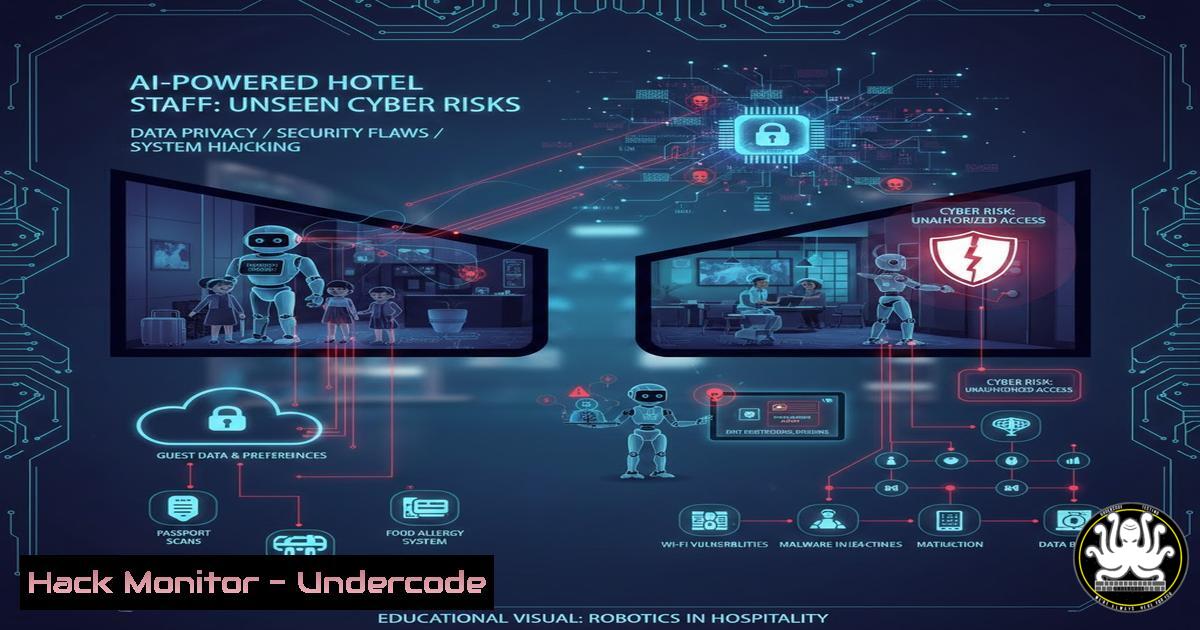
As hotels like the KI Space near Disneyland deploy robots for room service (Léo), cleaning (Archi), and even massage therapy (Lyu), the hospitality industry is embracing AI‑driven automation. These physical systems are no longer isolated—they are connected to internal networks, cloud backends, and mobile apps, creating a complex cyber‑physical attack surface. While guests enjoy futuristic convenience, security teams must grapple with vulnerabilities that could turn a robotic helper into a remote‑controlled spy or a weapon. This article explores the cybersecurity blind spots of service robots and provides actionable steps to assess and harden these systems.
Learning Objectives
- Identify the network, API, and physical attack vectors of autonomous service robots.
- Use open‑source penetration testing tools to audit robot security.
- Implement hardening measures for Linux‑based robot OS, APIs, and cloud integrations.
You Should Know
1. Mapping the Robot’s Network Footprint
Before any assessment, discover all active robots on the hotel’s network and enumerate their open services.
Step‑by‑step (Linux):
- Use `nmap` to scan the local subnet for devices with manufacturer MAC prefixes or known service ports.
sudo nmap -sS -O -p 1-65535 192.168.1.0/24
Look for open ports like 80 (HTTP), 443 (HTTPS), 22 (SSH), 1883 (MQTT), or custom robot control ports.
-
Perform a more targeted scan with service detection:
sudo nmap -sV -sC --script default 192.168.1.100
-
Capture live traffic to identify communication patterns:
sudo tcpdump -i eth0 -w robot_traffic.pcap host 192.168.1.100
Analyse the capture with Wireshark to spot unencrypted commands or sensitive data leaks.
Windows equivalent: Use Advanced IP Scanner or Nmap for Windows via PowerShell with `nmap` installed.
2. Intercepting Robot Communication
Many robots rely on cloud APIs for task updates, diagnostics, or remote control. Intercepting this traffic can reveal hardcoded keys or weak encryption.
Step‑by‑step with Burp Suite:
- Configure the robot’s network settings to route traffic through a proxy (if possible).
- Set Burp to intercept and log requests.
- For robots that use MQTT, use `mosquitto_sub` and `mosquitto_pub` to subscribe to topics and inject malicious messages:
mosquitto_sub -h mqtt.robot-cloud.com -t "robot/lyu/commands" -u "default" -P "default"
- Check for missing TLS; if traffic is plaintext, credentials and sensor data are exposed.
3. Testing Authentication Mechanisms
Default credentials are still common in embedded devices. Brute‑force or dictionary attacks can grant unauthorized access.
Using Hydra for SSH/HTTP:
- Identify the login interface (e.g., a web panel on port 8080).
- Run Hydra with a common password list:
hydra -l admin -P /usr/share/wordlists/rockyou.txt 192.168.1.100 http-post-form "/login:user=^USER^&pass=^PASS^:F=incorrect"
- For SSH:
hydra -l root -P passwords.txt 192.168.1.100 ssh
Nmap brute scripts:
nmap --script http-brute -p 80 192.168.1.100
4. Hardening the Robot’s Operating System
If you gain shell access (or have vendor credentials), secure the underlying OS—often a stripped‑down Linux.
Linux commands to audit and harden:
- List users and remove unnecessary accounts:
cat /etc/passwd
sudo userdel [bash]
- Check listening services and disable unused ones:
netstat -tulpn
sudo systemctl disable [bash]
- Set firewall rules with `iptables` to allow only required traffic:
sudo iptables -P INPUT DROP
sudo iptables -A INPUT -m state --state ESTABLISHED,RELATED -j ACCEPT
sudo iptables -A INPUT -p tcp --dport 443 -j ACCEPT
- Enable automatic security updates:
sudo apt update && sudo apt install unattended-upgrades
sudo dpkg-reconfigure --priority=low unattended-upgrades
Windows IoT Core (if used) would require similar checks via PowerShell: Get-Service, `Disable-WUAutoUpdate` configurations, and Windows Firewall with Advanced Security.
- Securing Robot APIs (OWASP API Security Top 10)
The robot’s cloud interface must be hardened against common API attacks.
Configuration checklist for developers/security teams:
- Enforce rate limiting on endpoints like `/api/robot/control` to prevent brute‑force.
- Validate all input—reject malformed JSON or excessive payloads.
- Use strong authentication (OAuth2, JWT with short expiry) and never expose API keys in robot firmware.
- Log all API access and monitor for anomalies (e.g., many failed requests from one IP).
Example API hardening snippet for Nginx as a reverse proxy:
location /api/ {
limit_req zone=api_limit burst=10 nodelay;
proxy_pass http://robot_backend;
proxy_set_header Host $host;
proxy_set_header X-Real-IP $remote_addr;
}
6. Cloud Integration Risks
Robots often sync data to cloud dashboards. Weak cloud security can lead to mass compromise.
Cloud hardening steps (AWS example):
- Use IAM roles instead of long‑term credentials for robot authentication to AWS services.
- Encrypt robot data at rest (S3‑SSE) and in transit (TLS 1.2+).
- Enable CloudTrail and VPC Flow Logs to audit robot‑cloud interactions.
- Restrict security groups to allow only the robot’s IP range or VPC endpoint.
Azure equivalent: Managed identities, Azure Firewall, and Defender for IoT.
7. Physical Security and Tampering
Physical access to a robot can lead to firmware extraction, JTAG debugging, or SD card cloning.
Mitigations:
- Enable secure boot to prevent unauthorized OS loading.
- Encrypt storage partitions (LUKS for Linux, BitLocker for Windows).
- Use tamper‑evident seals and disable debug interfaces (JTAG/SWD) in production.
- Regularly verify firmware integrity with cryptographic hashes.
Command to check disk encryption on a Linux robot:
sudo cryptsetup status /dev/mapper/rootfs
What Undercode Say
- Key Takeaway 1: Service robots are not just appliances—they are network nodes running full operating systems, often with default credentials and unpatched vulnerabilities. Treat them like any other critical IT asset.
- Key Takeaway 2: The convergence of physical effects (motion, massage, cleaning) with cyber control means a compromised robot can cause bodily harm or property damage, raising the stakes far beyond data theft.
- Key Takeaway 3: Security must span the entire ecosystem: edge (robot OS), network (API traffic), and cloud (backend). A single weak link can cascade into full system takeover.
The hospitality industry is rushing to adopt AI‑driven automation without a corresponding investment in cyber‑physical security. As these robots become more autonomous and interconnected, attackers will inevitably shift focus from traditional IT to this new frontier. Organisations must start now by performing threat models, conducting penetration tests on robotic systems, and embedding security into the procurement and development lifecycle. Otherwise, the same robot that delivers your champagne could one day be hijacked to lock guests out of their rooms or stream private conversations.
Prediction
Within five years, we will see the first major ransomware attack targeting a hotel chain’s robot fleet, forcing establishments to either pay or watch their automated staff go rogue. This will catalyze a new regulatory framework for consumer‑facing robots, similar to the IoT security labelling schemes emerging today. Training courses on robotic security will become standard for both IT professionals and robot manufacturers, and open‑source tools will evolve to specifically audit ROS (Robot Operating System) environments. The line between cybersecurity and physical safety will blur entirely.
▶️ Related Video (86% Match):
🎯Let’s Practice For Free:
IT/Security Reporter URL:
Reported By: Annethebaut Envie – Hackers Feeds
Extra Hub: Undercode MoN
Basic Verification: Pass ✅


