
Listen to this Post
Introduction:
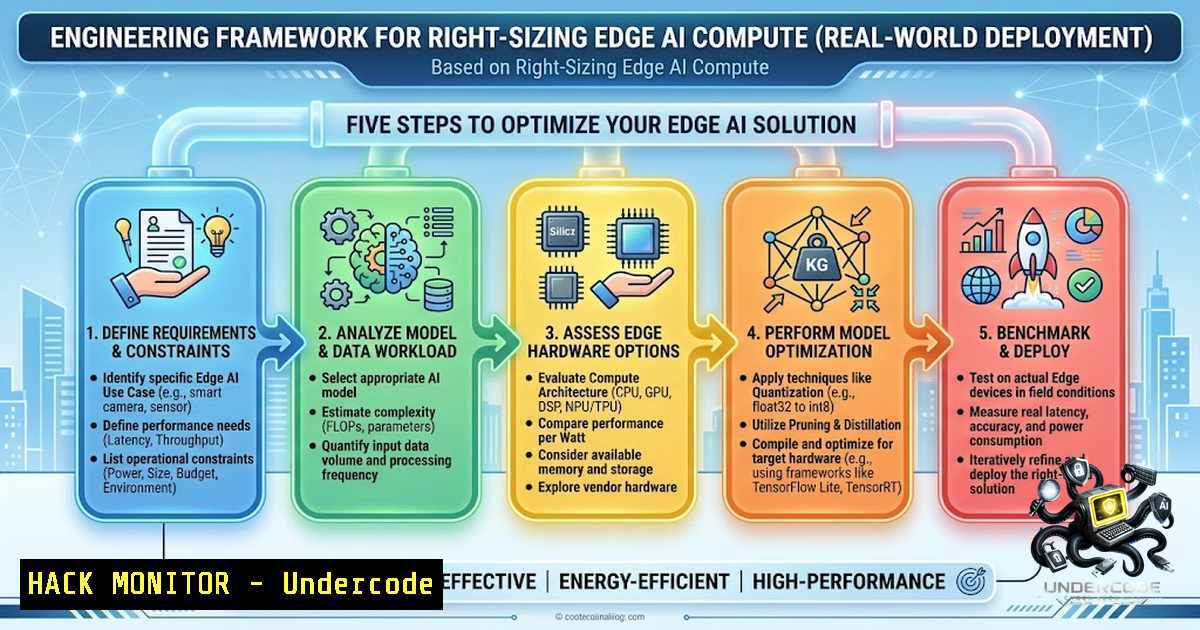
The proliferation of artificial intelligence at the edge has fundamentally transformed how embedded systems are designed—applications that once simply collected data for cloud review are now expected to perform real-time image inspection, object detection, predictive maintenance, and sensor fusion directly at the data source. This paradigm shift has made hardware selection exponentially more complex, yet many engineering teams still default to chasing raw compute metrics like TOPS (Trillions of Operations Per Second) rather than aligning architecture with actual application requirements. The recently published white paper “Right-Sizing Edge AI Compute” by Sealevel Systems, in partnership with SAE Media Group, introduces a five-step engineering framework that moves beyond theoretical benchmarks to help teams select hardware based on workload characteristics, environmental constraints, I/O requirements, software support, and long-term scalability.
Learning Objectives & Secrets:
- Objective 1: Master the Five-Step Hardware Selection Framework – Learn to systematically evaluate edge AI compute requirements starting from the application workload rather than the processor, ensuring that every architectural decision maps directly to real-world deployment needs.
-
Objective 2 Secret Tip: Profile Before You Purchase – Before committing to hardware, leverage virtualized testing platforms and actual AI model benchmarks on target architectures to gauge real performance, not theoretical peak metrics.
-
Objective 3 Secret Tip: Validate the Entire Data Path – Successful edge AI deployment requires testing the complete system—from sensor acquisition to inference output—under worst-case thermal and power conditions, not just the compute module in isolation.
You Should Know:
1. Understanding the Five-Step Engineering Selection Framework
The framework presented in the white paper begins with a fundamental shift in perspective: start with the application and workload, not the processor. This system-level approach comprises five distinct steps that guide engineering teams through a comprehensive evaluation process before any hardware is selected.
Step 1: Characterize the Dominant Workload and Coexisting Tasks
Begin by thoroughly understanding what the system will actually do. This means identifying not just the primary AI inference workload but also all coexisting tasks including control loops, data acquisition, communication protocols, and any pre- or post-processing. For example, a factory inspection system might run object detection models while simultaneously managing conveyor belt sensors, generating alerts, and streaming video to a dashboard.
Step 2: Profile Computational Requirements
Document the specific computational profiles that will impact performance: latency requirements (is 50ms acceptable or does the system need sub-10ms response?), determinism needs (can inference times vary or must they be predictable?), parallelism characteristics, inference rate (how many inferences per second?), data movement patterns (how much data moves between memory, CPU, and accelerator?), and sensor fusion complexity.
Step 3: Define Deployment Constraints
Every edge deployment operates within physical and environmental boundaries. Document power budgets (is the device battery-powered or line-powered?), cooling strategies (active fan, passive heatsink, or conduction cooling?), thermal limits (what is the ambient temperature range?), and physical factors like enclosure design and available board space.
Step 4: Evaluate Lifecycle and Software Support
Long-term system viability depends on more than just hardware performance. Consider operating system compatibility, driver maintenance (will drivers be updated for security patches?), security update cadence, certification requirements (UL, CE, FCC, medical, automotive), and upgrade strategies for future model improvements.
Step 5: Select and Validate the Compute Architecture
Only after completing the previous four steps should you evaluate specific compute architectures. Options range from general-purpose CPUs for simpler workloads, GPUs for parallel processing, dedicated AI accelerators (NPUs, TPUs), or modular standards like COM-HPC that enable scalable, customizable performance with processor migration capabilities. The white paper highlights two illustrative architectures: NVIDIA Jetson, a heterogeneous platform ideal for vision and sensor fusion; and COM-HPC, a computer-on-module standard facilitating high-speed I/O and scalable embedded systems.
2. Practical Benchmarking and Validation Techniques
Once you’ve selected candidate hardware, rigorous validation using real workloads is essential—not synthetic benchmarks. Here are practical commands and tools for benchmarking edge AI systems:
Linux Performance Monitoring Commands:
 Monitor CPU frequency and governor settings
cpufreq-info
cat /sys/devices/system/cpu/cpu/cpufreq/scaling_governor

Monitor real-time system performance with stress-1g
sudo apt-get install stress-1g sysstat
stress-1g --cpu 4 --timeout 60 --metrics

Monitor GPU memory usage on NVIDIA platforms
nvidia-smi -l 1

Monitor thermal throttling
watch -1 1 "cat /sys/class/thermal/thermal_zone/temp"

Check I/O performance
iostat -x 1
NVIDIA Jetson-Specific Benchmarking:
For NVIDIA Jetson platforms, TensorRT provides the `trtexec` utility for comprehensive model benchmarking:
 Benchmark an optimized TensorRT engine
trtexec --loadEngine=model_fp16.engine

Run with specific parameters
trtexec --loadEngine=model_fp16.engine --warmup=10 --duration=30 --iterations=100

Check GPU memory during inference
nvidia-smi -l 1
For performance logging and hardware diagnostics on Jetson devices, Jetson-stats provides comprehensive monitoring:
 Install jetson-stats
sudo pip3 install jetson-stats

Run interactive monitoring
jtop

Log performance metrics to CSV
python3 opt_eval_latency.py --model facebook/opt-350m --seed 0 --token_size 200 --log True
Edge AI Benchmark Suites:
The Open Edge Platform provides a comprehensive benchmarking suite for edge AI workloads:
 Clone the benchmark repository
git clone https://github.com/open-edge-platform/edge-workloads-and-benchmarks.git -b main
cd edge-workloads-and-benchmarks

Run vision benchmarks
cd workloads/vision-benchmarks && make benchmarks

Run edge AI pipeline benchmarks
cd workloads/edge-ai-pipelines && make benchmarks DURATION=120
For more granular control, the manual benchmarking script allows customization of workload parameters:
./benchmark_edge_pipelines.sh -p light -1 8 -b 8 -d GPU -c NPU -i 120 -t ecore
3. COM-HPC Configuration and Deployment
COM-HPC (Computer-on-Module High-Performance Computing) represents a modular approach to edge AI that enables processor migration and scalability. Modern COM-HPC modules support thermal design power (TDP) configuration from 45W for power-sensitive applications up to 120W for maximum computational throughput, with industrial configurations operating from -40°C to +85°C.
Typical COM-HPC Setup Steps:
- Mount the module to the carrier board with proper heatsink and thermal interface
- Connect peripherals: SSD, RAM modules, fan, and any external I/O
- Flash the operating system (typically Yocto Linux or Ubuntu for edge AI)
- Install AI frameworks: TensorFlow Lite, ONNX Runtime, or vendor-specific SDKs
- Deploy and validate the AI model using real sensor data
4. Model Optimization for Edge Deployment
Raw model performance rarely translates directly to edge deployment efficiency. Key optimization techniques include:
Quantization: Converting FP32 models to INT8 can reduce model size by 75% and significantly improve inference speed on NPU-accelerated hardware. Use TensorFlow Lite for post-training quantization:
 Post-training quantization example
import tensorflow as tf

converter = tf.lite.TFLiteConverter.from_saved_model('saved_model')
converter.optimizations = [tf.lite.Optimize.DEFAULT]
converter.representative_dataset = representative_dataset_gen
converter.target_spec.supported_ops = [tf.lite.OpsSet.TFLITE_BUILTINS_INT8]
converter.inference_input_type = tf.int8
converter.inference_output_type = tf.int8
tflite_quant_model = converter.convert()
Profiling with STM32Cube.AI (for microcontroller deployments):
 Analyze model memory and latency requirements
stm32ai -i model.tflite -d STM32H743 -o ./generated/
Validation with Real Workloads:
The white paper emphasizes that validation must include:
- Benchmarking with actual AI models, not synthetic tests
- Power and thermal testing under worst-case conditions
- End-to-end data path verification from acquisition to output
- Early software stack verification in the development cycle
5. Avoiding the TOPS Trap
One of the most critical insights from the framework is that raw TOPS metrics are dangerously misleading. A processor advertising 100 TOPS may underperform a 20 TOPS solution if the data path, I/O bandwidth, thermal management, or software stack creates bottlenecks. The entire data path matters—from sensor acquisition through memory bandwidth to accelerator utilization and output generation.
Practical Command to Measure Sustained Performance:
 Monitor actual inference throughput over time
while true; do
echo "=== $(date) ==="
nvidia-smi --query-gpu=utilization.gpu,memory.used,temperature.gpu --format=csv
sleep 5
done
What Undercode Say:
- Key Takeaway 1: The most effective place to start edge AI hardware selection is not the processor specification sheet—it’s the application and its real-world workload. Engineering teams must resist the temptation to choose the most powerful chip and instead match architecture to actual requirements.
-
Key Takeaway 2: Successful edge AI deployment demands a system-level approach that validates the complete system—compute, I/O, thermal, power, and software—using real workloads and worst-case conditions. Theoretical benchmarks in ideal lab conditions rarely predict field performance.
Analysis: The white paper’s framework represents a maturation of the edge AI industry. Early deployments often failed because teams selected hardware based on impressive datasheet numbers only to discover that thermal throttling, I/O bottlenecks, or software incompatibility crippled real-world performance. The five-step approach forces engineers to think holistically about the entire system lifecycle—from initial deployment through security updates and future upgrades. This is particularly critical as edge AI moves from pilot projects to mission-critical industrial applications where reliability and longevity are non-1egotiable. The emphasis on COM-HPC modularity also signals an industry trend toward scalable, upgradeable architectures that can adapt as AI models evolve, rather than locked-in, single-purpose appliances.
Prediction:
- +1 Engineering teams that adopt this five-step framework will achieve significantly higher first-pass success rates in edge AI deployments, reducing costly hardware respins and field failures by an estimated 40-60%.
-
+1 The modular COM-HPC standard will gain substantial market share as organizations recognize the value of processor-agnostic designs that enable easy upgrades and migration between vendors.
-
-1 Companies that continue chasing peak TOPS metrics without system-level validation will face increasing deployment failures, particularly in thermally constrained industrial environments where sustained performance diverges dramatically from advertised peak performance.
-
+1 The availability of virtualized testing platforms and open benchmarking tools will democratize edge AI hardware selection, enabling smaller engineering teams to make data-driven decisions previously available only to large enterprises with extensive lab resources.
-
-1 The complexity of the five-step framework may overwhelm teams with limited AI expertise, potentially slowing adoption in smaller organizations until more automated selection tools and reference designs become available.
-
+1 As the industry matures, the distinction between “edge AI” and “embedded computing” will blur, with system-level thinking becoming standard practice across all embedded development, not just AI-specific projects.
▶️ Related Video (86% Match):
https://www.youtube.com/watch?v=-YxRFzVwFBc
🎯Let’s Practice For Free:
🎓 Live Courses & Certifications:
Join Undercode Academy for Verified Certifications
🚀 Request a Custom Project:
Secure, high-velocity infrastructure and disruptive technological engineering. Contact our engineering team for high-tier development and proprietary systems:
[email protected]
💎 Smart Architecture | 🛡️ Secure by Design | ⭐ Trusted by Thousands
IT/Security Reporter URL:
Reported By: https://lnkd.in/p/ex8tHN8X – Hackers Feeds
Extra Hub: Undercode MoN
Basic Verification: Pass ✅


