Listen to this Post
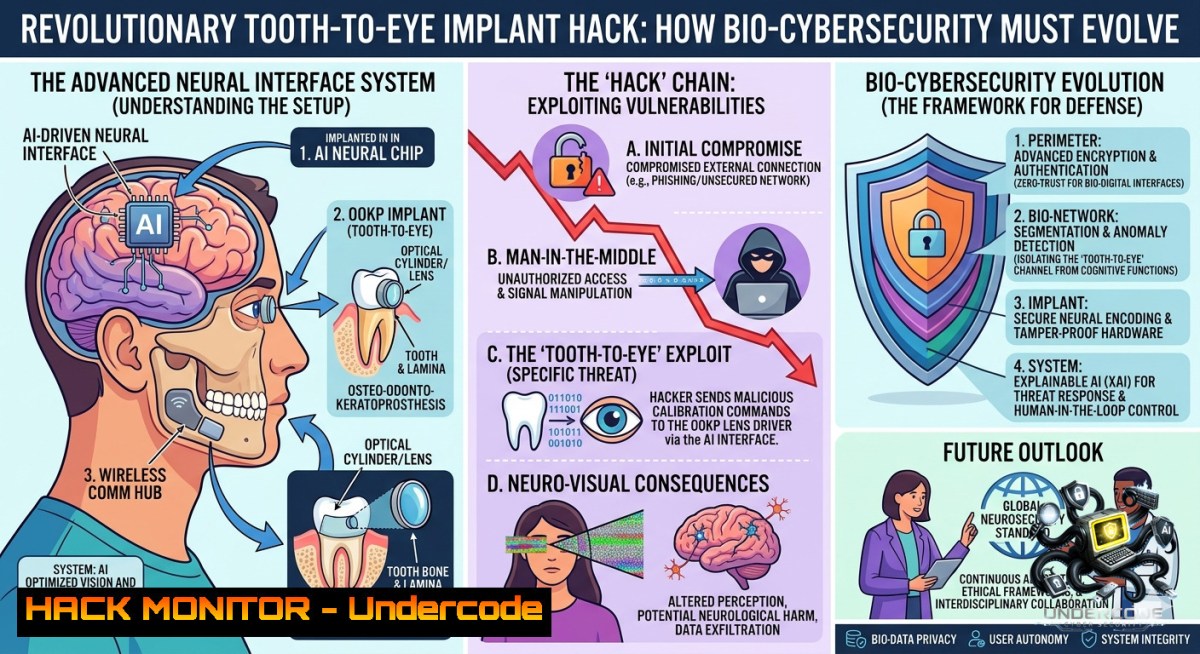
Introduction:
Osteo-Odonto-Keratoprosthesis (OOKP) is a breakthrough bioengineering procedure that uses a patient’s own tooth to support an artificial corneal lens, restoring vision in severe corneal blindness. As such biological implants integrate with AI-driven neural enhancement and connected health monitoring, the convergence of medical device security, adversarial machine learning, and patient data protection becomes critical.
Learning Objectives:
– Analyze the OOKP surgical workflow to identify potential cyber-physical attack surfaces in bio-implants.
– Apply Linux/Windows security hardening and API access controls to protect AI-powered vision restoration systems.
– Implement incident response simulations for medical device tampering, including log analysis and firmware integrity checks.
You Should Know:
1. Medical Implant Attack Surface Mapping & OSINT Reconnaissance
The OOKP procedure uses a PMMA (plexiglas) lens embedded within the patient’s tooth, then vascularized subcutaneously for three months before orbital grafting. From a cybersecurity perspective, any future digital enhancement (e.g., adjustable focus via IoT, AI-based retinal signal processing) introduces risks: Bluetooth/radio-frequency interception, firmware backdoors, and supply chain tampering.
Step‑by‑step guide to simulate reconnaissance on a hypothetical OOKP-connected implant:
– Linux (passive OSINT):
`nmap -sV -p 1-10000 192.168.1.105` (scan for open ports on the implant’s gateway)
`grep -r “OOKP” /var/log/syslog` (check local logs for device handshakes)
– Windows (active enumeration):
`Get-1etNeighbor -InterfaceIndex 12` (find nearby medical devices via IPv6)
`Test-1etConnection -Port 8080 10.0.0.45` (test API endpoint for implant configuration)
– Tool configuration: Use Wireshark with filter `btcommon` or `ble` to capture Bluetooth Low Energy advertisements from the implant’s telemetry unit.
– What this does: Identifies unencrypted channels, default credentials, and exposed debugging interfaces.
– How to use it: Conduct in a lab environment with written authorization; never against active human implants.
2. Hardening AI-Driven Vision Restoration Pipelines Against Adversarial Attacks
If the OOKP integrates a machine learning model to convert retinal signals into image data (e.g., pixel reconstruction via convolutional neural networks), attackers could inject adversarial noise into the sensory input, causing hallucinations or blindness.
Step‑by‑step guide to defend the AI pipeline:
– Linux (model validation):
`python3 -c “import tensorflow as tf; model = tf.keras.models.load_model(‘ookp_model.h5’); print(‘Input shape:’, model.input_shape)”`
Use `adversarial-robustness-toolbox` (ART): `pip install adversarial-robustness-toolbox`
– Windows (API security for AI endpoints):
`curl -X POST https://api.ookp-clinic.com/v1/verify -H “Content-Type: application/json” -d “{\”signature\”:\”$(openssl dgst -sha256 -hmac ‘key’ data.bin)\”}”`
– Mitigation: Implement input sanitization with `tf.keras.layers.GaussianNoise(0.01)` and run `cleverhans` evasion tests.
– Cloud hardening: Deploy AWS WAF with rate limiting and custom rule to block malformed image tensors (size > 512×512).
– Vulnerability exploitation example: Adversarial patch printed on a contact lens could cause model misclassification. Patch by using ensemble models and randomized smoothing.
3. Secure Over-the-Air (OTA) Firmware Updates for Prosthetic Devices
OOKP’s future versions may support remote recalibration via smartphone apps. Without code signing and encrypted channels, an attacker could roll back firmware to a vulnerable version and disable optical transmission.
Step‑by‑step guide to implement secure OTA:
– Linux (generate signing keys):
`openssl ecparam -1ame prime256v1 -genkey -1oout -out ookp_update.key`
`openssl req -1ew -x509 -key ookp_update.key -out ookp_update.crt -days 365`
– Windows (verify signature before applying update):
`Get-AuthenticodeSignature -FilePath .\firmware_v2.bin` (ensure status is “Valid”)
– Tool configuration: Use `wolfSSL` or `mbedtls` for embedded TLS. Flash the bootloader to only accept images signed by the hospital’s private key.
– How to use it: Integrate into a CI/CD pipeline for medical device vendors. Test on a Raspberry Pi emulating the OOKP controller.
– API security: Require mutual TLS between the implant and hospital backend; reject any firmware not accompanied by a nonce and timestamp.
4. Cloud Hardening for Telemetric Data from OOKP Recipients
Post-surgery, patients’ visual acuity, intraocular pressure, and lens position may be streamed to a cloud-based AI dashboard. This data is PHI (Protected Health Information) and a prime ransomware target.
Step‑by‑step guide to secure cloud infrastructure:
– Linux (configure firewall rules):
`sudo ufw allow from 10.0.0.0/8 to any port 443 proto tcp` (restrict implant telemetry to internal subnet only)
`sudo iptables -A INPUT -p tcp –dport 3306 -s 192.168.1.0/24 -j ACCEPT` (MySQL only accessible by API service)
– Windows (Azure policy for encryption):
`Set-AzSqlServerTransparentDataEncryptionProtector -ResourceGroupName “OOKP_RG” -ServerName “ookp-sql” -Type “AzureKeyVault”`
– Vulnerability mitigation: Enable VPC flow logs and set up Security Hub to detect anomalous egress traffic (e.g., 5 GB of patient scans uploaded at 3 AM).
– Command to check for misconfigured S3 buckets:
`aws s3api get-bucket-acl –bucket ookp-telemetry-prod` – if “AllUsers” has READ, remediate immediately.
– Training course recommendation: “Securing IoMT Devices” (Cloud Security Alliance) and “AI Red Team” (MITRE ATLAS).
5. Incident Response Simulation for Implant Tampering
If an attacker gains local access to an OOKP’s subcutaneous control module (e.g., via compromised surgical planning software), they could adjust the lens offset, causing diplopia or blindness.
Step‑by‑step guide to run a tabletop exercise:
– Linux (forensic acquisition):
`dd if=/dev/sda of=ookp_implant_dd.img bs=4096 status=progress` (acquire the implant’s flash storage)
`strings ookp_implant_dd.img | grep -i “unauthorized”`
– Windows (event log analysis):
`Get-WinEvent -LogName “Microsoft-Windows-Sysmon/Operational” | Where-Object {$_.Id -eq 1 -and $_.Message -like “ookp”}`
– Tool configuration: Deploy Osquery with packs for medical device processes: `SELECT FROM processes WHERE name LIKE ‘%ookp%’ OR cmdline LIKE ‘%lens%’`
– How to use it: After detection, isolate the implant via RF kill switch (if designed). Restore last known good firmware from offline backup.
– Mitigation: Enforce hardware-based secure boot using TPM 2.0; digitally sign all surgical planning files.
What Undercode Say:
– Key Takeaway 1: OOKP exemplifies biological ingenuity, but its digital twin (AI analytics, remote adjustments) inherits all vulnerabilities of connected medical devices – from BLE sniffing to model inversion attacks.
– Key Takeaway 2: Proactive defense requires embedding security into the surgical workflow: pre-operative threat modeling, intra-operative secure boot, and post-operative continuous monitoring with deception decoys (honeypot telemetry).
+ Analysis around 10 lines:
The OOKP procedure is a marvel of osteo-odonto-lamellar engineering, yet its current implementation lacks any digital component – which ironically makes it more secure than “smart” implants. However, as researchers integrate AI for real-time image enhancement (e.g., contrast adaptation via neural networks), the attack surface expands exponentially. A compromised lens actuator could induce seizures via rapid focus oscillation; adversarial patches on eyeglasses could trick the AI into dropping frames. Hospitals must adopt NIST SP 800-66 (HIPAA Security Series) and apply zero-trust principles to every biosignal. Cyber ranges like “MedSec” should include OOKP-like scenarios. Finally, regulatory bodies (FDA, CE) must mandate SBOMs (Software Bill of Materials) for any firmware within 5 cm of a tooth-derived prosthesis. Without these measures, the very tooth that restores sight could become a ransomware extortion vector.
Expected Output:
Introduction:
Osteo-Odonto-Keratoprosthesis (OOKP) is a breakthrough bioengineering procedure that uses a patient’s own tooth to support an artificial corneal lens, restoring vision in severe corneal blindness. As such biological implants integrate with AI-driven neural enhancement and connected health monitoring, the convergence of medical device security, adversarial machine learning, and patient data protection becomes critical.
What Undercode Say:
– Key Takeaway 1: OOKP exemplifies biological ingenuity, but its digital twin (AI analytics, remote adjustments) inherits all vulnerabilities of connected medical devices – from BLE sniffing to model inversion attacks.
– Key Takeaway 2: Proactive defense requires embedding security into the surgical workflow: pre-operative threat modeling, intra-operative secure boot, and post-operative continuous monitoring with deception decoys (honeypot telemetry).
Expected Output:
Prediction:
-1 OOKP will become a prime target for medical device hackers by 2028, with proof-of-concept exploits demonstrated at biohacking conventions, causing emergency recalls and patient panic.
+1 AI-driven retinal signal decoding will enable open-source DIY vision augmentation communities, forcing regulatory bodies to create “ethical implant” sandboxes.
-1 Legacy surgical planning systems (often Windows 7-based) used in developing nations will expose OOKP patients to pre-operative ransomware attacks that modify lens geometry files.
+1 The convergence of tooth-derived scaffolds and neuromorphic computing will lead to tamper-resistant homomorphic encryption for optic nerve data, setting a new standard for IoMT security.
-1 Without mandatory secure boot, a single firmware zero-day could remotely disable thousands of OOKP implants, leading to class-action lawsuits and a temporary moratorium on AI-connected vision prosthetics.
▶️ Related Video (82% Match):
🎯Let’s Practice For Free:
🎓 Live Courses & Certifications:
[Join Undercode Academy for Verified Certifications](https://undercode.co.uk/certifications/)
🚀 Request a Custom Project:
Secure, high-velocity infrastructure and disruptive technological engineering. Contact our engineering team for high-tier development and proprietary systems:
[[email protected]](mailto:[email protected])
💎 Smart Architecture | 🛡️ Secure by Design | ⭐ Trusted by Thousands
IT/Security Reporter URL:
Reported By: [Christine Raibaldi](https://www.linkedin.com/posts/christine-raibaldi-9a2547135_handicap-disability-technology-ugcPost-7467133868287012864-F9_z/) – Hackers Feeds
Extra Hub: Undercode MoN
Basic Verification: Pass ✅
🔐JOIN OUR CYBER WORLD [ CVE News • HackMonitor • UndercodeNews ]
[💬 Whatsapp](https://undercode.help/whatsapp) | [💬 Telegram](https://t.me/UndercodeCommunity)
📢 Follow UndercodeTesting & Stay Tuned:
[𝕏 formerly Twitter 🐦](https://x.com/undercodeupdate) | [@ Threads](https://www.threads.net/@undercodetesting) | [🔗 Linkedin](https://www.linkedin.com/company/undercodetesting/) | [🦋BlueSky](https://bsky.app/profile/undercode.bsky.social)


