Listen to this Post
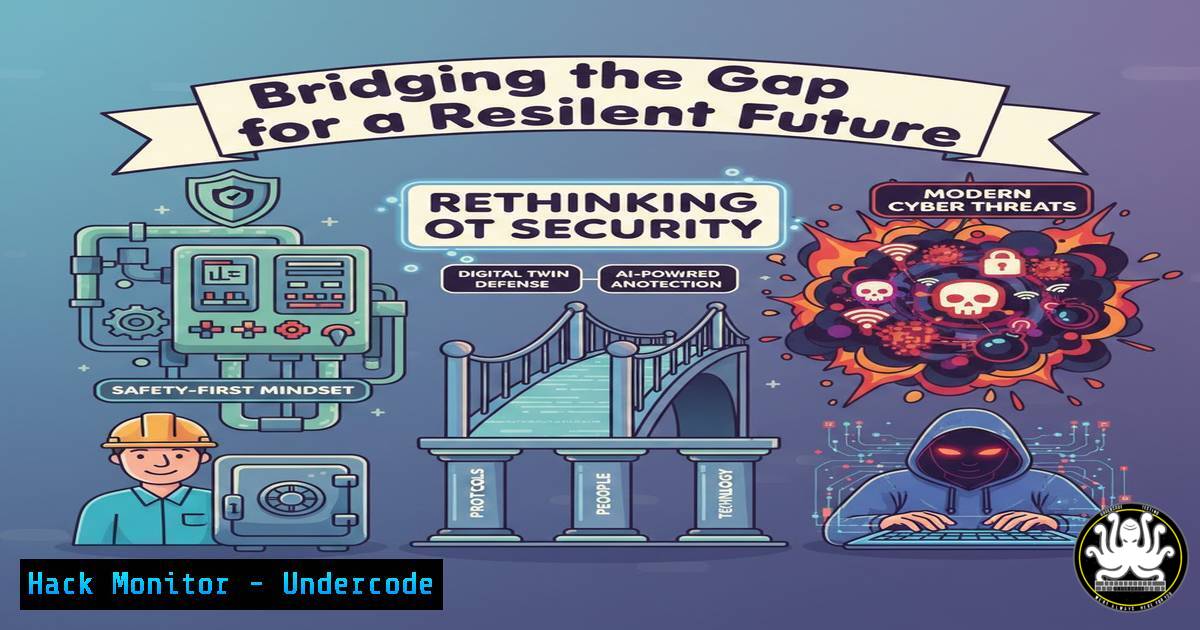
Introduction:
Operational Technology (OT) environments—the industrial control systems running power grids, water treatment plants, and manufacturing lines—face a critical cultural divide. Personnel are historically trained to prioritize physical safety and uptime above all else, often viewing cybersecurity as an IT problem. This article explores expert insights on transforming OT cybersecurity training to directly align cyber threats with operational safety and reliability, creating a unified defense posture against a converged threat landscape.
Learning Objectives:
- Understand why traditional safety and uptime culture creates a gap in OT cyber defense.
- Learn how to reframe cybersecurity incidents as direct causes of process upsets and safety failures.
- Discover practical steps for integrating cyber awareness into daily operational procedures and tool adoption.
You Should Know:
- Reframe the “Why”: Cybersecurity as a Core Safety Pillar
Step‑by‑step guide explaining what this does and how to use it.
The core shift required is linguistic and contextual. Operators must stop seeing a “cyber incident” as separate from a “process incident.” Training must use analogies that resonate: a compromised engineering workstation is as consequential as a failed pressure relief valve. To operationalize this, security teams must map cyber threats to specific safety and environmental consequences on plant schematics.
Actionable Step: In your next safety stand-down or pre-shift meeting, replace one generic safety topic with a concrete cyber-physical scenario. Example: “Today we discuss how a phishing email, if clicked, could lead to a malicious logic download on Pump Controller PLC-101, causing it to ignore high-pressure alarms. The safety procedure is the same: isolate the asset and follow the emergency shutdown checklist, but the cause is digital.” -
Contextualize Alerts: Integrate OT IDS with Operator Workflows
Step‑by‑step guide explaining what this does and how to use it.
Deploying an OT Intrusion Detection System (IDS) without operator context leads to ignored alerts. Operators must be involved in the tool’s selection and tuning so alerts are phrased in operational language (e.g., “Unauthorized configuration change to boiler feedwater valve V-202” instead of “Modbus TCP Exception Response”).
Actionable Step (Tool Configuration): When deploying an OT IDS like Suricata or a commercial solution, create custom rules with operator input.
Example Suricata Rule Snippet: `alert tcp $EXTERNAL_NET any -> $PLC_NET 502 (msg:”OT POLICY: Unauthorized Modbus Write to Holding Register from Internet”; content:”|00 01|”; depth:2; offset:2; flow:to_server,established; classtype:policy-violation; sid:1000001;)`
Procedure: 1) Workshop with operators to identify “crown jewel” assets and normal communication patterns. 2) Draft IDS rules that flag deviations. 3) Test rules in a staging environment and present sample alerts to operators for feedback on clarity.
3. Build Cross-Functional Tabletop Exercises with Real-World Scenarios
Step‑by‑step guide explaining what this does and how to use it.
Tabletop exercises that blend IT, OT, and safety teams break down silos. Use real-world malware like Industroyer2 or TRITON in scenarios that escalate from an IT breach to a potential safety-integrity event.
Actionable Step: Conduct a 2-hour tabletop exercise quarterly.
Scenario Seed: “An engineer’s laptop used for programming HMIs was infected via a USB drive. Forensic logs show the malware has now propagated to the safety instrumented system (SIS) engineering workstation. As operators, what abnormal process signs would you look for? As IT, what network segments would you isolate? Jointly, decide the threshold for initiating a safety shutdown versus a contained remediation.”
4. Implement Secure Operational Procedures: The “Cyber‑Lockout/Tagout”
Step‑by‑step guide explaining what this does and how to use it.
Just as Lockout/Tagout (LOTO) is a non-negotiable physical safety procedure, a “Cyber-LOTO” procedure should be established for maintenance and patch cycles on critical OT assets. This provides a familiar framework for secure change management.
Actionable Step: Develop a Cyber-LOTO checklist.
- Prepare for Shutdown: Identify all network connections (engineering, corporate, vendor dial-in) to the asset.
- Notify Affected Parties: Inform control room operators and IT security.
- Shutdown & Isolate: Physically disconnect or use a firewall to drop all traffic to/from the asset’s IP except from a dedicated, hardened jump host.
- Apply Patch/Change: Perform the maintenance from the jump host.
- Verify & Restore: Test functionality, then restore only pre-authorized network connections. Document the change in the asset management log.
5. Harden the Converged Zones: IT-OT Segmentation Enforcement
Step‑by‑step guide explaining what this does and how to use it.
The convergence zone is the primary attack surface. Operators need basic literacy in how network segmentation protects their domain. Simple command-line checks can verify isolation.
Actionable Commands for Monitoring:
From an OT Demilitarized Zone (DMZ) host, authorized personnel can check for unwanted connections from the IT network:
Linux (using netstat): `sudo netstat -tupan | grep :
Windows (using PowerShell): `Get-NetTCPConnection -State Established | Where-Object {$_.LocalPort -eq
Training Point: Teach operators that seeing unexpected IP addresses (especially from corporate subnets) in these connections should be reported as an abnormal condition, akin to a strange reading on a gauge.
6. Leverage Threat Intelligence for Proactive Hazard Identification
Step‑by‑step guide explaining what this does and how to use it.
Threat intelligence should be filtered and presented to highlight risks to specific industries and equipment (e.g., “Advisory: Threat group X is targeting Schneider Electric M340 PLCs using vulnerability Y”). This transforms abstract “hacker” news into relevant hazard awareness.
Actionable Step: Create a monthly 1-page “OT Threat Bulletin” for the control room.
1. Subscribe to feeds from CISA, ICS-CERT, and vendors.
2. Filter for your industry and asset inventory.
- List the threat, the targeted system, the potential operational impact (e.g., “could cause uncommanded valve cycling”), and the immediate action (e.g., “Verify firmware version on all P-300 series pumps”).
What Undercode Say:
- Culture Eats Strategy for Breakfast: The most advanced technical controls will fail if the operators and engineers on the front lines view them as a hindrance to uptime rather than an enabler of safe operation. Training must start with and continually reinforce the “why.”
- Shared Language is the First Control: The integration of security into OT begins by eliminating the term “cyber” as a separate category in operational dialogues. An incident is an incident; its root cause—whether mechanical, electrical, or digital—determines the specialized response, but the primary goal of protecting health, safety, and the environment remains unified.
Prediction:
The escalating convergence of IT and OT, driven by Industry 4.0 and remote operations, will make the current training gap unsustainable. Within 2-3 years, we will see regulatory bodies like OSHA (USA) and HSE (UK) formally incorporate specific cybersecurity response procedures into mandatory process safety management (PSM) standards. Cyber-physical incident response drills will become as commonplace as fire drills. Organizations that proactively build this integrated culture will achieve not only greater resilience but also a competitive advantage in operational reliability and insurability.
▶️ Related Video (82% Match):
🎯Let’s Practice For Free:
IT/Security Reporter URL:
Reported By: Anna Ribeiro – Hackers Feeds
Extra Hub: Undercode MoN
Basic Verification: Pass ✅


