
Listen to this Post
Introduction:
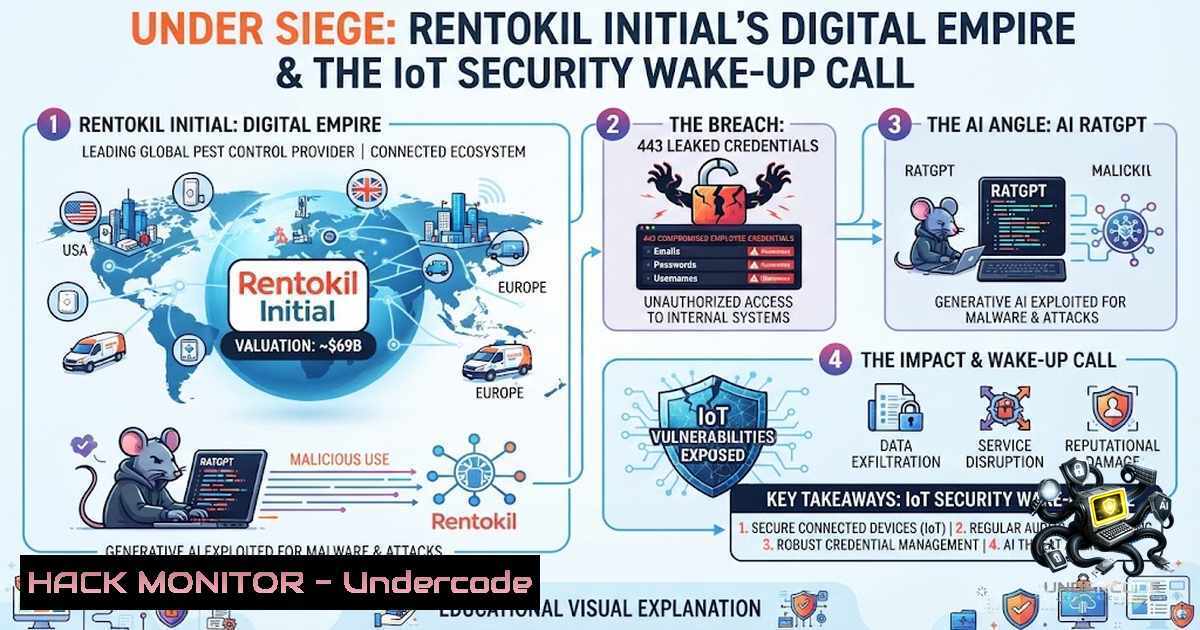
Rentokil Initial, a FTSE 60 global services giant operating across 90+ countries with over 60,000 employees and $6.9 billion in annual revenue, is undergoing a massive digital transformation. From deploying AI tools like Google Gemini and “RatGPT” to 60,000 colleagues, to rolling out a global LoRaWAN IoT network for connected pest control, the company is racing to digitize its operations. However, this rapid technological expansion comes with a dark underbelly: a Hudson Rock report reveals that the domain rentokil-initial.com has 443 compromised credentials, 19 compromised employees, and significant exposures to infostealer malware families like RedLine and Lumma. This article dissects the cybersecurity lessons from Rentokil Initial’s journey, providing a technical blueprint for securing large-scale enterprise IT, IoT, and AI deployments.
Learning Objectives:
- Understand the intersection of enterprise digital transformation and cybersecurity risk, using Rentokil Initial as a case study.
- Learn to identify, analyze, and mitigate credential theft, infostealer malware, and third-party supply chain risks.
- Gain practical knowledge in securing IoT networks (LoRaWAN), implementing AI safely, and hardening global IT infrastructure.
- Acquire step-by-step command-line and configuration techniques for Linux, Windows, and network security tools.
- Credential Theft and Infostealer Malware: The RedLine and Lumma Epidemic
The Hudson Rock analysis of rentokil-initial.com reveals a “medium threat posture” with 435 total compromised credentials, including 416 users. The presence of 125 instances of RedLine and 122 instances of Lumma stealer malware indicates a targeted campaign by threat actors aiming for comprehensive credential theft and potential corporate espionage. These malware families are notorious for exfiltrating passwords, cookies, autofill data, and cryptocurrency wallets from infected endpoints.
Step-by-step guide to detect and remediate infostealer infections:
- Identify Compromised Endpoints: Use endpoint detection and response (EDR) tools to hunt for indicators of compromise (IoCs) associated with RedLine and Lumma. On Linux, use `grep` and `find` to search for known malware file hashes:
Search for files with specific SHA256 hashes (example)
find / -type f -exec sha256sum {} \; 2>/dev/null | grep -i "known_malicious_hash"
On Windows PowerShell:
Get-ChildItem -Path C:\ -Recurse -ErrorAction SilentlyContinue | Get-FileHash -Algorithm SHA256 | Where-Object { $_.Hash -eq "KNOWN_MALICIOUS_HASH" }
- Force Immediate Credential Reset: As recommended by Hudson Rock, initiate an immediate credential reset for all employees with compromised credentials. Use Active Directory PowerShell cmdlets to force password changes at next logon:
Get-ADUser -Filter -Properties | Where-Object { $_.Enabled -eq $true } | Set-ADUser -ChangePasswordAtLogon $true -
Deploy Credential Screening: Implement Azure AD Password Protection or a similar solution to block weak passwords. The report notes that 29.09% of users had weak passwords. On Windows Server, install the Azure AD Password Protection DC Agent and configure the policy:
Install the Azure AD Password Protection DC Agent
$Installer = "AzureADPasswordProtection.DCAgent.msi"
msiexec /i $Installer /quiet /norestart
-
Enhance Endpoint Protection: The report highlights that 69.23% of endpoints lacked effective antivirus coverage. Deploy a next-generation antivirus (NGAV) or EDR/XDR solution across all corporate endpoints. On Linux, configure ClamAV for on-demand scanning:
sudo apt-get install clamav clamav-daemon -y
sudo freshclam  Update virus definitions
clamscan -r --bell -i /home
-
Third-Party Supply Chain Risk: The Google and Fuseuniversal Exposure
The Hudson Rock analysis also reveals high occurrences of compromised credentials from third-party domains such as `google.com` and fuseuniversal.com. This extensive exposure could lead to supply chain risks, particularly if these third parties experience security incidents themselves. Rentokil Initial uses over 134 different product categories from 192 different vendors, amplifying the attack surface.
Step-by-step guide to audit and mitigate third-party risk:
- Conduct a Third-Party Vendor Security Assessment: Inventory all third-party vendors and their access levels. Use tools like AWS IAM Access Analyzer or Azure AD Entitlement Management to review external identities.
- Implement Supply Chain Monitoring: Deploy a continuous monitoring solution like Hudson Rock’s Cavalier platform or SecurityScorecard to track third-party breaches.
- Enforce Least Privilege Access: Review and restrict third-party access to critical systems. On Linux, use `iptables` to restrict outbound connections from third-party applications:
Block outbound traffic from a specific user or group
iptables -A OUTPUT -m owner --uid-owner thirdparty -j DROP
- Regularly Rotate API Keys and Secrets: Use a secrets management tool like HashiCorp Vault. Automate rotation with a script:
Example: Rotate an API key using Vault
vault write -force aws/creds/my-rotating-role
-
IoT Network Security: Securing the LoRaWAN PestConnect Infrastructure
Rentokil Initial has selected LORIOT as its strategic technology partner for deploying a global LoRaWAN IoT network infrastructure to power its PestConnect™ digital pest control solutions. While LoRaWAN offers scalability and security features, IoT deployments are notoriously vulnerable to device spoofing, replay attacks, and network intrusion.
Step-by-step guide to secure a LoRaWAN IoT deployment:
- Implement Device Authentication and Activation: Use Over-The-Air Activation (OTAA) instead of Activation By Personalization (ABP) to ensure dynamic session keys. Configure the Network Server to validate device EUIs and application keys.
- Encrypt Payload Data: Ensure end-to-end encryption using the AES-128 algorithm specified in the LoRaWAN specification. Application payloads should be encrypted with a unique application session key (AppSKey).
- Monitor Network Traffic: Deploy intrusion detection systems (IDS) tailored for IoT. On Linux, use `tcpdump` to capture LoRaWAN gateway traffic (assuming the gateway exposes a network interface):
sudo tcpdump -i eth0 -w lorawan_traffic.pcap
- Conduct Regular Vulnerability Scans: Use tools like `nmap` to scan for open ports on IoT gateways and devices:
nmap -sV -p- -T4 <gateway_IP>
-
AI Security: Hardening Google Gemini and “RatGPT” Deployments
Rentokil Initial is aggressively scaling AI tools, including Google Gemini to approximately 60,000 colleagues and innovative products like “PestConnect Optics” and “RatGPT”. The company is also exploring generative AI, machine learning for data insights, and vision AI. However, AI systems introduce new risks, including data poisoning, prompt injection, and sensitive data leakage.
Step-by-step guide to secure enterprise AI deployments:
- Implement Input Validation and Sanitization: Filter and sanitize all inputs to AI models to prevent prompt injection attacks. On a web application firewall (WAF), add rules to block suspicious patterns:
Nginx WAF rule to block potential prompt injection location /api/ai { if ($request_body ~ "ignore previous instructions") { return 403; } } - Monitor AI Model Outputs: Implement logging and monitoring for all AI interactions. Use `auditd` on Linux to log access to AI model files:
sudo auditctl -w /path/to/ai/model -p rwxa -k ai_model_access
- Data Loss Prevention (DLP): Ensure that AI systems do not expose sensitive data. Implement DLP policies that scan AI outputs for PII, PHI, or financial data.
- Regular Security Assessments: Conduct red-team exercises specifically targeting AI systems to identify vulnerabilities.
-
Global IT Infrastructure Hardening: VMware, ServiceNow, and Network Operations
Rentokil Initial’s IT infrastructure relies heavily on VMware vSphere for virtualization and ServiceNow for IT service management. The company operates a Global Operations Control Centre (GOCC) that oversees monitoring and operation of IT infrastructure, network services, and application hosting.
Step-by-step guide to harden VMware and ServiceNow environments:
- Harden VMware vSphere: Disable unnecessary services, enable ESXi lockdown mode, and enforce strong password policies.
On ESXi host, list all running services
esxcli network ip connection list
Enable lockdown mode
esxcli system settings advanced set -o /UserVars/SuppressShellWarning -i 1
- Secure ServiceNow: Implement multi-factor authentication (MFA) for all admin accounts. Regularly review and audit roles and permissions.
- Network Monitoring and Incident Response: Use tools like Nagios or Zabbix for network monitoring. On Linux, configure `rsyslog` to forward logs to a central SIEM:
/etc/rsyslog.conf
. @192.168.1.100:514  Forward all logs to SIEM
- Backup and Disaster Recovery: Perform regular, high-performance, scalable backups and restores on a schedule, and track offsite storage. Use `rsync` for incremental backups:
rsync -avz --delete /data/ user@backup-server:/backup/data/
-
Data Protection and Privacy: GDPR and CCPA Compliance
Rentokil Initial processes vast amounts of personal data, including employee information, customer data, and shareholder records. The company has a designated Data Protection Officer (DPO) and adheres to data protection legislation globally. However, the 2020 phishing scam that exposed 14,708 current and former employees’ names and social security numbers highlights the ongoing risk.
Step-by-step guide to enhance data protection:
- Data Classification: Implement a data classification scheme to identify and label sensitive data. On Windows, use File Server Resource Manager (FSRM) to classify files:
Install FSRM
Install-WindowsFeature -1ame FS-Resource-Manager
- Encryption at Rest and in Transit: Encrypt all sensitive data using BitLocker on Windows and LUKS on Linux. For data in transit, enforce TLS 1.3.
- Access Controls: Implement role-based access control (RBAC) and regularly review access logs.
- Incident Response Plan: Develop and test an incident response plan specifically for data breaches, including notification procedures for regulators and affected individuals.
-
Building a Cybersecurity Culture: The Graduate Development Pathway
Rentokil Initial offers a 2-year graduate development pathway for Junior Information Security Analysts, focusing on fundamental cybersecurity principles, networking protocols, and security tools. This is a critical step in building a security-aware workforce.
Step-by-step guide to establish a cybersecurity training program:
- Define Learning Objectives: Align training with industry frameworks like NIST or ISO 27001.
- Hands-On Labs: Set up virtual environments using tools like VMware or VirtualBox for practical exercises.
- Phishing Simulations: Conduct regular phishing simulations to test and improve employee awareness. Use open-source tools like Gophish.
- Continuous Education: Encourage certifications like CompTIA Security+, CISSP, or CEH.
What Undercode Say:
- Key Takeaway 1: Digital transformation without a parallel investment in cybersecurity is a recipe for disaster. Rentokil Initial’s aggressive adoption of AI and IoT must be matched with robust security measures to prevent the 443 compromised credentials from becoming a full-blown breach.
- Key Takeaway 2: The supply chain is the new perimeter. With 192 vendors and exposure to third-party domains, organizations must implement rigorous third-party risk management and continuous monitoring.
Analysis:
Rentokil Initial’s situation is a microcosm of the challenges facing large, digitally transforming enterprises. The company’s financial performance is strong, with $6.9 billion in revenue and a 24.5% jump in free cash flow. However, the cybersecurity posture, as revealed by Hudson Rock, is concerning. The presence of RedLine and Lumma stealer malware indicates that threat actors are actively targeting the organization. The low antivirus coverage (69.23% of endpoints unprotected) is a critical vulnerability that could lead to ransomware deployment or data exfiltration. The company’s investment in AI, while innovative, introduces new attack surfaces that require specialized security controls. The graduate development pathway for information security analysts is a positive step, but it will take time to mature. The 2020 phishing incident that exposed 14,708 employees’ data serves as a stark reminder that even a single successful attack can have severe consequences. Organizations must adopt a “security-first” mindset, integrating security into every stage of the technology lifecycle, from development to deployment to operations.
Prediction:
- -1: If Rentokil Initial does not immediately address the credential theft and endpoint protection gaps highlighted by Hudson Rock, the company is likely to experience a significant ransomware or data breach within the next 12-18 months, potentially impacting its stock price and customer trust.
- -1: The scaling of AI tools like Google Gemini to 60,000 employees without rigorous data loss prevention and input validation controls could lead to accidental exposure of sensitive corporate or customer data, resulting in regulatory fines under GDPR or CCPA.
- +1: If Rentokil Initial successfully integrates its IoT, AI, and IT security initiatives, it could become a model for secure digital transformation in the services sector, potentially leading to increased market share and investor confidence.
- +1: The company’s investment in a 2-year graduate cybersecurity program could yield a highly skilled internal security team, reducing reliance on expensive external consultants and improving long-term security posture.
- -1: The reliance on a wide array of third-party vendors (192 vendors, 134 product categories) creates a complex and brittle supply chain. A single compromised vendor could provide a backdoor into Rentokil Initial’s network, leading to a supply chain attack similar to the SolarWinds incident.
🎯Let’s Practice For Free:
🎓 Live Courses & Certifications:
Join Undercode Academy for Verified Certifications
🚀 Request a Custom Project:
Secure, high-velocity infrastructure and disruptive technological engineering. Contact our engineering team for high-tier development and proprietary systems:
[email protected]
💎 Smart Architecture | 🛡️ Secure by Design | ⭐ Trusted by Thousands
IT/Security Reporter URL:
Reported By: At Rentokil – Hackers Feeds
Extra Hub: Undercode MoN
Basic Verification: Pass ✅


