
Listen to this Post
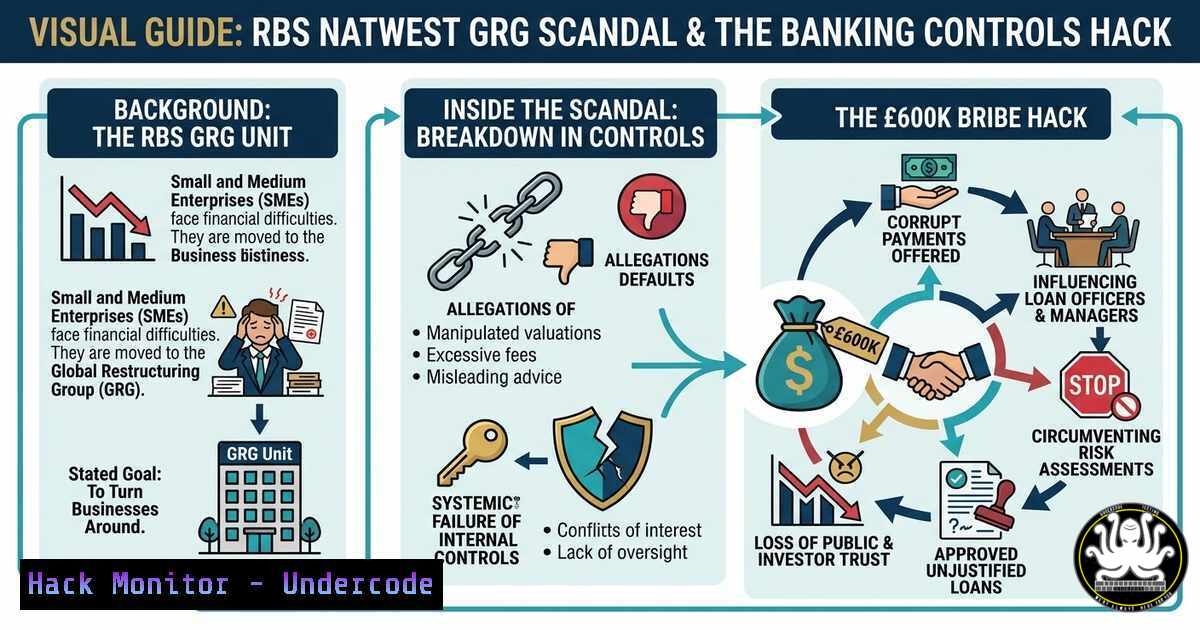
Introduction:
The recent admission by a senior manager within RBS/NatWest’s infamous Global Restructuring Group (GRG) of accepting £600,000 in bribes exposes a catastrophic failure in internal financial controls and regulatory compliance. While the story is rooted in financial crime, the methodology—bypassing risk management systems, manipulating customer data, and exploiting privileged access—mirrors the tactics of advanced insider threats in cybersecurity. This incident serves as a critical case study for IT security professionals, forensic accountants, and compliance officers on how human vectors can bypass even the most robust technical defenses.
Learning Objectives:
- Analyze the technical and procedural failures that allowed unauthorized financial overrides to occur undetected.
- Identify key indicators of compromise (IoCs) for insider threat behavior within banking transaction logs and access management systems.
- Implement enhanced monitoring and privileged access management (PAM) controls to prevent extortion via system manipulation.
You Should Know:
- Mapping the Attack Surface: Privilege Abuse in Financial Systems
The core of the Stuart Holloway case involved a manager using his elevated position within the GRG to manipulate customer debt portfolios. In cybersecurity terms, this is a classic “Privilege Abuse” scenario. The manager had legitimate access to systems controlling loan facilities, debt liability removal, and account transfers. The failure was not a lack of firewalls, but a lack of “Least Privilege” enforcement and “Segregation of Duties” (SoD). He could unilaterally execute high-risk transactions without mandatory secondary approval.
Step‑by‑step guide to auditing for Privilege Abuse (Linux/Windows Log Analysis):
To detect similar anomalies in a financial or enterprise environment, you must correlate user activity with financial outcomes.
– Step 1: Extract Relevant Logs. On a Linux log server (e.g., using rsyslog), isolate authentication and authorization logs.
sudo grep "session opened for user" /var/log/auth.log | grep "manager_username"
– Step 2: Monitor Windows Event ID for Overrides. On a Windows Domain Controller or SQL server hosting the banking app, check for Security Event ID 4670 (Permissions on an object were changed) or specific application logs where loan flags are modified.
Get-EventLog -LogName Security -InstanceId 4670 -Newest 50 | Where-Object {$<em>.Message -like "debt" -or $</em>.Message -like "liability"}
– Step 3: Correlate with Financial Transactions. Use a SIEM query to match user logins with times of “exception reports” where fees were waived or limits were increased beyond standard thresholds. If Holloway removed liability, the system should flag a “Zero Debt” journal entry as anomalous.
- The Extortion Vector: Data Manipulation and API Exploitation
Prosecutors noted Holloway threatened customers to pay or face account management changes. Technically, this would involve changing a customer’s risk profile in the core banking system. Modern banks use REST APIs for these updates. If API security is misconfigured (e.g., broken object level authorization), a privileged user could directly call an endpoint to change a customer’s status from “High Risk” to “Managed Exit.”
Step‑by‑step guide to securing financial APIs against insider manipulation:
– Step 1: Audit API Endpoint Permissions. Map out all API endpoints that handle sensitive customer financial data, specifically those under `/restructuring` or /workout.
– Step 2: Implement Input Validation. Ensure the API cannot accept arbitrary values for debt removal. For example, a deletion request should require a secondary token.
Conceptual cURL test for vulnerability (Authorized context only):
 Dangerous: Check if a user can modify another's debt without approval
curl -X PUT https://bankapi.internal/grg/v1/accounts/12345/debt \
-H "Authorization: Bearer $MANAGER_TOKEN" \
-d '{"balance": 0, "reason": "Manager override"}'
– Step 3: Enforce Multi-Party Approval. Implement a “Four-Eyes” principle in the API logic. The backend should reject any override of a high-risk flag unless accompanied by a second manager’s digital signature or a time-bound approval code from a compliance officer. This is a code-level change, not just a policy.
- Forensic Accounting Meets Forensics: Tracing the Bribe Trail (£600k)
The £366,100 and £154,447 payments to Holloway represent data exfiltration of a different kind: money. From a cyber forensics standpoint, these transactions should have triggered Anti-Money Laundering (AML) algorithms. The failure indicates that either the AML rules were misconfigured to ignore manager accounts, or the funds were routed through complex structures.
Step‑by‑step guide to analyzing suspicious financial flows (Python/SQL):
- Step 1: Query for Anomalous Payments to Employees. Extract transaction data where the recipient matches employee records but the source is a customer account.
SELECT t.transaction_id, t.amount, t.date, c.customer_name, e.employee_name
FROM transactions t
JOIN customers c ON t.source_account = c.account_id
JOIN employees e ON t.destination_account = e.personal_account
WHERE t.amount > 10000 AND t.date BETWEEN '2025-01-01' AND '2025-12-31';
- Step 2: Network Traffic Analysis. If these were digital payments, monitor for unusual outbound traffic from the corporate network to personal banking sites or cryptocurrency exchanges not whitelisted for corporate assets. Use `tcpdump` to analyze DNS requests from a manager’s workstation.
sudo tcpdump -i eth0 -n port 53 | grep -E "paypal|transferwise|coinbase"
4. Hardening the Cloud: Preventing “Deletion” of Liability
Holloway removed liability for customers’ debts. In a cloud-hosted database, this is a “DELETE” or “UPDATE” SQL statement. To prevent a rogue admin from covering their tracks, immutable backups and object locking are essential.
Step‑by‑step guide to implementing immutable backups (AWS/Azure Example):
- Step 1: Enable Versioning and Locking. On cloud storage buckets (like AWS S3) containing financial logs, enable Object Lock in Compliance mode.
- Step 2: Set Retention Policies. Ensure that even a root user cannot delete or overwrite transaction records for a set period (e.g., 7 years as per financial regulations). This creates a “paper trail” that cannot be altered by the insider.
- Step 3: Database Change Auditing. Enable tools like `pg_audit` for PostgreSQL or `SQL Server Audit` to log every `UPDATE` and `DELETE` statement, specifically capturing the `old_value` and `new_value` of the debt column.
5. Linux Hardening for Financial Servers
If GRG’s systems ran on Linux, Holloway or a co-conspirator might have attempted to hide scripts or cron jobs used to automate the fraud.
Step‑by‑step guide to forensic readiness on Linux:
- Step 1: Monitor `.bash_history` and Syscalls. Use auditd to monitor for commands that alter financial data.
sudo auditctl -w /var/www/html/banking_app/ -p wa -k banking_app_changes
sudo ausearch -k banking_app_changes | grep manager_username
- Step 2: Check for Hidden Processes. If malware was used to siphon data, use `pspy` or check for processes hiding from
ps.Check for discrepancies in /proc ls /proc | grep -E "[0-9]" | while read pid; do if [ ! -e /proc/$pid/exe ]; then echo "Suspicious PID: $pid"; fi; done
What Undercode Say:
- Technical Controls Fail Without Human Oversight: The GRG case proves that sophisticated SIEMs and firewalls are useless if a single manager has the “god-mode” ability to override financial logic. Segregation of Duties (SoD) must be coded into the application layer, not just written in a policy manual.
- Extortion is a Social Engineering Attack on Processes: The threat to move an account to “others” is analogous to a ransomware gang threatening to publish data. Defenses must include behavioral analytics (UEBA) to detect when a user’s actions deviate from their normal pattern, especially concerning high-risk customer accounts.
- Compliance is a Technical Debt Issue: Ross McEwan’s earlier denials were possible because the technical controls failed to surface the anomaly. Every financial override should generate a forensically sound, immutable log sent to an external, independent auditor, preventing the “burying” of bodies mentioned in the comments.
Prediction:
This conviction will accelerate the adoption of Zero Trust Architecture in finance. We will see a move away from “privileged access” roles for relationship managers towards dynamic, tokenized approval workflows. AI-driven Behavioral Analytics will become mandatory, flagging not just the movement of money, but the intent behind data access patterns. Future banking systems will likely use Homomorphic Encryption to allow compliance officers to audit transactions without ever exposing the raw data to the managers handling the restructuring, removing the human ability to extort based on information asymmetry.
▶️ Related Video (84% Match):
🎯Let’s Practice For Free:
IT/Security Reporter URL:
Reported By: Ianfraser A – Hackers Feeds
Extra Hub: Undercode MoN
Basic Verification: Pass ✅


