Listen to this Post
Introduction:
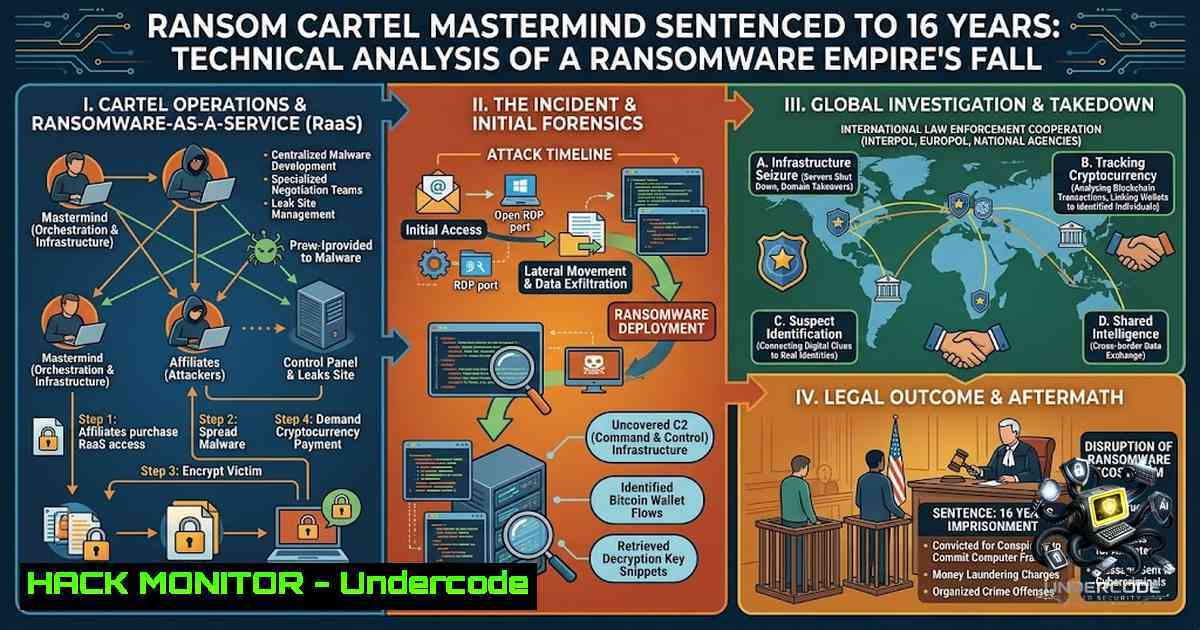
The U.S. Department of Justice announced on August 5, 2026, that Maksim Silnikau, a 40-year-old Belarusian national and the creator of the Ransom Cartel ransomware operation, was sentenced to 16 years in prison for his role in attacks against at least 18 companies worldwide, causing over $6.7 million in losses. Ransom Cartel, which first surfaced in mid-December 2021, operates as a ransomware-as-a-service (RaaS) provider employing double extortion tactics. The group gained notoriety for its technical similarities with the infamous REvil ransomware, including identical encryption schemes and code overlaps that suggest either a rebranding operation or direct access to REvil’s source code. This article provides a technical deep-dive into Ransom Cartel’s operations, its affiliation model, and the forensic artifacts that enabled law enforcement to dismantle the group, while offering actionable defense strategies for security professionals.
Learning Objectives:
- Understand Ransom Cartel’s technical infrastructure, encryption methodology, and operational TTPs (Tactics, Techniques, and Procedures).
- Learn to identify indicators of compromise (IoCs) and forensic artifacts associated with Ransom Cartel deployments.
- Acquire practical skills for configuring detection rules, analyzing ransomware binaries, and implementing cloud and endpoint hardening measures.
You Should Know:
- Ransom Cartel’s Encryption Scheme and REvil Code Overlap
Ransom Cartel’s encryptor exhibits striking technical similarities with REvil ransomware, which was best known for the Kaseya, JBS, and HX5 attacks. According to Palo Alto Networks’ Unit 42, both ransomware families use an identical encryption scheme that generates multiple public/private key pairs and creates session secrets using the same procedure found within REvil samples. The encryptors also share similarities in the structure of their configuration data. Researchers believe that Ransom Cartel operators had access to earlier versions of REvil’s source code, though they likely did not simply rebrand it but rather modified it.
Step‑by‑step guide: Analyzing Ransom Cartel encryption artifacts
To analyze a suspected Ransom Cartel sample, security researchers can follow this methodology:
- Extract the binary: Use `strings` (Linux) or a hex editor to extract readable strings from the ransomware executable. Look for references to session key generation routines.
- Identify encryption parameters: Search for hardcoded RSA public keys. Ransom Cartel samples typically produce multiple key pairs. Use `python` with the `pycryptodome` library to parse RSA structures:
from Crypto.PublicKey import RSA key = RSA.import_key(open('ransom_key.pem').read()) print(key.n.bit_length()) Check key size (typically 2048-bit) - Trace the file extension: Ransom Cartel appends specific extensions to encrypted files. Create a YARA rule to detect these patterns:
rule RansomCartel_Encrypted { strings: $ext = ".cartel" // Example extension – verify against real IoCs condition: $ext at 0 } - Analyze the ransom note: The note typically includes a victim ID and a Tor-based negotiation URL. Extract these for threat intelligence sharing.
2. The Ransomware-as-a-Service (RaaS) Affiliate Model
Ransom Cartel operated as a RaaS provider, recruiting affiliates to deploy the ransomware on compromised networks in exchange for a share of the ransom payments. This model lowers the technical barrier for entry into cybercrime, allowing less-skilled actors to launch sophisticated attacks. The group’s operators maintained the malware code, negotiation platforms, and data leak sites, while affiliates handled initial access and deployment. The “cartel” model—later adopted by other groups like DragonForce—represents an evolution toward distributed, white-label branding schemes where affiliates create their own ransomware brands using the cartel’s backend infrastructure.
Step‑by‑step guide: Detecting RaaS affiliate activity
To detect RaaS affiliate activity within your environment, implement these monitoring practices:
- Monitor for initial access tools: Ransom Cartel affiliates used tools like DonPAPI, which searches hosts for DPAPI blobs containing Wi-Fi keys, RDP passwords, and browser-stored credentials, then downloads and decrypts them locally. Deploy endpoint detection rules for DonPAPI execution:
– Windows (PowerShell): Monitor for processes named `donpapi.exe` or command lines containing donpapi.
– Linux (Auditd): Add rules to alert on unusual credential dumping activity.
2. Track remote management tools: Affiliates often use RMM tools like AnyDesk or ScreenConnect for persistence. Create alerts for unauthorized installation of these applications.
3. Deploy Sysmon (Windows): Configure Sysmon to log process creation (Event ID 1) and network connections (Event ID 3). Filter for connections to known bulletproof hosting providers.
4. Implement AWS SSM monitoring: If using AWS, enable CloudTrail and monitor SSM Inventory API calls for unusual activity.
3. Double Extortion and Data Leak Sites
Ransom Cartel employed double extortion—encrypting victim data while simultaneously exfiltrating sensitive information and threatening to publish it on a data leak site if the ransom was not paid. This tactic increases pressure on victims and complicates decision-making regarding ransom payment. The group’s leak site, hosted on the Tor network, displayed stolen data from non-paying victims, serving as both a coercive tool and a marketing mechanism for the RaaS operation.
Step‑by‑step guide: Hardening against double extortion
To mitigate double extortion risks, security teams should:
- Implement data loss prevention (DLP): Configure DLP policies to detect and block large-scale data exfiltration. Monitor outbound traffic for unusual data volumes.
– Linux: Use `iftop` or `nethogs` to monitor real-time bandwidth usage. Set up alerts for sustained high outbound traffic.
– Windows: Use Performance Monitor to track network utilization and trigger alerts on anomalies.
2. Deploy network segmentation: Segment critical systems and sensitive data repositories to limit the blast radius of a breach. Use VLANs and firewall rules to restrict lateral movement.
3. Enable detailed logging: Ensure Windows Event Logs (Security, System, and Application) are forwarded to a SIEM. Enable PowerShell logging (Module logging, Script block logging) to detect malicious scripts.
4. Conduct regular backups: Maintain offline, immutable backups. Test restoration procedures regularly to ensure business continuity.
4. Forensic Artifacts and Indicators of Compromise (IoCs)
Ransom Cartel leaves behind several forensic artifacts that can aid in incident response and threat hunting. The group uses a tool called DonPAPI to extract DPAPI blobs, which is a less common tool not widely seen in other ransomware operations. Other artifacts include:
- Registry modifications: Changes to `Run` and `RunOnce` keys for persistence.
- Scheduled tasks: Creation of tasks to execute the ransomware at specific times.
- File system changes: Creation of ransom notes in each affected directory.
- Network artifacts: Connections to Tor nodes and C2 servers.
Step‑by‑step guide: Collecting and analyzing forensic artifacts
- Windows forensic collection: Use `KAPE` (Kroll Artifact Parser and Extractor) to collect relevant artifacts:
.\kape.exe --target !SANS_Triage --dest .\output
- Linux forensic collection: Use `dfir` tools or `Autopsy` to analyze disk images. Extract bash history, SSH logs, and `/var/log/` files.
- Memory analysis: Use `Volatility 3` to analyze memory dumps for running processes and network connections:
vol -f memory.dump windows.pstree.PsTree
vol -f memory.dump windows.netscan.NetScan
- Network traffic analysis: Capture PCAPs and analyze with Wireshark or
tshark. Filter for Tor traffic (port 9001, 9030) and suspicious DNS queries.
5. Law Enforcement Takedown and Extradition
Silnikau was arrested in Poland in 2023 and subsequently extradited to the United States. His arrest effectively dismantled Ransom Cartel, as the group ceased operations following his detention. The U.S. Department of Justice charged him with conspiracy to commit offenses against the United States, conspiracy to commit wire fraud, and aggravated identity theft. This case highlights the increasing effectiveness of international law enforcement cooperation in combating ransomware, including the use of extradition treaties and joint task forces.
Step‑by‑step guide: Legal and compliance considerations for ransomware incidents
- Preserve evidence: Immediately isolate affected systems and create forensic images. Document the chain of custody.
- Engage legal counsel: Consult with legal teams regarding breach notification obligations and regulatory reporting.
- Coordinate with law enforcement: Report incidents to the FBI’s Internet Crime Complaint Center (IC3) or local authorities. Provide forensic artifacts and IoCs to aid investigations.
- Review insurance policies: Understand ransomware coverage and requirements for notification.
6. Cloud and Endpoint Hardening Recommendations
Given the RaaS model’s reliance on initial access via compromised credentials and vulnerabilities, organizations must prioritize robust cloud and endpoint security.
Step‑by‑step guide: Hardening cloud environments (AWS/Azure/GCP)
- Enable multi-factor authentication (MFA): Require MFA for all administrative accounts.
- Implement least privilege access: Use IAM roles and policies to restrict permissions. Regularly audit IAM configurations.
- Deploy endpoint detection and response (EDR): Use EDR solutions like CrowdStrike, SentinelOne, or Microsoft Defender to detect and block ransomware execution.
4. Harden operating systems:
- Windows: Disable SMBv1, enable Windows Defender, apply security patches regularly.
- Linux: Disable root SSH login, use SSH keys, implement fail2ban.
- Conduct regular vulnerability scans: Use tools like Nessus or OpenVAS to identify and remediate vulnerabilities.
What Undercode Say:
- Key Takeaway 1: The sentencing of Maksim Silnikau demonstrates that international law enforcement is making significant progress in dismantling ransomware operations, but the RaaS model ensures that new groups will continue to emerge as long as there is financial incentive.
-
Key Takeaway 2: The technical overlap between Ransom Cartel and REvil underscores the importance of code reuse in the cybercriminal ecosystem. Security professionals must track lineage of ransomware families to anticipate TTPs and develop effective countermeasures.
Analysis: The Ransom Cartel case is a landmark in ransomware prosecution, but it also reveals the resilience of the RaaS ecosystem. Silnikau’s arrest did not eliminate the underlying infrastructure—it merely displaced it. The “cartel” model, now adopted by groups like DragonForce, represents a more decentralized and resilient structure where affiliates operate under their own brands. This evolution makes it harder for law enforcement to attribute attacks and dismantle operations. Organizations must therefore focus on proactive defense: patch management, zero-trust architecture, and continuous monitoring. The use of tools like DonPAPI and the reliance on RMM tools for persistence highlight the need for endpoint visibility and behavioral detection. As ransomware groups continue to professionalize, the cybersecurity community must respond with equally sophisticated defenses, including AI-driven threat hunting and automated incident response.
Prediction:
- -1 RaaS fragmentation will accelerate: As more groups adopt the “cartel” model, the ransomware landscape will become increasingly fragmented, making it harder for defenders to track and attribute attacks. This fragmentation will complicate threat intelligence sharing and incident response.
-
-1 Increased targeting of cloud infrastructure: With the shift to cloud computing, ransomware groups will increasingly target cloud environments, exploiting misconfigurations and compromised credentials. Organizations must prioritize cloud security posture management (CSPM).
-
+1 Enhanced international cooperation: The successful extradition and prosecution of Silnikau will encourage further international cooperation, leading to more arrests and takedowns of ransomware operators.
-
+1 AI-driven defense will become standard: The complexity of the evolving threat landscape will drive adoption of AI and machine learning in cybersecurity, enabling faster detection and automated response to ransomware attacks.
▶️ Related Video (80% Match):
https://www.youtube.com/watch?v=5dCE2aW2A1c
🎯Let’s Practice For Free:
🎓 Live Courses & Certifications:
Join Undercode Academy for Verified Certifications
🚀 Request a Custom Project:
Secure, high-velocity infrastructure and disruptive technological engineering. Contact our engineering team for high-tier development and proprietary systems:
[email protected]
💎 Smart Architecture | 🛡️ Secure by Design | ⭐ Trusted by Thousands
IT/Security Reporter URL:
Reported By: https://lnkd.in/p/ez_7AQga – Hackers Feeds
Extra Hub: Undercode MoN
Basic Verification: Pass ✅


