Listen to this Post
Introduction:
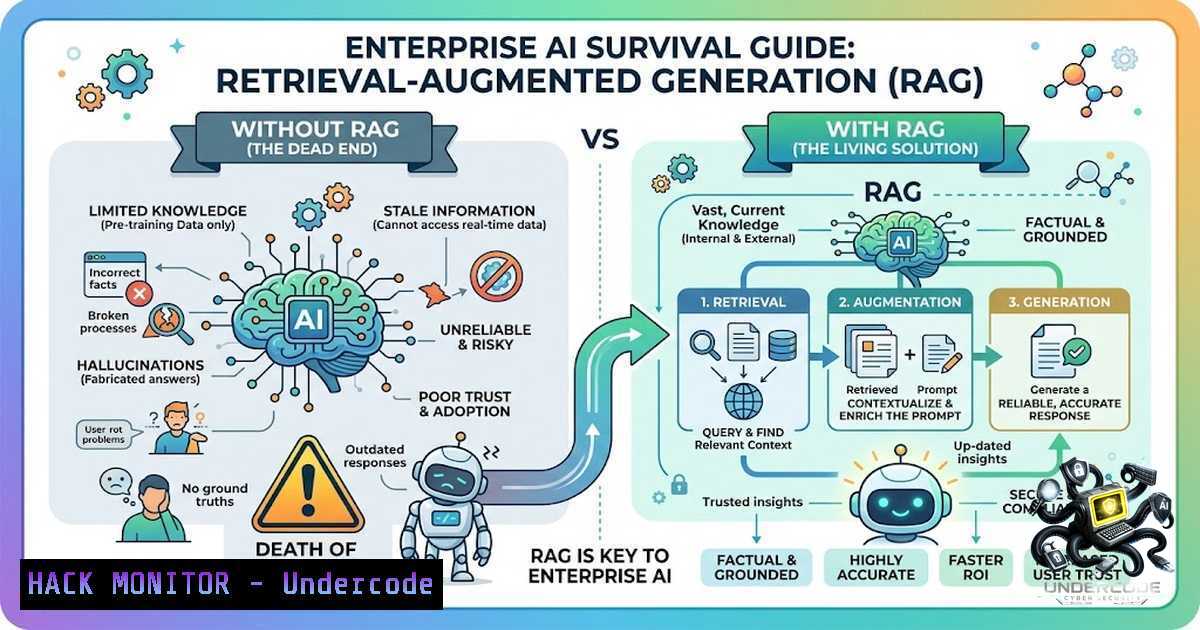
For all the hype surrounding Large Language Models (LLMs), a fundamental flaw remains: they are inherently static. An LLM’s knowledge is frozen at the cutoff date of its training data, making it incapable of accessing proprietary internal documents or real-time information. Retrieval-Augmented Generation (RAG) has emerged as the definitive architectural pattern to bridge this gap. By dynamically retrieving relevant context from enterprise knowledge repositories before generating a response, RAG grounds AI outputs in verifiable facts, effectively mitigating hallucinations and transforming generic chatbots into trustworthy, domain-specific assistants.
Learning Objectives:
- Understand the core architecture and workflow of a production-grade RAG pipeline, from ingestion to generation.
- Implement a functional RAG system using Python, LangChain, and vector databases like ChromaDB.
- Apply security best practices to prevent data leakage, prompt injection, and unauthorized access in enterprise RAG deployments.
- Evaluate and monitor RAG system performance using key metrics and observability tools.
You Should Know:
- Deconstructing the RAG Pipeline: Indexing, Retrieval, and Generation
A standard RAG system operates in three distinct phases: Indexing, Retrieval, and Generation.
- Indexing Phase (Offline): This is the preparation stage. Raw documents from various sources (PDFs, Confluence, SharePoint) are ingested, cleaned, and segmented into smaller, manageable chunks. These chunks are then passed through an embedding model to convert them into high-dimensional numerical vectors that represent their semantic meaning. These vectors, along with metadata, are stored in a specialized Vector Database (e.g., Pinecone, Milvus, ChromaDB) for fast similarity-based retrieval.
-
Retrieval Phase (Online): When a user submits a query, the system encodes it using the same embedding model. It then performs a similarity search against the vector database to find the most semantically relevant document chunks (typically the top 3-5).
-
Generation Phase: The retrieved context is combined with the user’s original query to construct a detailed prompt. This augmented prompt is sent to the LLM (e.g., GPT-4, Claude), which generates a final response grounded in the provided context.
- Building Your First RAG System: A Hands-on Tutorial
Ready to move from theory to practice? This step-by-step guide will help you set up a local RAG system using Python, LangChain, and ChromaDB.
Step 1: Environment Setup
Ensure you have Python 3.10 or higher installed. Create a project directory and set up a virtual environment.
 Create project directory
mkdir my-rag-project
cd my-rag-project

Create and activate a virtual environment
 macOS/Linux:
python -m venv venv
source venv/bin/activate
 Windows:
python -m venv venv
venv\Scripts\activate
Step 2: Install Dependencies
Install the necessary Python packages: LangChain for orchestration, ChromaDB for vector storage, and an embedding model.
pip install langchain langchain-community chromadb sentence-transformers pypdf
Step 3: Load and Chunk Documents
Load your documents (e.g., PDFs) and split them into chunks. The `RecursiveCharacterTextSplitter` is a robust choice for general purposes.
from langchain_community.document_loaders import PyPDFLoader
from langchain.text_splitter import RecursiveCharacterTextSplitter

Load your document
loader = PyPDFLoader("path/to/your/document.pdf")
documents = loader.load()

Split into chunks
text_splitter = RecursiveCharacterTextSplitter(chunk_size=1000, chunk_overlap=200)
chunks = text_splitter.split_documents(documents)
print(f"Created {len(chunks)} chunks")
Step 4: Create Embeddings and Store in Vector Database
Generate embeddings for your chunks and store them in a Chroma vector database.
from langchain_community.embeddings import HuggingFaceEmbeddings
from langchain_community.vectorstores import Chroma

Initialize the embedding model
embedding_model = HuggingFaceEmbeddings(model_name="sentence-transformers/all-MiniLM-L6-v2")

Create and persist the vector store
vectorstore = Chroma.from_documents(documents=chunks, embedding=embedding_model, persist_directory="./chroma_db")
Step 5: Set Up the Retrieval and Generation Chain
Create a retrieval chain that pulls relevant context from the vector store and passes it to an LLM for generation.
from langchain.chains import RetrievalQA
from langchain_community.llms import Ollama  Or use OpenAI

Initialize a local LLM (e.g., using Ollama)
 Make sure you have Ollama installed and have pulled a model: ollama pull llama3
llm = Ollama(model="llama3")

Create a retriever from the vector store
retriever = vectorstore.as_retriever(search_kwargs={"k": 3})

Create the RAG chain
qa_chain = RetrievalQA.from_chain_type(llm=llm, chain_type="stuff", retriever=retriever)

Ask a question
query = "What is the main topic of this document?"
result = qa_chain.invoke({"query": query})
print(result["result"])
3. Security is Non-1egotiable: Hardening Your RAG Pipeline
Connecting an LLM to proprietary data introduces a vast and dangerous attack surface. Security must be layered across the entire data lifecycle, not just at the API level. The OWASP Foundation provides a comprehensive cheat sheet for securing RAG pipelines.
- Document Poisoning: Malicious actors can inject hidden instructions into shared knowledge bases. When retrieved, these instructions can manipulate the LLM’s behavior. Mitigation: Implement document hashing and integrity verification at ingestion.
- Data Leakage and Authorization Drift: A common failure mode is “authorization drift,” where a user can access data they are not permitted to see. Mitigation: Enforce access control at every stage. Attach metadata (e.g., user roles, clearance levels) to every vector chunk and use this metadata to filter search results at the retrieval layer.
- Prompt Injection: Attackers may craft prompts that trick the system into ignoring its instructions and revealing sensitive information. Mitigation: Use context window protection with delimiters and chunk limits, and implement query normalization and abuse pattern detection.
- Exposed Vector Databases: Misconfigured or exposed vector databases are a goldmine for attackers. Mitigation: Treat vector databases with the same security rigor as any production database. Enforce network segmentation, authentication, and encryption at rest and in transit.
4. Agentic RAG: The Next Evolution
2025 has marked the shift from simple, “naive” RAG to Agentic RAG. In this paradigm, the RAG system doesn’t just retrieve and generate; it uses autonomous “agents” to orchestrate complex, multi-step workflows. For instance, an agentic RAG system can refine ambiguous queries, decide which knowledge bases to search, call external APIs, and even verify its own answers using a critic LLM. This evolution is critical for handling complex, enterprise-grade tasks that require reasoning and decision-making, not just simple question-answering.
5. Monitoring and Evaluation: Ensuring Trust and Performance
You cannot manage what you do not measure. Evaluating a RAG system requires a dual-pronged approach: assessing the retrieval component and the generation component separately.
- Retrieval Metrics: Metrics like `Recall@k` measure how often the relevant document is among the top-k retrieved results. Latency and throughput are also critical performance indicators.
- Generation Metrics: These assess the quality of the final answer. Metrics include “groundedness” (is the answer supported by the retrieved context?), “answer relevance,” and “contextual recall”.
- Observability: Tools like LangSmith provide deep tracing into every step of your RAG chain, making it easier to debug and optimize your pipeline. For automated evaluation, specialized models like REMi (RAG Evaluation Metrics) can simplify the assessment process.
6. Cost Optimization in Production RAG
Running a RAG system at scale can be expensive, primarily due to LLM API costs and embedding generation. Here are key strategies to optimize costs:
- Model Routing: Not every query requires a top-tier model like GPT-4. Implement a router that sends simple queries to smaller, faster, and cheaper models (e.g., Llama 3 8B) and only escalates complex ones to larger models.
- Semantic Caching: Cache the results of frequently asked queries. If a user asks a question that is semantically similar to a previously answered one, return the cached response instead of calling the LLM again.
- Efficient Chunking and Embedding: Optimize your chunk size. Larger chunks mean more tokens processed, increasing costs. Find the optimal balance between chunk size and retrieval accuracy for your specific use case.
What Undercode Say:
- RAG is the definitive solution for grounding LLMs in verifiable, up-to-date enterprise data, moving AI from a general-purpose toy to a specialized, trustworthy tool.
- The future of enterprise AI is Agentic RAG, where autonomous systems reason, retrieve, and act, creating a paradigm shift from simple question-answering to intelligent process automation.
- Security in RAG is not an afterthought; it is a fundamental architectural requirement. Failing to implement controls like document-level access control and input sanitization is an existential risk for any organization deploying AI.
Prediction:
- +1 The shift towards Agentic RAG will automate complex, multi-step business processes, leading to significant gains in operational efficiency and a new wave of AI-driven enterprise applications.
- +1 The development of specialized evaluation and monitoring tools will mature, enabling data science teams to build, trust, and iterate on RAG systems with the same rigor as traditional software engineering.
- -1 As RAG adoption explodes, so will the attack surface. We will see a rise in sophisticated, AI-powered attacks like vector database reconstruction and large-scale prompt injection, forcing a new industry standard for AI security.
▶️ Related Video (76% Match):
🎯Let’s Practice For Free:
🎓 Live Courses & Certifications:
Join Undercode Academy for Verified Certifications
🚀 Request a Custom Project:
Secure, high-velocity infrastructure and disruptive technological engineering. Contact our engineering team for high-tier development and proprietary systems:
[email protected]
💎 Smart Architecture | 🛡️ Secure by Design | ⭐ Trusted by Thousands
IT/Security Reporter URL:
Reported By: Akhil Gupta – Hackers Feeds
Extra Hub: Undercode MoN
Basic Verification: Pass ✅


