
Listen to this Post
Introduction:
Retrieval-Augmented Generation (RAG) is an architecture for optimizing the performance of an artificial intelligence model by connecting it with external knowledge bases, effectively giving LLMs an “open-book exam” instead of relying solely on their training data. In cybersecurity, this paradigm shift transforms how organizations process threat intelligence, correlate indicators of compromise, and automate incident response—but it also introduces a new attack surface that security teams must harden. As RAG systems move from proof-of-concept to production, understanding their architectural components, retrieval mechanisms, and security implications becomes mission-critical for defending AI-powered infrastructure.
Learning Objectives:
- Understand the core components of RAG architecture and how they integrate with existing security infrastructure
- Implement secure retrieval strategies, including hybrid search, vector database hardening, and access control
- Deploy RAG pipelines with defense-in-depth measures against prompt injection, data poisoning, and unauthorized knowledge extraction
- Optimize RAG performance using chunking strategies, embedding models, and caching techniques
- Build and govern enterprise-grade RAG workflows for threat intelligence and SOC automation
1. Understanding RAG Architecture: The Core Components
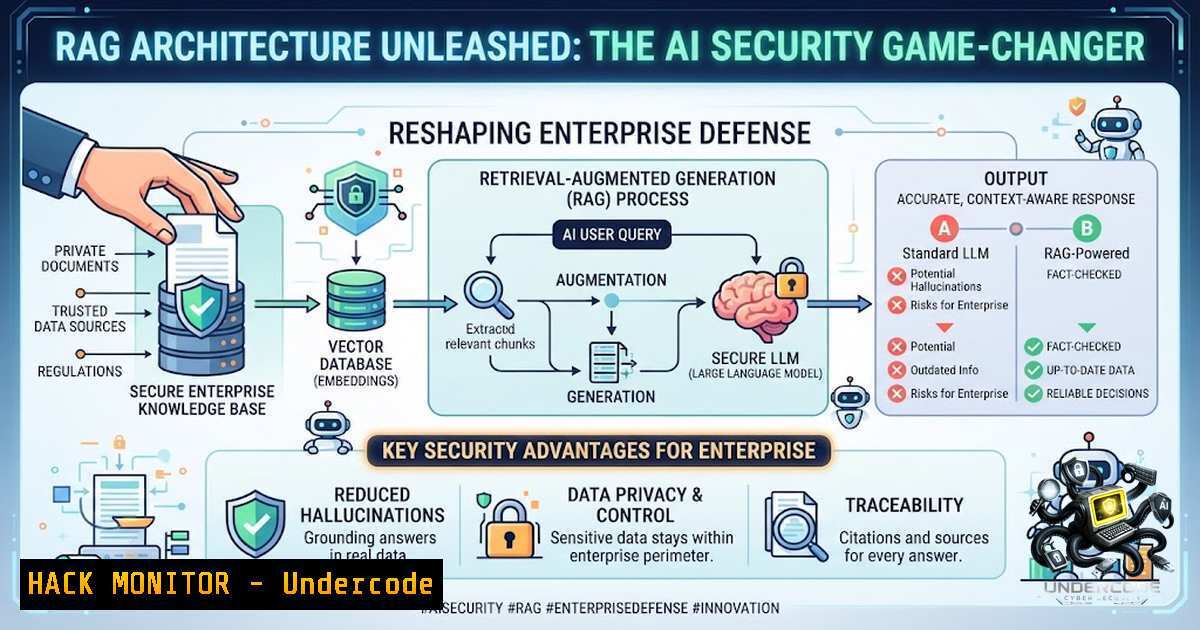
RAG architecture is the system design pattern that defines how components—document storage, embedding models, vector databases, retrieval logic, and language models—integrate and interact to deliver retrieval-augmented generation capabilities at scale. At its foundation, RAG operates through a pipeline: chunk → embed → retrieve → generate. However, production-grade RAG systems in 2026 are becoming more specialized, intelligent, and architecture-driven, moving beyond the naive implementation.
Step‑by‑step guide to understanding the RAG pipeline:
- Ingestion Phase: Raw documents (PDFs, Word files, SharePoint content, threat feeds) are parsed and cleaned. For security applications, this includes STIX/TAXII feeds, CVE databases, and internal incident reports.
-
Chunking: Documents are split into manageable segments. Optimal chunk size varies—too small loses context, too large reduces retrieval precision. For security bulletins, 512-token chunks with 50-token overlap are recommended.
-
Embedding Generation: Each chunk is passed through an embedding model (e.g., text-embedding-3-small, BAAI/bge-large) to produce vector representations. These vectors capture semantic meaning.
-
Vector Storage: Embeddings are stored in a vector database (Pinecone, Weaviate, Milvus, or pgvector) with appropriate indexing (HNSW, IVF) for fast similarity search.
-
Retrieval: At query time, the user’s question is embedded and compared against stored vectors using cosine similarity or dot product. Top-K most relevant chunks are retrieved.
-
Generation: Retrieved chunks are injected into the LLM prompt as context, and the model generates a grounded response.
Linux Command – Setting up a Local Vector Database with pgvector:
 Install PostgreSQL and pgvector on Ubuntu
sudo apt update && sudo apt install postgresql postgresql-contrib
sudo apt install postgresql-16-pgvector  Adjust version as needed

Start PostgreSQL and create database
sudo systemctl start postgresql
sudo -u postgres psql -c "CREATE DATABASE rag_db;"
sudo -u postgres psql -d rag_db -c "CREATE EXTENSION vector;"

Verify extension
sudo -u postgres psql -d rag_db -c "\dx"
Windows Command – Running a Local RAG Stack with Docker Desktop:
 Pull and run Qdrant vector database
docker run -d -p 6333:6333 qdrant/qdrant

Verify Qdrant is running
curl http://localhost:6333/healthz
- Hybrid Retrieval: Combining Dense and Sparse Search for Accuracy
Naive RAG relies solely on dense vector search, which can miss keyword-specific matches. Hybrid RAG combines dense vector search with sparse keyword search (BM25, TF-IDF) to improve retrieval accuracy. In cybersecurity, this is critical—threat actors often use specific IOCs (IPs, hashes, domains) that dense embeddings may not prioritize correctly.
Step‑by‑step guide to implementing hybrid retrieval:
- Set up dual indexes: Maintain both a vector index (for semantic search) and a keyword index (for exact/partial matches).
-
Implement retrieval fusion: Execute both searches in parallel, then combine results using Reciprocal Rank Fusion (RRF) or weighted scoring.
-
Tune the hybrid weight: Start with 0.7 for dense and 0.3 for sparse, then adjust based on validation data.
-
Cache frequent queries: Use Redis or Memcached to store results of common threat intelligence queries.
Python Code – Hybrid Retrieval with RRF:
from sentence_transformers import SentenceTransformer
import numpy as np
from rank_bm25 import BM25Okapi

def hybrid_search(query, documents, embed_model, top_k=5, alpha=0.7):
 Dense retrieval
query_embedding = embed_model.encode(query)
doc_embeddings = np.array([doc['embedding'] for doc in documents])
similarities = np.dot(doc_embeddings, query_embedding) / (
np.linalg.norm(doc_embeddings, axis=1)  np.linalg.norm(query_embedding)
)
dense_scores = [(i, sim) for i, sim in enumerate(similarities)]
dense_scores.sort(key=lambda x: x[bash], reverse=True)

Sparse retrieval (BM25)
tokenized_docs = [doc['text'].split() for doc in documents]
bm25 = BM25Okapi(tokenized_docs)
sparse_scores = bm25.get_scores(query.split())

Reciprocal Rank Fusion
rrf_scores = {}
for rank, (idx, _) in enumerate(dense_scores[:top_k2]):
rrf_scores[bash] = rrf_scores.get(idx, 0) + alpha / (rank + 60)
for rank, idx in enumerate(np.argsort(sparse_scores)[::-1][:top_k2]):
rrf_scores[bash] = rrf_scores.get(idx, 0) + (1-alpha) / (rank + 60)

Return top-k fused results
return sorted(rrf_scores.items(), key=lambda x: x[bash], reverse=True)[:top_k]
Security Consideration: Hybrid retrieval introduces multiple data access paths. Ensure both indexes are encrypted at rest and in transit, and implement field-level access control to prevent unauthorized data exposure.
- Hardening the RAG Pipeline: Security Controls for AI Systems
RAG systems face unique security threats: prompt injection, data poisoning, excessive agency, and unauthorized knowledge extraction. Implementing defense-in-depth across the pipeline is non-1egotiable for production deployments.
Step‑by‑step guide to RAG security hardening:
- Input Sanitization: Before embedding or passing to the LLM, sanitize all user inputs. Strip control characters, limit length, and use allowlists for expected formats.
-
Retrieval Access Control: Implement vector-level permissions. Use metadata filtering (e.g.,
doc.source == "approved" AND doc.classification <= "CONFIDENTIAL") to restrict retrieval based on user roles. -
Prompt Injection Defense: Use a dedicated classifier model (e.g., Llama Guard, OpenAI Moderation) to detect and block injection attempts before they reach the generation stage.
-
Output Filtering: Apply regex-based and semantic filters to prevent leakage of sensitive information (PII, API keys, internal IPs).
-
Audit Logging: Log all retrieval events, including query hashes, retrieved document IDs, user context, and generation outputs for forensic analysis.
Linux Command – Setting Up a RAG Security Proxy with NGINX:
 Install NGINX and ModSecurity
sudo apt install nginx libnginx-mod-http-headers-more-filter
sudo apt install libnginx-mod-http-subs-filter

Configure rate limiting and request filtering
cat > /etc/nginx/sites-available/rag-proxy << 'EOF'
server {
listen 443 ssl;
server_name rag.internal.local;

Rate limiting
limit_req_zone $binary_remote_addr zone=rag_limit:10m rate=10r/m;
limit_req zone=rag_limit burst=5 nodelay;

Request size limit
client_max_body_size 10k;

location / {
proxy_pass http://localhost:8000;
proxy_set_header X-Real-IP $remote_addr;

Filter sensitive headers
more_clear_input_headers 'Authorization';
}
}
EOF
sudo ln -s /etc/nginx/sites-available/rag-proxy /etc/nginx/sites-enabled/
sudo nginx -t && sudo systemctl reload nginx
Windows PowerShell – Enforcing RAG API Security Policies:
 Apply IP allowlist via Windows Firewall
New-1etFirewallRule -DisplayName "RAG API Allowlist" `
-Direction Inbound -Protocol TCP -LocalPort 8000 `
-RemoteAddress "192.168.1.0/24","10.0.0.0/8" -Action Allow

Enable advanced audit logging
auditpol /set /subcategory:"Application Generated" /success:enable /failure:enable
4. Chunking and Parsing: The Overlooked Reliability Layer
Document parsing is not a preprocessing detail but a reliability layer. Poor chunking leads to context loss, hallucinations, and inaccurate retrieval. For security documents (incident reports, threat advisories), structure matters as much as content.
Step‑by‑step guide to optimal chunking strategies:
- Semantic Chunking: Split by natural boundaries—paragraphs, sections, or markdown headers—rather than fixed token counts.
-
Overlap Strategy: Use 10-20% overlap between chunks to preserve context across boundaries.
-
Metadata Enrichment: Attach metadata (source, date, author, classification, file type) to each chunk for filtered retrieval.
-
Document Structure Preservation: For PDFs, extract headers, tables, and lists using libraries like `pypdf` or
unstructured. For code repositories, preserve function signatures and comments.
Python Code – Intelligent Document Chunking for Security Reports:
from langchain.text_splitter import RecursiveCharacterTextSplitter
from langchain.document_loaders import PyPDFLoader

def chunk_security_report(file_path, chunk_size=512, overlap=50):
loader = PyPDFLoader(file_path)
documents = loader.load()

Use recursive splitter with separators for structure
text_splitter = RecursiveCharacterTextSplitter(
chunk_size=chunk_size,
chunk_overlap=overlap,
separators=["\n ", "\n ", "\n- ", "\n\n", "\n", " "],
length_function=len,
)

chunks = text_splitter.split_documents(documents)

Enrich with metadata
for chunk in chunks:
chunk.metadata["source_type"] = "security_report"
chunk.metadata["chunk_id"] = f"{file_path}_{chunks.index(chunk)}"

return chunks
- Agentic RAG: From Static Retrieval to Autonomous Reasoning
Agentic RAG represents a shift from static retrieval to dynamic decision-driven knowledge access. Instead of a single retrieve-then-generate pass, agentic systems use iterative reasoning, tool calling, and self-verification to improve answer quality. In SOC environments, this enables automated threat hunting—agents can query SIEMs, correlate findings, and generate response playbooks.
Step‑by‑step guide to building an Agentic RAG for Threat Intelligence:
- Define Tools: Expose functions for the agent to call—e.g.,
search_cve(cve_id),query_siem(time_range),lookup_ioc(indicator). -
Implement ReAct Loop: The agent alternates between Reasoning (planning next action) and Acting (executing tool calls), with retrieval as one of many tools.
-
Self-Correction: After generating a response, the agent reviews its own output against retrieved evidence, flagging unsupported claims.
-
Verification Layer: Use a separate verification model to assess confidence and citation quality before surfacing results to analysts.
Linux Command – Deploying a Local Agentic RAG with Ollama and LangChain:
 Install Ollama and pull a model
curl -fsSL https://ollama.com/install.sh | sh
ollama pull llama3.2:3b

Set up Python environment
python3 -m venv rag-agent
source rag-agent/bin/activate
pip install langchain langchain-community chromadb ollama

Run a basic agent (save as agent.py)
cat > agent.py << 'EOF'
from langchain.agents import Tool, AgentExecutor
from langchain_community.llms import Ollama
from langchain.tools import DuckDuckGoSearchRun

llm = Ollama(model="llama3.2:3b")
tools = [Tool(name="Search", func=DuckDuckGoSearchRun().run, description="Search the web")]
agent = initialize_agent(tools, llm, agent=AgentType.ZERO_SHOT_REACT_DESCRIPTION, verbose=True)
agent.run("Find recent CVE-2025-XXXX exploits and suggest mitigations.")
EOF
python agent.py
6. Governance and Continuous Optimization for Production RAG
Production RAG requires ongoing monitoring, evaluation, and optimization. Key metrics include retrieval precision, answer faithfulness, latency, and cost per query. Implement continuous evaluation using ground-truth datasets and automated regression testing.
Step‑by‑step guide to RAG governance:
- Evaluation Framework: Use frameworks like RAGAS or TruLens to measure context relevance, answer relevance, and faithfulness.
-
A/B Testing: Deploy candidate retrieval strategies (different chunk sizes, embedding models, hybrid weights) and compare performance on a holdout set.
-
Feedback Loop: Collect user feedback (thumbs up/down, correction edits) and use it to fine-tune retrieval weights and prompt templates.
-
Version Control: Treat prompts, embeddings, and chunking strategies as code—store in Git, tag releases, and roll back on degradation.
Linux Command – Setting Up RAG Monitoring with Prometheus and Grafana:
 Install Prometheus and Grafana
wget https://github.com/prometheus/prometheus/releases/latest/download/prometheus-.linux-amd64.tar.gz
tar xvf prometheus-.linux-amd64.tar.gz
cd prometheus-.linux-amd64
./prometheus --config.file=prometheus.yml &

Install Grafana
sudo apt-get install -y adduser libfontconfig1
wget https://dl.grafana.com/oss/release/grafana_.deb
sudo dpkg -i grafana_.deb
sudo systemctl start grafana-server

Expose RAG metrics via Python
pip install prometheus-client
Windows Command – Monitoring RAG with Azure Application Insights:
 Install Application Insights SDK
pip install azure-monitor-opentelemetry

Configure instrumentation key
$env:APPLICATIONINSIGHTS_CONNECTION_STRING = "InstrumentationKey=your-key"
What Undercode Say:
- RAG is not a silver bullet: It’s an architectural pattern that requires careful design, continuous monitoring, and security-first thinking. The naive “chunk → embed → retrieve → generate” pipeline works for demos but fails in production at scale.
-
Retrieval is the bottleneck: Most RAG failures stem from poor retrieval—irrelevant chunks, missing context, or outdated data. Invest in hybrid search, metadata filtering, and regular corpus updates before optimizing the generation layer.
-
Security must be embedded, not bolted on: Prompt injection, data poisoning, and unauthorized extraction are real threats. Implement input sanitization, access controls, and audit logging from day one. Treat your RAG system as a high-value target because it is.
-
Agentic RAG is the next frontier: Static retrieval is giving way to autonomous, reasoning-driven systems that can adapt, iterate, and verify. Security teams should experiment with agentic workflows for threat hunting and incident response, but must implement strong guardrails to prevent excessive agency.
Prediction:
-
+1 RAG will become the de facto standard for enterprise AI by 2027, with 80% of production LLM applications incorporating some form of retrieval augmentation. Security vendors will embed RAG into SIEM and SOAR platforms, enabling real-time threat correlation and automated playbook generation.
-
+1 Agentic RAG will mature into autonomous security assistants capable of triaging alerts, querying multiple data sources, and recommending containment actions—reducing mean time to detect (MTTD) by 40-60%.
-
-1 The attack surface expansion introduced by RAG systems will lead to a new class of AI-specific vulnerabilities. Expect a surge in prompt injection attacks targeting retrieval pipelines, with threat actors using adversarial queries to exfiltrate sensitive knowledge bases or poison retrieval indexes.
-
-1 Governance and compliance will become major roadblocks. Organizations will struggle to meet data residency, privacy, and audit requirements for RAG systems that cross geographic and regulatory boundaries. Without standardized frameworks, many RAG projects will stall in pilot phases.
-
+1 Open-source RAG stacks (Dify, LangChain, LlamaIndex) will dominate the mid-market, while hyperscalers (AWS, Azure, GCP) will offer managed RAG services with built-in security and compliance. The convergence of these ecosystems will accelerate adoption but also create vendor lock-in risks.
-
-1 The cost of RAG operations—embedding generation, vector storage, and LLM inference—will remain a barrier for smaller organizations. Expect consolidation around optimized models (e.g., fine-tuned smaller LLMs) and efficient indexing algorithms to offset these costs.
▶️ Related Video (86% Match):
https://www.youtube.com/watch?v=2WEGQ2icnKE
🎯Let’s Practice For Free:
🎓 Live Courses & Certifications:
Join Undercode Academy for Verified Certifications
🚀 Request a Custom Project:
Secure, high-velocity infrastructure and disruptive technological engineering. Contact our engineering team for high-tier development and proprietary systems:
[email protected]
💎 Smart Architecture | 🛡️ Secure by Design | ⭐ Trusted by Thousands
IT/Security Reporter URL:
Reported By: Khaled Mohamed – Hackers Feeds
Extra Hub: Undercode MoN
Basic Verification: Pass ✅


