Listen to this Post
Introduction:
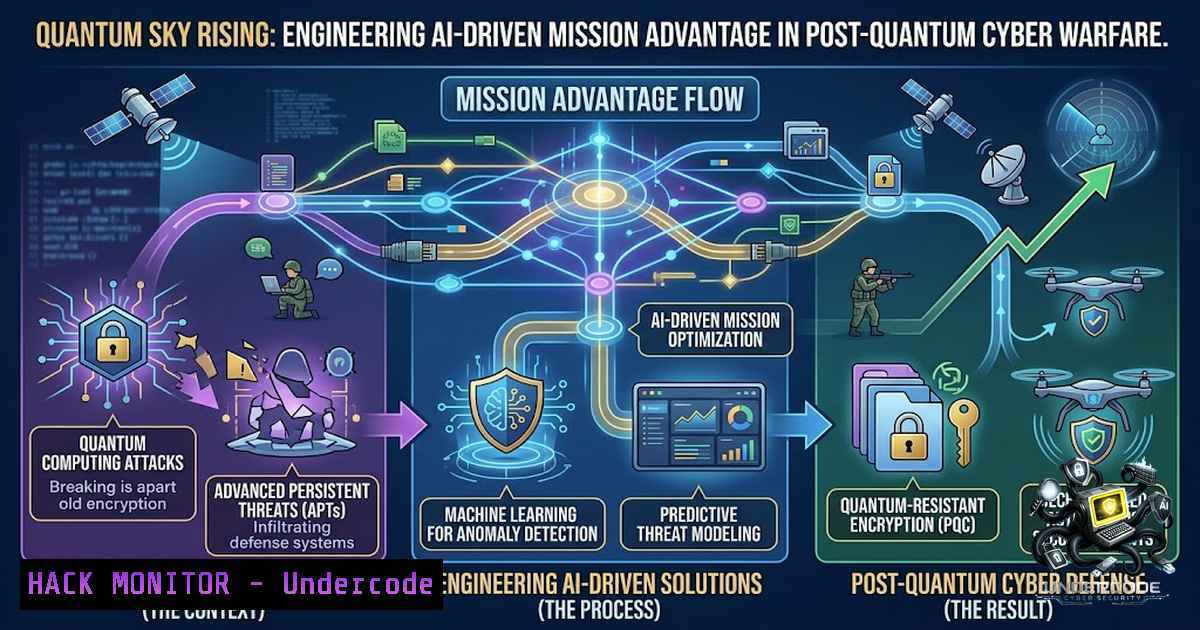
The federal technology landscape is undergoing a seismic shift as agencies confront data-intensive, cyber-contested, and AI-enabled operational environments. Tyto Athene’s strategic rebranding to Quantum Sky—backed by a two-year transformation involving leadership changes, strategic acquisitions, and a $6 billion investment fund—signals an urgent industry-wide pivot toward operational AI, quantum-ready infrastructure, and zero-trust cyber resilience. This evolution is not merely cosmetic; it reflects the accelerating mandate from the Office of Management and Budget and NIST for federal agencies to adopt responsible AI and post-quantum cryptography before commercially viable quantum computers render classical encryption obsolete.
Learning Objectives:
- Understand the technical pillars of Quantum Sky’s “Project 137” innovation engine and its four core domains: infrastructure/platform operations, cyber, decision advantage, and quantum.
- Master practical implementation of AI-enabled security operations, including LLM-powered threat detection and automated incident response.
- Gain hands-on proficiency with post-quantum cryptographic migration, including NIST-standard algorithms and hybrid deployment strategies.
- Learn cloud hardening and FedRAMP compliance automation techniques for federal mission-critical environments.
You Should Know:
- Operationalizing AI for Cyber Resilience: From Pilots to Field-Ready Capabilities
Quantum Sky’s CEO Andrew Boyd emphasizes that agencies need AI and quantum solutions “not as a pilot, but as a capability they can field, trust and sustain”. This shifts AI from experimental dashboards to embedded security operations. Below is a practical pipeline for deploying an AI-powered security agent that ingests SIEM logs, correlates threat intelligence, and executes automated responses.
Step-by-Step Guide: Deploying an AI Security Agent with Python and OpenAI API
This guide assumes a Linux Ubuntu 22.04 environment with Python 3.10+.
1. Install Dependencies:
sudo apt update && sudo apt install python3-pip python3-venv -y
python3 -m venv ai-security-env
source ai-security-env/bin/activate
pip install openai pandas numpy requests python-dotenv
2. Set Up Environment Variables:
Create a `.env` file to store your OpenAI API key and SIEM endpoint.
echo "OPENAI_API_KEY=your_api_key_here" > .env
echo "SIEM_ENDPOINT=https://your-siem.example.com/api/alerts" >> .env
3. Build the Threat Correlator Script:
Create `threat_agent.py`:
import os
import json
import requests
from openai import OpenAI
from dotenv import load_dotenv
load_dotenv()

client = OpenAI(api_key=os.getenv("OPENAI_API_KEY"))

def fetch_alerts():
 Simulate fetching high-severity alerts from SIEM
return [
{"id": "001", "source_ip": "10.0.0.5", "dest_ip": "192.168.1.100",
"signature": "ET SCAN Suspicious Outbound", "severity": "high"},
{"id": "002", "source_ip": "203.0.113.45", "dest_ip": "10.0.0.22",
"signature": "MALWARE-CNC Win.Trojan.Generic outbound", "severity": "critical"}
]

def analyze_with_ai(alerts):
response = client.chat.completions.create(
model="gpt-4",
messages=[
{"role": "system", "content": "You are a SOC analyst. Correlate these alerts, identify patterns, and suggest containment actions."},
{"role": "user", "content": json.dumps(alerts)}
]
)
return response.choices[bash].message.content

if <strong>name</strong> == "<strong>main</strong>":
alerts = fetch_alerts()
analysis = analyze_with_ai(alerts)
print("AI Analysis:\n", analysis)
4. Run and Automate:
python3 threat_agent.py
To operationalize, deploy this as a cron job or Kubernetes CronJob to run every 5 minutes. The AI output can feed into a ticketing system or SOAR platform for automated playbook execution.
- Preparing for the Quantum Apocalypse: Post-Quantum Cryptography Migration
NIST has finalized post-quantum encryption standards (FIPS 203, 204, 205) and urges organizations to begin migrating to quantum-resistant cryptography. Quantum Sky is building dedicated practices to help agencies transition. Below is a technical roadmap for integrating hybrid post-quantum algorithms into existing TLS infrastructures.
Step-by-Step Guide: Enabling Post-Quantum Hybrid Key Exchange in NGINX (Linux)
This guide uses OpenSSL 3.0+ with the OQS (Open Quantum Safe) provider.
1. Build OQS Provider:
sudo apt install git cmake gcc libssl-dev -y
git clone https://github.com/open-quantum-safe/oqs-provider.git
cd oqs-provider
mkdir build && cd build
cmake -DOPENSSL_ROOT_DIR=/usr/local/ssl ../
make -j$(nproc)
sudo make install
2. Configure NGINX to Use Hybrid KEM:
Edit `/etc/nginx/nginx.conf` to include the OQS engine and specify hybrid cipher suites (e.g., X25519Kyber768Draft00).
ssl_engine oqsprovider;
ssl_protocols TLSv1.3;
ssl_ciphers "ECDHE+X25519+KYBER+DRAFT00:ECDHE+AESGCM";
ssl_prefer_server_ciphers off;
3. Generate a Hybrid Certificate:
openssl req -x509 -1ewkey ec -pkeyopt ec_paramgen_curve:secp256r1 -keyout hybrid.key -out hybrid.crt -days 365 -1odes
4. Test Quantum-Safe Handshake:
openssl s_client -connect localhost:443 -tls1_3 -ciphersuites TLS_AES_256_GCM_SHA384 -groups X25519Kyber768Draft00
This establishes a TLS session where the key exchange is protected against both classical and quantum adversaries.
- Hardening Cloud Infrastructures: FedRAMP Automation and Compliance as Code
Quantum Sky’s acquisitions have added cloud compliance automation and FedRAMP acceleration capabilities. For federal agencies, continuous compliance is non-1egotiable. Below is a Terraform module that enforces CIS Benchmarks and automates audit logging on AWS GovCloud.
Step-by-Step Guide: Deploying a FedRAMP-Aligned VPC with Terraform
1. Initialize Terraform Project:
mkdir fedramp-vpc && cd fedramp-vpc
terraform init
2. Create `main.tf` for a Hardened VPC:
provider "aws" {
region = "us-gov-west-1"
}

resource "aws_vpc" "main" {
cidr_block = "10.0.0.0/16"
enable_dns_hostnames = true
tags = { Name = "fedramp-vpc" }
}

resource "aws_flow_log" "vpc_flow" {
vpc_id = aws_vpc.main.id
traffic_type = "ALL"
log_destination = aws_cloudwatch_log_group.flow_log.arn
}

resource "aws_cloudwatch_log_group" "flow_log" {
name = "/aws/vpc/flow-log"
retention_in_days = 365
}

resource "aws_default_security_group" "default" {
vpc_id = aws_vpc.main.id
ingress = [ {
from_port = 0
to_port = 0
protocol = "-1"
cidr_blocks = ["0.0.0.0/0"]
description = "Placeholder - to be restricted"
ipv6_cidr_blocks = []
prefix_list_ids = []
security_groups = []
self = false
} ]
egress = [ {
from_port = 0
to_port = 0
protocol = "-1"
cidr_blocks = ["0.0.0.0/0"]
description = "Allow all outbound"
ipv6_cidr_blocks = []
prefix_list_ids = []
security_groups = []
self = false
} ]
tags = { Name = "default" }
}
3. Apply and Validate:
terraform plan
terraform apply -auto-approve
This creates a VPC with mandatory flow logs sent to CloudWatch for 365-day retention, satisfying FedRAMP logging requirements. Integrate with AWS Config and Security Hub for continuous monitoring.
4. Exploiting and Mitigating AI Supply Chain Vulnerabilities
As agencies accelerate AI adoption, the software supply chain becomes a prime attack vector. Quantum Sky’s focus on “secure mission data” necessitates hardening ML pipelines. Below is a demonstration of identifying a compromised dependency in a typical Python ML project and applying mitigation.
Step-by-Step Guide: Detecting and Fixing a Malicious PyPI Package
1. Scan Dependencies with `safety` and `bandit`:
pip install safety bandit
safety check -r requirements.txt
bandit -r ./ml_project -f json -o bandit_report.json
2. Simulate a Compromised Package:
Assume `requirements.txt` includes `tensorflow==2.10.0` which has a known vulnerability (CVE-2022-29216). An attacker could exfiltrate model weights via a malicious side-channel.
3. Mitigation Strategy:
- Pin to Patched Version: Update `requirements.txt` to
tensorflow==2.10.1. - Implement SBOM (Software Bill of Materials): Generate an SBOM using
cyclonedx-bom:pip install cyclonedx-bom cyclonedx-py -i requirements.txt -o bom.json
- Enforce Artifact Signing: Use `cosign` to verify container images before deployment:
cosign verify-blob --key cosign.pub model.bin --signature model.sig
5. Windows-Based Quantum-Safe Endpoint Hardening
For Windows environments dominating federal endpoints, Group Policy Objects (GPO) can enforce quantum-safe cryptographic agility.
Step-by-Step Guide: Enabling Quantum-Resistant Algorithms via PowerShell (Windows Server 2022)
1. Check Current TLS Cipher Suites:
Get-TlsCipherSuite
2. Enable Hybrid Suites (if supported by Schannel):
Enable-TlsCipherSuite -1ame "TLS_ECDHE_ECDSA_WITH_AES_256_GCM_SHA384"
Enable-TlsCipherSuite -1ame "TLS_ECDHE_RSA_WITH_AES_256_GCM_SHA384"
 Note: Native Windows support for hybrid KEMs (like Kyber) is pending; use third-party providers or application-level libraries.
3. Harden PowerShell Execution Policy and Logging:
Set-ExecutionPolicy -ExecutionPolicy Restricted -Scope LocalMachine
Set-PSRepository -1ame PSGallery -InstallationPolicy Trusted
New-Item -Path "HKLM:\SOFTWARE\Policies\Microsoft\Windows\PowerShell\ScriptBlockLogging" -Force
Set-ItemProperty -Path "HKLM:\SOFTWARE\Policies\Microsoft\Windows\PowerShell\ScriptBlockLogging" -1ame "EnableScriptBlockLogging" -Value 1
What Undercode Say:
- Key Takeaway 1: Quantum Sky’s rebrand is a market signal that “AI and quantum readiness” are no longer differentiators but baseline requirements for federal contractors. The two-year transformation—from leadership appointments (CEO Andrew Boyd, CAIO Cutter Brenton) to strategic acquisitions—mirrors the broader industry’s need to consolidate capabilities around high-end mission technology.
-
Key Takeaway 2: The technical playbook for 2026-2030 is clear: hybrid cryptographic agility, AI-embedded security operations, and compliance-as-code. Organizations that fail to implement NIST post-quantum standards and FedRAMP automation will find themselves locked out of federal procurement vehicles like Alliant 3, OASIS+, and NASA SEWP VI.
Analysis: The shift from Tyto Athene to Quantum Sky is not merely a branding exercise but a calculated bet on the convergence of AI and quantum technologies. With Project 137 as its innovation engine, the company is positioning itself to deliver “repeatable mission capabilities” across infrastructure, cyber, decision advantage, and quantum domains. However, the technical challenges are immense: operationalizing AI in contested environments requires robust data pipelines, while quantum readiness demands a multi-year cryptographic migration. The $40 million Navy SEIMMP contract win demonstrates immediate traction, but long-term success hinges on talent acquisition—evidenced by their search for a Quantum Science Lead. The regulatory landscape, including OMB directives and NIST standards, provides tailwinds, but the execution gap between “pilot” and “fielded capability” remains the critical battleground.
Prediction:
- +1 Quantum Sky will secure at least two additional major DoD contracts within 18 months, leveraging its quantum practice and Project 137 IP to differentiate against incumbents.
- +1 The broader federal IT services market will see a wave of rebrands and M&A activity as competitors scramble to replicate Quantum Sky’s AI+quantum stack, driving consolidation among mid-tier players.
- -1 The shortage of quantum-safe cryptography expertise will create a bottleneck, delaying migration timelines for many agencies and potentially exposing critical infrastructure to “harvest now, decrypt later” attacks.
▶️ Related Video (84% Match):
🎯Let’s Practice For Free:
🎓 Live Courses & Certifications:
Join Undercode Academy for Verified Certifications
🚀 Request a Custom Project:
Secure, high-velocity infrastructure and disruptive technological engineering. Contact our engineering team for high-tier development and proprietary systems:
[email protected]
💎 Smart Architecture | 🛡️ Secure by Design | ⭐ Trusted by Thousands
IT/Security Reporter URL:
Reported By: Industry Update – Hackers Feeds
Extra Hub: Undercode MoN
Basic Verification: Pass ✅


