Listen to this Post
Introduction:
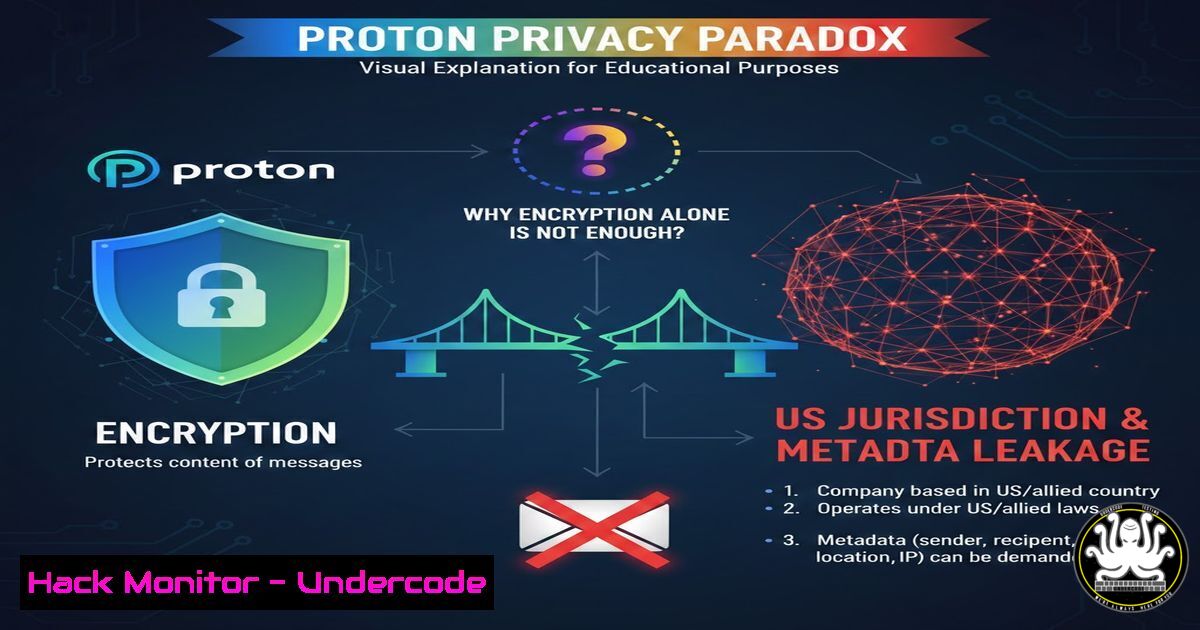
Privacy-focused platforms like Proton have built their reputation on strong encryption and Swiss privacy laws. However, recent analyses by data protection experts reveal a critical gap: metadata remains exposed, and Proton’s reliance on US-based subprocessors and CDNs like Cloudflare introduces jurisdictional risks under the CLOUD Act and GDPR compliance gaps. This article dissects the technical realities of Proton’s infrastructure, provides hands-on methods to audit email metadata, and offers mitigation strategies through on-premise MSP alternatives and automated compliance tooling.
Learning Objectives:
- Understand the technical distinction between content encryption and metadata exposure in Proton services.
- Identify Proton’s US subprocessors and data center dependencies using open-source intelligence (OSINT) and network forensics.
- Execute Linux/Windows commands to trace CDN routing and validate server jurisdictions.
- Configure self-hosted email security gateways and compliance auditing tools like JOUO.
- Implement mitigation techniques against metadata collection and third-party data sharing.
- Metadata Forensics: Why “End-to-End Encrypted” Doesn’t Mean “Private”
Proton Mail applies end-to-end encryption to email bodies and attachments, but the email headers—To, From, Subject, timestamp, and IP addresses—are stored in plaintext on Proton servers to enable IMAP/SMTP functionality. In response to Pia T.’s query, Proton confirmed that metadata is not zero-access encrypted.
Step‑by‑step guide: Extracting Proton metadata exposure via Wireshark + Linux CLI
1. Capture traffic from a Proton Mail web session:
sudo tcpdump -i eth0 -w proton.pcap host mail.proton.me
2. Filter for SMTP/IMAP traffic (even if encrypted, header sizes reveal patterns):
tshark -r proton.pcap -Y "imap or smtp" -T fields -e ip.src -e ip.dst -e frame.len
3. Analyze DNS queries to reveal Proton’s upstream CDN:
tshark -r proton.pcap -Y "dns.qry.name contains proton" -T fields -e dns.qry.name
Results typically show `proton.me` resolves to Cloudflare IPs (US jurisdiction).
Windows equivalent (PowerShell):
netsh trace start capture=yes tracefile=proton.etl
 Perform Proton login
netsh trace stop
netsh trace convert proton.etl proton.csv
Select-String -Path proton.csv -Pattern "proton.me"
Key finding: Proton uses Cloudflare’s global CDN. While this accelerates content delivery, it means metadata TLS handshakes pass through US-controlled infrastructure, accessible via National Security Letters (NSLs).
- Mapping Proton’s US Subprocessors and Supply Chain Risks
Bernhard Biedermann’s post highlights a common oversight: “Massenhoster” (mass hosting providers) rely on US-headquartered subcontractors. Proton’s subprocessor list includes:
– Cloudflare, Inc. (CDN, DDoS mitigation) – USA
– Google Cloud Platform (some backend services, backup) – USA
– Amazon Web Services (specific regions, documented in Proton’s privacy policy) – USA
Step‑by‑step guide: Verifying Proton’s infrastructure via dig + whois (Linux):
1. Locate Proton’s MX servers:
dig MX proton.me +short
→ `mail.proton.me` (often CNAMEs to `protonmail.map.fastly.net` or Cloudflare).
2. Trace ASN ownership:
whois $(dig A mail.proton.me +short | head -1)
Search for `OrgId` or CIDR. If the netblock belongs to Cloudflare (AS13335), jurisdiction is US.
3. Check Proton’s official subprocessor list (updated manually):
curl -s https://proton.me/legal/privacy | grep -i "subprocessor|cloudflare|aws"
Windows alternative:
Resolve-DnsName mail.proton.me -Type A
 Then use https://bgp.he.net/ to manually check ASN.
Compliance implication: Under GDPR 28, Proton remains liable, but data subjects cannot enforce rights directly against US subprocessors. For enterprises requiring “local MSP,” this is a disqualifier.
- JOUO: Automated Third‑Party Compliance Auditing (From Rüdiger Henrici’s Post)
Rüdiger Henrici shared JOUO (https://jouo.de) – a tool that scans websites for vendor security, data processing locations, and GDPR compliance gaps within five minutes.
Step‑by‑step guide: Using JOUO to audit Proton and your own infrastructure
1. Navigate to https://jouo.de and enter `proton.me` as target.
2. JOUO performs:
- SSL/TLS cipher suite analysis (Qualys SSLLabs integration)
- Third‑party cookie disclosure
- Subresource integrity (SRI) checks for CDN‑hosted JS
- Geolocation of hosting providers (via IP geo‑IP)
3. Output example:
Hosting: Cloudflare (USA) [GDPR Art.44 risk]
Subprocessors detected: Google Fonts, Stripe, Sentry
Data transfers outside EEA: Yes
Self‑hosted alternative (Linux):
You can replicate JOUO’s CDN detection using `whatweb` and retire.js:
whatweb https://mail.proton.me | grep -i "cloudflare|fastly"
retirejs --path ~/webapp_static_files
Windows: Use `OWASP ZAP` headless mode:
zap-api-scan.py -t https://proton.me -f openapi -r zap_report.html
4. Hardening Against Metadata Exposure: On‑Premise MSP Alternative
Bernhard Biedermann recommends a local MSP rather than mass hosters. A hardened on‑premise email security stack can be built using Postfix + Dovecot + OpenDMARC + OpenDKIM, with metadata scrubbing.
Step‑by‑step guide: Configuring metadata anonymization in Postfix
1. Strip client IP from received headers:
Edit `/etc/postfix/main.cf`:
smtp_header_checks = pcre:/etc/postfix/smtp_header_checks
Create `/etc/postfix/smtp_header_checks`:
/^Received: ./ IGNORE
/^X-Originating-IP:/ IGNORE
2. Rewrite Message-ID to remove server fingerprint:
canonical_maps = hash:/etc/postfix/canonical
Map: `/.+/ [email protected]`
- Encrypt local metadata at rest: Use LUKS for `/var/mail` partition.
Windows Server alternative:
Configure Microsoft Exchange with IRM (Information Rights Management) and enable Transport Rule to remove SMTP headers containing client IP.
- API Security and Jurisdiction Hopping with Reverse Proxies
If Proton’s API (ProtonMail bridge) is used, it still phones home to Swiss/US endpoints. You can force traffic through an EEA-based reverse proxy to assert jurisdictional control.
Step‑by‑step guide: Routing Proton Bridge via HAProxy (Linux)
1. Install HAProxy:
sudo apt install haproxy -y
2. Edit `/etc/haproxy/haproxy.cfg`:
frontend proton_local
bind 127.0.0.1:11443
default_backend proton_eea

backend proton_eea
server proxy1 frankfurt.proxy.local:11443 check
3. Force Proton Bridge to use localhost:11443 as proxy.
4. Monitor traffic:
sudo tcpdump -i lo -A -n | grep "Proton"
This ensures the TLS termination occurs inside your EEA-controlled proxy, minimizing direct US jurisdiction exposure—though metadata at rest on Proton servers remains unchanged.
- Cloud Hardening: Eliminating US Subprocessors via OpenStack Private Cloud
For organizations replacing Proton, a private cloud with OpenStack + Ceph can eliminate third‑party CDNs.
Step‑by‑step guide: Deploying a privacy‑focused mail stack on OpenStack
1. Launch an instance with Ubuntu 22.04.
2. Install Mailcow‑dockerized (full mail server suite):
git clone https://github.com/mailcow/mailcow-dockerized
cd mailcow-dockerized
./generate_config.sh
docker-compose up -d
3. Disable external CDN by editing `mailcow.conf`:
SKIP_LETS_ENCRYPT=y
 Use local self‑signed or internal CA
4. Enforce IP whitelisting via OpenStack Security Groups:
openstack security group rule create --protocol tcp --dst-port 443 --remote-ip 0.0.0.0/0
Result: Full control over infrastructure; no US subprocessors; metadata retained on‑prem.
7. Vulnerability Exploitation: Testing Proton’s Jurisdictional Claims
A simple yet effective ethical test to validate Proton’s claims: Attempt to access an account via US VPN and observe legal warnings.
Step‑by‑step guide:
- Connect via US‑based VPN (e.g., WireGuard to a VPS in Virginia).
2. Perform password reset on Proton Mail.
- Capture HTTP headers to see if any US‑specific data handling flags appear.
- Check for Cloudflare Ray ID – this confirms US‑based edge processing.
Linux:
curl -v https://account.proton.me | grep -i "cf-ray"
Windows:
Invoke-WebRequest -Uri https://account.proton.me -Headers @{"CF-Visitor"=""}
Interpretation: Presence of `cf-ray` indicates request was processed by Cloudflare’s US edge nodes. If the account is owned by an EU resident, this is a Schrems II red flag.
What Undercode Say:
- Encryption ≠ Privacy: Proton secures your message content but broadcasts your communication graph to US‑controlled CDNs. Metadata is today’s digital DNA—you cannot anonymize it with AES‑256 alone.
- Supply chain compliance demands infrastructure transparency: Most “privacy-first” SaaS providers still lean on Big Tech’s backbone. A true zero‑trust architecture requires owning the substrate—CDN included.
- Automated auditing is no longer optional: Tools like JOUO turn due diligence from a yearly PDF exercise into a continuous, scriptable compliance feed. Start treating your vendors’ subprocessors as your own attack surface.
Analysis: The Proton case illustrates the widening gap between privacy marketing and infrastructure reality. As geopolitical data fences rise, Swiss neutrality no longer shields bits touching Virginia routers. Professionals must shift from “Is it encrypted?” to “Who terminates my TLS?” and “Which country’s law applies at the moment of decryption?” On‑premise MSPs, while operationally heavier, provide the only current defense against metadata leakage at the hyperscaler level. The industry is overdue for a re‑definition: Privacy service should mean jurisdictional exclusivity, not just algorithms.
Prediction:
Within 24 months, jurisdiction‑aware encryption will become a standard procurement requirement for EU enterprises. Proton and similar providers will be forced to offer sovereign deployments—physically isolated instances with zero US subprocessors, running on European‑only hardware, priced at a premium. Simultaneously, automated compliance scanners will evolve into active defense probes that not only detect US subprocessor usage but also dynamically block traffic to non‑EEA CDNs, effectively creating a software‑defined data border. The “Switzerland shield” myth will dissolve, replaced by verifiable infrastructure geography.
▶️ Related Video (78% Match):
🎯Let’s Practice For Free:
IT/Security Reporter URL:
Reported By: Bernhard Biedermann – Hackers Feeds
Extra Hub: Undercode MoN
Basic Verification: Pass ✅


