Listen to this Post
Introduction:
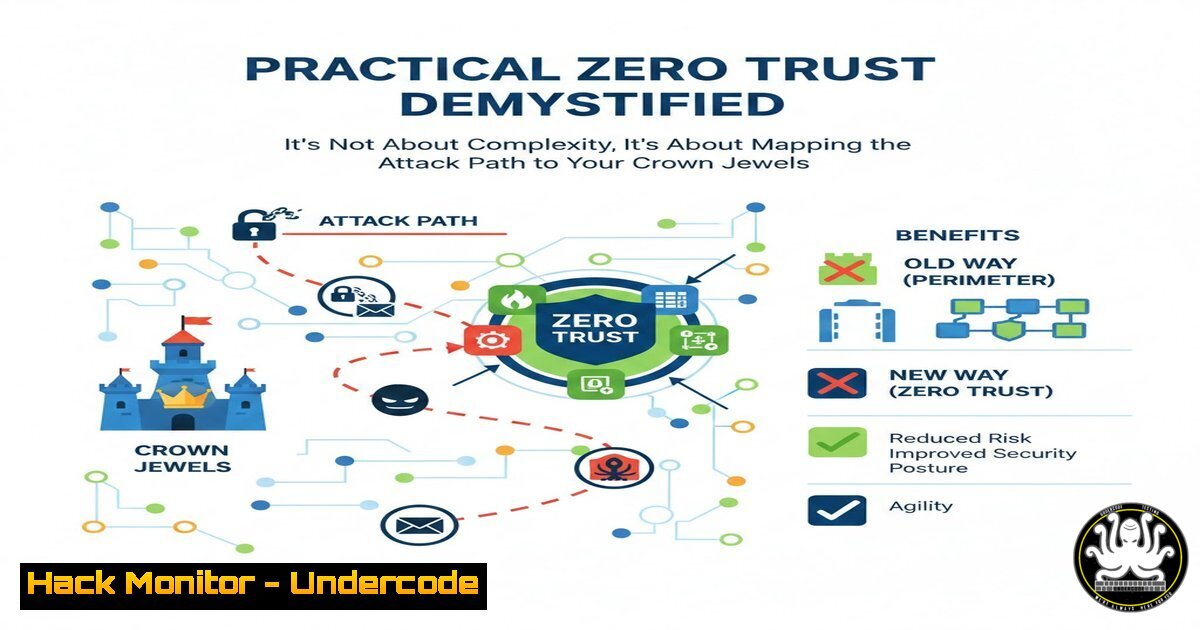
Zero Trust is often shrouded in jargon and perceived as an overwhelmingly complex architectural overhaul. However, its core principle is starkly simple: assume breach and rigorously defend what matters most by explicitly verifying every request. This article moves beyond theory to provide a tactical blueprint for implementing Zero Trust by mapping and securing the attack paths leading directly to your organization’s “crown jewels”—its most critical data and assets.
Learning Objectives:
- Understand how to identify and prioritize your organization’s crown jewels and the attack paths that lead to them.
- Learn practical, actionable steps to enforce Zero Trust principles at critical chokepoints along those paths.
- Gain hands-on knowledge of commands and configurations for network segmentation, access enforcement, and monitoring.
You Should Know:
- Identifying Crown Jewels and Modeling the Attack Path
The foundational step of Practical Zero Trust is identifying what you are actually protecting. This isn’t just data classification; it’s understanding the specific systems, applications, and data stores that, if compromised, would cause catastrophic business damage. Subsequently, you must model how an adversary could move from an initial foothold to that asset.
Step‑by‑step guide:
- Asset Criticality Tagging: Use your CMDB or cloud console to tag resources. In AWS, use the CLI to tag a critical S3 bucket:
aws s3api put-bucket-tagging --bucket crown-jewel-bucket --tagging 'TagSet=[{Key=Confidentiality,Value=Critical},{Key=DataClassification,Value=CrownJewel}]' - Attack Path Modeling: Manually trace connections or use tools like Microsoft’s Attack Path Analysis in Defender for Cloud, BloodHound for Active Directory, or CSPM tools for cloud environments. The goal is to answer: “If this user/endpoint is compromised, what can they reach?”
- Diagram the Path: Create a simple diagram mapping the steps: Initial Access → Lateral Movement → Privilege Escalation → Crown Jewel Access.
-
Enforcing Micro-Segmentation & Least Privilege at the Network Layer
Once paths are mapped, break them with network controls. This means segmenting your network so that access to crown jewel segments is explicitly denied by default and only allowed for specific, necessary flows.
Step‑by‑step guide:
- Define Segmentation Policy: Policy: “The PCI segment (10.0.1.0/24) can only be initiated from the Jump-Box subnet (10.0.2.0/24) on port 3389 (RDP).”
2. Implement with NSG/ACL (Azure Example):
 Create a Network Security Group rule allowing specific traffic
az network nsg rule create \
--nsg-name PCI-NSG \
--name Allow-RDP-From-JumpBox \
--priority 100 \
--source-address-prefixes 10.0.2.0/24 \
--source-port-ranges '' \
--destination-address-prefixes 10.0.1.0/24 \
--destination-port-ranges 3389 \
--protocol Tcp \
--access Allow
 Add an explicit Deny-All rule at lower priority (e.g., 4000)
3. Linux Host-Based Firewall (Fallback): Use `nftables` or `iptables` on critical servers to drop all unrelated traffic.
sudo nft add rule inet filter input ip saddr != 10.0.2.0/24 tcp dport 22 drop
3. Implementing Strong Identity and Device Verification (MFA/Compliance)
Zero Trust mandates “never trust, always verify.” For any connection attempt to a critical path, identity and device health must be verified.
Step‑by‑step guide:
- Conditional Access Policy (Microsoft 365/Azure AD): Create a policy that blocks access to your critical enterprise app unless the user is on a compliant and joined device and uses MFA.
- For SSH Access (Linux): Enforce key-based authentication and consider MFA using `google-authenticator` or certificate-based smart cards. Disable password logins.
/etc/ssh/sshd_config
PasswordAuthentication no
PubkeyAuthentication yes
AuthenticationMethods publickey,keyboard-interactive:pam
- Device Compliance Script (Conceptual): A script that checks for disk encryption, firewall status, and security agent health before granting network access (used in NAC or VPN pre-connect checks).
4. Application Layer Controls and API Security
The crown jewel is often accessed via an application or API. Protect it there with fine-grained authorization and input validation.
Step‑by‑step guide:
- Implement OAuth 2.0 Scopes & API Gateways: Ensure your API gateway validates JWT tokens and enforces scopes. A user token with `scope:read_profile` should be denied access to
POST /api/financial/transfer. - SQL Injection Mitigation: Use parameterized queries. Never concatenate user input.
BAD: cursor.execute("SELECT FROM users WHERE email = '" + email + "'") GOOD: cursor.execute("SELECT FROM users WHERE email = %s", (email,)) - Log All Access: Ensure your application logs all authentication and authorization decisions, especially failures and accesses to sensitive data.
5. Continuous Monitoring and Logging for Path Deviation
Zero Trust is not a set-and-forget firewall rule. You must monitor for deviations from the allowed paths, which indicate potential compromise.
Step‑by‑step guide:
- Centralize Logs: Ingest logs from network devices, identity providers, endpoints, and applications into a SIEM.
- Create Detection Rules: Build alerts for path deviations.
Splunk SPL Example: Alert on a user authenticating from two geographically impossible locations within 10 minutes.index=auth_logs source="AAD" | stats earliest(_time) as firstTime, latest(_time) as lastTime by user, location | where (lastTime - firstTime) < 600 | table user, location
Sigma Rule (for critical file access): Detect unusual after-hours access to a crown jewel file server.
- Regularly Review: Use your attack path diagrams during incident response to quickly understand the scope of a breach.
What Undercode Say:
- Map First, Buy Later: The most critical tool for Zero Trust is a whiteboard, not a vendor product. Diagramming attack paths reveals where to apply pressure, preventing wasteful spending on irrelevant controls.
- Assume Breach is a Design Lens, Not Just a Mantra: Designing security with the assumption that attackers are already inside forces you to focus on containment around specific assets, leading to more resilient architectures than brittle perimeter-focused defenses.
Analysis:
The post correctly reframes Zero Trust from a buzzword to a pragmatic exercise in attack path analysis. The comments underscore this, highlighting “assume breach” as a principle for realistic incident response planning. The real value lies in the intentionality it forces upon security teams—you must explicitly define what matters and how it can be reached. This process often reveals shocking, unintended trust relationships (e.g., development servers with routes to production databases) that perimeter tools miss. It shifts security from a blanket “hardening” exercise to a surgical, intelligence-driven defense.
Prediction:
The future of this “Practical Zero Trust” approach will be deeply integrated with AI-driven Attack Surface Management (ASM) and Attack Path Simulation tools. These platforms will automatically discover crown jewels, continuously map dynamic attack paths in hybrid environments, and recommend specific, minimal-configuration security policies to break them. Manual diagramming will give way to live, interactive attack graphs, and enforcement will become increasingly automated, with security groups and access policies auto-generated and maintained. The principle remains, but the execution will become proactive, continuous, and deeply contextual.
▶️ Related Video (72% accuracy):
🎯Let’s Practice For Free:
IT/Security Reporter URL:
Reported By: Kaniksachdeva Readonlyfriday – Hackers Feeds
Extra Hub: Undercode MoN
Basic Verification: Pass ✅


