Listen to this Post
Introduction:
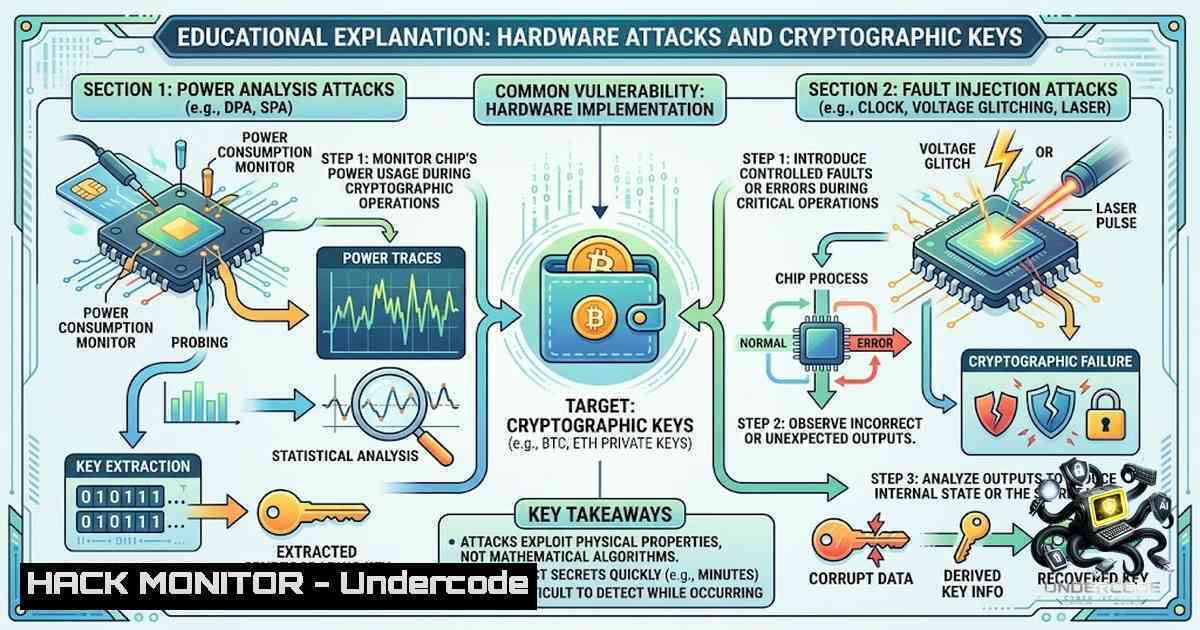
Power analysis and fault injection attacks represent two of the most devastating yet underappreciated vectors in modern hardware security. Unlike traditional software exploits that target code vulnerabilities, these physical attacks exploit the fundamental physics of how semiconductor devices operate—measuring the microscopic fluctuations in power consumption or deliberately corrupting execution with precisely timed voltage and clock glitches. What makes these attacks particularly alarming is their accessibility: with open-source toolchains like ChipWhisperer and affordable hardware such as the Pico Glitcher, even resource-constrained attackers can extract cryptographic keys from embedded systems, smart locks, payment terminals, and IoT devices.
Learning Objectives:
- Understand the fundamental principles behind Simple Power Analysis (SPA), Differential Power Analysis (DPA), and Correlation Power Analysis (CPA) attacks
- Master the practical execution of voltage and clock glitching fault injection attacks using open-source toolchains
- Learn to implement and evaluate side-channel countermeasures including masking, hiding, and randomization techniques
- Develop hands-on skills with industry-standard tools including ChipWhisperer, Riscure Inspector, and Pico Glitcher
- Apply attack methodologies to real-world targets including AES-128 implementations, password verification systems, and bootloader security mechanisms
- Understanding Power Analysis Attacks: From SPA to CPA
Power-based side-channel attacks operate on a simple but profound premise: in CMOS devices, there is a direct correlation between the power consumed and the operations being performed. An attacker monitors the device’s power rails during cryptographic operations—typically using an oscilloscope or specialized capture hardware—and analyzes the resulting power traces to extract sensitive information.
Simple Power Analysis (SPA) is the most rudimentary form, where an attacker visually interprets power consumption measurements directly. This technique is particularly effective against consumer-grade hardware and resource-constrained IoT devices such as smart locks, USB fingerprint scanners, and Wi-Fi routers. For example, when attacking a smart lock, an attacker reviews the firmware disassembly to identify critical branches in the code path, then uses an oscilloscope attached to the microcontroller’s Vcc rail to build a mapping of power consumption patterns to specific code paths.
Differential Power Analysis (DPA) is significantly more sophisticated, requiring statistical analysis across thousands of power consumption traces. Rather than visually interpreting individual traces, DPA uses statistical techniques to identify correlations between power consumption and intermediate values in cryptographic computations. This approach can extract full AES-128 decryption keys from targets including Trusted Platform Modules (TPMs), Hardware Security Modules (HSMs), EMV payment cards, and self-encrypting hard drives.
Correlation Power Analysis (CPA) represents the most advanced form, using Pearson correlation coefficients to identify the relationship between power measurements and hypothetical power consumption models. The attack proceeds by choosing an intermediate point in the cryptographic algorithm that depends on both known plaintext/ciphertext and a small portion of the secret key, measuring power consumption, calculating hypothetical power consumption for each possible key guess, and correlating the two. CPA has been proven to break encryption algorithms previously thought unbreakable, including AES and DES.
- Fault Injection Attacks: Voltage Glitching and Clock Glitching
While power analysis passively observes a device’s behavior, fault injection actively disrupts it. These attacks induce deliberate errors in a device’s operation, often causing it to skip security checks, reveal sensitive data, or produce exploitable cryptographic outputs.
Voltage Glitching involves temporarily manipulating the device’s power supply to cause a brief voltage drop or spike. When the voltage dips below the minimum required for reliable operation, transistors may switch incorrectly, leading to instruction skips or data corruption. A well-documented example is bypassing the Code Read Protection (CRP) on NXP LPC1343 microcontrollers, where a precisely timed voltage glitch causes the bootloader to skip the CRP check entirely. Modern tools like the Pico Glitcher—an open-source voltage glitching device costing under $100—make these attacks accessible to virtually anyone.
Clock Glitching manipulates the device’s clock signal, inserting extra clock edges or stretching/shortening clock cycles. This can cause the device to misinterpret instructions or fetch incorrect data. The ChipWhisperer platform provides extensive support for clock glitching, allowing attackers to precisely control glitch parameters including width, offset, and repetition.
The practical impact is severe: clock glitch fault injection has been shown to effectively circumvent authentication in secure AES-128 bootloaders, highlighting the critical need for better fault protection in embedded systems.
3. Hands-On Attack Execution with ChipWhisperer
The ChipWhisperer platform has revolutionized hardware security research by providing a complete, open-source toolchain for side-channel power analysis and glitching attacks. The platform supports both power analysis attacks and voltage/clock glitching on a wide range of targets including 8-bit AVR and 32-bit ARM microcontrollers.
Setting Up the Environment:
 Install ChipWhisperer on Linux/macOS
git clone https://github.com/newaetech/chipwhisperer
cd chipwhisperer
pip install -e .

Verify installation
python -c "import chipwhisperer as cw; print(cw.<strong>version</strong>)"
Performing a CPA Attack on AES-128:
import chipwhisperer as cw
import numpy as np

Connect to capture hardware
scope = cw.scope()
target = cw.target(scope)

Capture power traces during AES encryption
traces = []
plaintexts = []
for i in range(1000):
pt = np.random.randint(0, 256, 16, dtype=np.uint8)
plaintexts.append(pt)
scope.arm()
target.write(pt)
trace = scope.capture()
traces.append(trace)

Perform CPA attack using SBox output leakage model
from chipwhisperer.analyzer import cpa
attack = cpa.CPA(traces, plaintexts, cpa.leakage_models.SBox_output)
attack.run()
key = attack.get_key()
print(f"Recovered AES-128 key: {key.hex()}")
This script demonstrates how an attacker, with just 1,000 power traces, can recover the full AES-128 encryption key.
Performing a Voltage Glitching Attack:
import chipwhisperer as cw

scope = cw.scope()
target = cw.target(scope)

Configure glitch parameters
scope.glitch.clk_src = 'clkgen'
scope.glitch.output = 'enable_only'
scope.glitch.offset = 0.5  Glitch position relative to clock edge
scope.glitch.width = 0.1  Glitch duration in clock cycles
scope.glitch.repeat = 10  Number of glitch attempts

Execute glitch attack on password check
for glitch_attempt in range(1000):
scope.arm()
target.write(b'password_attempt')
ret = scope.capture()
if target.read() == b'access_granted':
print(f"Successful glitch at attempt {glitch_attempt}")
break
This code automates voltage glitching to bypass a software password check by disrupting the conditional branch instruction.
4. Countermeasures: Building Resilient Hardware
Defending against power analysis and fault injection attacks requires a multi-layered approach. Countermeasures generally fall into three categories:
Hiding Countermeasures reduce the signal-to-1oise ratio of measurements by adding noise, introducing random delays, or desynchronizing operations. Techniques include clock jittering, random instruction insertion, and the use of dual-rail logic that consumes constant power regardless of data being processed.
Masking Countermeasures dissociate the leakage from sensitive values by splitting each secret bit into multiple shares. Boolean and arithmetic masking ensure that any subset of shares remains statistically independent of the original secret, making DPA attacks exponentially more difficult. Higher-order masking provides even stronger protection but comes with increased latency and area overhead.
Protocol-Level Countermeasures limit the usage of sensitive values like cryptographic keys, enforce rate limiting on authentication attempts, and implement fault detection mechanisms that trigger secure resets when anomalies are detected.
For FPGA and SoC designs, moving target defense strategies like RandOhm exploit partial reconfiguration to dynamically alter the circuit’s physical characteristics, making it significantly harder for attackers to extract consistent side-channel information.
5. The IoT and Automotive Security Implications
The proliferation of IoT devices and increasingly connected automotive systems has dramatically expanded the attack surface for power analysis and fault injection. These devices often lack robust physical security measures, yet handle sensitive data ranging from encryption keys to user authentication credentials.
In IoT Devices: Resource constraints often prevent the implementation of comprehensive side-channel countermeasures. A single power analysis attack can extract Wi-Fi credentials, device encryption keys, or proprietary algorithms from smart home devices, allowing attackers to pivot to more sensitive network segments.
In Automotive Systems: Modern vehicles contain dozens of microcontrollers handling everything from engine control to infotainment and autonomous driving functions. Fault injection attacks have been demonstrated against automotive-grade microcontrollers, potentially allowing attackers to bypass safety-critical checks or extract cryptographic keys protecting firmware updates.
The emerging landscape of post-quantum cryptography adds another layer of complexity. As organizations begin implementing lattice-based and other post-quantum algorithms, these implementations must be carefully evaluated for side-channel leakage—a challenge that requires extending traditional analysis techniques to handle more complex mathematical operations.
6. Training and Certification Pathways
As hardware security threats continue to evolve, specialized training has become essential for security professionals, hardware engineers, and embedded systems designers. Industry-recognized certifications and comprehensive training programs provide the hands-on skills needed to both execute and defend against these attacks.
Key training providers and offerings include:
- ChipWhisperer Power Analysis 101: A self-paced online course covering power analysis fundamentals with virtual labs available (no hardware required)
- Tonex Side-Channel Attack Resistance Training: A comprehensive 2-day course exploring timing attacks, power analysis, fault injection, and countermeasure implementation
- IEEE HOST Tutorials: Hardware-oriented security and trust tutorials covering correlation power analysis, t-testing, and pre-silicon side-channel analysis
- Hands-On Training’s Advanced Hardware Attacks: A 2-day course using ChipWhisperer to attack software AES, hardware AES, password checks, and RSA implementations
For professionals pursuing formal credentials, certifications like OSEP (Offensive Security Experienced Penetration Tester) and OSCP (Offensive Security Certified Professional) now increasingly incorporate hardware attack vectors. The OffSec training curriculum, as highlighted by Mike Gropp’s profile, emphasizes clear communication and practical offensive security skills spanning both traditional penetration testing and specialized hardware attack methodologies.
7. Practical Defensive Testing and Validation
Organizations must adopt a proactive approach to side-channel security validation. This involves testing both pre-silicon (during the design phase) and post-silicon (on physical hardware).
Pre-Silicon Testing: By analyzing simulation data produced by standard EDA tools, hardware designers can detect and root-cause side-channel leakage before tape-out. This approach provides actionable feedback earlier in the design process, making it significantly more cost-effective to protect designs against side-channel attacks. Tools like the Riscure Inspector and ChipWhisperer Analyzer are essential for this validation.
Post-Silicon Testing: Physical testing on actual hardware remains critical. Organizations should establish testing protocols including:
– Power trace acquisition across multiple operating conditions
– Statistical analysis using DPA and CPA methodologies
– Fault injection testing using voltage and clock glitching
– Electromagnetic emission analysis using EM probes
Validation Commands for Linux Security Professionals:
 Monitor system for potential side-channel indicators
sudo perf stat -e power/energy-pkg/ -a sleep 10

Check for microcode updates addressing hardware vulnerabilities
dmesg | grep -i "microcode"

Verify secure boot and TPM status
sudo dmesg | grep -i tpm
sudo systemctl status tpm2-abrmd

Audit cryptographic library implementations
openssl speed -evp aes-256-cbc
What Undercode Say:
Key Takeaway 1: Power analysis and fault injection attacks are no longer theoretical threats reserved for nation-state actors. With open-source tools like ChipWhisperer and Pico Glitcher costing under $500, these attacks are accessible to penetration testers, bug bounty hunters, and malicious actors alike. The barrier to entry has dropped dramatically, making hardware-level security testing an essential skill for modern security professionals.
Key Takeaway 2: The most effective defense against these attacks requires a holistic approach combining algorithmic countermeasures (masking, shuffling), physical countermeasures (noise generation, balanced logic), and operational controls (limited key usage, secure boot validation). No single countermeasure provides complete protection—defense in depth is essential.
Analysis: The evolution from expensive, specialized equipment to affordable, open-source toolchains represents a paradigm shift in hardware security. Organizations can no longer assume that physical access to devices is adequately protected by obscurity or proprietary implementations. The rapid adoption of IoT, automotive electronics, and edge computing devices has exponentially increased the attack surface, while the complexity of modern SoC designs makes comprehensive side-channel validation increasingly challenging. Training programs like those offered by OffSec and ChipWhisperer are bridging the skills gap, but the industry-wide shortage of hardware security expertise remains a critical vulnerability. The emergence of post-quantum cryptography adds urgency to this challenge—new algorithms must be designed with side-channel resistance from the ground up, not as an afterthought.
Prediction:
+1 The democratization of side-channel attack tools will drive a new wave of hardware security innovation, with chip manufacturers implementing more robust countermeasures and security teams developing automated testing frameworks.
-P The proliferation of affordable fault injection hardware will lead to a surge in physical attacks against IoT devices, particularly in smart home, industrial control, and medical device sectors, forcing regulators to mandate side-channel resistance certification.
+1 Training programs and certifications in hardware security will experience exponential growth over the next 3-5 years, with OffSec, ChipWhisperer, and academic institutions expanding their curricula to meet industry demand.
-P The complexity of post-quantum cryptographic implementations will introduce new side-channel vulnerabilities that attackers will rapidly exploit, requiring continuous research and adaptation of both attack and defense methodologies.
+1 The integration of machine learning into side-channel analysis will accelerate attack automation while simultaneously enabling more sophisticated detection and prevention mechanisms.
▶️ Related Video (72% Match):
🎯Let’s Practice For Free:
🎓 Live Courses & Certifications:
Join Undercode Academy for Verified Certifications
🚀 Request a Custom Project:
Secure, high-velocity infrastructure and disruptive technological engineering. Contact our engineering team for high-tier development and proprietary systems:
[email protected]
💎 Smart Architecture | 🛡️ Secure by Design | ⭐ Trusted by Thousands
IT/Security Reporter URL:
Reported By: Mikegropp Power – Hackers Feeds
Extra Hub: Undercode MoN
Basic Verification: Pass ✅


