Listen to this Post
Introduction:
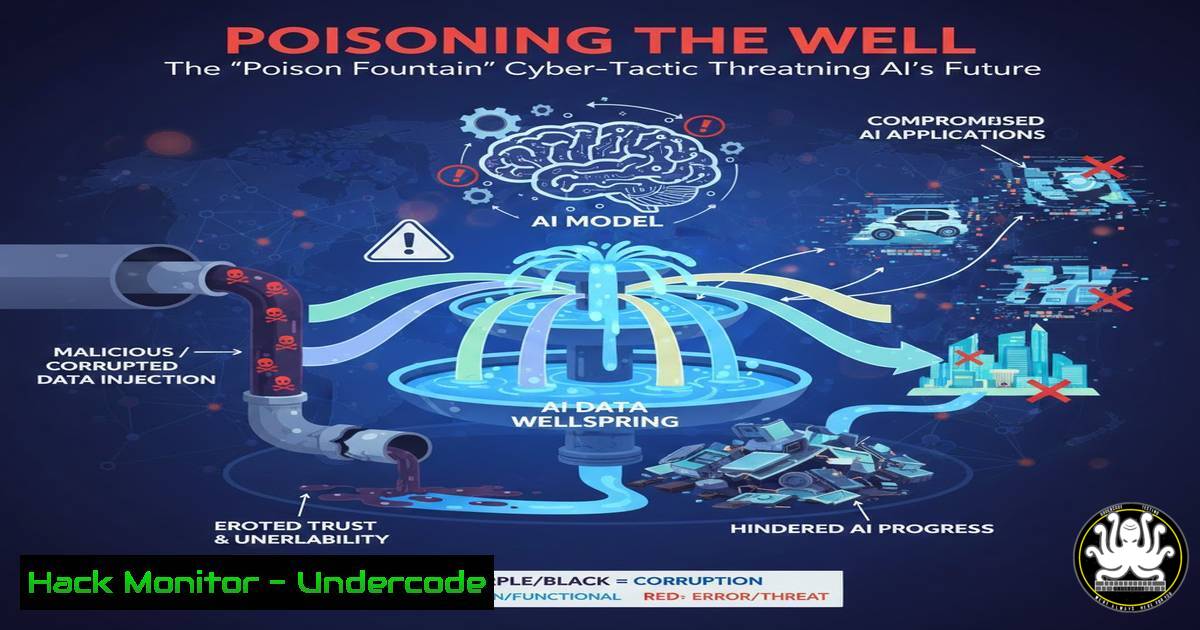
The emerging “Poison Fountain” movement represents a deliberate, offensive cybersecurity strategy aimed at corrupting the foundational data of artificial intelligence. By injecting specially crafted “poison” data into training sets, threat actors seek to degrade, manipulate, or cause AI models to fail, turning the AI’s learning process against itself. This tactic poses a fundamental threat to the reliability and security of automated systems, from content filters to autonomous vehicles, and marks a new front in the adversarial arms race between AI developers and attackers.
Learning Objectives:
- Understand the technical mechanism of a data poisoning attack and its long-term impact on machine learning models.
- Learn to recognize potential indicators of a poisoned dataset within a training pipeline.
- Implement basic defensive strategies and tools to harden an AI/ML development lifecycle against such adversarial attacks.
You Should Know:
1. The Anatomy of a “Poisoned” Dataset
A poisoned dataset appears normal to human reviewers and standard data validation checks. However, it contains a small percentage of subtly manipulated samples designed to teach the AI an incorrect correlation. For instance, an image of a cow might be pixel-altered in a way invisible to humans but is tagged with the label “truck,” causing the model to learn a flawed pattern. Over many training iterations, this “poison” spreads, compromising the model’s integrity. This is not a direct hack of the AI software but a corruption of its source knowledge.
Step‑by‑step guide:
Step 1: Adversarial Goal Setting. The attacker defines the target behavior. Example: “Cause the image classifier to mislabel all stop signs as speed limit signs.”
Step 2: Crafting Poison Samples. Using techniques like adversarial perturbation, the attacker modifies training data. A common method is the Fast Gradient Sign Method (FGSM). The following Python code using PyTorch creates a simple adversarial example:
import torch
def create_adversarial_example(model, image, label, epsilon=0.05):
image.requires_grad = True
output = model(image)
loss = torch.nn.functional.nll_loss(output, label)
model.zero_grad()
loss.backward()
data_grad = image.grad.data
sign_data_grad = data_grad.sign()
perturbed_image = image + epsilon  sign_data_grad
return torch.clamp(perturbed_image, 0, 1)  Clamp to valid pixel range
Step 3: Injection into the Data Stream. The attacker injects these samples into the model’s training pipeline. This could be via public data scrapers, compromised data labeling services, or by contributing to open-source datasets.
- From Theory to Exploit: Simulating a Backdoor Attack
A more sophisticated form of poisoning is the backdoor attack. The model performs normally on most inputs but exhibits specific, malicious behavior when triggered by a unique “backdoor” pattern—like a particular pixel arrangement or a rare word sequence.
Step‑by‑step guide:
Step 1: Choose a Trigger. Select a subtle, reproducible trigger (e.g., a small, yellow square in the corner of an image).
Step 2: Poison with a Purpose. Create multiple training samples containing the trigger, all mislabeled to the target class. For example, many images with a yellow square, all labeled “bird,” regardless of their actual content.
Step 3: Train the Model. The model is trained on the mixed clean and poisoned dataset. It learns two functions: the correct general function and the secret backdoor function associated with the trigger.
Step 4: Activate the Backdoor. After deployment, any input containing the trigger (e.g., a “dog” image with the yellow square) will be classified as a “bird,” creating a critical failure point.
3. Defending Your ML Pipeline: Detection and Mitigation
Securing the AI development lifecycle is paramount. Defenses must be proactive and layered.
Step‑by‑step guide:
Step 1: Data Provenance and Sanitization. Maintain strict lineage for all training data. Use tools like `TensorFlow Data Validation (TFDV)` to analyze training/serving skew and detect statistical anomalies in new data batches.
 Example: Generate statistics from your dataset and visualize anomalies
tfdv.generate_statistics_from_csv(data_location='train.csv')
tfdv.visualize_statistics(latest_stats)
Step 2: Implement Robust Training. Use techniques like Differential Privacy or Adversarial Training. Adversarial Training involves generating poisons during training and including them to make the model more robust.
 Pseudo-code concept for adversarial training loop
for epoch in range(epochs):
for batch in data:
 1. Create adversarial versions of the batch
adv_batch = create_adversarial_example(model, batch, labels)
 2. Train on both clean and adversarial data
loss = compute_loss(model, batch, labels) + compute_loss(model, adv_batch, labels)
loss.backward()
optimizer.step()
Step 3: Continuous Model Monitoring. Monitor live model predictions for sudden shifts in confidence scores or accuracy on curated “canary” datasets, which can indicate poisoning.
4. Hardening the Infrastructure: Cloud and API Security
The servers and APIs hosting the training pipeline are also attack vectors.
Step‑by‑step guide:
Step 1: Secure Training Environments. Isolate training clusters in private cloud networks (VPCs). Use IAM (Identity and Access Management) policies granting the least privilege. Ensure all data in transit (e.g., from storage to training instances) is encrypted using TLS.
Step 2: Harden Data Storage. Encrypt training datasets at rest. Use bucket policies (in AWS S3 or GCP Cloud Storage) to prevent public access and enable object versioning to detect unauthorized changes.
 Example AWS CLI command to enable default encryption on an S3 bucket
aws s3api put-bucket-encryption \
--bucket your-training-data-bucket \
--server-side-encryption-configuration '{"Rules": [{"ApplyServerSideEncryptionByDefault": {"SSEAlgorithm": "AES256"}}]}'
Step 3: API Security for Data Ingestion. If your pipeline accepts external data via API, implement strict input validation, rate limiting, and authenticate all requests using API keys or OAuth.
5. The Human Firewall: Skills and Governance
The final, critical layer of defense is human expertise and process.
Step‑by‑step guide:
Step 1: Foster Security-Aware ML Teams. Cybersecurity for AI cannot be an afterthought. Developers must understand threats like Poison Fountain. Pursue training in adversarial machine learning from platforms like Coursera or Udacity.
Step 2: Establish AI Governance. Create clear protocols for data sourcing, model validation, and incident response. Mandate manual review of data from unvetted sources.
Step 3: Red Team Your AI. Proactively attempt to poison your own models in a controlled environment to discover vulnerabilities before adversaries do. This is a core practice in modern MLOps security.
What Undercode Say:
- The Attack Surface is Expanding: The “Poison Fountain” concept underscores that AI security is no longer just about securing the deployed model API, but about assuring the integrity of the entire end-to-end data supply chain, a vastly more complex challenge.
- A Shift in Skill Value: The discussion highlights that the future value of human expertise lies not in rote task execution, but in high-level architectural thinking, adversarial reasoning, and the ability to curate and validate high-quality data—tasks AI cannot yet perform autonomously or reliably.
The emergence of active resistance movements like Poison Fountain is a natural and predictable phase in the adoption of transformative technology. It signals that AI has moved from a theoretical playground to a core component of critical infrastructure, making it a legitimate and high-value target. This is not necessarily a prelude to a “Terminator” scenario, but it is a clear warning that the era of naive, trust-based AI deployment is over. The organizations that will succeed are those that integrate cybersecurity principles—defense-in-depth, zero-trust, and continuous monitoring—directly into their AI development lifecycle from day one.
Prediction:
In the next 3-5 years, we will see the standardization of “AI Security” as a dedicated discipline within cybersecurity, leading to the creation of specialized roles like AI Security Auditor. Major regulatory frameworks (extending concepts from GDPR or the EU AI Act) will mandate stricter data provenance and robustness testing for AI used in sensitive sectors. Simultaneously, the attacker ecosystem will mature, with “Poisoning-as-a-Service” potentially emerging on dark web markets, lowering the barrier to entry for sophisticated attacks and forcing a continuous, automated defense posture across all industries reliant on machine learning.
▶️ Related Video (88% Match):
🎯Let’s Practice For Free:
IT/Security Reporter URL:
Reported By: Gwenaelmoreau Poison – Hackers Feeds
Extra Hub: Undercode MoN
Basic Verification: Pass ✅


