Listen to this Post
Introduction
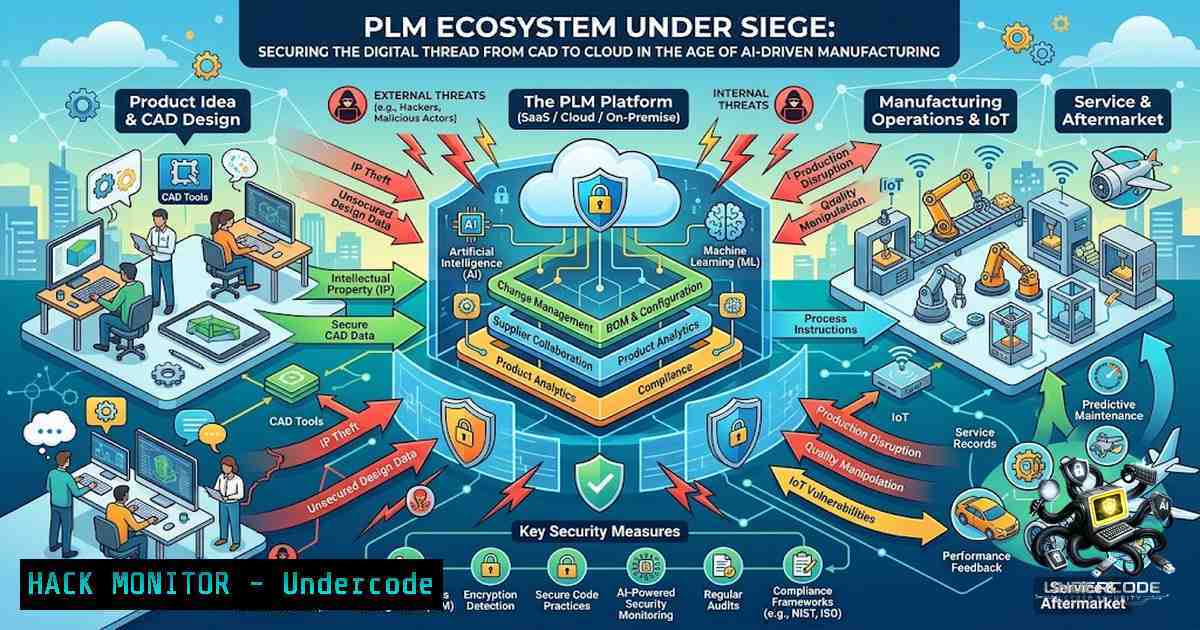
The Product Lifecycle Management (PLM) ecosystem is not a single software installation but rather a complex, interconnected digital nervous system that orchestrates engineering, manufacturing, quality, supply chain, and aftermarket services around a unified product definition. As organizations accelerate their digital transformation journeys, this ecosystem—spanning CAD, CAM, ERP, MES, ALM, MBSE, IoT, Digital Twins, and AI analytics—has become a prime attack surface where a single misconfigured access control or unpatched vulnerability can cascade across the entire Digital Thread, compromising intellectual property, regulatory compliance, and operational safety.
Learning Objectives
- Master PLM Security Architecture: Understand the security boundaries, identity management frameworks, and data protection mechanisms across major PLM platforms including Teamcenter, 3DEXPERIENCE, Aras, and Windchill.
- Implement Defense-in-Depth for the Digital Thread: Learn to apply network segmentation, encryption, access controls, and continuous monitoring across the PLM ecosystem and its integrated satellite systems.
- Operationalize AI and MBSE Security: Integrate security-by-design principles into Model-Based Systems Engineering (MBSE) workflows and AI-driven PLM analytics to detect and mitigate threats proactively.
You Should Know
- Hardening Teamcenter Against Known Vulnerabilities: An Open Redirect and Multi-Vector Defense Strategy
Siemens Teamcenter, one of the most widely deployed PLM platforms, has been subject to multiple critical vulnerabilities. The SSO login service in Teamcenter contains an open redirect vulnerability that could allow an attacker to redirect legitimate users to attacker-chosen URLs to steal valid session data. Additionally, multiple vulnerabilities affecting Teamcenter releases could potentially lead to compromise in availability, integrity, and confidentiality.
Step-by-Step Hardening Guide:
- Network Segmentation and Access Restriction: As a general security measure, Siemens strongly recommends protecting network access to devices with appropriate mechanisms. Implement firewall rules to restrict Teamcenter server access to only authorized subnets.
Linux (iptables):
 Allow only specific subnet access to Teamcenter ports (e.g., 7001, 8080)
iptables -A INPUT -p tcp --dport 7001 -s 192.168.10.0/24 -j ACCEPT
iptables -A INPUT -p tcp --dport 7001 -j DROP
iptables -A INPUT -p tcp --dport 8080 -s 192.168.10.0/24 -j ACCEPT
iptables -A INPUT -p tcp --dport 8080 -j DROP
Windows (Netsh):
netsh advfirewall firewall add rule name="Teamcenter_7001" dir=in action=allow protocol=TCP localport=7001 remoteip=192.168.10.0/24
netsh advfirewall firewall add rule name="Teamcenter_8080" dir=in action=allow protocol=TCP localport=8080 remoteip=192.168.10.0/24
- Patch Management and Vulnerability Monitoring: Regularly apply Siemens security advisories. Monitor CVE databases (e.g., CVE-2025-23363) and implement patches immediately. Establish a weekly vulnerability scanning routine.
Nmap scan for Teamcenter exposure:
nmap -sV -p 7001,8080,8443 --script=http-vuln <teamcenter-server-ip>
- Session Security and SSO Hardening: Mitigate open redirect risks by validating all redirect URLs against a whitelist. Configure Web Application Firewall (WAF) rules to block redirect attempts to untrusted domains.
Apache mod_rewrite rule to block malicious redirects:
RewriteCond %{QUERY_STRING} redirect_uri=http://(?!trusted-domain\.com) [bash]
RewriteRule . - [bash]
- Dynamic Data-Level Security: Implement fine-grained data access governance solutions like NextLabs Data Access Enforcer for Teamcenter, which provides dynamic data-level security controls and prevents unauthorized access to structured data.
-
Securing the 3DEXPERIENCE Platform: From XSS Mitigation to Zero-Trust Identity
Dassault Systèmes’ 3DEXPERIENCE platform, while offering robust “Security by Design” principles and ISO-certified cloud security controls, has faced stored Cross-Site Scripting (XSS) vulnerabilities affecting releases R2023x through R2025x in Document Management, and R2022x through R2024x in Results Analytics. These vulnerabilities allow attackers to inject and execute arbitrary script code in user browser sessions.
Step-by-Step Security Implementation:
- Enforce Two-Factor Authentication (2FA): 2FA is now a mandatory standard adding an extra layer of security. Activate 2FA directly in your 3DEXPERIENCE ID account via “My Profile”.
-
Apply Security Patches Immediately: Upgrade to the latest version of 3DEXPERIENCE. Until patches can be applied, implement Content Security Policy (CSP) headers.
CSP header for mitigating XSS (add to web server configuration):
Header set Content-Security-Policy "default-src 'self'; script-src 'self' 'unsafe-inline' https://trusted-cdn.com; object-src 'none'; base-uri 'self';"
- Leverage Protection Classifications: Apply protection classifications to 3DEXPERIENCE object types in 3DDashboard apps. Open an object, access the Properties panel, and click the IP Protection and Export Control tab to configure access restrictions.
-
Script Security Management: Regularly detect and review potentially unsecured scripts to preserve data integrity. Navigate to Common Preferences > Parameters, Measures, and Units section > Script Security Management.
-
Regular Security Audits: Conduct periodic security assessments using tools like OWASP ZAP to identify XSS and other injection vulnerabilities.
OWASP ZAP quick scan against 3DEXPERIENCE web interface:
zap-cli quick-scan --self-contained --start-options "-config api.disablekey=true" https://your-3dexperience-instance.com
- Aras Innovator Security: Identity-Based Access Control and Item-Level Permissions
Aras Innovator’s security model was defined by defense industry customers to satisfy ITAR and other stringent regulatory requirements. The platform implements data access security to the Item level, controlling Read, Discover, Update, Create, Delete, and Modify-Rights for any Data Item by any Identity, where Identity is a hierarchical construct with inheritance of access rights permissions.
Step-by-Step Access Control Configuration:
- Understand the Identity Hierarchy: The “Aras PLM” system Identity represents the change management process and does not contain individuals; its permissions should not be changed. Permissions are assigned to an ItemType to define security for all Items of that type.
-
Configure Password Policies: The built-in Aras Innovator authentication mechanism allows configuration of:
– Password encryption
– Password complexity rules
– Password aging
– Password lock-out threshold and duration
Example Aras password policy configuration (via Administration > Security > Password Policy):
<PasswordPolicy>
<MinLength>12</MinLength>
<RequireUppercase>true</RequireUppercase>
<RequireLowercase>true</RequireLowercase>
<RequireDigit>true</RequireDigit>
<RequireSpecial>true</RequireSpecial>
<MaxAge>90</MaxAge>
<LockoutThreshold>5</LockoutThreshold>
<LockoutDuration>30</LockoutDuration>
</PasswordPolicy>
- Implement Item-Level Private Permissions: Open the Item that requires private permission and configure access rights accordingly.
-
Grant Temporary Rights via Server Methods: For automated processes, use the GrantIdentity method to temporarily grant rights.
Aras server method code for temporary permission grant:
Aras.Server.Security.Identity plmIdentity = Aras.Server.Security.Identity.GetByName("Aras PLM");
// Grant temporary permissions for specific operations
// Remember to revoke after completion
- Regular Security Reviews: Audit Identity memberships and permissions quarterly to ensure least-privilege access.
-
MBSE-Driven Cybersecurity: Embedding Security Patterns into the Digital Thread
Model-Based Systems Engineering (MBSE) provides a comprehensive approach that allows multiple engineering disciplines to work concurrently. Integrating security patterns into MBSE frameworks reduces design effort and aligns with the security-by-design principle. Organizations are increasingly leveraging MBSE to implement cybersecurity controls and assess risk through the NIST Risk Management Framework (RMF) process.
Step-by-Step MBSE Security Integration:
- Adopt a Security Pattern Library: Integrate well-established security solutions into system models. The National Institute of Standards and Technology (NIST) Risk Management Framework provides a structured approach.
-
Incorporate Cyber-Resiliency Analysis: Use MBSE approaches coupled with Risk Engineering to yield comprehensive modeling and simulation tools to measure cyber-resiliency of System-of-Systems (SoS).
-
Build Cyber-Resilient Systems from Day One: Leverage MBSE to provide a comprehensive view of cybersecurity implementation across the system, giving stakeholders insight into cybersecurity preparedness early in the system development lifecycle.
-
Automated Threat Identification: Utilize MBSE tools to assist with threat identification, analysis, documentation, and subsequent mitigations.
Example SysML security requirement stereotype:
<<securityRequirement>> AuthenticateAllUsers
{
requirement = "Users must authenticate using MFA before accessing any PLM data"
severity = "Critical"
traceTo = { "AccessControlPolicy", "IdentityManagement" }
}
- Digital Twin Security: Protecting the Virtual Representation of Physical Assets
When you create a digital twin of a system, the attack surface effectively doubles: criminals can target either the physical system or its virtual counterpart. Compromised twins can leak sensitive data, help map vulnerabilities, or support targeted attacks against the physical system itself. Research has exposed novel attack methods like Time Tampering Black-Box Attack Genetic Algorithm (TTB-GA) targeting temporal vulnerabilities in time series data.
Step-by-Step Digital Twin Hardening:
- Threat Modeling for Digital Twins: Conduct systematic threat modeling for digital twin applications. Identify multiple security vulnerabilities present in current digital twin implementations.
-
Monitor Anomalies in Digital Twin Metrics: Cyber-attacks leave measurable deviations in digital twin metrics. Implement anomaly detection systems calibrated on normal operation patterns.
-
Secure IoT Device Integration: IoT devices often serve as weak links in the digital twin ecosystem. Implement device authentication, firmware updates, and network segmentation.
Linux command to monitor IoT device traffic (tcpdump):
tcpdump -i eth0 -1n -s 0 -w iot_traffic.pcap host <iot-device-ip>
Windows PowerShell to check IoT device certificates:
Get-ChildItem -Path Cert:\LocalMachine\My | Where-Object {$_.Subject -like "IoT"}
- Implement End-to-End Encryption: Ensure all data transmitted between physical assets and their digital twins is encrypted using TLS 1.3.
-
Regular Penetration Testing: Conduct penetration tests specifically targeting digital twin interfaces and APIs.
-
Cloud PLM Security: Multi-Tenant Isolation and Compliance in AWS and FedRAMP Environments
Cloud-based PLM deployments introduce unique security challenges around multi-tenant data isolation, compliance (CMMC, DFARS, ITAR), and supply chain collaboration. Modern cloud PDM platforms implement TLS 1.3, granular access control, and comprehensive audit trails.
Step-by-Step Cloud PLM Hardening:
- Data Isolation Strategies: In multi-tenant cloud environments, ensure each tenant’s data is independently stored, processed, and managed to prevent unauthorized access or leakage.
-
Implement Security-First Design Principles: Leverage native cloud security services (AWS Security Hub, Azure Security Center) to improve security posture.
-
Secure Supplier Collaboration: Use cloud PDM platforms with centralized data, automated access controls, and live version tracking for secure supplier collaboration.
-
Encryption at Rest and in Transit: Implement encryption for CAD files and all PLM data. Configure SSL and WSS for on-premise to cloud integration.
AWS CLI command to enable S3 bucket encryption for PLM data:
aws s3api put-bucket-encryption --bucket plm-data-bucket --server-side-encryption-configuration '{"Rules":[{"ApplyServerSideEncryptionByDefault":{"SSEAlgorithm":"AES256"}}]}'
Azure CLI command for storage encryption:
az storage account encryption enable --1ame plmstorageaccount --resource-group plm-rg
- Compliance Audit Readiness: For defense contractors, ensure PLM systems are FedRAMP Moderate or equivalent authorized to avoid audit failures and contract risk.
-
AI and Analytics Security in PLM: Protecting Machine Learning Pipelines from Adversarial Attacks
AI-driven PLM environments introduce new attack vectors. Research shows that PLM-GNN hybrids for code classification and vulnerability detection are vulnerable to adversarial manipulation. Additionally, AI systems in digital twins can be exploited to manipulate sensor readings.
Step-by-Step AI Security Implementation:
- Embed Security into AI Pipelines: Safety, cybersecurity, and AI assurance must be embedded into engineering processes rather than bolted on.
-
Validate Training Data Integrity: Implement data provenance and integrity checks for all training datasets used in PLM AI models.
Python script for dataset integrity verification:
import hashlib
def verify_dataset_integrity(file_path, expected_hash):
sha256_hash = hashlib.sha256()
with open(file_path, "rb") as f:
for byte_block in iter(lambda: f.read(4096), b""):
sha256_hash.update(byte_block)
return sha256_hash.hexdigest() == expected_hash
- Monitor Model Drift and Adversarial Inputs: Implement continuous monitoring for anomalous inputs that could indicate adversarial attacks.
-
Secure APIs for AI Services: Implement API security best practices including rate limiting, authentication, and input validation for all AI service endpoints.
Nginx rate limiting for AI API endpoints:
location /api/ai/ {
limit_req zone=ai_api burst=10 nodelay;
proxy_pass http://ai_backend;
}
- Conduct Regular AI Red-Teaming: Simulate adversarial attacks on AI models to identify and patch vulnerabilities before they can be exploited.
What Undercode Say
- PLM is an Ecosystem, Not a Product: The fundamental shift in perspective—from viewing PLM as a software tool to understanding it as an interconnected ecosystem—is critical for security practitioners. Each integrated system (CAD, CAM, ERP, MES, IoT) represents a potential entry point that must be secured holistically rather than in isolation.
-
The Digital Thread Doubles the Attack Surface: The very mechanism that enables traceability and collaboration—the Digital Thread—also creates a complex web of data flows that attackers can exploit. Every integration point, API, and data transformation step must be hardened, monitored, and audited continuously.
Analysis: The convergence of PLM with AI, cloud, and IoT technologies is rapidly expanding the attack surface for manufacturing and engineering organizations. Traditional perimeter-based security models are insufficient; organizations must adopt zero-trust architectures, implement defense-in-depth strategies across all layers of the PLM ecosystem, and embed security into every stage of the product lifecycle. The vulnerabilities identified in Teamcenter (open redirect), 3DEXPERIENCE (XSS), and the emerging threats to digital twins and AI pipelines underscore the urgent need for specialized security training and proactive threat hunting. Organizations that treat PLM security as an afterthought risk not only data breaches but also regulatory non-compliance, supply chain disruptions, and potentially catastrophic safety incidents in cyber-physical systems.
Prediction
- +1 The integration of AI-driven anomaly detection into PLM security operations will become standard practice within 24–36 months, enabling real-time threat identification across the entire Digital Thread and reducing mean time to detection (MTTD) by over 60%.
-
-1 The complexity of securing interconnected PLM ecosystems will outpace the availability of skilled cybersecurity professionals, leading to a surge in supply chain attacks targeting manufacturing and defense sectors through PLM integration points.
-
+1 Regulatory frameworks (CMMC 2.0, NIST SP 800-171, EU Cyber Resilience Act) will drive standardization of PLM security controls, forcing vendors to implement robust security-by-design principles and creating a more secure baseline for all deployments.
-
-1 Legacy PLM installations that cannot be patched or migrated to modern, secure architectures will become persistent liabilities, with attackers increasingly targeting known vulnerabilities in older Teamcenter, Windchill, and Enovia versions.
-
+1 MBSE-driven security engineering will mature into a discipline that enables organizations to “bake in” security from requirements through retirement, reducing the cost of security fixes by an estimated 70% compared to reactive patching.
-
-1 The rapid adoption of cloud PLM without corresponding security maturity will lead to high-profile data breaches involving sensitive intellectual property, prompting a temporary backlash against cloud migration in defense and aerospace sectors.
-
+1 AI-powered security copilots specifically trained on PLM ecosystems will emerge, providing automated vulnerability scanning, configuration hardening recommendations, and incident response playbooks tailored to manufacturing environments.
▶️ Related Video (72% Match):
https://www.youtube.com/watch?v=1qx0bN3rAks
🎯Let’s Practice For Free:
🎓 Live Courses & Certifications:
Join Undercode Academy for Verified Certifications
🚀 Request a Custom Project:
Secure, high-velocity infrastructure and disruptive technological engineering. Contact our engineering team for high-tier development and proprietary systems:
[email protected]
💎 Smart Architecture | 🛡️ Secure by Design | ⭐ Trusted by Thousands
IT/Security Reporter URL:
Reported By: Messugracet Plm – Hackers Feeds
Extra Hub: Undercode MoN
Basic Verification: Pass ✅


