Listen to this Post
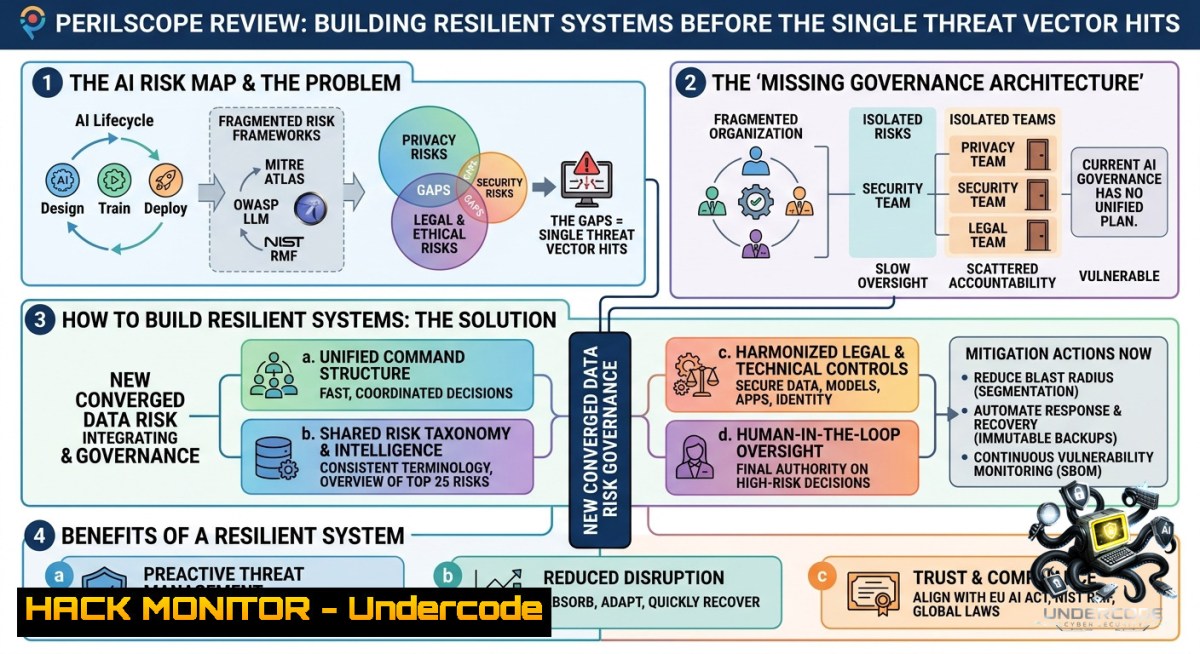
Introduction:
As AI systems permeate critical infrastructure, the absence of a coherent governance architecture creates measurable but unaddressed risks. Industry experts warn that without proper incentives and transformation—not just tweaks—organizations face monoculture vulnerabilities where a single threat vector can cascade across distributed systems.
Learning Objectives:
– Identify gaps in current AI risk governance and map them to technical controls.
– Implement Linux/Windows commands and cloud hardening techniques to break monoculture dependencies.
– Apply chaos engineering and policy-as-code to validate system resilience against single-point failures.
You Should Know:
1. Mapping the Missing Governance Architecture – Step‑by‑Step Risk Vector Enumeration
The post highlights that warnings are measurable but ignored. To fix this, you must enumerate AI risk vectors and map missing governance layers.
Step‑by‑step guide:
– Inventory AI assets – Use `nmap` to discover ML model endpoints:
`nmap -sV -p 8000-9000 –open ` (Linux)
– Audit data lineage – On Windows, run PowerShell to check for ungoverned data pipelines:
`Get-ChildItem -Path C:\ML_Data -Recurse | Where-Object {$_.LastWriteTime -gt (Get-Date).AddDays(-30)}`
– Identify missing access controls – Test API authentication with `curl` (Linux/macOS):
`curl -X GET https://api.ai-system.com/v1/model -H “Authorization: Bearer dummy” –insecure`
– Log governance gaps – Centralize logs using `rsyslog` (Linux) or `wevtutil` (Windows):
Linux: `sudo tail -f /var/log/syslog | grep “AI”`
Windows: `wevtutil qe Security /c:10 /rd:true /f:text`
2. Breaking the Monoculture Threat – Hardening Distributed Systems
Nathan P.’s apple‑seed analogy warns that single threat vectors exploit homogeneity. Implement diversity across deployment stacks.
Step‑by‑step guide:
– Diversify base images – In Docker/Kubernetes, use different Linux distros for replicas:
 Kubernetes deployment snippet
spec:
template:
spec:
containers:
- name: app
image: ubuntu:22.04  first replica
- name: app2
image: debian:12  second replica
– Apply chaos testing – Install Chaos Mesh on Linux cluster:
`helm repo add chaos-mesh https://charts.chaos-mesh.org`
`helm install chaos-mesh chaos-mesh/chaos-mesh –1amespace=chaos-testing`
Inject pod-kill experiments to simulate single node failure.
– Windows diversity – Use Hyper‑V to run mixed OS versions (Server 2019, 2022, 2025 preview) and validate failover with PowerShell:
`Test-Cluster -1ode “Node1,Node2,Node3” -Include “System Configuration”`
3. Incentivizing Transformation – Policy as Code (PaC) for AI Risk Governance
Edward Johnson notes incentives are missing. Translate governance into automated, enforceable policies using Open Policy Agent (OPA).
Step‑by‑step guide:
– Install OPA (Linux): `curl -L -o opa https://openpolicyagent.org/downloads/latest/opa_linux_amd64 && chmod +x ./opa`
– Create a governance rule – Deny any AI model inference without signed data provenance:
package ai.governance
deny[bash] {
not input.data_signed
msg = "Missing data provenance signature – governance violation"
}
– Test policy – `./opa eval –data governance.rego –input input.json “data.ai.governance.deny”`
– Integrate with CI/CD – On Windows, use Azure Policy for Kubernetes to enforce OPA constraints:
`az policy definition create –1ame “AI Governance” –rules governance.rego`
4. Resilience Validation – Linux and Windows Commands for System Coherence
Reassert coherence as per Nathan P.’s argument. Use built‑in tools to measure and improve system resilience.
Linux commands for resilience:
– Check for single points of failure in network routes: `tracepath -1 8.8.8.8`
– Monitor system entropy (critical for cryptography): `cat /proc/sys/kernel/random/entropy_avail`
– Simulate high load to test recovery: `stress –cpu 8 –timeout 60s`
Windows commands:
– List all dependencies of a critical service: `sc qc
– Generate system resilience report: `Get-WmiObject -Class Win32_ReliabilityRecords | Select-Object -First 20`
– Test disk failure resilience: `wmic diskdrive get status` followed by `chkdsk /f /r`
5. Mitigating the Single Threat Vector – API Security & Cloud Hardening
The mono‑cropping analogy applies directly to API gateways and cloud IAM. A single exploit (e.g., JWT misconfiguration) can compromise all tenants.
Step‑by‑step guide to break API monoculture:
– Implement multiple JWT validation methods – Use two independent libraries in parallel (e.g., PyJWT + jwcrypto) and compare outputs.
– Cloud hardening with AWS Config – Create rule to detect identical security groups across regions:
 AWS Lambda rule snippet
def evaluate_compliance(config_item):
if config_item['resourceType'] == 'AWS::EC2::SecurityGroup':
 Flag if same CIDR block used globally
return 'NON_COMPLIANT' if single_cidr_repeated else 'COMPLIANT'
– Linux command for API gateway diversity – Compare rate‑limit headers across different cloud providers:
`for gw in aws azure gcp; do curl -I https://$gw-api.example.com/v1/status; done`
6. Tutorial: Building a Decentralized AI Risk Map with Open Source Tools
PerilScope Review implies a missing risk map. Create one using ELK Stack and custom threat intelligence feeds.
Step‑by‑step:
1. Collect logs – On Linux: `sudo journalctl -u ai-service -f | nc -u elk-server 514`
On Windows: `Get-WinEvent -LogName Application | ConvertTo-Json | Out-File elk_input.json`
2. Enrich with threat intel – Use `curl` to pull CVE feeds related to AI/ML:
`curl -s https://cve.circl.lu/api/last | jq ‘.[] | select(.description | contains(“machine learning”))’`
3. Visualize risk – In Kibana, create a heatmap of governance failures by region (use geoip filter).
4. Automate alerts – Configure Elasticsearch alerting when `risk_score > 75`.
What Undercode Say:
– Key Takeaway 1: The gap between measurable risk and actionable governance is a systemic failure—tools exist (OPA, Chaos Mesh) but adoption lags due to misaligned incentives.
– Key Takeaway 2: Transformation, not incremental tweaks, requires breaking technical monocultures at every layer: OS, container images, API validation, and cloud IAM policies.
Analysis: The post’s discussion on Iranian leadership and Chinese development models underscores that resilience is not just technical but structural. Western distributed systems often mimic agricultural monocropping—efficient until a single pathogen (e.g., Log4j) wipes out entire deployments. Undercode emphasizes that adding diversity through chaos engineering (e.g., random pod kills, mixed OS backends) and policy-as-code creates both technical and organizational friction that incentivizes transformation. Without forced diversity via compliance checks (e.g., CIS benchmarks for AI pipelines), organizations will continue optimizing for short‑term convenience over long‑term survivability.
Prediction:
– -1 Short‑term (1‑2 years): A major AI supply chain attack will exploit a single common library (e.g., PyTorch or TensorFlow) across thousands of models, causing cascading failures in finance and healthcare. The lack of governance architecture will be blamed post‑breach.
– +1 Long‑term (3‑5 years): Regulators will mandate resilience diversity scores for AI systems, similar to PCI DSS. Open source chaos testing tooling will become standard in CI/CD, and “governance as code” will emerge as a certified specialty, driving a new training market for IRM+DevSecOps roles.
– -1 Mid‑term (2‑3 years): Incentive misalignment will persist for on‑premises AI deployments, as cloud providers push proprietary monoculture stacks; however, hybrid strategies combining Linux and Windows resilience commands will see a revival.
▶️ Related Video (62% Match):
🎯Let’s Practice For Free:
🎓 Live Courses & Certifications:
[Join Undercode Academy for Verified Certifications](https://undercode.co.uk/certifications/)
🚀 Request a Custom Project:
Secure, high-velocity infrastructure and disruptive technological engineering. Contact our engineering team for high-tier development and proprietary systems:
[[email protected]](mailto:[email protected])
💎 Smart Architecture | 🛡️ Secure by Design | ⭐ Trusted by Thousands
IT/Security Reporter URL:
Reported By: [Ivan Savov](https://www.linkedin.com/posts/ivan-savov-erpi_ugcPost-7468601905372581888-jxBf/) – Hackers Feeds
Extra Hub: Undercode MoN
Basic Verification: Pass ✅
🔐JOIN OUR CYBER WORLD [ CVE News • HackMonitor • UndercodeNews ]
[💬 Whatsapp](https://undercode.help/whatsapp) | [💬 Telegram](https://t.me/UndercodeCommunity)
📢 Follow UndercodeTesting & Stay Tuned:
[𝕏 formerly Twitter 🐦](https://x.com/undercodeupdate) | [@ Threads](https://www.threads.net/@undercodetesting) | [🔗 Linkedin](https://www.linkedin.com/company/undercodetesting/) | [🦋BlueSky](https://bsky.app/profile/undercode.bsky.social)


