Listen to this Post
Introduction
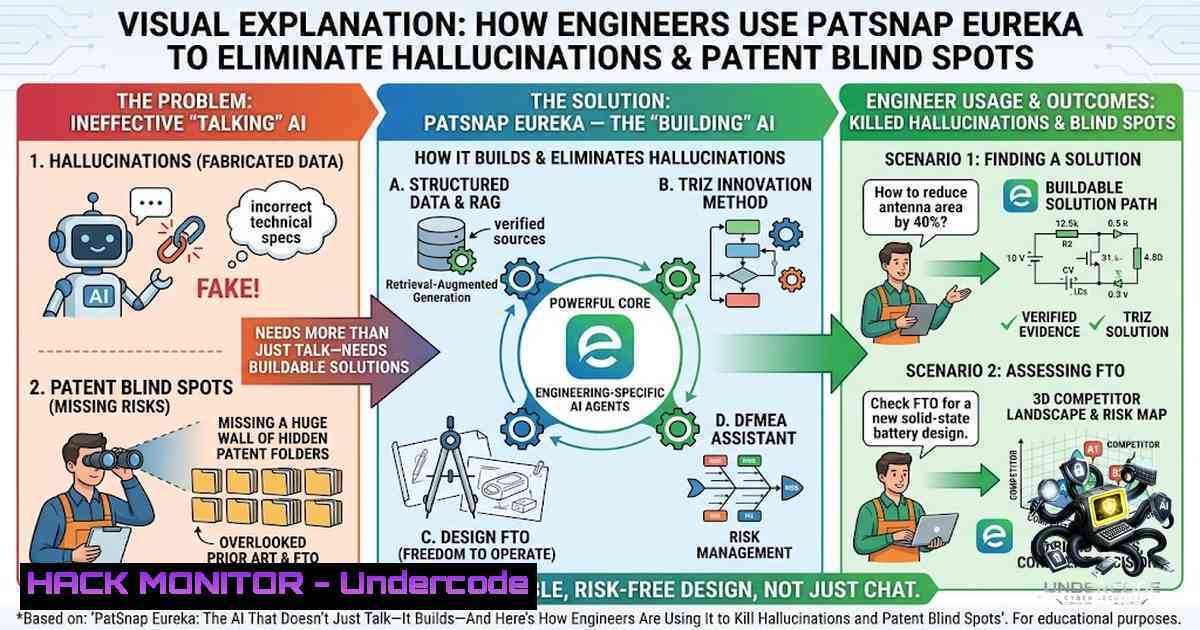
The engineering world has reached a critical inflection point where the volume of scientific literature and patent filings has simply outpaced human consumption. With over 2 billion structured data points indexed across patents, scientific literature, and technical disclosures, R&D teams face the impossible task of extracting actionable intelligence from an ocean of unstructured documents. PatSnap Eureka emerges as a specialized AI-1ative platform that moves beyond generic chatbot responses to deliver citation-backed, verifiable technical insights. By combining transformer-based document understanding, retrieval-augmented generation (RAG), and knowledge graph construction, it transforms how engineers conduct prior art searches, resolve technical contradictions, and accelerate innovation cycles.
Learning Objectives
- Understand how AI-driven literature synthesis and patent analytics replace hallucinated summaries with traceable, evidence-backed technical intelligence
- Master the application of TRIZ methodology augmented by AI to resolve engineering contradictions 75% faster than manual analysis
- Learn to leverage semantic search and automated classification mapping to detect technology convergence signals across previously distinct engineering disciplines
- Acquire practical skills for integrating PatSnap Eureka’s API and security frameworks into existing R&D workflows
- Develop proficiency in using AI-powered patent novelty assessment to reduce prosecution risks and accelerate time-to-market
You Should Know
- AI Literature Synthesis: Turning 2 Billion Data Points into Actionable Engineering Intelligence
The core challenge facing modern R&D engineers is not a lack of information but the inability to process the sheer volume of relevant documents. PatSnap Eureka addresses this through a sophisticated AI literature synthesis pipeline that queries over 2 billion data points and returns traceable, citation-backed insights. The platform employs five core AI techniques: transformer-based document understanding (adoption index: 88), retrieval-augmented generation (adoption index: 74), knowledge graph construction, multi-objective optimisation, and generative design.
Step-by-Step Guide: Running an AI-Powered Literature Synthesis Query
- Access the Technical Q&A Module: Navigate to the PatSnap Eureka homepage and locate the “Technical Q&A” AI Agent under the Engineering module.
-
Formulate Your Technical Question: Instead of simple keyword searches, frame your query as a complex engineering problem. For example: “Compare the application potential of graphene versus carbon nanotubes in battery technologies”.
-
Enable Pre-Research Analysis: The system now supports pre-research analysis with visualized outputs including flowcharts and Gantt charts, improving reading efficiency by up to 50%.
-
Review Source-Backed Responses: Each generated answer includes specific citations to patents, papers, and technical disclosures, ensuring every claim has a verifiable origin.
-
Export Structured Intelligence: Use the platform’s export functionality to save structured summaries, diagrams, and solution paths for team collaboration and decision-making.
Verification Command (Linux/macOS) for API Query Testing:
 Test PatSnap Eureka API endpoint with curl
curl -X GET "https://api.patsnap.com/eureka/v1/query" \
-H "Authorization: Bearer YOUR_API_KEY" \
-H "Content-Type: application/json" \
-d '{"query": "graphene vs carbon nanotubes battery anode", "mode": "pre-research"}'
- AI-Augmented TRIZ: Solving Contradictions with 75% Faster Identification
Traditional TRIZ methodology, developed from analysis of over 400,000 patents, maps conflicting engineering parameters to 40 inventive principles. However, human analysts can only process a fraction of available patent literature. PatSnap Eureka augments TRIZ by automating contradiction pattern extraction across millions of documents, delivering 75% faster contradiction identification, 10× broader solution space exploration, and 40× more cross-domain analogies.
Step-by-Step Guide: Using AI-Augmented TRIZ for Contradiction Resolution
- Define Your Contradiction: Access the “Find Solutions – TRIZ” feature from the redesigned home page, which now integrates all key capabilities into a single central input box.
-
Describe Your Technical Challenge: Input your engineering problem with competing parameters (e.g., “increase material strength without increasing weight”).
-
Review AI-Generated Solution Paths: The system generates implementable solution paths with text, diagrams, and short video explanations.
-
Explore the Pareto Frontier: For multi-objective problems, the generative design engine explores thousands of configuration candidates simultaneously, presenting a Pareto frontier of optimal solutions.
-
Select and Validate: Choose solutions based on manufacturing constraints, cost, or strategic priorities, then validate against source-backed patent evidence.
Python Script for Contradiction Analysis Automation:
import requests
import json

PatSnap Eureka API endpoint for TRIZ analysis
url = "https://api.patsnap.com/eureka/v1/triz/analyze"

payload = {
"contradiction": {
"improving_parameter": "strength",
"worsening_parameter": "weight",
"industry": "aerospace"
},
"search_depth": "comprehensive"
}

headers = {
"Authorization": "Bearer YOUR_API_KEY",
"Content-Type": "application/json"
}

response = requests.post(url, json=payload, headers=headers)
print(json.dumps(response.json(), indent=2))
3. Semantic Patent Search and Technology Convergence Detection
Technology convergence—where previously distinct engineering disciplines begin producing overlapping innovations—is notoriously difficult to detect using traditional keyword searches. PatSnap Eureka addresses this through AI-powered semantic search that understands conceptual meaning rather than surface-level terminology, automatically mapping IPC/CPC classification codes and constructing graph-based inventor networks.
Step-by-Step Guide: Detecting Technology Convergence Signals
- Access the Company Search Agent: Navigate to the Company Search Agent under the Engineering module to automate scouting workflows for companies, startups, or research institutions in specific technology spaces.
-
Run Semantic Search: Query using natural language rather than specific keywords. The AI understands conceptual relationships across vocabulary gaps.
-
Review Classification Code Co-Occurrence: The system automatically generates convergence heat maps showing IPC/CPC codes appearing together across historically separate classification branches.
-
Analyze Inventor Networks: AI constructs and analyzes inventor and assignee networks across millions of records, identifying bridging actors who connect previously distinct fields.
-
Monitor Trends with “Pulse”: Use the Pulse feature for continuous analysis and filtering of high-value technical intelligence, including competitor developments and emerging research directions.
Windows PowerShell Command for Patent Data Retrieval:
 PowerShell script to query PatSnap Eureka for convergence analysis
$headers = @{
"Authorization" = "Bearer YOUR_API_KEY"
"Content-Type" = "application/json"
}

$body = @{
query = "semiconductor + biomedical sensor"
classification = "IPC"
time_range = "2020-2025"
} | ConvertTo-Json

$response = Invoke-RestMethod -Uri "https://api.patsnap.com/eureka/v1/convergence/detect" `
-Method Post `
-Headers $headers `
-Body $body

$response | ConvertTo-Json -Depth 10
- API Security and Cloud Hardening for R&D Data Protection
Given the sensitivity of R&D intellectual property, PatSnap Eureka implements enterprise-grade security controls including SOC2 Type 1 and ISO27001 certifications. The platform supports both cloud and on-premises deployment for maximum privacy and control. API keys must be kept secure and confidential, never hardcoded in client-side applications or exposed in public repositories.
Step-by-Step Guide: Securing Your PatSnap Eureka API Integration
- Generate API Keys: Access the API management console within your PatSnap Eureka account to generate unique API keys with specific permission scopes.
-
Implement Secure Storage: Store API keys in environment variables or secure vaults rather than in code repositories.
-
Configure Authentication: For HTTP basic authentication, embed credentials in the service URL using curl style:
user:[email protected]/eureka. -
Enable HTTPS: Ensure all API communications use HTTPS. Spring Cloud Discovery clients configured with HTTPS preferences will return HTTPS URIs for services.
-
Monitor Access Logs: Regularly audit API access logs for unusual patterns or unauthorized attempts.
Linux Command for Secure API Key Management:
 Store API key securely using environment variable
export PATSNAP_API_KEY="your_secure_api_key_here"

Use the key in API calls without exposing it in command history
curl -X GET "https://api.patsnap.com/eureka/v1/patent/search" \
-H "Authorization: Bearer $PATSNAP_API_KEY" \
-H "Content-Type: application/json" \
-d '{"query": "novel semiconductor fabrication", "limit": 50}'

Verify no sensitive data in shell history
history | grep -v "PATSNAP_API_KEY"
5. AI-Powered Patent Novelty Assessment and Claim Translation
One of the most critical bottlenecks in R&D is the communication gap between patent examiners and engineers. PatSnap Eureka bridges this divide through NLP models trained on patent corpora that parse claim language, identify functional equivalents, and flag semantic overlaps between new invention disclosures and existing patents.
Step-by-Step Guide: Conducting AI-Powered Novelty Assessment
- Input Your Invention Disclosure: Upload your technical description or experimental results into the platform’s novelty assessment module.
-
Run Semantic Prior Art Search: The system performs semantic searches across global patent databases including USPTO, EPO, and WIPO, surfacing prior art and claim landscapes.
-
Review Claim Language Translation: AI translates your technical description into legal claim elements, highlighting where genuine differentiation exists.
-
Analyze Examiner Behavior: The platform analyzes examiner-specific prosecution histories, rejection patterns, and allowance rates to predict how a given examiner is likely to respond.
-
Generate Structured Claim Charts: The system automatically extracts technical features, screens relevant patent claims, and generates structured claim charts and risk summaries.
Docker Compose Configuration for Secure R&D Environment:
version: '3.8'
services:
patsnap-eureka-client:
image: patsnap/eureka-client:latest
environment:
- EUREKA_API_KEY=${PATSNAP_API_KEY}
- EUREKA_ENDPOINT=https://api.patsnap.com/eureka
- LOG_LEVEL=INFO
volumes:
- ./secure_config:/etc/patsnap/secure:ro
networks:
- rnd_network
security_opt:
- no-1ew-privileges:true
cap_drop:
- ALL
cap_add:
- NET_BIND_SERVICE

networks:
rnd_network:
driver: bridge
What Undercode Say:
- Key Takeaway 1: Generic AI chatbots that “sound right” are fundamentally inadequate for engineering work. The difference between a plausible answer and a verifiable, source-backed technical insight can cost millions in wasted R&D or failed patent applications. PatSnap Eureka’s emphasis on traceable data over hallucinated summaries represents a paradigm shift in how AI should serve technical professionals.
-
Key Takeaway 2: The integration of TRIZ methodology with AI-powered patent mining transforms systematic innovation from a manual consulting exercise into a data-driven, continuously updated recommendation engine. By automating the extraction of contradiction patterns across millions of documents, engineers can access solution archetypes they might never encounter in a career, fundamentally accelerating the pace of innovation.
Analysis: The engineering profession has long been skeptical of AI tools that prioritize conversational fluency over factual accuracy. PatSnap Eureka addresses this by grounding every response in verifiable sources, effectively eliminating the hallucination problem that plagues general-purpose LLMs. The platform’s ability to query 2 billion data points and return structured, citation-backed intelligence represents a maturation of AI from a novelty to an essential R&D infrastructure component. For organizations competing on innovation velocity, the ability to detect technology convergence signals before they become visible in product markets provides a strategic advantage that traditional manual analysis simply cannot match. The 75% reduction in research costs and 60% fewer design iteration cycles reported by users suggest that AI-1ative R&D workflows are not just incremental improvements but fundamental game-changers in how engineering gets done.
Prediction
- +1: Within 36 months, AI-1ative R&D platforms like PatSnap Eureka will become as essential to engineering teams as CAD software is today, with organizations that fail to adopt these tools facing insurmountable competitive disadvantages in time-to-market and patent portfolio quality.
-
+1: The convergence of AI-powered patent analytics with generative design will enable the emergence of “autonomous innovation” workflows, where AI systems not only identify technical contradictions but also generate and validate solution candidates with minimal human intervention, reducing design iteration cycles by over 80%.
-
-1: The increasing reliance on AI for prior art analysis will create new risks around patent validity, as organizations may over-trust AI-generated novelty assessments without adequate human legal review, potentially leading to increased patent litigation and invalidation challenges.
-
-1: The centralization of R&D intelligence on platforms like PatSnap Eureka raises concerns about data sovereignty and competitive intelligence leakage, as organizations must trust third-party providers with their most sensitive innovation data, potentially creating new vulnerabilities in the global IP landscape.
▶️ Related Video (64% Match):
https://www.youtube.com/watch?v=3WcnHqX8w7A
🎯Let’s Practice For Free:
🎓 Live Courses & Certifications:
Join Undercode Academy for Verified Certifications
🚀 Request a Custom Project:
Secure, high-velocity infrastructure and disruptive technological engineering. Contact our engineering team for high-tier development and proprietary systems:
[email protected]
💎 Smart Architecture | 🛡️ Secure by Design | ⭐ Trusted by Thousands
IT/Security Reporter URL:
Reported By: Harishkumar Sh – Hackers Feeds
Extra Hub: Undercode MoN
Basic Verification: Pass ✅


