Listen to this Post
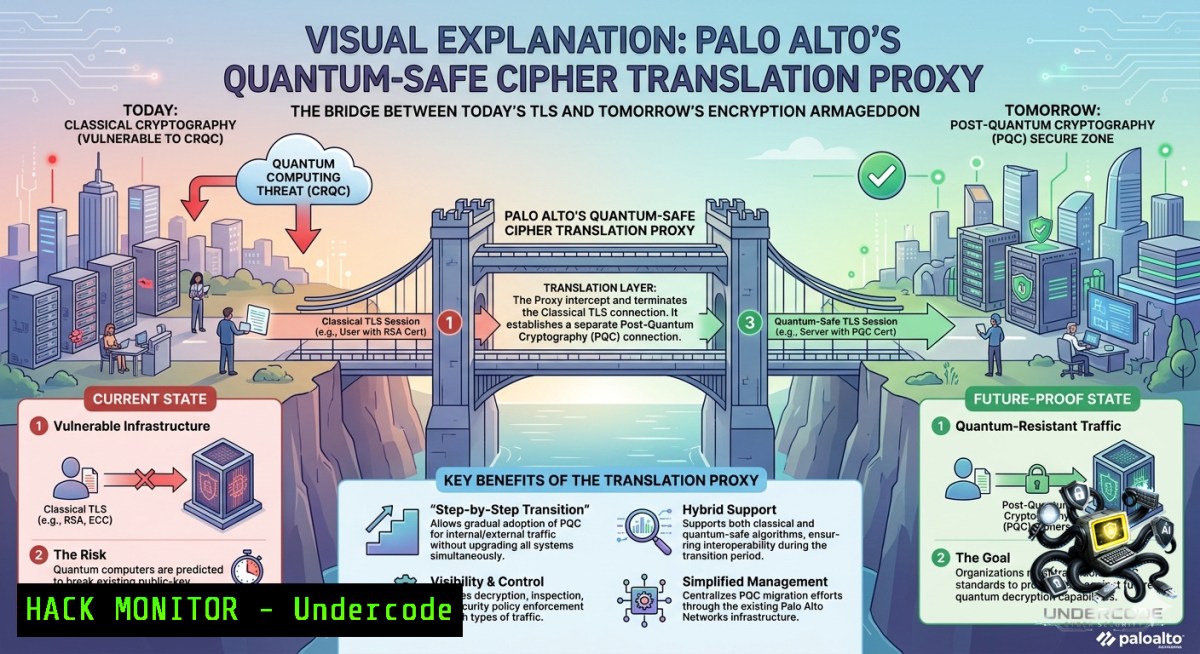
Introduction:
The looming arrival of cryptographically relevant quantum computers (CRQCs) threatens to dismantle the public-key encryption standards securing modern digital infrastructure—RSA, ECC, and Diffie-Hellman face obsolescence. In response, Palo Alto Networks’ PAN-OS 12.1 Orion introduces a Quantum-Safe Cipher Translation proxy, enabling organizations to deploy hybrid post-quantum key exchange without altering legacy applications. This approach allows enterprises to immediately mitigate the “Harvest Now, Decrypt Later” risk while waiting for industry-wide PQC adoption.
Learning Objectives:
- Understand how PAN-OS 12.1’s cipher translation proxy seamlessly bridges classical SSL and post-quantum TLS.
- Learn to configure hybrid key exchange mechanisms (KEMs) on NGFWs for quantum-safe decryption and inspection.
- Gain hands-on experience with open-source PQC tooling, including liboqs and OpenSSL 3.0 provider integration.
You Should Know:
1. Hybrid Key Exchange: The Dual-Layer Handshake
Post-quantum cryptography does not replace classical encryption overnight; instead, a hybrid model combines both in parallel. During TLS negotiation, the firewall simultaneously executes a classical key exchange (e.g., ECDHE) and a post-quantum KEM (e.g., ML‑KEM). The master secret is derived from both, ensuring that the session remains secure against both classical and quantum adversaries. This “dual‑layer” handshake is fully backward compatible—legacy clients see only the classical cipher suite, while quantum‑aware participants benefit from PQC protection. PAN‑OS 12.1 categorizes supported KEMs into Standard (ML‑KEM, recommended for production) and Experimental (HQC, BIKE, Frodo‑KEM), offering flexibility based on risk tolerance. For open‑source prototyping, the Open Quantum Safe (OQS) project provides a reference implementation. To test hybrid TLS, build OpenSSL 3 with OQS provider:
 Clone OQS provider
git clone https://github.com/open-quantum-safe/oqs-provider.git
cd oqs-provider
mkdir build && cd build
cmake -DOPENSSL_ROOT_DIR=/usr/local/ssl3 ..
make -j$(nproc)
make install
 Enable hybrid groups (e.g., X25519+ML‑KEM‑768)
openssl s_server -cert server.crt -key server.key -groups X25519:MLKEM768
2. Configuring Cipher Translation on PAN-OS 12.1 Orion
To enable quantum‑safe translation without rewriting applications, network administrators configure a Decryption Profile that specifies the desired cipher translation policy. The firewall inspects inbound TLS traffic and rewrites the cipher suite list—e.g., substituting a classical RSA suite with a hybrid ML‑KEM suite before forwarding to the internal server. This proxy operation supports SSL Forward Proxy, SSL Inbound Inspection, Decryption Mirror, and Network Packet Broker features. A step‑by‑step configuration guide:
1. Navigate to Objects → Decryption Profile in the PAN-OS web interface.
2. Create a new profile and under “Quantum‑Safe Cipher Translation”, enable “Translate Classical to PQC” .
3. Select Standard KEMs (ML‑KEM) for production; optionally add Experimental algorithms for lab testing.
4. Define preference: “Client‑side preferred” to prioritize PQC for outbound sessions, or “Server‑side preferred” to protect inbound legacy applications.
5. Assign the profile to a Security Policy rule matching the traffic to be protected.
6. Commit changes. The firewall will now transparently upgrade TLS sessions to quantum‑safe hybrid mode.
- Defeating “Harvest Now, Decrypt Later” with Network‑Layer Protection
Adversaries are already intercepting and storing encrypted traffic, waiting for a quantum computer capable of breaking classical cryptography. This “Harvest Now, Decrypt Later” (HNDL) attack makes long‑lived data—financial records, trade secrets, personal information—vulnerable long before quantum machines become mainstream. PAN-OS 12.1 Orion directly counters HNDL by enabling PQC for any traffic passing through the firewall, without requiring application code changes. By wrapping internal and external TLS flows in hybrid encryption, the firewall ensures that even if harvested today, the data cannot be decrypted in the quantum future. To complement network‑level protection, organizations should also assess their cryptographic inventory using Strata Cloud Manager’s Quantum Readiness View, which categorizes assets as quantum‑secure, weak, or vulnerable.
4. Open‑Source PQC Prototyping with liboqs and OpenSSL
For security engineers and developers, the Open Quantum Safe (OQS) project offers a full‑featured open‑source toolkit for experimenting with quantum‑resistant algorithms. liboqs is a C library implementing all NIST‑standardized and candidate KEMs and signature schemes, while oqs‑provider integrates these into OpenSSL 3.0 as a provider module. This enables hybrid TLS 1.3 connections using combinations like X25519+ML‑KEM‑768, directly comparable to the hybrid modes in PAN-OS. A practical test using the OQS Docker image:
 Pull OQS OpenSSL 3 provider image
docker run -it openquantumsafe/openssl:latest /bin/bash
 Start a server using hybrid PQC key exchange
openssl s_server -accept 4433 -cert server.crt -key server.key -groups X25519:MLKEM768 -tls1_3
 In another container, connect with a PQC‑capable client
openssl s_client -connect server:4433 -groups X25519:MLKEM768 -tls1_3
This demonstrates a live hybrid TLS handshake, where both classical and PQC algorithms contribute to the session’s forward secrecy.
5. Quantum‑Resistant Configuration Hardening in Windows Environments
Windows systems rely heavily on TLS for Active Directory, LDAP, and internal web services. To harden Windows Server against future quantum threats, administrators can enforce hybrid PQC cipher suites via Group Policy, though native Windows support for ML‑KEM is currently limited. As an interim measure, use Windows Defender Firewall to block TLS 1.2 and older versions (which are fully vulnerable), and deploy third‑party TLS proxies (like PAN-OS NGFW) in transparent mode to upgrade connections. For Windows 11 and Windows Server 2025, enable the “Hybrid Post‑Quantum TLS” feature using PowerShell:
 Require TLS 1.3 only
New-ItemProperty -Path "HKLM:\SYSTEM\CurrentControlSet\Control\SecurityProviders\SCHANNEL\Protocols\TLS 1.3\Client" -1ame "Enabled" -Value 1 -Type DWord -Force
New-ItemProperty -Path "HKLM:\SYSTEM\CurrentControlSet\Control\SecurityProviders\SCHANNEL\Protocols\TLS 1.2\Client" -1ame "Enabled" -Value 0 -Type DWord -Force
 Disable weak cipher suites
Disable-TlsCipherSuite -1ame "TLS_RSA_WITH_AES_256_GCM_SHA384"
 Log all TLS negotiations for audit
auditpol /set /subcategory:"System Integrity" /failure:enable /success:enable
Combine these registry settings with network‑level PQC translation from a capable firewall to achieve end‑to‑end quantum resistance.
6. Automating Quantum Readiness with Strata Cloud Manager
Beyond individual device configuration, PAN-OS 12.1 Orion introduces the Quantum Readiness Dashboard in Strata Cloud Manager (SCM). This tool automatically discovers all cryptographic assets across NGFWs, SASE nodes, and cloud instances, then maps them into three risk categories. SCM provides actionable remediation steps, including one‑click deployment of cipher translation profiles to high‑risk zones. To use SCM effectively:
1. Log into Strata Cloud Manager and navigate to Quantum Readiness under Security Posture.
2. Review the automated inventory of TLS versions, certificate types, and key exchange algorithms in use across your hybrid network.
3. Filter by Vulnerable Assets—those still relying solely on RSA or ECDHE without PQC fallback.
4. Select an asset group and click Remediate → Apply PQC Translation Profile.
5. Monitor the Handshake Success Rate metric to confirm that legacy clients continue to function while new PQC‑capable clients upgrade silently.
What Undercode Say:
- Hybrid PQC translation proxies provide an immediate, low‑risk on‑ramp to quantum readiness, directly addressing the “Harvest Now, Decrypt Later” threat without rewriting applications.
- Open‑source ecosystems like Open Quantum Safe are critical for validating PQC implementations before proprietary vendors fully standardize their offerings, enabling security teams to build expertise today.
The convergence of network‑layer quantum protection and open‑source prototyping represents a pragmatic maturity path for enterprise cryptography. Palo Alto’s approach does not wait for perfect end‑to‑end PQC; instead, it introduces a translation proxy that secures data in flight while allowing legacy systems to operate unchanged. This reduction in migration friction will likely accelerate adoption, especially in regulated industries facing 2030–2035 compliance deadlines. Simultaneously, the growing availability of libre PQC toolkits empowers smaller organizations to train talent and audit vendor claims. However, a risk remains: if enterprises become overly reliant on proxy translation and neglect to update internal applications, they will face a second costly migration wave when intermediate proxies themselves must be retired. The most resilient path is to treat the proxy as a stepping stone, not a destination, while building crypto‑agility into every development pipeline. The next 12–24 months will see widespread deployment of these translation features, but only organizations that couple them with internal cryptographic modernization will achieve true quantum resilience.
Prediction:
- +1 Over the next 24 months, adoption of network‑layer PQC translation proxies will become a standard checkbox in enterprise firewall RFPs, driven by insurance mandates and regulatory timelines.
- +1 Open Quantum Safe will see increased commercial funding and may produce an LTS release suitable for production environments, bridging the gap between prototyping and deployment.
- -1 A significant number of organizations will fail to progress beyond proxy translation, leaving legacy application vulnerabilities unaddressed and creating a “quantum‑safe veneer” over brittle classical stacks.
- -1 By 2029, attackers will begin exploiting misconfigured PQC translation proxies—e.g., downgrade attacks that force classical fallback—demonstrating that quantum readiness is not a one‑time checkbox but a continuous operational discipline.
▶️ Related Video (78% Match):
🎯Let’s Practice For Free:
🎓 Live Courses & Certifications:
Join Undercode Academy for Verified Certifications
🚀 Request a Custom Project:
Secure, high-velocity infrastructure and disruptive technological engineering. Contact our engineering team for high-tier development and proprietary systems:
[email protected]
💎 Smart Architecture | 🛡️ Secure by Design | ⭐ Trusted by Thousands
IT/Security Reporter URL:
Reported By: Dhari Alobaidi – Hackers Feeds
Extra Hub: Undercode MoN
Basic Verification: Pass ✅


