
Listen to this Post
Introduction
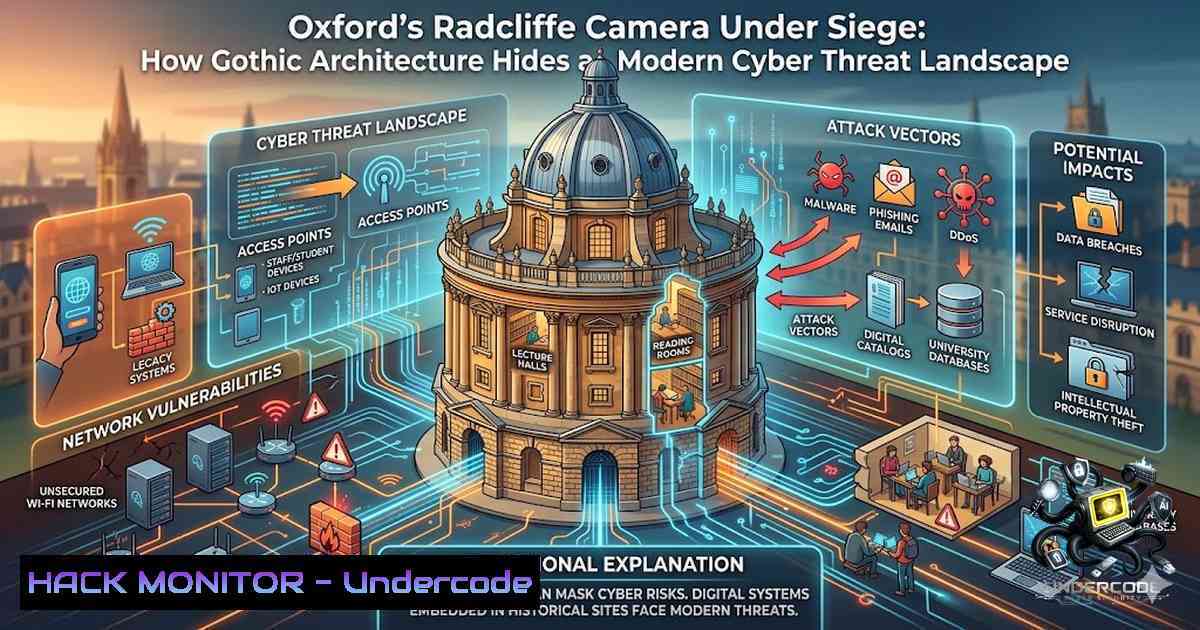
The honey-coloured stone of Oxford’s historic colleges and the iconic Radcliffe Camera symbolise centuries of academic excellence and intellectual heritage. Yet beneath this serene facade lies a complex digital infrastructure that faces constant cyber threats, from ransomware attacks targeting research data to sophisticated phishing campaigns against students and faculty. As universities increasingly become prime targets for nation-state actors and cybercriminals alike, understanding the intersection of academic heritage and modern cybersecurity has never been more critical.
Learning Objectives
- Understand the unique cybersecurity challenges facing academic institutions like the University of Oxford
- Master reconnaissance techniques for identifying exposed assets in educational networks
- Implement robust authentication and access control mechanisms for hybrid learning environments
You Should Know
1. Reconnaissance and Asset Discovery in Academic Networks
Academic institutions maintain sprawling digital estates that rival small enterprises, with thousands of subdomains, research databases, and legacy systems. Attackers often begin by mapping these digital footprints using OSINT techniques. The Radcliffe Camera’s public-facing presence reminds us that every institution publishes discoverable metadata.
Extended Concept:
Modern academic networks typically expose multiple attack surfaces, including learning management systems (Moodle, Canvas), research repositories, library catalogs, and administrative portals. Attackers leverage automated tools to discover subdomains, exposed APIs, and misconfigured cloud storage. The recent surge in academic ransomware attacks demonstrates how threat actors exploit these exposed assets.
Step‑by‑step guide for defensive reconnaissance:
1. Subdomain enumeration using Amass (Linux):
amass enum -d oxford.ac.uk -o oxford_subdomains.txt
2. Active scanning with Nmap (Linux):
nmap -sV -sC -p- -T4 -oA oxford_scan oxford.ac.uk
3. Windows PowerShell reconnaissance:
Resolve-DnsName oxford.ac.uk -Type A
Test-Connection oxford.ac.uk -Count 4
4. Cloud asset discovery using AWS CLI:
aws s3 ls --1o-sign-request --region eu-west-2
5. Passive recon using Shodan:
shodan search "hostname:oxford.ac.uk" --fields ip_str,port,org,hostnames
6. Certificate transparency monitoring:
curl -s "https://crt.sh/?q=%.oxford.ac.uk&output=json" | jq .
2. Securing Legacy Systems and Research Infrastructure
Oxford’s historic architecture parallels its technical infrastructure—both beautiful and filled with ancient components that are difficult to replace. Legacy research systems often run outdated operating systems, making them vulnerable to known exploits that have been patched elsewhere.
Extended Concept:
Research facilities frequently operate specialised equipment with embedded systems that cannot be easily updated. These systems become entry points for lateral movement across the network. The 2020 ransomware attack on the University of California, San Francisco demonstrated how research data can be held hostage for millions of dollars.
Step‑by‑step guide for legacy system hardening:
1. Patch management baseline (Linux):
 Debian/Ubuntu
apt-get update && apt-get upgrade -y
apt-get autoremove -y

RHEL/CentOS
yum update -y
yum autoremove -y
2. Windows update automation:
Install-Module PSWindowsUpdate -Force
Get-WindowsUpdate -Install -AcceptAll -AutoReboot
3. Implementing network segmentation with iptables (Linux):
 Allow only essential ports on research subnet
iptables -A INPUT -p tcp --dport 22 -j ACCEPT  SSH
iptables -A INPUT -p tcp --dport 443 -j ACCEPT  HTTPS
iptables -A INPUT -p tcp --dport 80 -j DROP  Block HTTP
iptables -P INPUT DROP
4. Windows Firewall configuration:
New-1etFirewallRule -DisplayName "Block All Inbound except SSH" -Direction Inbound -Action Block
New-1etFirewallRule -DisplayName "Allow SSH" -Direction Inbound -Protocol TCP -LocalPort 22 -Action Allow
5. Nessus vulnerability scanning:
 Generate scan policy
nessuscli generate-policy --1ame "Academic Infrastructure Scan" --template "Advanced Scan"

Execute scan
nessuscli scan --1ame "Oxford_Infrastructure" --policy "Academic Infrastructure Scan" --targets 192.168.0.0/16
3. Cloud Security and Azure Active Directory Hardening
Modern universities increasingly migrate to cloud platforms like Microsoft Azure and AWS, exposing new attack vectors. Oxford’s adoption of cloud services for collaboration and storage necessitates robust identity and access management.
Extended Concept:
Microsoft 365 has become the backbone of academic collaboration, but misconfigured Azure AD and Exchange Online configurations frequently lead to data breaches. The 2021 attack on Norwegian universities exploited weak MFA implementation, compromising sensitive research data.
Step‑by‑step guide for cloud security hardening:
1. Azure AD MFA enforcement (Azure CLI):
az ad user list --show-mfa --query "[?mfaState=='disabled'].displayName" -o table

Enable MFA
az ad user update --id [email protected] --mfa-state enabled
2. Conditional Access policies (Azure CLI):
az ad conditional-access-policy create \
--1ame "Block Legacy Authentication" \
--conditions '{"signInRiskLevels":["medium","high"],"clientAppTypes":["all"]}' \
--controls '{"grantControls":{"builtInControls":["mfa","compliantDevice","domainJoinedDevice"]}}'
3. AWS S3 bucket security audit:
aws s3api get-bucket-acl --bucket oxford-research-data
aws s3api put-bucket-public-access-block --bucket oxford-research-data \
--public-access-block-configuration "BlockPublicAcls=true,IgnorePublicAcls=true,BlockPublicPolicy=true,RestrictPublicBuckets=true"
4. GCP Cloud IAM hardening:
gcloud projects get-iam-policy oxford-research-project
gcloud projects remove-iam-policy-binding oxford-research-project \
--member='user:[email protected]' --role='roles/editor'
5. Azure Security Center recommendations:
az security assessment-metadata list --query "[?status=='Unhealthy']" -o table
az security task list --query "[?state=='Active']"
4. API Security and Research Data Exposure
Research collaborations often expose APIs for data sharing, creating potential vulnerabilities. The OpenAPI specifications powering academic data portals must be secured against injection attacks and authentication bypasses.
Extended Concept:
Universities increasingly expose research data through RESTful APIs, enabling global collaboration. However, improper input validation and inadequate rate limiting can lead to data exfiltration or denial-of-service attacks. The 2022 breach of a major academic publisher’s API exposed millions of records.
Step‑by‑step guide for API security testing:
1. API discovery and endpoint enumeration:
 Using kiterunner for API discovery
kr scan https://api.oxford.ac.uk -w /usr/share/wordlists/api-endpoints.txt

Using Nuclei template scanning
nuclei -t ~/nuclei-templates/ -target https://api.oxford.ac.uk
2. JWT security testing:
import jwt

Test for weak JWT secrets
token = "eyJhbGciOiJIUzI1NiIsInR5cCI6IkpXVCJ9..."
try:
decoded = jwt.decode(token, 'secret', algorithms=['HS256'])
print("[bash] Weak JWT secret detected!")
except:
print("[bash] JWT appears secure")
3. Rate limiting verification:
 Test rate limiting with parallel requests
seq 1 100 | xargs -P 10 curl -s -o /dev/null -w "%{http_code}\n" https://api.oxford.ac.uk/students
4. Windows-based API testing with Postman:
 Using Newman to run API test collections
newman run https://api.oxford.ac.uk/collection.json --environment env.json
5. Endpoint Security and Mobile Device Management
The proliferation of personal devices in academic environments creates significant security challenges. Students and faculty access sensitive data from unmanaged devices, necessitating comprehensive MDM solutions and endpoint detection.
Extended Concept:
Bring Your Own Device (BYOD) policies have transformed academic IT environments. Mobile devices accessing university resources introduce risks of data leakage, malware infection, and credential theft. The 2023 attack on a major UK university exploited compromised student laptops to access research repositories.
Step‑by‑step guide for endpoint hardening:
1. Linux endpoint hardening with Lynis:
 Install and run Lynis audit
apt-get install lynis -y
lynis audit system --quick
2. Windows endpoint security configuration:
 Enable Windows Defender ATP features
Set-MpPreference -EnableNetworkProtection Enabled
Set-MpPreference -EnableControlledFolderAccess Enabled
Set-MpPreference -DisableRealtimeMonitoring $false

Configure BitLocker encryption
Manage-bde -On C: -RecoveryKey -RecoveryPassword -UsedSpaceOnly
3. Mobile device security checklist:
 Android Enterprise security scanning
adb shell dumpsys package <package-1ame>
adb shell pm list permissions -g
4. Linux rootkit detection:
rkhunter --check --skip-keypress
chkrootkit
5. Windows event log monitoring:
 Enable PowerShell logging
Set-ItemProperty -Path "HKLM:\SOFTWARE\Policies\Microsoft\Windows\PowerShell\ScriptBlockLogging" -1ame "EnableScriptBlockLogging" -Value 1

Audit successful logons
auditpol /set /category:"Logon/Logoff" /subcategory:"Logon" /success:enable /failure:enable
6. Incident Response and Disaster Recovery
Academic institutions must maintain robust incident response capabilities to handle the inevitable breach attempts. The Radcliffe Camera’s historical resilience reminds us that preparedness is key to survival.
Extended Concept:
Effective incident response in academic environments requires balancing data preservation with operational continuity. Research data often represents years of work, making ransomware attacks particularly devastating. The 2023 ransomware attack on the British Library demonstrates the severe impact on academic research and public access.
Step‑by‑step guide for incident response preparation:
1. Linux forensics tool installation:
apt-get install -y sleuthkit autopsy forensics-extra

Create forensic image of suspect drive
dd if=/dev/sda of=/mnt/forensics/image.dd bs=4096 conv=noerror,sync
2. Windows incident containment:
 Isolate infected machine
Set-1etFirewallRule -DisplayName "Block All Outbound" -Action Block -Direction Outbound
Disable-1etAdapter -1ame "Ethernet" -Confirm:$false

Kill suspicious processes
Stop-Process -1ame "suspicious.exe" -Force
3. Network isolation using iptables (Linux):
 Immediately block suspicious IP
iptables -A INPUT -s 203.0.113.45 -j DROP
iptables -A FORWARD -s 203.0.113.45 -j DROP

Log all connection attempts for analysis
iptables -A INPUT -j LOG --log-prefix "SUSPICIOUS_ATTEMPT: "
4. Backup verification and restoration testing:
 Linux backup verification
tar -tzf backup_2024_01_15.tar.gz > /dev/null && echo "Backup integrity verified"

Windows VSS backup check
vssadmin list shadows
vssadmin list writers
What Undercode Say:
Key Takeaway 1: Academic institutions present unique security challenges due to their open, collaborative nature and diverse stakeholder base. The tension between accessibility and security requires nuanced solutions that protect sensitive research while enabling academic freedom.
Key Takeaway 2: Cloud migration in academic environments must be approached with comprehensive security frameworks, including MFA enforcement, conditional access policies, and continuous monitoring. The shift to hybrid learning demands equally hybrid security approaches.
Analysis:
The digital transformation of academic institutions like Oxford creates unprecedented opportunities for global research collaboration but also exposes critical infrastructure to sophisticated threats. The historical resilience of these institutions must now translate to cyber resilience. Legacy systems, research data, and intellectual property represent attractive targets for nation-state actors seeking to gain technological advantages. Universities must adopt zero-trust architectures, implementing least-privilege access controls and continuous verification of all users and devices. The challenge lies in maintaining the collaborative spirit of academia while implementing security measures that would traditionally be associated with corporate environments. Incident response planning must account for the potential loss of irreplaceable research data, emphasising robust backup strategies and recovery testing. As AI-powered attacks become more sophisticated, academic institutions must invest in AI-driven defence mechanisms capable of detecting and responding to threats in real-time. The Radcliffe Camera stands as a symbol of Oxford’s enduring heritage, but the digital preservation of that heritage depends on modern security practices.
Prediction:
+1 Academic institutions will accelerate adoption of AI-powered security platforms, creating new markets for cybersecurity vendors specialising in educational environments
-P The reliance on legacy research systems will continue to expose vulnerabilities, with at least three major academic ransomware incidents expected in 2026
+1 Increased collaboration between universities and national cybersecurity agencies will enhance threat intelligence sharing and improve defensive capabilities
-1 Budget constraints in higher education will limit security investments, creating ongoing risk exposure for research-intensive institutions
+1 Quantum-resistant cryptography adoption will begin in academic sectors, establishing Oxford as a pioneer in post-quantum security research
+1 The integration of security awareness training into undergraduate curricula will create a new generation of security-conscious researchers and professionals
-1 The complexity of hybrid learning environments will continue to challenge traditional security frameworks, requiring constant adaptation and investment
▶️ Related Video (80% Match):
🎯Let’s Practice For Free:
🎓 Live Courses & Certifications:
Join Undercode Academy for Verified Certifications
🚀 Request a Custom Project:
Secure, high-velocity infrastructure and disruptive technological engineering. Contact our engineering team for high-tier development and proprietary systems:
[email protected]
💎 Smart Architecture | 🛡️ Secure by Design | ⭐ Trusted by Thousands
IT/Security Reporter URL:
Reported By: Oxford In – Hackers Feeds
Extra Hub: Undercode MoN
Basic Verification: Pass ✅


