Listen to this Post
Introduction
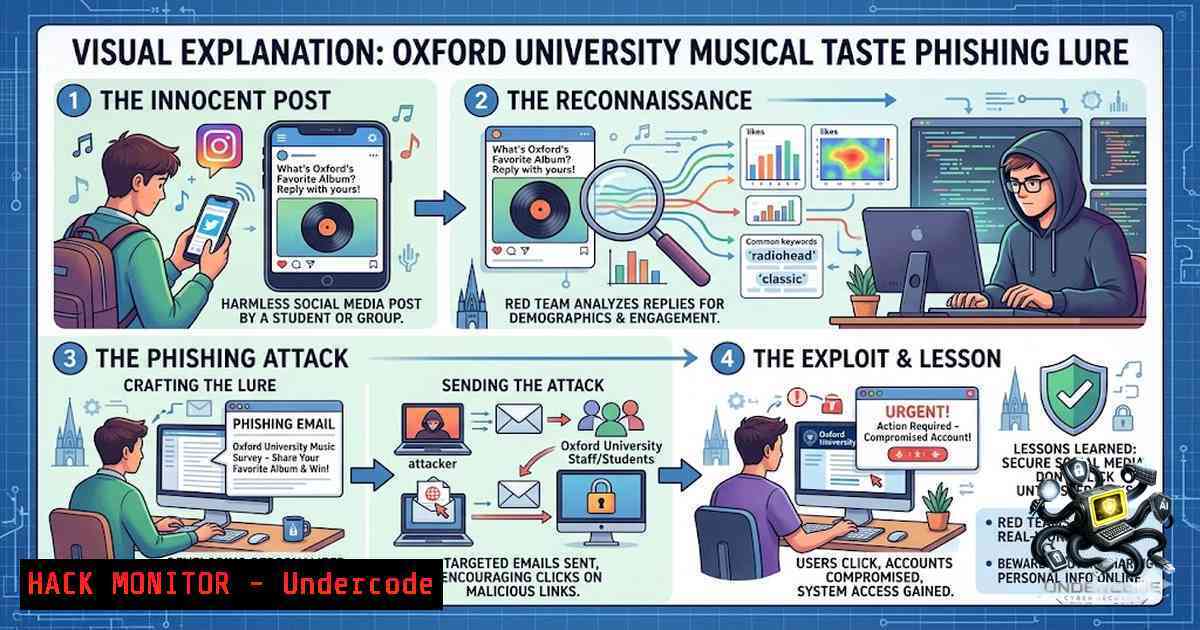
In an era where cyber adversaries leverage every piece of publicly available information for social engineering attacks, even seemingly innocuous social media content can become a weapon. The recent World Music Day post from Oxford University students—revealing their favorite artists from Harry Styles to Aaliyah—demonstrates how threat actors can exploit personal preferences and institutional affiliations to craft highly targeted phishing campaigns. This article explores the intersection of open-source intelligence (OSINT), social media reconnaissance, and the technical countermeasures organizations must deploy to protect against such psychologically engineered attacks.
Learning Objectives
- Understand how publicly available social media content can be weaponized for sophisticated social engineering and spear-phishing campaigns
- Implement technical controls including email authentication protocols, DMARC policies, and advanced threat detection systems
- Master OSINT gathering techniques and defensive countermeasures to protect institutional reputation and sensitive data
You Should Know
- Social Media OSINT: Turning Music Preferences into Attack Vectors
The Oxford University post, showcasing students from Lincoln College, St Peter’s College, Corpus Christi College, and Balliol College, represents a goldmine for threat actors conducting reconnaissance. By correlating personal interests (musical preferences) with institutional affiliations and locations, attackers can build detailed victim profiles for highly convincing social engineering campaigns.
Step-by-step guide on what this does and how to use it defensively:
Attackers use tools like theHarvester, Sherlock, and Recon-1g to scrape social media platforms for employee data. The following Python script demonstrates how easily metadata can be extracted from public posts:
import requests
from bs4 import BeautifulSoup
import re

def extract_social_metadata(url):
response = requests.get(url)
soup = BeautifulSoup(response.text, 'html.parser')

Extract potential usernames, affiliations, and interests
mentions = re.findall(r'@\w+', soup.text)
institutions = re.findall(r'(Oxford|Lincoln College|St Peter\'s|Corpus Christi|Balliol)', soup.text)
musical_interests = re.findall(r'(Harry Styles|Aaliyah|George Harrison|Bring Me The Horizon)', soup.text)

return {
'mentions': list(set(mentions)),
'institutions': list(set(institutions)),
'interests': musical_interests
}

Example usage
post_url = "https://linkedin.com/feed/update/urn:li:activity:..."
print(extract_social_metadata(post_url))
Linux Command for OSINT Gathering:
 Use theHarvester to gather email addresses associated with Oxford University
theHarvester -d oxford.ac.uk -l 500 -b google,bing,linkedin

Use Sherlock to find usernames across platforms
sherlock "harry.styles.fan.oxford"

Extract metadata from images (exif data that might reveal location)
exiftool -a -u social_media_image.jpg
Windows PowerShell Commands for Social Media Analysis:
 Extract URLs from text files containing social media content
Select-String -Path .\social_posts.txt -Pattern 'https?://[^\s]+' | ForEach-Object { $_.Matches.Value }

Parse JSON data from social media APIs
$jsonData = Get-Content .\instagram_data.json | ConvertFrom-Json
$jsonData | Where-Object { $_.location -match "Oxford" } | Select-Object username, full_name, biography
- Spear-Phishing Campaigns: The Human Element of Cyber Attacks
The World Music Day post provides attackers with three critical elements for spear-phishing: personal interests (musical tastes), institutional context (Oxford colleges), and temporal relevance (World Music Day). A well-crafted phishing email might reference “Harry Styles” or “Bring Me The Horizon” to establish false rapport, increasing the likelihood of successful credential harvesting.
Step-by-step guide on what this does and how to use it defensively:
Attackers use frameworks like GoPhish or SET (Social-Engineer Toolkit) to create convincing phishing campaigns. Defenders must implement email filtering and user awareness training.
Configuring SPF, DKIM, and DMARC to Prevent Email Spoofing:
 Linux - Check existing DNS records for SPF/DKIM/DMARC
dig txt oxford.ac.uk | grep -E "v=spf1|v=DKIM|_dmarc"

Linux - Add DMARC policy using nsupdate (example)
nsupdate <<EOF
update add _dmarc.oxford.ac.uk 3600 TXT "v=DMARC1; p=quarantine; rua=mailto:[email protected]; ruf=mailto:[email protected]; fo=1; pct=100"
send
EOF
Windows Command to Test Email Headers for Phishing Indicators:
 Analyze email headers for spoofing attempts
$headers = Get-Content .\suspicious_email.txt
$headers | Select-String "Authentication-Results", "DKIM-Signature", "SPF"

Using PowerShell to check domain reputation
Resolve-DnsName -1ame "suspicious-domain.com" -Type MX
Resolve-DnsName -1ame "suspicious-domain.com" -Type TXT
- Zero-Trust Architecture: Minimizing Blast Radius from Compromised Credentials
When a user falls victim to a spear-phishing campaign leveraging social media data, zero-trust principles limit the damage. Implementing least-privilege access, continuous verification, and micro-segmentation ensures that compromised credentials cannot traverse the network.
Step-by-step guide on what this does and how to implement it:
Linux – Implementing Fail2ban with Custom Rules:
 Install and configure Fail2ban to block suspicious authentication attempts
sudo apt-get install fail2ban
sudo cp /etc/fail2ban/jail.conf /etc/fail2ban/jail.local

Create custom filter for SSH brute force attempts
sudo nano /etc/fail2ban/filter.d/ssh-custom.conf
 Add:
[bash]
failregex = ^.Failed password for . from <HOST> port .$
ignoreregex =

Restart service
sudo systemctl restart fail2ban
Windows – Configuring Windows Defender Firewall for Zero-Trust Network Segmentation:
 Block all inbound traffic except explicitly allowed
New-1etFirewallRule -DisplayName "Block All Inbound" -Direction Inbound -Action Block -Profile Any

Allow only specified IP ranges for administrative access
New-1etFirewallRule -DisplayName "Allow Admin IPs" -Direction Inbound -RemoteAddress 192.168.1.0/24 -Action Allow

Enable Windows Defender Credential Guard to protect against pass-the-hash attacks
$CredGuardPath = "HKLM:\SYSTEM\CurrentControlSet\Control\DeviceGuard\Scenarios\CredentialGuard"
New-Item -Path $CredGuardPath -Force | Out-1ull
Set-ItemProperty -Path $CredGuardPath -1ame "Enabled" -Value 1 -Type DWord
4. Machine Learning for Social Media Threat Detection
AI-powered tools can automatically monitor social media for mentions of institutional names, employee identifiers, and potentially malicious content. Training ML models to recognize social engineering patterns is essential for proactive defense.
Step-by-step guide on what this does and how to implement:
Python – NLP-Based Threat Detection Script:
import re
from transformers import pipeline

Load pre-trained sentiment/analysis model
classifier = pipeline("text-classification", model="distilbert-base-uncased-finetuned-sst-2-english")

def analyze_social_post(text):
 Extract mentions of institutions or interests
patterns = {
'institution': re.compile(r'(Oxford|Lincoln|St Peter\'s|Corpus Christi|Balliol)', re.I),
'interests': re.compile(r'(Harry Styles|Aaliyah|George Harrison|Bring Me The Horizon)', re.I)
}

Evaluate sentiment (potential for malicious intent)
sentiment = classifier(text)

return {
'institutions_found': patterns['institution'].findall(text),
'interests_found': patterns['interests'].findall(text),
'sentiment': sentiment[bash]
}

Example usage
sample_post = "Harry Styles is my favorite! Studying at Oxford this summer."
print(analyze_social_post(sample_post))
Using Microsoft Defender for Cloud (Azure) to Monitor Social Media Threats:
 Linux - Install Azure CLI and configure security monitoring
curl -sL https://aka.ms/InstallAzureCLIDeb | sudo bash
az login
az security alert list --query "[?status=='Active']" --output table

Set up alerts for social media-based threats
az security alert create --1ame "social-media-threat-detection" \
--resource-group "security-rg" \
--status "Active" \
--description "Alert when social media mentions contain suspicious patterns"
- API Security: Protecting Institutional Data from OSINT Exposure
APIs often leak endpoint information that can be correlated with social media data. Ensuring robust API authentication, rate limiting, and input validation prevents adversaries from automating data exfiltration.
Step-by-step guide on what this does and how to implement:
Linux – Using Nginx to Implement API Rate Limiting:
 Edit Nginx configuration for API rate limiting
sudo nano /etc/nginx/nginx.conf

Add rate limit zone
http {
limit_req_zone $binary_remote_addr zone=mylimit:10m rate=5r/m;

server {
location /api/ {
limit_req zone=mylimit burst=10 nodelay;
proxy_pass http://api_backend;
proxy_set_header X-Forwarded-For $proxy_add_x_forwarded_for;
}
}
}

sudo nginx -t
sudo systemctl reload nginx
Windows – Implementing API Key Validation with PowerShell:
 Function to validate API tokens before processing requests
function Validate-APIToken {
param([bash]$Token)

$validTokens = @("prod-token-12345", "dev-token-67890", "test-token-abcde")

if ($Token -in $validTokens) {
return $true
}
return $false
}

Simulate API request validation
$requestToken = "prod-token-12345"
if (Validate-APIToken($requestToken)) {
Write-Host "API request authorized" -ForegroundColor Green
} else {
Write-Host "API request denied - potential threat" -ForegroundColor Red
 Log the attempt for security monitoring
Add-Content -Path "C:\SecurityLogs\API_Threats.log" -Value "$(Get-Date): Invalid API token: $requestToken"
}
6. Cloud Security Hardening for Public-Facing Assets
Organizations like Oxford University must secure their cloud environments against data exfiltration and unauthorized access, especially when OSINT exposes employee and student details.
Step-by-step guide on what this does and how to implement:
AWS CLI Commands for Security Hardening:
 Enable AWS GuardDuty for threat detection
aws guardduty create-detector --enable

Configure AWS Config to track changes in security groups
aws configservice put-configuration-recorder --configuration-recorder name=default,roleARN=arn:aws:iam::account-id:role/config-role

Enable AWS CloudTrail for API activity monitoring
aws cloudtrail create-trail --1ame default-trail --s3-bucket-1ame cloudtrail-logs-bucket --is-multi-region-trail

Set up VPC Flow Logs to monitor network traffic
aws ec2 create-flow-logs --resource-type VPC --resource-id vpc-12345678 --traffic-type ALL --log-destination-type cloud-watch-logs --log-group-1ame vpc-flow-logs
Azure Security Center for Cloud Hardening:
 Install Azure Az module
Install-Module -1ame Az -AllowClobber -Force

Enable Azure Security Center standard tier
Set-AzSecurityCenterPricing -ResourceGroupName "security-rg" -Tier "Standard"

Configure Microsoft Defender for Cloud
$workspace = New-AzOperationalInsightsWorkspace -ResourceGroupName "security-rg" -1ame "security-workspace" -Location "westeurope"
Enable-AzSecurityCenterAutoProvisioning -ResourceGroupName "security-rg" -WorkspaceId $workspace.ResourceId

Set up email notifications for security alerts
Set-AzSecurityContact -Email "[email protected]" -Phone "+44-1865-270000" -AlertNotifications $true -AlertsToAdmins $true
7. Vulnerability Assessment and Patch Management
After a social engineering attack, vulnerability scanning and patch management are critical to address any exploitation attempts on exposed systems.
Linux – Using OpenVAS for Vulnerability Scanning:
 Install OpenVAS (Greenbone Vulnerability Management)
sudo apt-get install openvas
sudo gvm-setup
sudo gvm-start

Run a scan against a target IP
gvm-cli socket --gmp-username admin --gmp-password password socket --socketpath /var/run/gvmd.sock --xml '<create_task>...'
Windows – Using Nessus Essentials for Vulnerability Scanning:
 Launch Nessus from command line
& "C:\Program Files\Tenable\Nessus\nessuscli.exe" fix --reset

Schedule a scan using PowerShell
$scanConfig = @"
{
"uuid": "ad629e16-03b6-8c1d-cef6-ef8c9dd3c658",
"settings": {
"name": "Oxford University Systems Scan",
"text_targets": "192.168.1.0/24",
"launch": "WEEKLY",
"starttime": "20260530T020000"
}
}
"@

Invoke-RestMethod -Method POST -Uri "https://nessus-server:8834/scans" -Body $scanConfig -ContentType "application/json"
What Undercode Say
- Social media posts are reconnaissance goldmines—even a simple music preference post can be weaponized by sophisticated threat actors to craft personalized spear-phishing campaigns targeting specific individuals within institutions
-
Defense requires both technical controls and human awareness—implementing SPF, DKIM, DMARC, zero-trust architecture, and continuous security awareness training creates layered protection against OSINT-based attacks
-
AI-powered monitoring is essential—machine learning models that analyze social media for institutional mentions can detect potential reconnaissance activities before they result in data breaches
-
Cloud security misconfigurations remain the leading cause of data exposure—organizations must regularly audit their cloud environments, enforce least-privilege access, and enable comprehensive logging and monitoring
-
Vulnerability management is non-1egotiable—regular scanning, prompt patching, and configuration hardening prevent adversaries from exploiting known vulnerabilities after social engineering success
-
Incident response must be practiced—organizations should conduct tabletop exercises simulating social media-based attacks to improve detection and response times
-
Collaboration between security and PR teams is vital—coordinating social media policies and public communication strategies reduces the amount of sensitive information exposed online
-
Continuous monitoring across all attack surfaces—including social media, email, APIs, cloud infrastructure, and endpoints—provides holistic threat visibility
-
The human factor remains the weakest link—even with robust technical controls, user awareness training and behavioral analytics are critical for preventing successful social engineering
-
A zero-trust mindset transforms security architecture—assuming breach and continuously verifying all access requests minimizes the impact of compromised credentials obtained through social engineering
Prediction
+N The increasing sophistication of social media OSINT will drive the development of AI-powered defensive tools that proactively identify and neutralize reconnaissance activities before they escalate into full-blown attacks, creating a new market for automated threat intelligence platforms
-1 As organizations become more aware of social media risks, they may implement overly restrictive policies that stifle authentic employee and student engagement, potentially harming institutional culture and reputation
+N The integration of behavioral analytics with social media monitoring will enable real-time detection of compromised accounts and anomalous access patterns, significantly reducing the dwell time of attackers
-1 Cybercriminal groups will invest heavily in deepfake technologies and advanced social engineering frameworks, making it increasingly difficult to distinguish legitimate communications from sophisticated phishing attempts
+1 Regulatory frameworks like GDPR and NIS2 will evolve to mandate stricter social media monitoring and threat intelligence sharing, improving collective resilience against OSINT-based attacks
+N The demand for cybersecurity professionals with expertise in OSINT, social engineering defense, and AI-powered threat detection will surge, creating new career opportunities and specialized training programs
-1 Smaller institutions with limited cybersecurity budgets will remain vulnerable to social media-based attacks, potentially leading to high-profile data breaches that erode public trust in academic and cultural organizations
▶️ Related Video (70% Match):
🎯Let’s Practice For Free:
🎓 Live Courses & Certifications:
Join Undercode Academy for Verified Certifications
🚀 Request a Custom Project:
Secure, high-velocity infrastructure and disruptive technological engineering. Contact our engineering team for high-tier development and proprietary systems:
[email protected]
💎 Smart Architecture | 🛡️ Secure by Design | ⭐ Trusted by Thousands
IT/Security Reporter URL:
Reported By: Worldmusicday UgcPost – Hackers Feeds
Extra Hub: Undercode MoN
Basic Verification: Pass ✅


