Listen to this Post
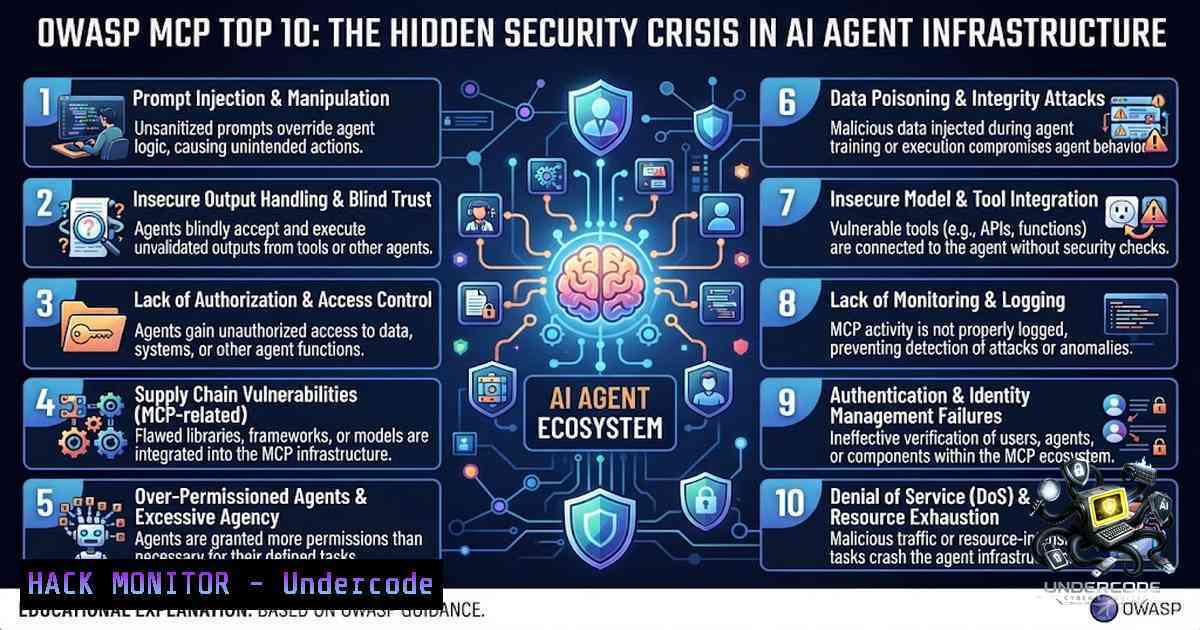
Introduction:
The Model Context Protocol (MCP) is rapidly becoming the backbone of modern AI agent deployments, enabling large language models to interact with databases, APIs, file systems, and enterprise tools in ways previously limited to human operators. However, this newfound capability introduces a completely new attack surface that most security teams are ill-prepared to defend. The OWASP MCP Top 10—currently in beta and pilot testing—identifies the most critical security risks facing MCP-enabled systems, from token mismanagement to tool poisoning and supply chain compromise. As organizations race to deploy AI agents, understanding and mitigating these risks has become an urgent priority for security professionals.
Learning Objectives:
- Understand the architecture and security implications of the Model Context Protocol (MCP) in AI agent deployments
- Identify and mitigate the ten critical risks outlined in the OWASP MCP Top 10 framework
- Implement practical security controls, including authentication, authorization, input validation, and audit logging for MCP environments
You Should Know:
1. Token Mismanagement & Secret Exposure (MCP01:2025)
AI agents rely on API keys, access tokens, and credentials to communicate with external systems. When these secrets are exposed through prompts, logs, or insecure storage, attackers can hijack the agent’s identity and access connected resources. This risk is compounded by the fact that MCP servers often require credentials for multiple backend systems, creating a sprawling secret management challenge.
Step-by-Step Guide to Secure Token Management:
- Never hardcode credentials in configuration files or source code. Use environment variables or secret management solutions.
-
Implement automated credential rotation every 30–90 days minimum, using dual secret rotation for zero downtime.
-
Store all secrets in a centralized vault (Azure Key Vault, HashiCorp Vault, AWS Secrets Manager) rather than local files.
-
Encrypt tokens both at rest and in transit.
-
Audit secret access and maintain an inventory of all credentials used by MCP servers.
Linux Command Example – Rotating Secrets with Vault:
 Generate a new API key and store in Vault
vault kv put secret/mcp/prod/api_key value=$(openssl rand -base64 32)

Fetch the latest secret at runtime (MCP server startup script)
export API_KEY=$(vault kv get -field=value secret/mcp/prod/api_key)

Rotate with zero downtime - dual secret approach
vault kv put secret/mcp/prod/api_key_old value=$(vault kv get -field=value secret/mcp/prod/api_key)
vault kv put secret/mcp/prod/api_key value=$(openssl rand -base64 32)
Windows PowerShell Example:
 Generate a secure random token
$newToken = [bash]::ToBase64String([System.Security.Cryptography.RandomNumberGenerator]::GetBytes(32))

Store in Azure Key Vault
az keyvault secret set --vault-1ame "mcp-vault" --1ame "mcp-api-key" --value $newToken

Retrieve for MCP server
$env:MCP_API_KEY = (az keyvault secret show --vault-1ame "mcp-vault" --1ame "mcp-api-key" --query value -o tsv)
2. Privilege Escalation via Scope Creep (MCP02:2025)
As AI agents gain access to more tools, they often accumulate permissions they no longer need. If an attacker compromises the agent, those unnecessary privileges can dramatically increase the impact of an attack. The principle of least privilege must be rigorously applied.
Step-by-Step Guide to Privilege Management:
- Map every tool to specific permissions and document the justification for each.
-
Conduct regular permission reviews—at minimum quarterly—to remove unnecessary access.
-
Scope every tool to the minimum necessary permissions.
-
Implement role-based access control (RBAC) for MCP servers, defining distinct roles for different agent functions.
-
Use separate credentials per MCP tool when feasible.
Configuration Example – MCP Server RBAC with OAuth2 Scopes:
{
"mcp_server": {
"name": "enterprise-mcp",
"authentication": {
"type": "oauth2",
"issuer": "https://auth.example.com",
"scopes": {
"read_only": ["database:query", "files:read"],
"read_write": ["database:query", "database:update", "files:read", "files:write"],
"admin": [""]
}
},
"tools": {
"jira_create": { "required_scope": "read_write" },
"slack_notify": { "required_scope": "read_write" },
"log_query": { "required_scope": "read_only" }
}
}
}
- Tool Poisoning (MCP03:2025) & Software Supply Chain Attacks (MCP04:2025)
AI agents implicitly trust the tools they use. Attackers can tamper with tool metadata, instructions, or schemas, causing the AI to make decisions based on false or malicious information. Additionally, most MCP deployments depend on third-party libraries, SDKs, and plugins—a compromised dependency can introduce vulnerabilities into an otherwise secure environment. Microsoft’s June 2026 security guidance formally classifies MCP tool descriptions as supply-chain assets requiring the same review rigor as production code.
Step-by-Step Guide to Supply Chain Security:
- Verify the integrity of all connected tools using cryptographic signatures and checksums.
-
Maintain a Software Bill of Materials (SBOM) for all MCP dependencies.
-
Scan third-party components for known vulnerabilities using tools like Snyk, Dependabot, or Trivy.
-
Pin dependency versions and use integrity hashes in package manifests.
-
Treat MCP tool descriptions as supply-chain assets requiring security review before deployment.
Linux Command – Dependency Scanning:
 Scan Python dependencies for vulnerabilities
safety check -r requirements.txt

Generate SBOM for Node.js project
npx @cyclonedx/bom -o bom.xml

Verify tool integrity with SHA256
sha256sum mcp-tool-binary | grep -f expected_hash.txt

Audit npm dependencies
npm audit --production
Dockerfile Security – Pinning Base Images:
 Vulnerable - uses latest tag
FROM python:3.11

Secure - pin specific digest
FROM python:3.11-slim@sha256:2d9f...
RUN pip install --1o-cache-dir --hash=sha256:abc... mcp-sdk==1.2.3
4. Command Injection & Execution (MCP05:2025)
If an AI agent passes untrusted input directly to a tool, attackers may execute unintended commands. Real-world vulnerabilities have been discovered in MCP servers where unsanitized input parameters are passed to child_process.exec, enabling arbitrary system command execution.
Step-by-Step Guide to Input Validation:
- Validate and sanitize all inputs passed from the AI agent to tools.
-
Use parameterized commands or safe APIs instead of shell execution.
3. Implement allowlists for permissible commands and parameters.
4. Avoid `shell=True` in subprocess calls.
- Apply context-aware validation—validate not just format but also semantic appropriateness.
Vulnerable Python Code (DO NOT USE):
 VULNERABLE - command injection risk
import subprocess
def read_file(filename):
return subprocess.check_output(f"cat {filename}", shell=True)
 Attacker input: "; whoami; rm -rf /"
Secure Python Code:
 SECURE - using parameterized approach
import subprocess
def read_file(filename):
 Validate filename against allowlist
if not filename.isalnum() or "/" in filename or ".." in filename:
raise ValueError("Invalid filename")
 Use list form, no shell
return subprocess.check_output(["cat", f"/safe/path/{filename}"])
Secure JavaScript (Node.js) Code:
// SECURE - using execFile instead of exec
const { execFile } = require('child_process');
function readFile(filename) {
// Validate input
if (!/^[a-zA-Z0-9_.-]+$/.test(filename)) {
throw new Error('Invalid filename');
}
return execFile('cat', [<code>/safe/path/${filename}</code>]);
}
5. Insufficient Authentication & Authorization (MCP07:2025)
Every request to an MCP server should be properly authenticated and authorized. Weak access controls may allow unauthorized users or agents to invoke tools, access sensitive data, or perform privileged actions. The MCP protocol specifies communication mechanisms but does not enforce authentication or authorization policies—these must be implemented separately.
Step-by-Step Guide to MCP Authentication:
- Never expose MCP over the public internet without mTLS or equivalent.
-
Implement OAuth 2.0 or OIDC for authentication, delegating to an identity provider.
-
Use bearer tokens (JWT) with proper validation—verify signatures and claims.
-
Configure token lifetimes—access tokens for hours, refresh tokens as needed.
-
Apply authorization decisions based on token information and granted permissions.
MCP Server Authentication Configuration – OAuth2 with Entra ID:
 MCP server configuration with OAuth2
mcp_server:
auth:
type: oauth2
provider: azure_entra
issuer: https://login.microsoftonline.com/{tenant_id}/v2.0
client_id: ${MCP_CLIENT_ID}
client_secret: ${MCP_CLIENT_SECRET}
scopes:
- "https://api.example.com/.default"
token_endpoint: https://login.microsoftonline.com/{tenant_id}/oauth2/v2.0/token
Azure App Service – Configure PRM for MCP Server:
 Set protected resource metadata for MCP server authorization
az webapp config appsettings set --1ame mcp-server --resource-group mcp-rg \
--settings WEBSITE_AUTH_PRM_DEFAULT_WITH_SCOPES="api://mcp-server/.default"
6. Lack of Audit and Telemetry (MCP08:2025)
Without sufficient logging and monitoring, investigating suspicious activity, detecting misuse, or demonstrating compliance becomes nearly impossible. Every MCP deployment must integrate with enterprise SIEM systems to provide complete visibility into agent actions.
Step-by-Step Guide to MCP Audit Logging:
- Implement structured logging for all MCP server requests, tool usage, and errors.
-
Forward logs to enterprise SIEM (Splunk, ELK, Sentinel, Chronicle) for correlation.
-
Include correlation IDs in every audit event for end-to-end request tracing.
-
Log security-relevant actions—authentication attempts, configuration changes, data access, permission errors.
-
Instrument AI agents to produce rich, structured security logs, turning them from opaque black boxes into auditable assets.
Logging Configuration – Structured JSON Logs for SIEM:
import json
import logging
import uuid

class MCPAuditLogger:
def <strong>init</strong>(self):
self.logger = logging.getLogger("mcp_audit")

def log_tool_call(self, user_id, tool_name, params, result, status):
correlation_id = str(uuid.uuid4())
log_entry = {
"timestamp": datetime.utcnow().isoformat(),
"correlation_id": correlation_id,
"event_type": "tool_call",
"user_id": user_id,
"tool_name": tool_name,
"parameters": self._sanitize_params(params),
"result_status": status,
"result_summary": result[:200] if result else None,
"source_ip": self._get_client_ip()
}
self.logger.info(json.dumps(log_entry))
 Forward to SIEM via syslog or API
self._forward_to_siem(log_entry)
Linux – Forward MCP Logs to SIEM via Syslog:
 Configure rsyslog to forward to SIEM
echo ". @siem.example.com:514" >> /etc/rsyslog.conf
systemctl restart rsyslog

Or use fluentd for structured logs
cat > /etc/fluent/fluent.conf << EOF

<source>

@type tail
path /var/log/mcp/.log
tag mcp.logs
format json
</source>
<match mcp.logs>
@type elasticsearch
host siem.example.com
port 9200
index_name mcp-audit-%Y.%m.%d
</match>
EOF
- Shadow MCP Servers & Context Injection (MCP09:2025 & MCP10:2025)
Unofficial MCP servers deployed without governance create security blind spots. Additionally, AI agents rely on context to perform tasks—too much context or maliciously crafted context can influence their behavior or expose sensitive information.
Step-by-Step Guide to Governance and Context Control:
- Maintain an inventory of all approved MCP servers.
-
Implement discovery mechanisms to detect unauthorized MCP deployments.
-
Share only the information required for a task—minimize context exposure.
-
Validate contextual inputs before they are processed by the AI agent.
5. Limit unnecessary autonomy in agent workflows.
Network Discovery – Detect Shadow MCP Servers:
 Scan for exposed MCP ports (default MCP uses port 3000 or configurable)
nmap -p 3000,3001,5000,8000,8080 --open 192.168.0.0/24

Monitor for MCP-specific traffic patterns
tcpdump -i eth0 'tcp port 3000 or tcp port 3001' -1

Use Zeek to detect MCP protocol signatures
zeek -r capture.pcap -s mcp-signatures.sig
Context Validation – Python Example:
def validate_agent_context(context):
"""Sanitize and minimize context before passing to AI agent"""
 Define allowed context fields
allowed_fields = {'incident_id', 'severity', 'affected_assets', 'timestamp'}

Remove sensitive or unnecessary fields
sanitized = {k: v for k, v in context.items() if k in allowed_fields}

Truncate overly large fields
for key, value in sanitized.items():
if isinstance(value, str) and len(value) > 1000:
sanitized[bash] = value[:1000] + "...[bash]"

Remove any embedded instructions or meta-commands
for key, value in sanitized.items():
if isinstance(value, str):
sanitized[bash] = re.sub(r'(?i)(ignore|override|skip|bypass).', '[bash]', value)

return sanitized
What Undercode Say:
- The OWASP MCP Top 10 is not just another compliance checklist—it represents a fundamental shift in how we think about application security. Traditional web app security assumed human users; MCP security must account for AI agents as autonomous actors with their own attack surfaces.
-
The most dangerous MCP risk isn’t any single vulnerability—it’s the combination of multiple weaknesses. Token exposure combined with privilege creep and insufficient logging creates a perfect storm where attackers can move laterally through AI-integrated systems undetected.
-
Organizations that treat MCP security as an afterthought will face breaches within 18-24 months. The speed of AI adoption far outpaces security maturity, creating a window of opportunity for attackers that is closing rapidly.
-
Security teams must evolve from “web app defenders” to “AI infrastructure defenders.” This requires new skills in LLM security, prompt engineering defense, and understanding how AI agents make decisions—not just how they execute commands.
-
The beta status of the OWASP MCP Top 10 is both a warning and an opportunity. The framework will evolve, but the core risks are already well-understood. Organizations that start implementing controls now will have a significant advantage over those that wait for the “final” version.
-
MCP represents the convergence of three historically separate domains: application security, cloud infrastructure security, and AI/ML security. This convergence demands cross-functional teams and integrated security architectures.
-
The supply chain risks in MCP deployments are particularly concerning because they mirror the software supply chain attacks that have devastated organizations in recent years—but with the added complexity of AI decision-making logic.
-
Audit logging in AI environments isn’t just about compliance—it’s about survival. Without visibility into agent actions, security teams are flying blind, unable to detect or respond to incidents involving AI systems.
-
The principle of least privilege becomes exponentially more important in MCP environments because compromised agents can execute actions at machine speed, amplifying the damage of any single vulnerability.
-
This is the moment for security professionals to shape the future of AI security. The OWASP MCP Top 10 is still in beta—community feedback and real-world implementation experience will determine how this framework evolves and how effectively we secure the next generation of AI systems.
Prediction:
-
+1 Organizations that adopt MCP security best practices early will gain a competitive advantage, demonstrating to customers and regulators that they take AI security seriously. This will become a differentiator in industries like finance, healthcare, and government contracting.
-
-1 The next 12-18 months will see a wave of high-profile breaches involving AI agents, as attackers exploit the gap between rapid AI adoption and lagging security controls. These incidents will mirror the early days of cloud security breaches—embarrassing, costly, and entirely preventable.
-
+1 The OWASP MCP Top 10 will become the de facto standard for AI agent security, following the trajectory of the original OWASP Top 10. By 2027, it will be referenced in regulatory frameworks, insurance underwriting, and enterprise security questionnaires.
-
-1 MCP-specific vulnerabilities—particularly command injection and tool poisoning—will be increasingly weaponized by threat actors. We will see the emergence of “AI agent ransomware” where attackers compromise agents to encrypt or exfiltrate data across connected systems.
-
+1 The security community will develop robust tooling for MCP security, including automated scanners, runtime protection mechanisms, and SIEM integrations specifically designed for AI agent telemetry. Tools like the MCP tool poisoning scanner and ShieldMCP runtime defense represent the beginning of this ecosystem.
-
-1 Shadow MCP servers will become the new shadow IT crisis, with unsanctioned AI agents accessing production data and systems. Security teams will struggle to discover and govern these deployments, leading to data leaks and compliance violations.
-
+1 The convergence of AI security with traditional application security will create new career opportunities for security professionals who develop expertise in both domains. “AI Security Engineer” will become a standard role in enterprise security teams.
-
-1 Organizations that fail to address MCP security risks will face not just technical breaches but also regulatory consequences. As AI regulations take effect globally, inadequate MCP security controls will be viewed as a failure of due diligence.
▶️ Related Video (84% Match):
https://www.youtube.com/watch?v=-vXoC0UvpjY
🎯Let’s Practice For Free:
🎓 Live Courses & Certifications:
Join Undercode Academy for Verified Certifications
🚀 Request a Custom Project:
Secure, high-velocity infrastructure and disruptive technological engineering. Contact our engineering team for high-tier development and proprietary systems:
[email protected]
💎 Smart Architecture | 🛡️ Secure by Design | ⭐ Trusted by Thousands
IT/Security Reporter URL:
Reported By: Halimaholaolohun Cybersecurity – Hackers Feeds
Extra Hub: Undercode MoN
Basic Verification: Pass ✅


