Listen to this Post
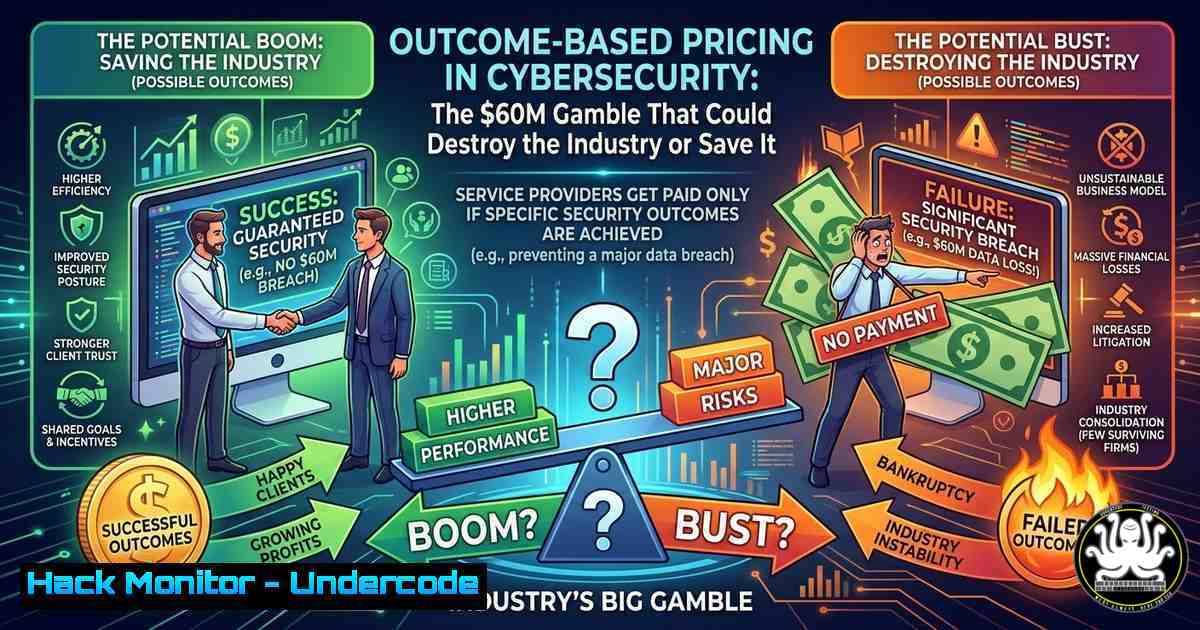
Introduction:
The cybersecurity industry is built on a foundation of paying for noise. Organizations are billed per endpoint, per gigabyte of log data, or per seat, regardless of whether the alerts generated are “gold” or “digital garbage.” Inspired by Intercom’s (Fin) pivot to outcome-based pricing—where they charge only per resolved customer support issue, risking $60M in ARR to eventually hit $100M—the security world is now questioning if a similar model is viable. However, as experts in the field point out, security is fundamentally about proving a negative: nothing happened. This creates a dangerous paradox where vendors might be incentivized to let threats through to get paid for “stopping” them.
Learning Objectives:
- Understand the economic and ethical pitfalls of outcome-based pricing in cybersecurity.
- Analyze the technical measurement problems that prevent effective outcome-based security models.
- Learn how to architect detection and response strategies to mitigate perverse incentives created by new vendor pricing models.
You Should Know:
1. The “Cobra Effect” in Detection Engineering
When discussing outcome-based pricing, Rafał Kitab highlighted the “Indian Cobra” urban legend—where a bounty on cobras led to people breeding them. In cybersecurity, if a vendor is paid per “threat stopped” or per “True Positive,” they are financially motivated to ensure threats exist in the environment to stop. This leads to a slippery slope in detection engineering where the threshold for what constitutes a “threat” is lowered, or where preventive controls are deliberately weakened to allow an attack to reach the detection layer.
Step‑by‑step guide: How to Audit Your SIEM for “Padded” Metrics
To ensure your current vendor isn’t artificially inflating metrics, security teams must perform log integrity checks.
– Linux (Log Analysis): Use `grep` and `awk` to identify alert frequency anomalies.
 Count alerts per hour from a specific source to detect inflation
sudo grep "ALERT_TRIGGERED" /var/log/siem/connector.log | awk '{print $1, $2}' | uniq -c
– Windows (PowerShell): Check Event Logs for repetitive, low-severity alerts that pad numbers.
 Query Security log for specific Event IDs associated with a vendor tool
Get-EventLog -LogName Security -InstanceId 4688 | Group-Object Message | Sort-Object Count -Descending | Select -First 10
– Splunk Query (If applicable): Identify alerts that fire frequently but rarely result in incident response tickets.
index= sourcetype=alert | stats count by signature, dest | where count > 100 AND dest="false_positive_pool"
2. Building a Prevention-First Architecture
As Nirosh J. noted, focusing on reactive outcomes (threats stopped) is akin to “keeping ransom money in the bank ready to pay.” It funds the problem rather than solving it. The alternative is to build a defense-in-depth strategy where the success of the security stack is measured by the absence of alerts, not the presence of them. This involves shifting left and hardening assets so that threats never materialize into alerts.
Step‑by‑step guide: Hardening Windows Servers to Reduce Alert Volume
– Windows: Use the Local Group Policy Editor or PowerShell to enforce AppLocker, preventing unapproved software from executing (a major source of malware alerts).
 Create an AppLocker rule to allow only signed executables from trusted publishers
New-AppLockerPolicy -RuleType Exe -User Everyone -RuleNamePrefix "Block Unsigned" -Action Deny
– Linux: Implement Mandatory Access Control (SELinux/AppArmor) to confine application permissions, reducing the blast radius and preventing alerts by design.
 Set an nginx profile to enforce mode, blocking any undefined behavior before it becomes an alert
sudo aa-enforce /etc/apparmor.d/usr.sbin.nginx
3. Verifying Outcomes: The “Zero-Knowledge” Problem
Ian Grigg’s “Market for Silver Bullets,” referenced by Alankrit Chona, explains that security buyers cannot verify quality. If a vendor claims they stopped 10,000 threats, how does the client verify those threats were real and would have succeeded? This is a measurement problem. To move toward outcome-based pricing, we need cryptographic or forensic proof of interception, not just vendor dashboards.
Step‑by‑step guide: Creating a Verifiable “Proof of Block” Log
If a vendor claims to block a threat, the log must be immutable and verifiable by a third party.
– Linux (Syslog-ng with Hashing): Configure syslog-ng to generate a SHA-256 hash of every log line immediately upon ingestion and store it in a separate, write-once file.
 Example using rsyslog and a template to output log lines with a hash
template(name="SecureLog" type="string" string="%msg% : HASH-%$now%-%$timegenerated%-%fromhost-ip%\n")
. action(type="omfile" file="/var/log/verified.log" template="SecureLog")
– Windows (PowerShell Log Verification): Use a script to monitor the Security log and create a hash chain.
 Generate a hash of the latest 10 security events to verify integrity over time
Get-EventLog -LogName Security -Newest 10 | Out-String | Get-FileHash -Algorithm SHA256
4. The “Fraud” Potential: Cooking the Metrics
Lebin Cheng and others warned about the ease of cooking security metrics. If money is attached to “detections,” vendors have an incentive to treat every network scan or user typo as a sophisticated attack. Security teams must implement their own independent verification layers (honeypots or canary tokens) to test if the vendor’s “threats stopped” are actually targeting real assets or just generic internet noise.
Step‑by‑step guide: Deploying Canary Tokens to Test Vendor Effectiveness
Deploy a canary token (a fake database record, file, or URL) that has no production value. If a vendor charges you for “blocking” an access attempt to this token, you know they are flagging background noise.
– Canarytokens (Generic): Use the open-source Canarytokens server or the free Thinkst Canarytokens service.
– Generate a “Web Bug” token (a URL).
– Place the URL in a hidden directory on your web server.
– Monitor the canarytoken server. If you receive a ping, someone (or something) scanned that URL.
– Linux (Auditd for File Access): Use `auditd` to monitor a fake file. If the vendor alerts on an attempt, you can verify if the attempt actually reached the file system layer.
sudo auditctl -w /path/to/fake_credentials.txt -p rwxa -k canary_alert
5. API Security: The “Resolution” Measurement
Unlike Intercom, which measures “resolved tickets,” cybersecurity struggles to measure “resolved threats.” However, in the API security space (like AppSecAI.io mentioned by Michael Cartsonis), it is easier to measure “vulnerabilities fixed.” This requires tight integration with the development pipeline to confirm remediation.
Step‑by‑step guide: Automating Vulnerability Remediation Verification
- CI/CD Integration (GitLab CI): Create a pipeline that runs a DAST (Dynamic Application Security Testing) tool. If the tool finds a vulnerability and the developer commits a fix, the next pipeline run must prove the vulnerability is gone before the code is merged.
.gitlab-ci.yml snippet
dast_scan:
script:</li>
<li>zap-api-scan.py -t https://staging.example.com/openapi.json -f openapi -r report.html
artifacts:
paths: [report.html]
allow_failure: false
- Curl Command: Use `curl` to test if a specific patch actually mitigates an injection flaw.
Attempt a SQL Injection payload after patch
curl -X POST https://app.example.com/login -d "username=admin' OR '1'='1&password=pass"
Expected result: 403 Forbidden or 200 with "Invalid credentials" (not a database error or login success)
What Undercode Say:
- Key Takeaway 1: Incentive Misalignment is Fatal. The cybersecurity industry cannot adopt a pure “per-threat-stopped” model without fundamentally corrupting the detection landscape. Vendors require the existence of attackers to survive financially, creating a conflict of interest that undermines the very goal of security: prevention.
- Key Takeaway 2: Measurement is the Missing Ingredient. Until the industry can create verifiable, cryptographic proof of a threat’s existence and its successful interception (beyond vendor dashboards), outcome-based pricing remains a theoretical exercise. The focus must shift to measuring “mean time to patch” and “prevention coverage” rather than “threats blocked.”
Analysis: The debate highlights a critical inflection point. While the current model of paying for “noise” is unsustainable and bloated, the proposed alternative is fraught with moral hazard. The future likely lies in a hybrid model: paying a base retainer for infrastructure and support (prevention), with bonuses or variable pricing tied to objective metrics like “reduction in CVSS score across the environment” or “patches deployed within SLA,” rather than reactive incident counts. Until blockchain-like verifiability enters the security log space, we are stuck trusting the salesperson instead of the data.
Prediction:
Within the next three to five years, we will see a bifurcation in the market. Low-tier security tools will cling to volume-based pricing (per endpoint, per GB) to maximize revenue from noise. However, high-tier AI-driven security platforms will begin offering “outcome-based” contracts that are heavily hedged with insurance policies. These contracts will pay out if the vendor’s failure to stop a threat leads to a breach, essentially turning the vendor into a co-insurer. This shift will force vendors to truly harden client environments, as their own profitability will be directly tied to the client’s security posture. The “cobra breeding” problem will be mitigated by strict third-party audits and public transparency reports on detection logic.
🎯Let’s Practice For Free:
IT/Security Reporter URL:
Reported By: Calebsima Paying – Hackers Feeds
Extra Hub: Undercode MoN
Basic Verification: Pass ✅


