Listen to this Post
Introduction:
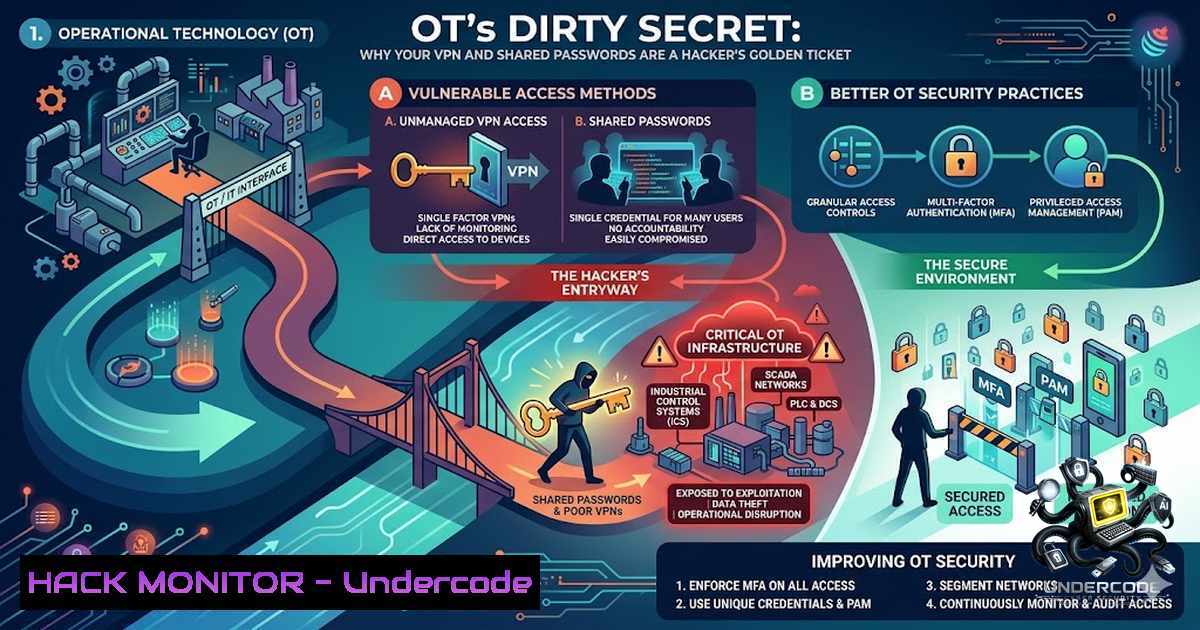
As operational technology (OT) environments become increasingly interconnected with IT networks, the traditional perimeter-based security model has crumbled. The most significant threat today is no longer malware but the question of who has access, when, and how they are using it. Many organizations still rely on outdated methods like VPNs, shared accounts, and limited access visibility, creating a massive attack surface that adversaries are eager to exploit. This article explores the critical gaps in OT access security and provides a practical roadmap for implementing robust privileged access management (PAM) and zero-trust principles to protect industrial infrastructure without disrupting operations.
Learning Objectives:
- Understand why privileged access is the primary attack vector in modern OT environments and the limitations of traditional security controls.
- Learn how to implement least-privilege principles, just-in-time (JIT) access, and real-time monitoring to secure vendor and operator access.
- Gain actionable knowledge on configuring PAM solutions, network segmentation, and compliance strategies aligned with frameworks like ISMS-P and NIST SP 800-82.
You Should Know:
- The Illusion of Security: Why VPNs and Shared Accounts Are Failing OT
For decades, VPNs and shared credentials have been the default methods for enabling remote access in industrial environments. However, these approaches are fundamentally flawed. A VPN creates a flat, shared network tunnel; once an attacker compromises a single credential, they can move laterally across the entire subnet, scanning for vulnerabilities and tampering with critical systems. Shared accounts, while convenient for emergencies, erase individual accountability, making it nearly impossible to determine who performed a specific action during an incident.
The core problem is that these traditional methods lack granular control and visibility. They operate on an implicit trust model, assuming that anyone inside the network is legitimate. In contrast, a Zero Trust approach removes this implicit trust and replaces it with continuous verification. Every user, device, and request must prove its legitimacy every single time, drastically reducing the risk of lateral movement and credential misuse.
Step-by-Step Guide: Auditing and Hardening Existing Access
To move beyond these outdated methods, you must first understand your current exposure.
- Inventory All Access Points: Identify every VPN gateway, jump host, and remote access tool used to connect to your OT environment. Document who uses them and for what purpose.
- Audit Shared and Default Accounts: Scan for default credentials on industrial control systems (ICS) and shared local administrator accounts. These are prime targets for attackers.
- Enforce Multi-Factor Authentication (MFA): Immediately implement MFA for all remote access points, especially for privileged accounts. This adds a critical layer of identity verification beyond just a password.
- Implement a DMZ and Jump Hosts: Replace direct VPN access to OT assets with a demilitarized zone (DMZ) that hosts secure jump hosts or bastion hosts. All remote sessions should be brokered through this intermediate system, which can enforce strong authentication, log activities, and inspect commands.
- Adopt Just-in-Time (JIT) Access: Move away from standing, always-on privileges. Implement JIT access, where privileged rights are granted only for the specific time and duration needed to perform a task, and are automatically revoked afterward.
Linux Command Examples for Auditing:
- Check for users with UID 0 (root equivalent): `awk -F: ‘($3 == 0) {print}’ /etc/passwd`
– List all users with sudo privileges: `grep -Po ‘^sudo.+:\K.$’ /etc/group`
– Audit recent successful logins: `last -a | head -20`
– Check for listening network services (potential backdoors): `ss -tulpn`
Windows Command Examples (PowerShell):
- List all local users: `Get-LocalUser`
– Find members of the Administrators group: `Get-LocalGroupMember -Group “Administrators”`
– Audit logon events (Event ID 4624): `Get-WinEvent -FilterHashtable @{LogName=’Security’; ID=4624} -MaxEvents 50`
- Implementing Zero Trust and Least Privilege in OT Environments
Zero Trust in OT is not a one-size-fits-all solution. It requires a tailored approach that respects the unique constraints of industrial environments, such as legacy systems, protocol limitations, and the absolute priority of operational uptime. The goal is to enforce least-privilege access, ensuring that users and machines have only the minimum permissions necessary to perform their functions.
A practical starting point is to align security controls with the Purdue Model for Industrial Control Systems (ICS). This model segments OT networks into distinct levels, from Level 0 (physical processes) to Level 4 (enterprise IT). By implementing strict access controls between these levels, you can contain a breach and prevent an attacker from moving from a compromised IT system down to a critical PLC. For example, a vendor technician should only have access to the specific machine or Level 1 device they are servicing, not the entire Level 3 site network.
Step-by-Step Guide: Configuring Role-Based Access Control (RBAC) and Segmentation
- Define Roles and Permissions: Map out all user types (internal engineers, third-party vendors, administrators) and define the specific OT assets and functions each role requires. This is the foundation of RBAC.
- Segment the Network: Use firewalls and access control lists (ACLs) to create security zones based on the Purdue Model. Restrict communication between zones to only what is absolutely necessary.
- Deploy a PAM Solution: Implement a Privileged Access Management (PAM) platform, such as BeyondTrust, to centralize the management of privileged accounts. A PAM solution provides credential vaulting, session recording, and access approval workflows.
- Enforce MFA for All Privileged Access: Require multi-factor authentication for any user accessing systems within the OT environment, particularly for remote vendor connections.
- Implement Session Recording and Monitoring: Record all privileged sessions for audit and forensic purposes. This provides a detailed log of who did what, when, and how, which is crucial for incident response and compliance.
-
The Technical Arsenal: PAM Configuration and API Security
Modern PAM solutions are not just about password management; they are comprehensive platforms for securing identities across hybrid and OT environments. They utilize APIs to integrate with existing directories and ticketing systems, automating the process of access requests and approvals. A key feature is the ability to manage non-human identities (NHIs), such as service accounts and AI agents, which are often overlooked but pose significant risks if compromised.
Furthermore, securing APIs that connect IT and OT systems is paramount. These APIs often serve as bridges for data exchange and remote commands, and if not properly secured, they can be exploited to manipulate industrial processes. Implementing API gateways, enforcing strict authentication (e.g., OAuth 2.0), and conducting regular vulnerability assessments on these interfaces are critical steps.
Example PAM API Configuration Snippet (Conceptual):
 Example using curl to request a privileged session via a PAM API
curl -X POST https://pam-api.example.com/v1/sessions/request \
-H "Authorization: Bearer $API_TOKEN" \
-H "Content-Type: application/json" \
-d '{
"user": "vendor_engineer",
"target_system": "PLC-01",
"reason": "Emergency firmware update",
"duration": 3600
}'
Hardening Commands for Linux/Windows Jump Hosts:
- Linux (Disable root SSH login): Edit `/etc/ssh/sshd_config` and set
PermitRootLogin no. - Linux (Implement fail2ban): `sudo apt-get install fail2ban` (or
yum install fail2ban) and configure it to protect SSH and other services. - Windows (Disable SMBv1): `Set-SmbServerConfiguration -EnableSMB1Protocol $false -Force` (PowerShell).
- Windows (Configure Windows Firewall): Use `New-1etFirewallRule` to create strict inbound rules allowing only specific IPs.
4. Bridging the Gap: Compliance and Strategic Alignment
Regulatory frameworks like ISMS-P in South Korea and NIST SP 800-82 provide a structured approach to securing OT environments. ISMS-P, which is becoming mandatory for major public system operators, includes over 100 control requirements covering access control, encryption, and incident response. Aligning your OT access strategy with these frameworks is not just about checking a box; it’s about implementing a robust security posture.
A comprehensive OT access strategy must address management, technical, and physical controls. This includes establishing centralized IAM, conducting regular access rights audits, integrating physical security measures, and ensuring that default accounts are disabled. The key is to introduce these controls in a sequence that supports operational continuity, minimizing disruption while maximizing security.
What Undercode Say:
- Key Takeaway 1: The biggest security threat in OT is no longer just malware; it is the unmanaged and unmonitored access that vendors, operators, and internal teams have. VPNs and shared accounts are relics that create a false sense of security.
- Key Takeaway 2: Implementing Zero Trust and PAM in OT is not an impossible task. By starting with secure remote access, enforcing least privilege, and segmenting networks, organizations can significantly reduce their attack surface without sacrificing operational uptime. The transition from a reactive to a proactive security posture is essential for protecting critical infrastructure in an era of increasing cyber-kinetic threats.
Prediction:
- +1 The increasing adoption of PAM and Zero Trust principles in OT will lead to a measurable decrease in successful ransomware attacks targeting industrial sectors over the next three years, as attackers find it harder to move laterally and escalate privileges.
- -1 However, the complexity of integrating these solutions with legacy systems will remain a significant hurdle. Many organizations will struggle with implementation, potentially leaving gaps that sophisticated state-sponsored actors will continue to exploit.
- +1 Regulatory pressures, such as the mandatory expansion of ISMS-P, will accelerate investment in OT security, driving innovation in identity-centric security solutions and creating a new wave of specialized cybersecurity professionals.
- -1 The skills gap in OT security will worsen before it improves. The demand for engineers who understand both industrial control systems and modern cybersecurity practices will far outstrip supply, making it difficult for many organizations to effectively manage their security posture.
- +1 The convergence of IT and OT will continue, but with a stronger security foundation. As more organizations adopt secure-by-design principles and integrate security into their operational technology lifecycle, the resilience of critical infrastructure will improve, fostering greater trust in digital transformation initiatives like Industry 4.0.
▶️ Related Video (80% Match):
🎯Let’s Practice For Free:
🎓 Live Courses & Certifications:
Join Undercode Academy for Verified Certifications
🚀 Request a Custom Project:
Secure, high-velocity infrastructure and disruptive technological engineering. Contact our engineering team for high-tier development and proprietary systems:
[email protected]
💎 Smart Architecture | 🛡️ Secure by Design | ⭐ Trusted by Thousands
IT/Security Reporter URL:
Reported By: Sxirxgtxurvyswmtxu Pam – Hackers Feeds
Extra Hub: Undercode MoN
Basic Verification: Pass ✅


