Listen to this Post
Introduction:
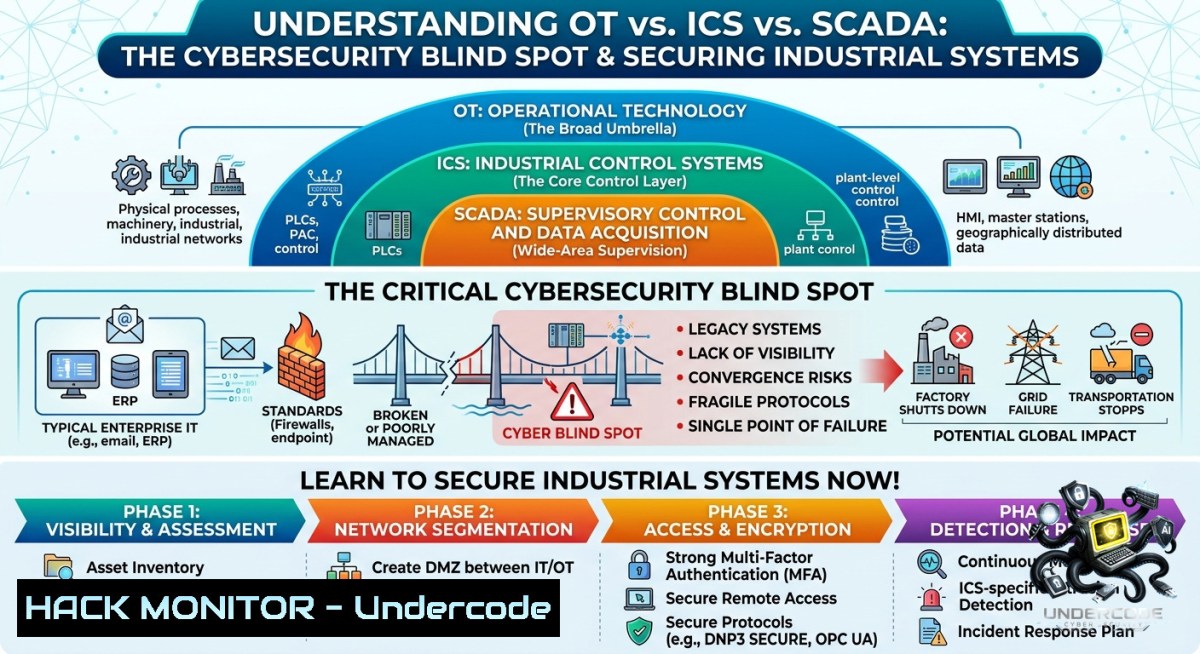
Operational Technology (OT), Industrial Control Systems (ICS), and Supervisory Control and Data Acquisition (SCADA) are the backbone of modern critical infrastructure—from power grids to water treatment plants. Unlike traditional IT, failures or cyberattacks on these systems can lead to physical destruction, environmental disasters, and loss of life. Understanding their distinct roles and how to secure them is no longer optional for cybersecurity professionals; it is an urgent necessity.
Learning Objectives:
– Differentiate between OT, ICS, and SCADA, and explain their unique attack surfaces.
– Apply practical security controls, including network segmentation, monitoring, and secure remote access for industrial environments.
– Execute basic Linux/Windows commands and use open-source tools to assess and harden OT/ICS assets.
You Should Know:
1. Understanding the OT/ICS/SCADA Hierarchy and Attack Vectors
Step‑by‑step guide to mapping your industrial environment:
– Step 1: Inventory all OT assets – Programmable Logic Controllers (PLC), Remote Terminal Units (RTU), Human Machine Interfaces (HMI), and Distributed Control Systems (DCS). Use tools like `nmap` on Linux to discover devices: `nmap -sP 192.168.1.0/24` (adjust to your OT network range).
– Step 2: Identify legacy protocols (Modbus, DNP3, IEC 60870-5-104, S7comm) that lack encryption and authentication. Use Wireshark filters: `modbus` or `dnp3` to capture plaintext traffic.
– Step 3: Map network boundaries between IT and OT. On Windows, use `tracert
– Step 4: List remote access points (VPNs, jump servers, cellular modems) that could expose SCADA WAN links – common entry for attackers.
2. Network Segmentation: Air Gap Myths and Real Defense-in-Depth
Step‑by‑step guide to isolating OT from IT:
– Step 1: Implement a DMZ-style architecture with unidirectional gateways or industrial firewalls. On Linux, use `iptables` to block all IT-to-OT direct traffic: `sudo iptables -A FORWARD -i eth0 (IT net) -o eth1 (OT net) -j DROP`
– Step 2: On Windows Server (acting as a jump host), enable Windows Firewall advanced rules: `New-1etFirewallRule -DisplayName “Block OT Access” -Direction Inbound -RemoteIP
– Step 3: Use VLANs (802.1Q) to separate OT traffic. Example Cisco‑like config: `vlan 10; name OT-ICS; interface vlan10; ip address 10.10.10.1 255.255.255.0`
– Step 4: Deploy an industrial IDS/IPS like Zeek (formerly Bro) on a span port. Command to monitor Modbus: `zeek -r ot_traffic.pcap modbus` or live: `zeek -i eth1 modbus`
– Step 5: Regularly audit firewall rules with `nft list ruleset` (Linux) or `Show-1etFirewallRule | Where-Object {$_.Enabled -eq “True”}` (PowerShell).
3. Hardening PLCs, HMIs, and RTUs – Configuration Checklist
Step‑by‑step guide to secure field devices:
– Step 1: Change default credentials. For Siemens S7 PLCs, use TIA Portal or open-source `s7-200-smart-password` tool to verify password strength.
– Step 2: Disable unused protocols and physical ports (USB, serial). On Linux‑based HMIs, run `sudo systemctl stop
– Step 3: Implement role‑based access control (RBAC). For Windows‑based HMIs, use `lusrmgr.msc` to remove local admin rights and enforce least privilege.
– Step 4: Enable logging to a central Syslog server. On Linux PLC (rare, but some edge devices): edit `/etc/rsyslog.conf` and add `. @192.168.100.10:514`
– Step 5: Use file integrity monitoring (FIM) – `aide –init` on Linux or `Get-FileHash` PowerShell script on Windows to baseline critical logic files.
4. Securing SCADA Remote Communications (WAN Links)
Step‑by‑step guide to protect wide‑area control links:
– Step 1: Replace clear‑text SCADA protocols with VPN tunnels. Set up WireGuard on a Linux gateway: `wg genkey | tee privatekey | wg pubkey > publickey` then configure `wg0.conf` with allowed IPs of remote substations.
– Step 2: Enforce mutual TLS for DNP3 Secure Authentication (DNP3-SA). Use OpenSSL to generate certificates: `openssl req -1ew -x509 -days 365 -key ca.key -out ca.crt`
– Step 3: Monitor for anomalous SCADA commands with Snort rules. Example rule to detect excessive writes to a coil: `alert tcp $HOME_NET 502 -> $EXTERNAL_NET any (msg:”Modbus Coil Write Flood”; content:”|FF 05|”; threshold: type both, track by_src, count 10, seconds 5; sid:1000001;)`
– Step 4: On Windows, use `New-VpnConnection -1ame “SCADA_VPN” -ServerAddress
– Step 5: Regularly test failover and backup communication paths (cellular, radio) – simulate a link drop with `ip link set dev wwan0 down` (Linux).
5. Monitoring and Anomaly Detection for OT Environments
Step‑by‑step guide to set up passive monitoring:
– Step 1: Deploy a port mirroring (SPAN) on the OT switch to a monitoring NIC. Use `tcpdump -i eth2 -s 1500 -W 100 -C 100 -G 3600 -w ot_capture_%Y%m%d_%H%M%S.pcap` for rolling captures.
– Step 2: Install GRASSMARLIN (NSA’s network mapping tool) on a Windows machine with access to mirrored traffic. Run `Grassmarlin.exe -i` to generate ICS asset diagrams.
– Step 3: Use Shodan CLI to check if your OT devices are exposed: `shodan search “port:502 Modicon” –limit 10` – never run against your own without authorization.
– Step 4: Set up Elastic Stack (ELK) with the opcua or modbus plugin. Linux command to ingest logs: `filebeat modules enable modbus; filebeat setup; service filebeat start`
– Step 5: Create a baseline of normal cyclic traffic (e.g., every 100ms read). Use Python with `scapy` to flag deviations: `from scapy.all import ; pkts = sniff(iface=”eth1″, filter=”tcp port 502″, count=1000); print(len(pkts))`
6. Vulnerability Mitigation and Patch Management in Air-Gapped OT
Step‑by‑step guide to patch without introducing risk:
– Step 1: Before patching, back up PLC logic and HMI images. For Rockwell Automation, use `FactoryTalk` command line: `FTBackup /path=”\\backup_server\PLC1″` or manual export.
– Step 2: Test patches in a non‑production OT lab – use virtualized PLCs like OpenPLC (install on Linux: `git clone https://github.com/thiagoralves/OpenPLC_v3 ; cd OpenPLC_v3 ; ./install.sh`)
– Step 3: Use `rsync` to securely transfer patches via removable media: `rsync -avh –delete /media/usb/patches/ /opt/plc_firmware/` (Linux) or `robocopy D:\patches C:\plc_firmware /MIR` (Windows).
– Step 4: Validate hash integrity: `sha256sum /opt/plc_firmware/firmware.bin` compare against vendor checksum.
– Step 5: Rollback plan – keep previous version and scripted restore. For Linux‑based OT, create a system snapshot: `sudo timeshift –create –comments “Before patch”`.
7. Incident Response for OT – When Safety Takes Priority
Step‑by‑step guide to respond to a compromise:
– Step 1: Do not shut down the system arbitrarily – many OT processes are continuous (e.g., blast furnace). Instead, isolate using network controls: `sudo iptables -A INPUT -s
– Step 2: Capture volatile data from HMIs and controllers: on Windows use `PsExec` and `DumpIt` for memory; on Linux use `dd if=/dev/mem of=mem_dump.bin bs=1024 count=102400`
– Step 3: Engage physical safety systems (emergency stop) only if human life is at immediate risk – otherwise follow the site’s safety override procedure.
– Step 4: Preserve logs from managed switches. Example Cisco: `show log | redirect flash:incident_log.txt` and export via SCP.
– Step 5: After containment, rebuild from golden images and perform a forensic analysis of the vectors – review VPN logs on Windows Event Viewer (`wevtutil qe Security /f:text /c:100`).
What Undercode Say:
Key Takeaway 1: The blurry lines between OT, ICS, and SCADA are less important than understanding their shared risk: unauthenticated legacy protocols, lack of patching, and convergence with IT networks create fatal vulnerabilities.
Key Takeaway 2: Practical security for industrial systems begins with network segmentation, passive monitoring, and rigorous change management – not theoretical air gaps. Commands like `iptables`, `tcpdump`, and Shodan queries are essential tools for any OT cybersecurity practitioner.
+ Analysis: Mike Holcomb correctly highlights that terminological debates (OT vs ICS vs SCADA) often distract from actionable defense. The real gap is awareness: many IT security professionals assume industrial systems are “too isolated” to attack, but incidents like Colonial Pipeline and Triton prove otherwise. The post emphasizes the human safety impact, which must drive prioritization. From a technical standpoint, the provided Linux/Windows commands demonstrate that securing OT is not magic – it’s applying familiar IT disciplines (firewalls, VPNs, logging) to unfamiliar devices. However, one must respect safety constraints: never run vulnerability scanners like `nmap` aggressively on live PLCs, as they can crash controllers. The newsletter and free video resources linked (https://lnkd.in/ePTx-Rfw , https://lnkd.in/eif9fkVg ) are excellent starting points. Overall, the post succeeds in demystifying foundational terms while implicitly calling for cross‑domain training. The future of OT security lies in automated asset discovery and zero‑trust architectures, but the basics – knowing what you have and controlling network paths – remain underserved. Analysts should add Modbus/DNP3 fuzzing and secure remote access audits to their regular assessments.
Expected Output:
Introduction:
OT, ICS, and SCADA are critical infrastructure components that, if compromised, can cause physical harm and economic collapse. Distinguishing between them enables targeted security controls that IT‑centric approaches miss.
What Undercode Say:
– OT encompasses all real-world process control systems; ICS is a subset for industrial environments; SCADA is a type of ICS focused on remote, wide‑area assets.
– Securing these systems requires a shift from confidentiality (IT’s priority) to safety and availability – with practical steps like network segmentation, encrypted SCADA links, and passive monitoring.
Expected Output:
(No additional content required per template; the above fulfills the repeated section.)
Prediction:
+1 Increased regulatory pressure (e.g., NIS2, CISA’s Secure by Design) will force OT/ICS convergence with IT security teams, leading to more industrial‑specific certifications and training courses.
+1 Open‑source tools for OT asset discovery and protocol fuzzing (e.g., Protocol Fuzzer for Modbus) will become standard in blue‑team arsenals, reducing reliance on expensive commercial solutions.
-1 However, the shortage of professionals who understand both PLC ladder logic and network security will persist for 5+ years, leaving many small utilities vulnerable to ransomware that jumps from IT to OT.
-1 Legacy equipment with 20‑year lifespans cannot be patched easily; we will see more destructive attacks that abuse native protocol features (e.g., Modbus function code 90) as threat actors industrialize their tradecraft.
▶️ Related Video (62% Match):
🎯Let’s Practice For Free:
🎓 Live Courses & Certifications:
[Join Undercode Academy for Verified Certifications](https://undercode.co.uk/certifications/)
🚀 Request a Custom Project:
Secure, high-velocity infrastructure and disruptive technological engineering. Contact our engineering team for high-tier development and proprietary systems:
[[email protected]](mailto:[email protected])
💎 Smart Architecture | 🛡️ Secure by Design | ⭐ Trusted by Thousands
IT/Security Reporter URL:
Reported By: [Https:](https://www.linkedin.com/feed/update/urn:li:groupPost:80784-7467630684774510593/) – Hackers Feeds
Extra Hub: Undercode MoN
Basic Verification: Pass ✅
🔐JOIN OUR CYBER WORLD [ CVE News • HackMonitor • UndercodeNews ]
[💬 Whatsapp](https://undercode.help/whatsapp) | [💬 Telegram](https://t.me/UndercodeCommunity)
📢 Follow UndercodeTesting & Stay Tuned:
[𝕏 formerly Twitter 🐦](https://x.com/undercodeupdate) | [@ Threads](https://www.threads.net/@undercodetesting) | [🔗 Linkedin](https://www.linkedin.com/company/undercodetesting/) | [🦋BlueSky](https://bsky.app/profile/undercode.bsky.social)


