Listen to this Post
Introduction:
In Operational Technology (OT) environments, the gap between a misconfigured protocol and an operational catastrophe is razor-thin. While IT cybersecurity prioritizes data confidentiality and integrity, OT security is fundamentally about availability, safety, and business continuity—where a single exposed service on TCP 502 or a malformed packet sent to port 102 can halt a production line, disrupt a power grid, or trigger a safety incident. Understanding industrial protocols and their associated ports isn’t an academic exercise; it’s the foundation of threat hunting, anomaly detection, and incident response in the industrial control systems (ICS) domain.
Learning Objectives:
- Understand the critical OT/ICS protocols most frequently targeted by adversaries and their default port assignments
- Learn to identify vulnerabilities and misconfigurations associated with each protocol using real-world CVE examples
- Master practical command-line techniques for asset discovery, network monitoring, and threat detection across Linux and Windows environments
You Should Know:
- Modbus TCP (Port 502) — The Ubiquitous Yet Insecure Workhorse
Modbus TCP remains the most widely deployed industrial protocol, found in PLC communications across manufacturing, energy, and water treatment facilities. However, its age is its Achilles’ heel—the default port was assigned roughly 30 years ago, long before cybersecurity was a consideration.
Recent vulnerabilities highlight the severity of this exposure. CVE-2025-55221 (CVSS 8.6, High) affects Socomec DIRIS Digiware M-70 devices, where missing authentication on critical functions accessible via Modbus TCP on port 502 allows an unauthenticated attacker to send a specially crafted packet and trigger a denial-of-service condition. Similarly, CVE-2025-54849 enables DoS by sending a single unauthenticated Modbus TCP message using Write Single Register function code (6).
What This Means for Defenders: Modbus lacks built-in encryption, authentication, and message integrity checks. Attackers can read/write coil and register values, manipulate processes, or cause physical damage if the protocol is exposed.
Step-by-Step: Modbus Asset Discovery and Monitoring
Linux (Nmap):
 Discover Modbus devices and enumerate slave IDs
nmap --script modbus-discover.nse --script-args='modbus-discover.aggressive=true' -p 502 <target_network>/24

Basic port scan for Modbus endpoints
nmap -Pn -p 502 --open <target_network>/24
The `modbus-discover` script attempts to find valid slave IDs (sids) and extract vendor and firmware information.
Linux (Wireshark/TShark capture):
 Capture live Modbus traffic
sudo tshark -i eth0 -f "tcp port 502" -Y "modbus" -w modbus_capture.pcap

Display specific function codes (e.g., read holding registers - code 3)
tshark -r modbus_capture.pcap -Y "modbus.func_code == 3"
Windows (PowerShell with Wireshark):
 Start capture on interface index 1
& "C:\Program Files\Wireshark\tshark.exe" -i 1 -f "tcp port 502" -Y "modbus" -w modbus_capture.pcap
Shodan Search (for exposure assessment):
port:502 tag:ics
port:502 "Schneider Electric"
Over one million open Modbus ports are visible on the public internet—most of which aren’t actually running the service, but the exposure alone is a risk indicator.
Mitigation: Isolate Modbus devices in dedicated network segments, implement strict firewall rules to block port 502 from untrusted networks, and deploy deep packet inspection (DPI) to detect anomalous Modbus function codes.
- OPC UA (Port 4840) — The “Secure” Protocol That Isn’t Always Secure
OPC Unified Architecture (OPC UA) is promoted as a modern, vendor-independent standard designed for secure interoperability. Yet a 2025 Internet-wide scan revealed that 62% of the 1,812 OPC UA servers exposed on port 4840 suffer from vulnerabilities tied to misconfigurations, outdated software, broken access control, and certificate management issues. Worse, 25% of these servers had received either none or only minor updates in recent years.
Real-World Risks: OPC UA servers face threats including unauthorized read/write operations, subscription hijacking, and data exfiltration. The OPC Foundation’s Local Discovery Server (LDS) before version 1.03.367 was vulnerable to an XXE attack that allowed remote attackers to access system resources via specially crafted packets.
Step-by-Step: OPC UA Security Auditing
Linux (Nmap service detection):
 Identify OPC UA servers
nmap -Pn -p 4840 --script=opcua-info <target>

Enumerate OPC UA endpoints and security policies
nmap --script opcua-enumerate -p 4840 <target>
Wireshark/tshark analysis:
 Capture OPC UA traffic
sudo tshark -i eth0 -f "port 4840" -Y "opcua" -w opcua_capture.pcap

Filter for specific OPC UA services (OpenSecureChannel, CreateSession, etc.)
tshark -r opcua_capture.pcap -Y "opcua.service_id == 0x01"  OpenSecureChannel
Windows (Wireshark GUI filter):
tcp.port == 4840 || opcua
Mitigation: Block port 4840 via external firewalls and open it only for authenticated access. Use VPN tunnels for remote access. Enforce certificate-based communication with message security modes (Sign or Sign&Encrypt). Activate user administration and password functions—they’re deactivated by default on many controllers.
- Siemens S7 (Port 102) — The Crown Jewel of Siemens Automation
Siemens S7 protocol is critical throughout Siemens industrial automation environments, used in SIMATIC S7-1200, S7-1500, and ET 200系列 controllers. The protocol runs on TCP port 102 (ISO-TSAP) and has been the subject of multiple high-severity vulnerabilities.
CVE-2025-40944 affects Siemens SIMATIC devices that mishandle S7 disconnect requests on port 102, causing a denial-of-service condition that requires a device restart or power cycle to recover. Additionally, the authentication protocol between clients and PLCs via port 102 insufficiently protects transmitted passwords, enabling attackers with network interception capabilities to obtain valid PLC credentials.
Step-by-Step: Siemens S7 Discovery and Hardening
Linux (Nmap S7 enumeration):
 Enumerate Siemens S7 PLC information
nmap --script s7-info.nse -p 102 <target>
 Output reveals: Basic Hardware (e.g., 6ES7 315-2AG10-0AB0), System Name, etc.

Bulk enumeration from a host list
while read LINE; do nmap --script s7-info.nse -p 102 $(awk '{print $4}'); done < host_list.txt
Python (stopping S7 CPUs—authorized testing only):
 This is for authorized penetration testing. Unauthorized use is illegal.
 Reference: Various ICS security frameworks
Wireshark filter for S7 traffic:
tcp.port == 102
Shodan discovery:
port:102 "Siemens"
Mitigation: Apply vendor patches promptly (CVE-2025-40944 requires updates). Restrict port 102 access to trusted engineering workstations only. Implement network segmentation following the Purdue model to prevent unauthorized access to S7-enabled devices.
- DNP3 (Port 20000) — The Power Grid’s Protocol Under Siege
Distributed Network Protocol (DNP3) is widely deployed in power grids, utilities, and SCADA systems for communication with remote terminal units (RTUs) and outstations. Legacy DNP3 implementations lack encryption and authentication, enabling potential command injection, data spoofing, buffer overflow, and replay attacks.
Critical Vulnerabilities: The DNP3 link layer address can be brute-forced by iterating through likely values—if successful, attackers can perform read/write operations to compromise process control data integrity. DNP3 .NET Protocol components (versions 3.06.0.171 through 3.15.0.369) allow remote DoS via crafted DNP3 TCP packets. The IOServer DNP3 driver has been vulnerable to improper input validation on port 20000/TCP.
Step-by-Step: DNP3 Assessment
Linux (Nmap DNP3 enumeration):
 Enumerate DNP3 devices
nmap -Pn -p 20000 --script dnp3-info <target>

Discover DNP3 stations on a network
nmap -Pn -p 20000 --script dnp3-discover <target_network>/24
Wireshark filter for DNP3:
tcp.port == 20000 || dnp3
Shodan discovery:
port:20000 dnp3
Mitigation: Select complex, non-guessable link layer addresses. Filter access to TCP port 20000 using strict firewall rules. Deploy intrusion detection systems (IDS) to monitor for anomalous DNP3 traffic patterns. Consider protocol gateways that add encryption and authentication layers.
5. EtherNet/IP (Port 44818) — Rockwell Automation’s Backbone
EtherNet/IP, based on the Common Industrial Protocol (CIP), is the backbone of Rockwell Automation environments and is frequently deployed in manufacturing. It operates on TCP port 44818 (and UDP port 44818).
Attack Surface: When affected Rockwell products receive valid CIP messages from unauthorized sources to port 44818 that change configuration and network parameters, a DoS condition occurs. Malformed CIP packets can create buffer overflows that crash the NIC or CPU. Specially crafted CIP messages can trigger out-of-bounds writes and enable arbitrary code execution.
Step-by-Step: EtherNet/IP Discovery
Linux (Nmap ENIP enumeration):
 Enumerate EtherNet/IP devices
nmap -Pn -sU -p 44818 --script enip-info <target>
 Script sends a Request Identity Packet and parses device information

TCP scan for EtherNet/IP
nmap -Pn -p 44818 --script enip-info <target>
Wireshark filter for EtherNet/IP:
tcp.port == 44818 || enip
Shodan discovery:
port:44818 "Rockwell"
Mitigation: Apply vendor patches (Rockwell has released multiple updates). Restrict port 44818 access to authorized engineering and maintenance systems. Implement network segmentation to isolate EtherNet/IP traffic from corporate IT networks.
6. PROFINET (Port 34964/UDP) — Real-Time Industrial Ethernet
PROFINET is designed for real-time industrial Ethernet communications with strict performance requirements. It operates on UDP port 34964 (PROFINET Context Manager).
Vulnerabilities: Siemens has issued multiple advisories for PROFINET vulnerabilities. CVE-2019-13946 affects multiple Siemens products, with the recommended mitigation being to create a firewall rule that blocks the PROFINET Context Manager port (34964/udp). PROFINET, like many industrial protocols, lacks basic security mechanisms such as authentication and encryption.
Step-by-Step: PROFINET Monitoring
Wireshark filter for PROFINET:
udp.port == 34964
Linux (UDP scan):
 Scan for PROFINET devices
nmap -Pn -sU -p 34964 <target_network>/24
Mitigation: Block port 34964/udp at firewalls unless explicitly required. Update to vendor-recommended firmware versions (e.g., V6.1.2 or later). Isolate PROFINET traffic to dedicated industrial network segments.
- BACnet (Port 47808/UDP) — The Overlooked Building Automation Protocol
BACnet is commonly used in building automation systems, including HVAC, lighting, and physical access control. It operates on UDP port 47808 and is frequently overlooked in security assessments—yet building automation networks are often accessible from corporate networks.
Critical Vulnerability: CVE-2020-36872 (CVSS 8.7, High) affects BACnet Test Server versions up to 1.01. The server fails to properly validate the BVLC Length field in incoming UDP BVLC frames on port 47808/udp. A remote unauthenticated attacker can send a malformed BVLC Length value to trigger an access violation and crash the application, resulting in complete denial of service.
Step-by-Step: BACnet Discovery and Hardening
Linux (Nmap BACnet discovery):
 Discover BACnet devices
nmap -Pn -sU -p 47808 --script bacnet-info <target>
Wireshark filter for BACnet:
udp.port == 47808 || bacnet
Shodan discovery:
port:47808 bacnet
Mitigation: Update BACnet Test Server beyond version 1.01. Implement network segmentation to isolate BACnet devices from all other network segments following the Purdue model. Use firewalls to restrict access to port 47808/udp. Monitor network traffic for unusual UDP packets on the BACnet port.
What Undercode Say:
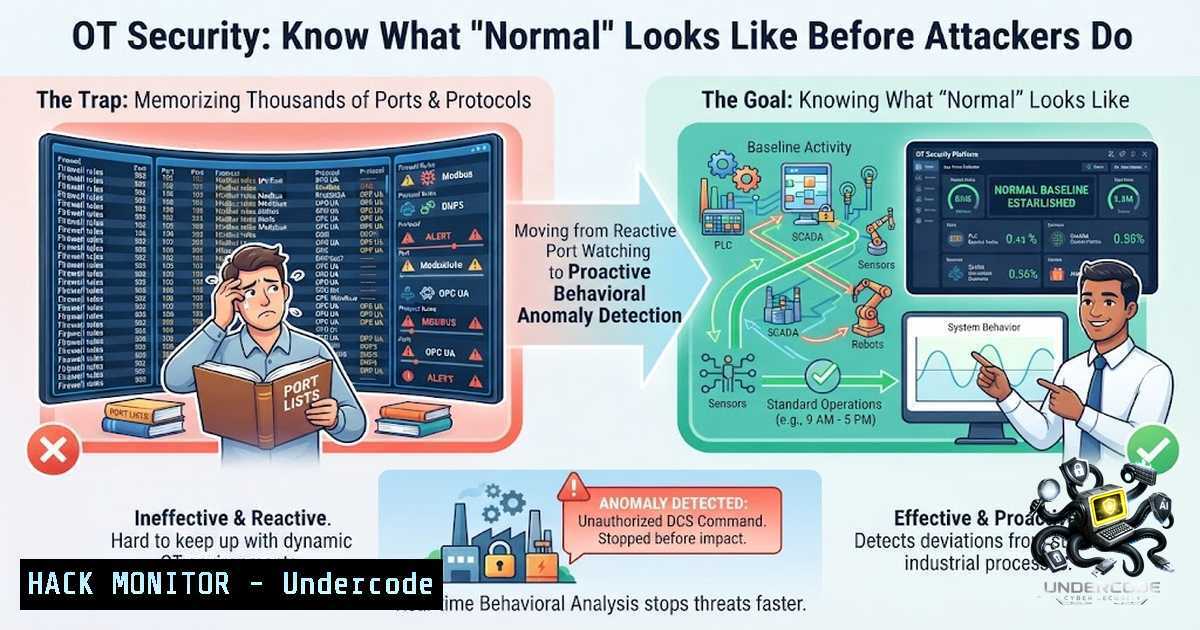
- Visibility is the strongest security control in OT environments. Knowing what “normal” looks like for each protocol—traffic patterns, expected function codes, typical data volumes—enables defenders to spot anomalies before they become operational disruptions. The post’s author captures this perfectly: “It’s about knowing what ‘normal’ looks like, so abnormal behavior becomes immediately visible.”
-
Protocol awareness is the foundation, not the destination. Memorizing port numbers is useless without understanding the attack surface each protocol presents. Defenders must go beyond the numbers to grasp the MITRE ATT&CK techniques associated with each protocol—T0862 (Denial of Service), T0863 (Man-in-the-Middle), T0861 (Command Injection)—and implement defenses accordingly.
Analysis: The post highlights a critical gap in OT cybersecurity education—many professionals focus on IT-style defenses (firewalls, antivirus, patching) without understanding the operational protocols these defenses are meant to protect. This is particularly dangerous because OT protocols were designed for reliability and determinism, not security. The six protocols listed represent the most common attack vectors in industrial environments, yet many organizations lack basic asset inventories of what’s running on these ports. The post’s emphasis on “understanding normal” aligns with the NIST Cybersecurity Framework’s “Detect” function—you can’t detect what you don’t understand. Organizations should invest in passive network monitoring tools (like GRASSMARLIN or Nozomi) that build baselines of normal protocol behavior, then alert on deviations. The real challenge isn’t technical—it’s cultural. OT teams need to collaborate with IT security teams to bridge the protocol knowledge gap, and security teams need to recognize that scanning OT networks with aggressive IT tools can crash PLCs.
Prediction:
-1 The continued exposure of OT protocols to the public internet (over 1 million open Modbus ports, 1,800+ exposed OPC UA servers) will drive a wave of ransomware and wiper attacks targeting industrial sectors. Threat actors have already demonstrated the ability to weaponize these exposures—the Colonial Pipeline attack and TRITON/TRISIS malware are just the beginning. As geopolitical tensions rise, nation-state actors will increasingly target critical infrastructure through these protocol-level vulnerabilities.
-1 The “air gap” myth will continue to erode as IT/OT convergence accelerates. Industrial organizations that believe their networks are isolated will suffer the most significant breaches. The reality is that many OT networks have undocumented connections to corporate IT networks, cloud services, or remote access solutions—creating pathways for attackers to reach exposed protocol ports.
+1 The growing awareness of OT protocol vulnerabilities will drive significant investment in specialized OT security tools, passive monitoring solutions, and ICS-specific training. Organizations that prioritize protocol-level visibility and anomaly detection will build resilient defenses that can withstand both commodity ransomware and sophisticated nation-state attacks.
+1 Regulatory frameworks (NERC CIP, IEC 62443, and emerging EU cyber resilience legislation) will mandate protocol-level security controls, forcing organizations to implement asset inventories, network segmentation, and continuous monitoring. This regulatory pressure will accelerate the adoption of secure-by-design protocols and the retrofitting of security controls onto legacy systems.
🎯Let’s Practice For Free:
🎓 Live Courses & Certifications:
Join Undercode Academy for Verified Certifications
🚀 Request a Custom Project:
Secure, high-velocity infrastructure and disruptive technological engineering. Contact our engineering team for high-tier development and proprietary systems:
[email protected]
💎 Smart Architecture | 🛡️ Secure by Design | ⭐ Trusted by Thousands
IT/Security Reporter URL:
Reported By: Yildiz Yasemin – Hackers Feeds
Extra Hub: Undercode MoN
Basic Verification: Pass ✅


