
Listen to this Post
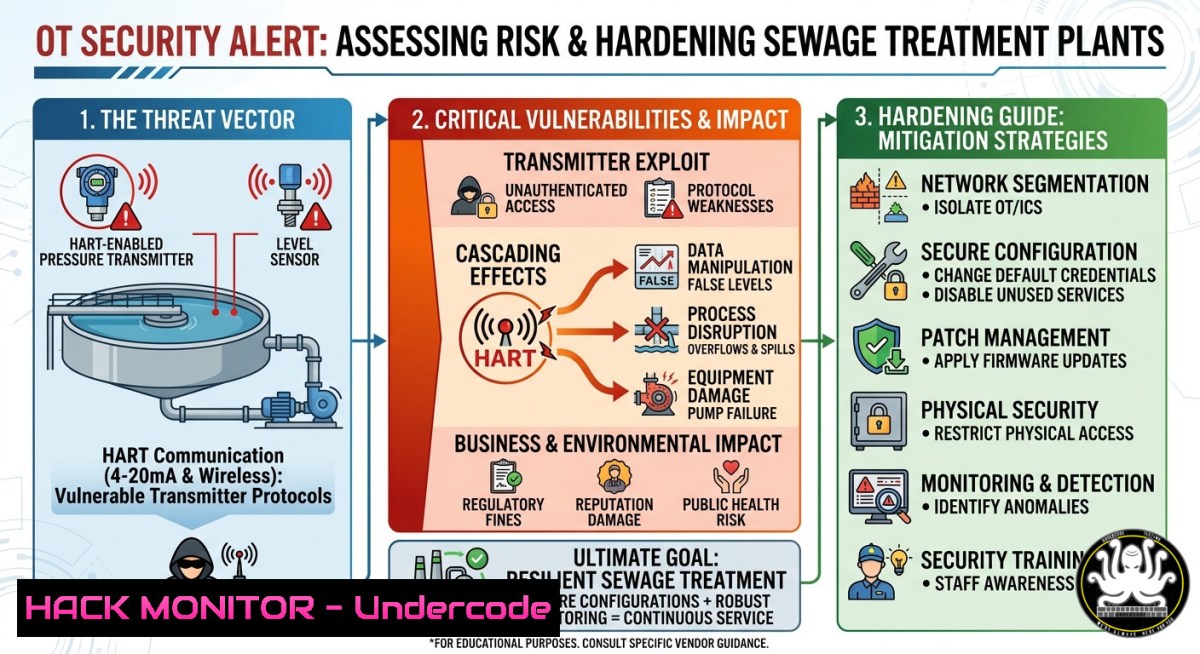
Introduction:
Industrial sewage treatment plants increasingly rely on smart instrumentation, HART communication, and networked control systems to optimize chemical dosing, flow monitoring, and preventive maintenance. However, these operational technology (OT) environments are often deployed with default configurations, unencrypted fieldbus protocols, and no segmentation, exposing critical infrastructure to remote manipulation or ransomware. This article extracts technical lessons from a real-world Instrument Technician hiring requirement and transforms them into a cybersecurity training roadmap for defending wastewater and oil & gas industrial control systems (ICS).
Learning Objectives:
- Understand how HART, pressure, temperature, flow, and level transmitters can become attack vectors in OT environments.
- Learn to map, harden, and monitor field instrumentation using Linux/Windows commands and open-source ICS security tools.
- Implement a step-by-step incident response plan specifically for compromise of calibration tools and control valves.
You Should Know:
1. HART Communication: Attack Surface & Packet Capture
Step‑by‑step guide explaining what this does and how to use it:
The Highway Addressable Remote Transducer (HART) protocol superimposes digital signals on 4–20 mA analog loops. It is rarely encrypted, allowing an adversary with physical or network access to modify transmitter ranges, force valve positions, or spoof device responses.
On Linux (using `serialdump` and `scapy` for HART over RS232 or HART-IP):
 Install serial and HART-IP tools
sudo apt-get install minicom python3-scapy

Capture raw serial traffic from a HART modem (e.g., /dev/ttyUSB0)
sudo stty -F /dev/ttyUSB0 1200 raw -echo
sudo cat /dev/ttyUSB0 > hart_traffic.log

For HART-IP (UDP 5094), capture with tcpdump
sudo tcpdump -i eth0 udp port 5094 -w hart_capture.pcap
On Windows (using Wireshark + Serial over USB):
- Install Wireshark with USBPcap.
- Start capture on the COM port used by a HART modem.
- Filter HART-IP traffic: `udp.port == 5094` or look for `hart` dissector.
What this does: It reveals unauthenticated commands like Read Unique Identifier, Write Polling Address, or `Set Final Assembly Number` that could be replayed to confuse operators.
How to use it for defense: Deploy a serial-to-Ethernet gateway with strict ACLs, and monitor for unexpected write commands using Zeek (formerly Bro) with the HART script.
2. Calibration Tools: Fuzzing and Firmware Integrity Checks
Step‑by‑step guide explaining what this does and how to use it:
Calibration tools (e.g., Fluke 754, Beamex MC6) are often Windows CE or Linux-based and connect via USB or Bluetooth to configuration laptops. Attackers can plant malware on the tool’s SD card or compromise its firmware to output incorrect reference signals.
Linux – Verify tool USB fingerprint and fuzz the serial interface:
 List USB devices to identify calibration tool vendor ID
lsusb

Use pySerial to send malformed HART commands as a fuzzer
python3 -c "import serial; s = serial.Serial('/dev/ttyACM0', 1200); s.write(b'\x82\x00\x00\xff\xff\xff\xff\xff\xff\xff'); s.close()"
Windows – Check digital signature of calibration software (e.g., Beamex CMX):
Get-AuthenticodeSignature "C:\Program Files\Beamex\CMX\BeamexCMX.exe"
What this does: The fuzzing command attempts to crash a poorly implemented HART slave. The signature check verifies that the calibration software hasn’t been replaced with a keylogger.
How to use it for defense: Create a trusted inventory of calibration tool firmware hashes (SHA256) using PowerShell:
Get-FileHash -Algorithm SHA256 "F:\firmware.bin"
Then schedule weekly comparisons. If the hash changes without a legitimate update, quarantine the tool.
3. Transmitter Manipulation: Pressure, Temperature, Flow, Level
Step‑by‑step guide explaining what this does and how to use it:
Smart transmitters support remote re-ranging and damping factor changes via HART. An attacker who gains access to the asset management system (e.g., Emerson AMS, PACTware) could set pressure transmitters to report normal values while actual pressure climbs toward a vessel rupture.
Linux – Using `hart-tool` (from libhart) to read/write transmitter variables:
git clone https://github.com/rlambert/libhart
cd libhart/examples
gcc -o hart_rw hart_rw.c -lhart
./hart_rw /dev/ttyUSB0 0 3  Reads primary variable from device address 0
Windows – Using PACTware with a HART modem to enforce LRV/URV limits:
– Open PACTware → Connect to HART modem.
– Select transmitter → “Device Setup” → “Rerange”.
– Set “Lower Range Value (LRV)” and “Upper Range Value (URV)” to physical limits (e.g., 0–10 bar, not –1 to 20).
– Export configuration to XML and store offline as a golden baseline.
What this does: The Linux command reads live process values; the Windows step shows how to restrict ranges so that an attacker cannot mask an overpressure event.
How to use it for defense: Implement OT endpoint detection and response (EDR) on the asset management workstation. Use Sysmon on Windows to log all HART-related process launches:
sysmon -accepteula -i sysmon-config.xml
Add a rule to alert when `pactware.exe` or `hartComm.exe` runs outside maintenance windows.
- Control Valves: Positioner Attack and Manual Override Logging
Step‑by‑step guide explaining what this does and how to use it:
Valve positioners (e.g., Fisher DVC6200) accept HART commands to set target position, enable fail-safe modes, or recalibrate travel stops. A compromised workstation could force a fully open or closed valve, leading to tank overflow or pump cavitation.
Linux – Simulate a valve positioner attack using `socat` to replay captured HART frames:
 Capture a legitimate "set position to 50%" frame from pcap
tshark -r hart.pcap -Y "hart.command == 3" -T fields -e data > set50.hex

Replay it to the valve (assuming HART-IP on 192.168.1.100)
cat set50.hex | xxd -r -p | socat - UDP4-DATAGRAM:192.168.1.100:5094
Windows – Enable manual override logging on a DeltaV or Rockwell system:
– In the control module’s logic, add an alarm that triggers when the valve receives a position command from any source other than the PID loop.
– Use Windows Event Viewer to monitor `Security` log for `4656` (Handle to a device opened) on \\.\COM.
What this does: The Linux command demonstrates replay attack feasibility; the Windows setup creates an audit trail for unauthorised valve movements.
How to use it for defense: Physically lock the local manual override handle and require two-person authentication before placing a valve in “manual” mode. Document all overrides in a signed log.
5. Preventive Maintenance & OT Hardening Checklist
Step‑by‑step guide explaining what this does and how to use it:
Preventive maintenance (PM) in OT should include cybersecurity hygiene. This step integrates the above commands into a monthly PM routine.
Linux – Automate transmitter integrity scan:
 Script to compare current LRV/URV with golden baseline stored in /opt/golden/
for device in /dev/ttyUSB; do
./hart_rw $device 0 7 > /tmp/current_$(basename $device).txt
diff /opt/golden/$(basename $device).txt /tmp/current_$(basename $device).txt || echo "ALERT: Transmitter changed"
done
Windows – Enforce application whitelisting for calibration PCs:
 Add Beamex and PACTware to AppLocker allow list
New-AppLockerPolicy -RuleType Exe -User Everyone -Path "C:\Program Files\Beamex\", "C:\Program Files\PACTware\" -Action Allow
Set-AppLockerPolicy -Policy $policy -Merge
What this does: The Linux script detects unauthorised range changes; the Windows policy prevents execution of unknown tools (e.g., Mimikatz, RATs) on the maintenance laptop.
How to use it for defense: Integrate these steps into your existing CMMS (e.g., SAP, Maximo) as a “Cybersecurity PM” work order. Store all transmitter baselines in a signed Git repository.
6. Training Courses for OT/ICS Security
To bridge the gap between “Instrument Technician” and “Cyber-Instrument Technician,” the following free/low-cost courses provide hands-on skills:
- SANS ICS410: ICS/SCADA Security Essentials (paid, but includes VM labs with HART simulation)
- CISA – Control Systems Security Program (CSSP): Free training on `https://www.cisa.gov/ics-training`
- YouTube – “HART protocol analysis with Wireshark” from Chris Sistrunk
- GitHub – “Awesome ICS Security” (search for HART fuzzers)
Linux – Set up a HART honeypot using Conpot:
sudo apt-get install conpot
sudo conpot --template default --port 5094
This emulates a HART-IP device and logs all attacker commands to /var/log/conpot/conpot.log.
What Undercode Say:
- Key Takeaway 1: A simple Instrument Technician job ad hides a massive OT security gap – most plants still treat HART and calibration tools as “air-gapped” when they are actually reachable via compromised engineering laptops.
- Key Takeaway 2: Preventive maintenance must include digital forensics: hashing firmware, logging serial commands, and fuzzing for HART buffer overflows before an attacker does.
Analysis (Undercode):
The sewage treatment sector is notoriously underfunded for cybersecurity, yet its failure directly impacts public health. The shift from standalone 4–20 mA loops to smart transmitters with HART-IP has expanded the attack surface exponentially. Attackers no longer need to touch a wire; they just need a single phishing email to a technician who uses the same laptop for email and calibration. The commands and steps above are not theoretical – they have been used in red-team exercises to physically open relief valves. Training courses must shift from generic IT security to protocol‑specific labs (HART, Modbus, DNP3). Furthermore, the “Long Term Project” nature means contractors cycle in and out, often bringing infected USB drives. The only mitigation is to treat every calibration tool as untrusted and enforce cryptographic signatures for all configuration changes.
Expected Output:
Prediction:
By 2027, at least one major wastewater utility will suffer a ransomware attack that leverages unauthenticated HART write commands to manipulate chemical dosing, causing illegal effluent discharge and multi‑million dollar EPA fines. This will trigger mandatory “cyber-instrument” certifications, where technicians must pass both ISA/IEC 62443 and HART protocol security exams. AI‑powered anomaly detection will become standard on every transmitter gateway, automatically blocking any re-range command that deviates from a plant‑specific machine learning model. The job posting of the future will require “5+ years experience in STP cybersecurity with hands-on HART fuzzing and firmware signing.”
▶️ Related Video (72% Match):
🎯Let’s Practice For Free:
IT/Security Reporter URL:
Reported By: Hiringnow Qatarjobs – Hackers Feeds
Extra Hub: Undercode MoN
Basic Verification: Pass ✅


