Listen to this Post
Introduction
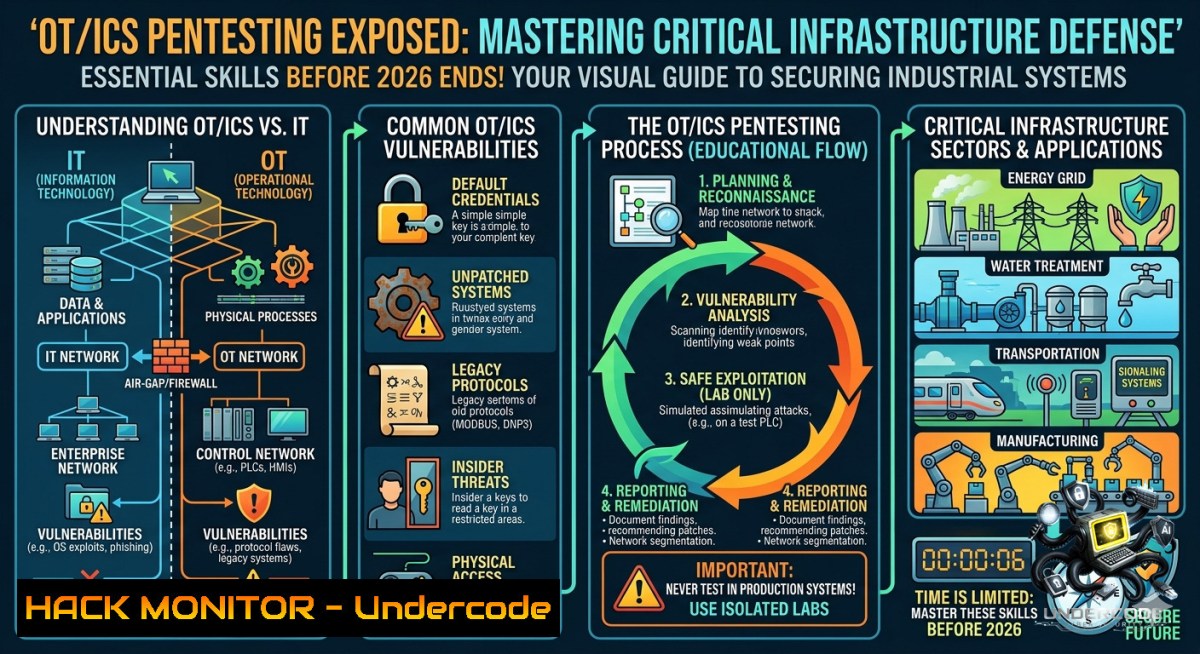
Operational Technology (OT) and Industrial Control Systems (ICS)—the backbone of power plants, water treatment facilities, and chemical refineries—face unique cybersecurity challenges that traditional IT penetration testing cannot address. Unlike IT environments where confidentiality reigns supreme, OT/ICS prioritizes safety and availability, meaning a poorly executed scan can trigger a physical valve closure or turbine shutdown. Mike Holcomb’s upcoming live public course offers a rare, hands-on dive into safely evaluating these high-stakes environments, bridging the gap between theoretical knowledge and practical, risk-aware testing.
Learning Objectives
– Differentiate OT/ICS pentesting methodologies from conventional IT security assessments, focusing on safety protocols and availability preservation.
– Execute safe, non-intrusive reconnaissance and vulnerability discovery against industrial protocols (Modbus, DNP3, S7comm) and assets like PLCs and HMIs.
– Apply attacker tactics in a controlled lab environment to identify security gaps in OT cyber programs, including network segmentation flaws and weak authentication mechanisms.
You Should Know
1. Why OT/ICS Pentesting Differs Radically from IT – And Why It Matters
Standard IT penetration testing assumes that systems can be rebooted, patched aggressively, and scanned with high-intensity tools like Nessus or Nmap’s default aggressive flags. In OT, a simple ICMP sweep or port scan of a legacy PLC may cause controller lockups, unexpected state changes, or watchdog timer resets. Safety is the overriding constraint—human lives and equipment integrity depend on stable operations.
Step‑by‑step safe testing approach:
1. Pre‑engagement: Obtain written authorization specifying IP ranges, PLCs, and allowed test windows. Include emergency stop procedures.
2. Passive reconnaissance first: Use network taps or span ports to monitor traffic for 48+ hours, identifying normal protocol baselines without injecting packets.
3. Active scanning with extreme care: Use low‑rate, single‑threaded scans. Example with Nmap on Linux:
 Scan a single PLC on Modbus TCP port 502 with minimal timing
sudo nmap -sS -p 502 --max-parallelism 1 --min-rate 10 --max-retries 1 --host-timeout 30s 192.168.1.100
4. Exploit only in isolated lab replicas of the actual OT environment, never on live production gear.
5. Monitor logs and physical processes during each test step; abort immediately if any abnormal actuator movement occurs.
2. Hands‑On Reconnaissance: Mapping Industrial Protocols Without Causing Chaos
Discovering PLCs, RTUs, and HMIs requires protocol‑aware tools that send read‑only requests. The Modbus protocol, for example, supports function code 0x01 (read coils) and 0x03 (read holding registers)—these are generally safe. Avoid function codes that write (0x05, 0x06, 0x0F, 0x10) unless in a lab.
Step‑by‑step guide (Linux with Kali or Ubuntu):
1. Install `plcscan` and `modbus-cli`:
sudo apt update && sudo apt install python3-pip git
git clone https://github.com/arnaudsoullie/plcscan.git
cd plcscan && pip3 install -r requirements.txt
2. Perform passive Modbus device discovery:
 Capture live traffic to identify Modbus devices
sudo tcpdump -i eth0 -1 'tcp port 502' -c 100 -w modbus_traffic.pcap
 Extract IPs of Modbus servers
tshark -r modbus_traffic.pcap -Y "modbus" -T fields -e ip.dst | sort -u
3. Active but safe read‑only enumeration using `modbus-cli`:
 Read first 10 holding registers from a PLC
modbus-cli read --host 192.168.1.100 --port 502 --unit 1 --function 3 --address 0 --quantity 10
4. For Windows environments, use PowerShell with `Test-1etConnection` to verify port 502 reachability, then employ a lightweight Modbus reader like `Modbus Poll` in read‑only mode.
5. Critical check: Confirm that all write coils remain unchanged after your scans. Compare before/after snapshots of a few registers.
3. Attacker Mindset: Escalating from Information Gathering to Impact Analysis
Once an attacker identifies accessible PLCs, they often attempt to read logic ladder diagrams or upload malicious code that overrides safety interlocks. As a pentester, you must demonstrate realistic attack paths without disrupting operations. This involves understanding the ICS kill chain: reconnaissance → weaponize (craft malicious control logic) → deliver (via compromised engineering workstation) → exploit (download new ladder logic) → maintain presence.
Step‑by‑step lab exercise (use VirtualBox with OpenPLC or a Siemens S7‑1200 simulator):
1. Set up a virtual OT network: Kali attacker machine + OpenPLC VM (Linux) + Windows 10 as HMI.
2. Scan for S7comm (port 102) using `s7scan`:
git clone https://github.com/ANSSI-FR/s7scan && cd s7scan
python3 s7scan.py 192.168.56.0/24
3. Use `pyComm7` to read CPU info and block list (no write yet):
pip install pyComm7
python3 -c "from pyComm7 import S7Client; c=S7Client('192.168.56.10'); c.connect(); print(c.get_cpu_info())"
4. Simulate a malicious download: In a isolated lab, compile a benign ladder logic program (e.g., toggle an LED) using OpenPLC editor and upload via `s7upload` script.
5. Mitigation analysis: Record how the victim HMI fails to detect the change (no code signing, no integrity checks). Recommend implementing PLC firmware change detection via periodic hash checks of logic blocks.
4. Cloud & Remote Access Hardening for OT – Lessons from Recent Breaches
Modern OT environments increasingly connect to cloud analytics platforms and allow remote vendor access. Each such connection expands the attack surface. Misconfigured VPNs, weak MFA on jump hosts, and exposed HMI web interfaces are common entry points. Use these commands to audit your OT cloud gateways.
Step‑by‑step cloud/OT hardening checks:
1. Identify exposed OT‑related services on Azure/AWS using nmap from a permitted external IP:
 Scan a bastion host's public IP for RDP, SSH, and HTTPS
nmap -p 22,3389,443,502,102 --open -T4 <public_bastion_ip>
2. Check VPN configurations – On Linux, verify IPsec or OpenVPN settings do not allow split‑tunneling that leaks OT traffic to the internet:
sudo cat /etc/ipsec.conf | grep -i "split"
 Or for OpenVPN:
grep -i "redirect-gateway" /etc/openvpn/client.conf
3. Windows‑based jump host audit: List all listening ports and associated processes to ensure no unintended services (e.g., SMB) are exposed to OT subnet:
netstat -ano | findstr "LISTENING"
tasklist | findstr <PID>
4. Enforce MFA and JIT access: Use Azure AD Conditional Access or AWS IAM with MFA for any user who can reach OT management interfaces. Regularly review access logs:
 PowerShell example for Azure: Get sign‑ins from OT admin accounts
Get-AzureADAuditSignInLogs -Filter "userPrincipalName eq '[email protected]' and status/errorCode eq 0"
5. Remediate: Disable default HTTP on HMIs, enforce TLS 1.2, and configure network ACLs to allow cloud ingest only from specific API endpoints (not full subnet access).
5. Vulnerability Exploitation & Mitigation: The PLC Logic Injection Walkthrough
Many legacy PLCs lack authentication for program upload/download. An attacker with network access can inject arbitrary ladder logic. To test this safely, build a lab with a vulnerable PLC (e.g., Modicon M221 simulator or OpenPLC) and exploit using the `pymodbus` library with write capabilities.
Step‑by‑step exploit simulation (Linux):
1. Install pymodbus:
pip install pymodbus
2. Write a Python script to write a single coil (turning on a pump motor) – ONLY FOR LAB:
from pymodbus.client import ModbusTcpClient
client = ModbusTcpClient('192.168.56.20', port=502)
client.connect()
 Write coil 0 to ON (this would start a pump in real life)
client.write_coil(0, True)
client.close()
3. For a full logic replacement, use `modbus-tk` to write multiple registers containing malicious payload.
4. Mitigation: Implement deep packet inspection (DPI) firewalls that block Modbus writes from unauthorized IPs. Use network segmentation (Purdue Model Level 3 to Level 2) with access control lists on switches.
5. Example iptables rule on Linux guardian: Block all Modbus writes except from a specific engineering workstation:
iptables -A FORWARD -p tcp --dport 502 -m string --string "\x05" --algo bm -j LOG --log-prefix "MODBUS_WRITE_BLOCKED"
iptables -A FORWARD -p tcp --dport 502 -m string --string "\x05" --algo bm -j DROP
6. Free Resources and Continuous Learning Path
Mike Holcomb provides a free video series (https://lnkd.in/eif9fkVg) covering OT/ICS fundamentals, and a newsletter (https://lnkd.in/ePTx-Rfw) with 8,100+ subscribers. These complement the hands‑on course. For deeper self‑study, explore the following commands to set up your own ICS lab with Docker or VM.
Step‑by‑step home lab setup:
1. Install Docker on Linux/Windows WSL2 and pull a Modbus simulator:
docker pull itzg/modbus-server
docker run -d -p 502:502 itzg/modbus-server
2. Test with `mbpoll` command‑line tool:
sudo apt install mbpoll
mbpoll -a 1 -r 0 -c 10 127.0.0.1:502
3. Windows alternative: Use PowerSploit’s `Invoke-ModbusScan` (run within isolated lab):
Import-Module .\Invoke-ModbusScan.ps1
Invoke-ModbusScan -IPAddress "192.168.56.1/24" -Port 502 -Threads 1
4. Enroll in Mike’s course before the final live session of 2026 at https://lnkd.in/eQK3Rn_y. If budget is tight, email [email protected] for free admission – this reflects the community’s commitment to securing critical infrastructure.
What Undercode Say
– Key Takeaway 1: OT/ICS pentesting is not a subset of IT pentesting—it’s a discipline requiring safety‑first protocols, specialized tools, and deep respect for physical consequences. The course’s emphasis on safe, hands‑on labs is precisely what the industry lacks.
– Key Takeaway 2: Real attacker tactics in OT environments focus on manipulating control logic and exploiting weak authentication, not just network vulnerabilities. Learning how to inject malicious ladder logic in a lab setting equips defenders to implement critical mitigations like code signing and network segmentation.
Analysis: The post highlights a glaring resource gap: while IT security training is abundant, OT/ICS pentesting resources remain scarce. Mike Holcomb’s course addresses this by offering live instruction, downloadable content, and even free admission for those who cannot pay—a model that prioritizes knowledge diffusion over profit. The inclusion of a 30‑day access window and recordings ensures sustainability. For professionals working in or near industrial sectors, this course provides actionable skills that go beyond theory. Given the rise of ransomware targeting water and energy utilities (e.g., Colonial Pipeline, Oldsmar), such practical training is no longer optional—it is a societal imperative. The technical walkthroughs above (Modbus enumeration, safe scanning, logic injection) mirror what the course likely teaches, confirming that even a preview of its curriculum delivers high value. The call to follow Mike’s newsletter and free videos further lowers barriers for continuous learning.
Prediction
– -1 Short‑term (1‑2 years): As more OT systems become internet‑accessible via cloud bridges, the number of successful intrusions will increase, especially in mid‑sized utilities that lack dedicated ICS security staff. Without mandatory training like this course, these organizations will remain vulnerable to automated scanners and commodity malware.
– +1 Mid‑term (3‑5 years): Widespread availability of free and low‑cost OT pentesting courses will cultivate a new generation of hybrid engineers who understand both control logic and cyber threats. This will drive demand for secure‑by‑design PLCs and push vendors to adopt authentication and encryption by default.
– -1 Long‑term (5+ years): If governments fail to enforce minimum training standards for OT security professionals, nation‑state actors will continue exploiting the gap, potentially causing physical damage and loss of life. However, community‑driven initiatives (like Mike’s free admission policy) may offset this by democratizing knowledge. The net effect hinges on regulatory adoption of such training as mandatory.
▶️ Related Video (82% Match):
🎯Let’s Practice For Free:
🎓 Live Courses & Certifications:
[Join Undercode Academy for Verified Certifications](https://undercode.co.uk/certifications/)
🚀 Request a Custom Project:
Secure, high-velocity infrastructure and disruptive technological engineering. Contact our engineering team for high-tier development and proprietary systems:
[[email protected]](mailto:[email protected])
💎 Smart Architecture | 🛡️ Secure by Design | ⭐ Trusted by Thousands
IT/Security Reporter URL:
Reported By: [Mikeholcomb Last](https://www.linkedin.com/posts/mikeholcomb_last-chance-for-my-2-day-intro-to-otics-share-7467982661089726464-zkA_/) – Hackers Feeds
Extra Hub: Undercode MoN
Basic Verification: Pass ✅
🔐JOIN OUR CYBER WORLD [ CVE News • HackMonitor • UndercodeNews ]
[💬 Whatsapp](https://undercode.help/whatsapp) | [💬 Telegram](https://t.me/UndercodeCommunity)
📢 Follow UndercodeTesting & Stay Tuned:
[𝕏 formerly Twitter 🐦](https://x.com/undercodeupdate) | [@ Threads](https://www.threads.net/@undercodetesting) | [🔗 Linkedin](https://www.linkedin.com/company/undercodetesting/) | [🦋BlueSky](https://bsky.app/profile/undercode.bsky.social)


