Listen to this Post
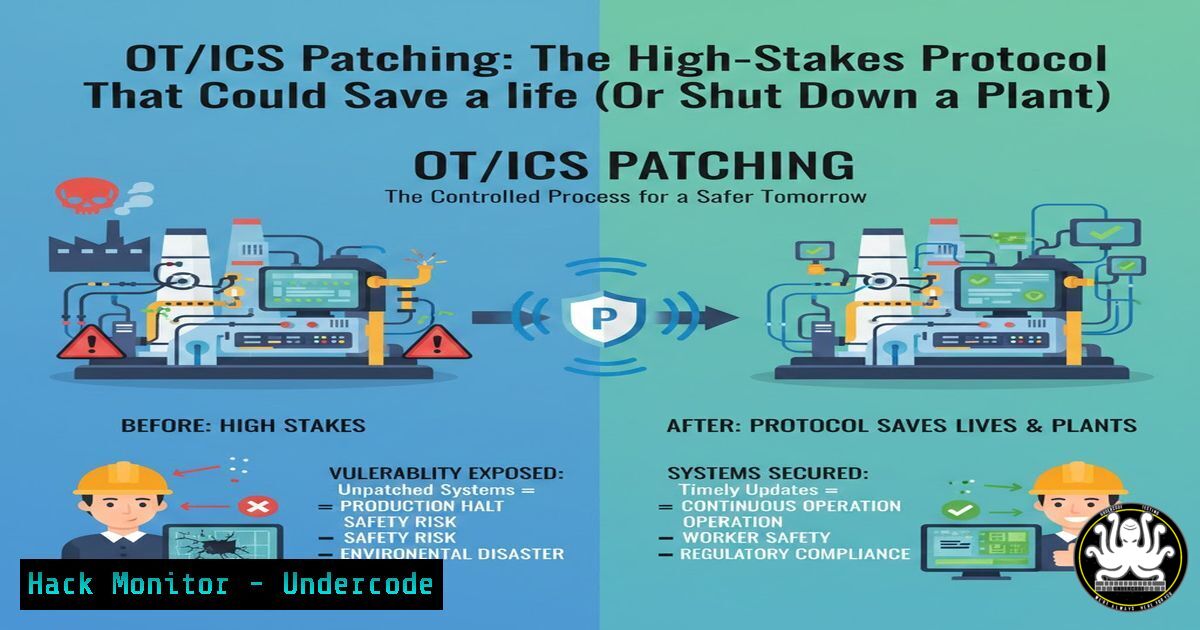
Introduction:
In the world of Information Technology (IT), patching is often a routine, automated process driven by speed and vulnerability scores. In Operational Technology (OT) and Industrial Control Systems (ICS), patching is a high-stakes, multidisciplinary protocol where a misstep can halt production for weeks or lead to catastrophic physical consequences. This article delves into the critical methodology required to secure industrial environments, where availability and safety trump all other security concerns.
Learning Objectives:
- Understand the fundamental philosophical and procedural differences between IT and OT/ICS patch management.
- Learn to conduct a holistic OT risk assessment that evaluates physical process impact, compensating controls, and maintenance windows.
- Develop a collaborative framework for patch deployment involving engineers, operators, and technicians.
You Should Know:
- The OT Patching Philosophy: Risk Assessment Over Reflex
The core tenet is that no patch is deployed without first answering critical environmental and operational questions. This is a deliberate process of risk triage, not a race against the clock.
Step‑by‑step guide explaining what this does and how to use it.
Step 1: Vulnerability Contextualization. Don’t just read the CVE score. Analyze the vulnerability (e.g., CVE-2023-3595 in a PLC firmware). Does it require network adjacency? Can it be triggered remotely over the internet? Does it affect a protocol even used in your specific process line?
Step 2: Asset Criticality & Network Placement Mapping. Identify the asset in your OT asset inventory. Where is it? Is it in a Level 3 (Site Operations) network or deep in Level 1 (Process Control)? Use network diagrams. A Windows Server in the DMZ is treated differently than a controller on a safety-instrumented system.
Step 3: Compensating Control Audit. Document existing defenses. Is the vulnerable system segmented behind an industrial firewall? Are access controls via a PAM solution strict? Is network traffic to it monitored by an IDS with specific signatures? For example, a vulnerable S7-300 PLC could be protected by a whitelist rule on a Tofino or Cisco industrial firewall:
Example conceptual rule for a industrial firewall (Claroty/Check Point/Tofino)

ALLOW src=Engineering_Station_IP dst=PLC_IP proto=TCP port=102  ISO-TSAP (S7 Comm)

<h2 style="color: yellow;">DENY any dst=PLC_IP any
Step 4: Impact Analysis with Operations. This is the crucial human step. Consult control engineers and plant operators. “If this PLC fails during or after an update, what happens? Does the conveyor stop? Does a reactor overpressure? Could a safety interlock fail?”
2. Building the Cross-Functional Patch Board
OT patching cannot be dictated by the CISO’s office alone. It requires a formalized board with shared responsibility.
Step‑by‑step guide explaining what this does and how to use it.
Step 1: Form the Committee. Mandatory members include: OT Cybersecurity Lead, Control Systems Engineer, Process/Operations Manager, Maintenance Lead, and Plant Safety Officer.
Step 2: Establish a Communication Protocol. Use a standardized form or ticket (in a system like ServiceNow or Jira, air-gapped if necessary) that forces input from all parties. Fields must include: “Required Downtime Window,” “Rollback Procedure Verified By,” “Safety Review Sign-off.”
Step 3: Conduct the Pre-Patch Meeting. This is not an email thread. A synchronous meeting (virtual or in-person) to walk through the test results, the rollback plan, and the final go/no-go decision. The operator’s veto on grounds of safety or production impact is final.
3. Implementing & Verifying Compensating Controls
When a patch cannot be applied, robust compensating controls are your primary defense. These are not just IT firewall rules.
Step‑by‑step guide explaining what this does and how to use it.
Step 1: Network Micro-Segmentation. Implement strict firewall rules at the OT zone boundaries. Use deep packet inspection (DPI) capable of industrial protocols.
` Example Linux iptables rule to restrict Modbus TCP traffic to a specific source (Engineering Workstation)
sudo iptables -A FORWARD -p tcp –dport 502 -s 10.10.5.50 -d 10.10.10.20 -j ACCEPT
sudo iptables -A FORWARD -p tcp –dport 502 -d 10.10.10.20 -j DROP`
Step 2: Host Hardening on OT Assets. On Windows-based HMIs or engineering workstations, enforce strict application whitelisting (e.g., Microsoft AppLocker) and disable unused services.
PowerShell to disable SMBv1 on a Windows HMI (a common vulnerability vector)

<h2 style="color: yellow;">Set-SmbServerConfiguration -EnableSMB1Protocol $false</h2>

<h2 style="color: yellow;">Disable-WindowsOptionalFeature -Online -FeatureName SMB1Protocol
Step 3: Enhanced Monitoring. Deploy an OT-aware IDS/IPS (like Nozomi Networks, Dragos, or Tenable.ot) to detect anomalous traffic patterns targeting the known vulnerability. Create custom alerts for the specific CVE ID.
- The Sanctity of the Maintenance Window: Building the Patch Package
The update itself is a meticulously planned event, not a “click and pray” operation.
Step‑by‑step guide explaining what this does and how to use it.
Step 1: Build an Isolated Test Environment. This must mirror production as closely as possible, including simulated process inputs. Test the patch and the full rollback procedure here.
Step 2: Create the Gold Master Image & Backup. Before touching production, take a full, verified backup of the controller program, configuration, and state.
Example using a vendor tool (Siemens TIA Portal) via CLI to backup a PLC project

 This is a conceptual representation; actual commands are vendor-specific.

<h2 style="color: yellow;">tia_portal_cli --project="Plant1_LineA" --backup --target="Z:\Backups\PLC_Backup_20231027.s7p"
Step 3: Staged Deployment During the Window. Patch in stages: 1) Supporting servers (historians, domain controllers), 2) HMIs/SCADA, 3) Controllers (PLCs/RTUs), starting with the least critical unit. Have physical engineers on standby.
5. Post-Patch Validation: Beyond “It Booted”
Verification is as critical as the deployment. The system must operate correctly within the physical process.
Step‑by‑step guide explaining what this does and how to use it.
Step 1: Functional Test Procedures (FTPs). Run through a checklist with operators. Does the valve open at 50 PSI? Does the motor start/stop correctly from the HMI? Does the alarm trigger at the right setpoint?
Step 2: Security Verification. Rescan the patched asset with a passive or credentialed scanner to confirm the vulnerability is remediated. Check firewall logs for any denied attempts to probe the old vulnerability.
Step 3: Documentation & Knowledge Transfer. Update the asset inventory with new firmware versions. Document any issues encountered and lessons learned. Share these with the patch committee for continuous improvement.
What Undercode Say:
- Safety and Availability are the Primary Security Controls. In OT, a “secure” system is one that runs safely and continuously. A patched system that causes an unplanned shutdown has failed its primary security mandate.
- Collaboration is Non-Negotiable Technology. The most critical tool in OT security is not a firewall but a formal, respectful communication channel between cybersecurity professionals and process engineers. One group understands bits and bytes, the other understands physics and kinetics; both are required for true defense.
The analysis underscores that OT cybersecurity is fundamentally a risk management discipline applied to a physical world. It requires shifting from an IT-centric “patch fast” mindset to an engineering-centric “patch wise” methodology. The procedures, timelines, and decision-making hierarchy are dictated by the operational reality that these systems control the physical world—where consequences are measured in downtime, environmental damage, or human safety. Effective OT security is less about bleeding-edge threat hunting and more about rigorous change management, comprehensive defense-in-depth, and unwavering cross-disciplinary communication.
Prediction:
The future of OT/ICS security will be shaped by convergence under duress. Increasingly sophisticated and targeted threats (like ransomware gangs understanding process disruption) will force tighter, more formal integration between IT and OT teams. We will see the rise of OT-specific patch orchestration platforms that bake in change management workflows, mandatory operational sign-offs, and integrated rollback capabilities. Furthermore, regulatory pressure (similar to NERC CIP in power) will expand into other critical infrastructure sectors, mandating these structured patch processes. Simultaneously, the adoption of immutable backups and “air-gappable” virtual patching through advanced IPS will become standard as a stopgap for systems with decade-long maintenance cycles. The industry will move towards predictive patch impact modeling using digital twins, allowing teams to simulate the effects of an update on the virtual process before ever touching the physical one.
▶️ Related Video (78% Match):
🎯Let’s Practice For Free:
IT/Security Reporter URL:
Reported By: Mikeholcomb Patching – Hackers Feeds
Extra Hub: Undercode MoN
Basic Verification: Pass ✅


