Listen to this Post
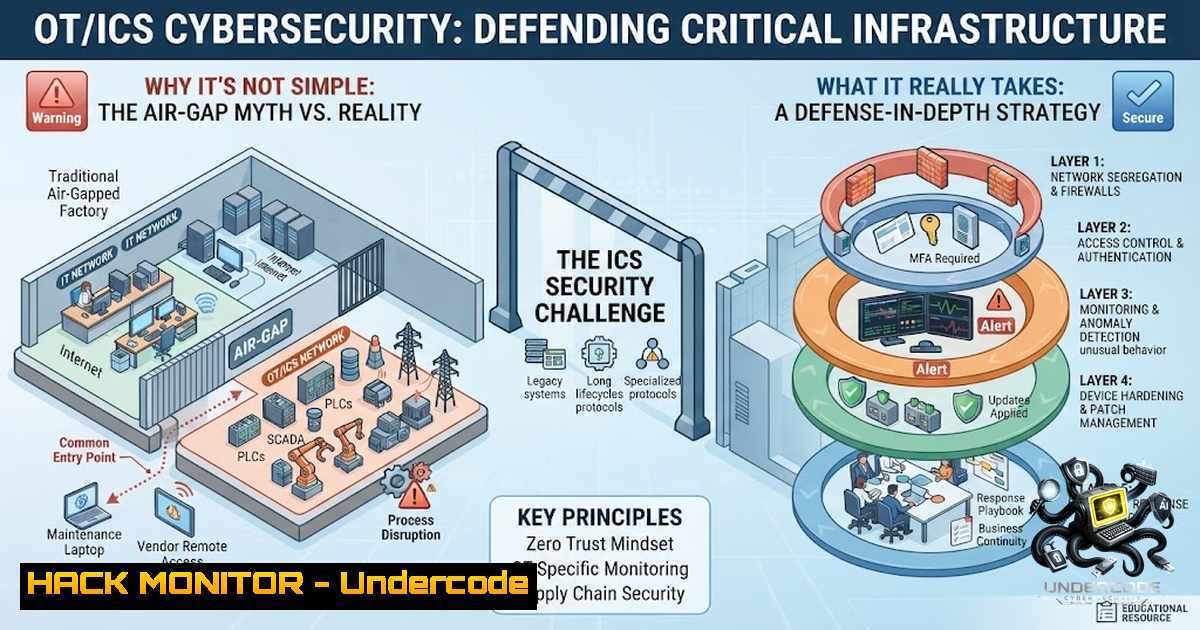
Introduction:
Operational Technology (OT) and Industrial Control Systems (ICS) cybersecurity is not an entry-level discipline—it is a high-stakes specialization that demands a deep foundation in both information technology and industrial operations. Unlike traditional IT security, where a breach might result in data loss, a compromise in OT environments can lead to physical damage, environmental disasters, and loss of human life. This article explores the prerequisites, technical competencies, and practical pathways for entering this critical field, while providing actionable commands and frameworks for those already on the journey.
Learning Objectives:
- Understand why OT/ICS cybersecurity requires years of foundational experience in IT, engineering, or plant operations.
- Learn the key technical skills—network segmentation, protocol analysis, and vulnerability assessment—needed to secure industrial environments.
- Acquire practical Linux and Windows commands for monitoring, hardening, and incident response in OT/ICS settings.
- Identify reputable training resources and certification pathways, including free and advanced options.
You Should Know:
- The Prerequisite Pipeline: Building Your Foundation Before You Defend
Mike Holcomb, a prominent OT/ICS security advocate, states unequivocally: “OT/ICS cybersecurity is not an entry level job. It’s like becoming a doctor. You can’t just go directly to med school. You’ve got to hit the prerequisites first.” The reality is that defenders of critical infrastructure must understand not only cyber threats but also the physical processes they protect. This means years of experience in IT, OT, automation, engineering, maintenance, or plant operations are typically required before one can effectively secure these environments.
The journey is more about the destination than a quick entry point. As Ryan Sharpnack, a Systems Administrator and Technical Risk Analyst, notes, “by and large, it will take a while and a focused skill development plan”. This is not to discourage aspiring professionals but to underscore the gravity of the responsibility. When lives and safety are at stake, there is no substitute for hands-on maturity and deep foundational knowledge.
For those without an engineering or IT background, the path is longer but not impossible. Start by immersing yourself in IT fundamentals—networking, operating systems, and cybersecurity principles—while simultaneously learning about industrial processes. Free resources like Mike Holcomb’s 25+ hour YouTube course on “Getting Started in ICS/OT Cyber Security” (available at https://youtube.com/watch?v=CCIrntyqe64&list=PLOSJSv0hbPZAlINIh1HcB0L8AZcSPc80g) provide an excellent starting point.
- Mastering the Technical Terrain: Essential Commands for OT/ICS Security
Once you have built your foundational knowledge, you must develop hands-on technical skills. OT/ICS environments are heterogeneous, often running a mix of legacy Windows systems, Linux-based controllers, and proprietary firmware. Here are essential commands and techniques for monitoring and hardening these systems:
Linux Commands for Network Monitoring and Analysis:
tcpdump -i eth0 -s 0 -w ics_traffic.pcap: Capture all network traffic on interface eth0 for later analysis in Wireshark.nmap -sS -p 1-1024 192.168.1.0/24: Perform a stealth SYN scan of common ICS ports (e.g., Modbus TCP on 502, DNP3 on 20000, EtherNet/IP on 44818) to discover active devices.arp-scan --localnet: Discover all devices on the local network segment, which is crucial for asset inventory in flat OT networks.ss -tulpn | grep -E ':(502|20000|44818|2222)': List all listening ports and filter for common ICS protocols to identify exposed services.
Windows Commands for Endpoint and USB Monitoring:
Get-WmiObject -Class Win32_USBHub | Select-Object DeviceID, Description: List all connected USB devices, a common vector for malware introduction in air-gapped systems.netstat -an | findstr :502: Check for active Modbus TCP connections on the local machine.Get-Process | Where-Object { $_.Path -like "PLC" -or $_.Path -like "SCADA" }: Identify running processes related to industrial control software.
3. The ICS ATT&CK Framework and Threat-Informed Defense
Understanding adversary behavior is paramount. The MITRE ATT&CK for ICS framework provides a comprehensive knowledge base of adversary tactics and techniques used against industrial control systems. Key techniques include:
- T0871 (Access Management): Adversaries may exploit weak authentication in field controllers. Mitigation involves centralized authentication and enforcing authorization policies.
- T0882 (Theft of Operational Information): Attackers steal process data to understand system behavior. Implement network segmentation and encryption to protect sensitive data in transit.
To operationalize this knowledge, conduct regular threat hunting exercises. Use Shodan to identify exposed ICS devices (e.g., `tag:ics` or port:502) and assess your organization’s external exposure. Then, apply mitigations such as:
– Isolating control networks with firewalls and VPNs.
– Implementing a “known good” configuration baseline for all ICS devices.
– Applying vendor patches in a test environment before deployment to avoid disrupting operations.
4. Securing Industrial Protocols: The Case of Modbus
Modbus is one of the most ubiquitous industrial protocols, yet it was designed without security in mind. It transmits data in plaintext, making it vulnerable to eavesdropping and man-in-the-middle attacks. To secure Modbus communications:
- Network Segmentation: Place an OT/IT gateway between field devices and higher-level systems. This gateway communicates natively with Modbus on the OT side and converts data to a secure protocol (e.g., HTTPS, TLS) on the IT side.
- Encryption: Implement Modbus Secure (Modbus over TLS) to provide confidentiality and integrity. TLS 1.2 or higher is mandated, with X.509v3 certificates for mutual authentication.
- Access Control: Enable role-based access control (RBAC) to enforce granular permissions. Additionally, implement bidirectional certificate authentication to ensure only authorized devices can connect.
- Monitoring and Logging: Continuously monitor Modbus traffic for anomalies and maintain detailed logs for forensic analysis.
5. Advanced Training and Real-World Exercises
Formal training is indispensable. The Idaho National Laboratory (INL), in collaboration with CISA, offers comprehensive ICS cybersecurity training that goes beyond theory. Their programs feature:
– Operational Realism: Purpose-built environments modeled on real industrial systems.
– Research-Driven Scenarios: Course scenarios informed by active ICS security research.
– ICS 301: ICS Cybersecurity & Red/Blue Exercise: An advanced, in-person training experience where participants apply cybersecurity principles in a live industrial setting. The capstone is a full Red Team vs. Blue Team exercise.
– ICS Cybersecurity Escape Rooms: Time-sensitive scenarios that simulate real-world operational disruption, testing technical skill, teamwork, and adaptive problem-solving.
These exercises cover scenarios such as network discovery under time pressure, insider threat mitigation, and recovery from sabotage. For those unable to attend in-person, INL also provides fact sheets and online resources.
6. Compliance and Governance: Beyond Checklists
Compliance in OT is not about ticking boxes—it is about understanding what you are protecting. Mike Holcomb warns that “there are too many OT compliance folks that simply do not understand what they’re trying to protect and are only going off of checklists which in the OT world can be dangerous”. Effective OT governance requires:
- Risk Management Frameworks: NIST SP 800-82 Revision 3 provides guidance on improving OT security while addressing unique performance, reliability, and safety requirements. It emphasizes a defense-in-depth approach.
- IEC 62443 Standards: This international series of standards covers cybersecurity for industrial automation and control systems. It helps organizations establish baseline controls, strengthen resilience, and build compliance across global industrial ecosystems.
- Continuous Assurance: Shift from static, siloed processes to continuous, integrated, and operationally grounded assurance.
7. Career Pathways and Continuous Learning
Breaking into OT/ICS cybersecurity requires a deliberate, multi-year plan. Here are actionable steps:
- Build IT Fundamentals: Gain experience in networking, system administration, and cybersecurity. Pursue certifications like CompTIA Security+, Network+, or Cisco CCNA.
- Learn Industrial Processes: Understand how PLCs, SCADA, DCS, and RTUs work. Take courses on industrial automation and control systems.
- Specialize in OT Security: Enroll in specialized training like INL’s ICS courses or SANS courses such as ICS 515 (though note that even intermediate roles may require foundational OT knowledge).
- Get Hands-On: Set up a lab environment with virtual PLCs and practice using tools like Wireshark, Nmap, and Shodan.
- Network and Mentor: Follow industry leaders like Mike Holcomb, join professional groups, and seek mentorship. As Holcomb notes, “some have mentors that guide them directly on the job”.
- Stay Current: Subscribe to newsletters (e.g., Holcomb’s at https://utilsec.kit.com/95e31307f7) and follow YouTube channels like https://youtube.com/@utilsec for continuous learning.
What Undercode Say:
- Key Takeaway 1: OT/ICS cybersecurity is a journey, not a destination. It demands years of foundational experience in IT, engineering, or plant operations before one can effectively defend critical infrastructure.
- Key Takeaway 2: Practical, hands-on skills—including network monitoring, protocol analysis, and vulnerability assessment—are essential. Commands like
tcpdump,nmap, and `netstat` are your daily tools. - Analysis: The discourse around OT/ICS cybersecurity reveals a critical gap between the urgent need for skilled defenders and the reality that this field is not for beginners. While free resources and training programs exist, they are supplements to, not substitutes for, real-world experience. The emphasis on mentorship and structured skill development is crucial, as is the recognition that compliance must be grounded in operational understanding rather than checklists. The involvement of national laboratories like INL underscores the gravity of the threat and the need for rigorous, research-backed training. However, the field faces a paradox: the demand for OT security professionals is high, yet the pipeline is narrow because of the steep prerequisites. This creates an opportunity for motivated individuals to invest the time and effort required, but it also poses a systemic risk if the industry fails to cultivate new talent effectively.
Prediction:
- +1 The increasing digitization of industrial processes and the rise of Industry 4.0 will drive unprecedented demand for OT/ICS security professionals, leading to more structured apprenticeship and mentorship programs that bridge the experience gap.
- -1 However, the shortage of qualified personnel will persist, leaving many critical infrastructure systems vulnerable to sophisticated cyber-physical attacks, particularly as nation-state actors continue to target industrial control systems.
- +1 Advances in AI-driven security analytics and automated threat detection will augment human defenders, potentially reducing the barrier to entry for those with strong analytical skills but limited operational experience.
- -1 The legacy nature of many ICS environments—running outdated operating systems and unpatched firmware—will remain a significant liability, as upgrades are costly and risk operational disruption.
- +1 The integration of OT security into broader cybersecurity curricula and the expansion of free, high-quality training resources will democratize access to knowledge, enabling a new generation of defenders to emerge.
- -1 Despite these efforts, the “compliance checkbox” mentality will persist in some organizations, leading to a false sense of security and potentially catastrophic incidents.
- +1 Collaborative initiatives between government agencies (like CISA and INL), private industry, and academia will foster a more resilient ecosystem, with shared threat intelligence and best practices becoming the norm.
- -1 The complexity and diversity of OT environments mean that no single solution or framework will suffice; defenders must continuously adapt to evolving threats and technologies, making lifelong learning non-1egotiable.
▶️ Related Video (74% Match):
🎯Let’s Practice For Free:
🎓 Live Courses & Certifications:
Join Undercode Academy for Verified Certifications
🚀 Request a Custom Project:
Secure, high-velocity infrastructure and disruptive technological engineering. Contact our engineering team for high-tier development and proprietary systems:
[email protected]
💎 Smart Architecture | 🛡️ Secure by Design | ⭐ Trusted by Thousands
IT/Security Reporter URL:
Reported By: Mikeholcomb You – Hackers Feeds
Extra Hub: Undercode MoN
Basic Verification: Pass ✅


