Listen to this Post
Introduction:
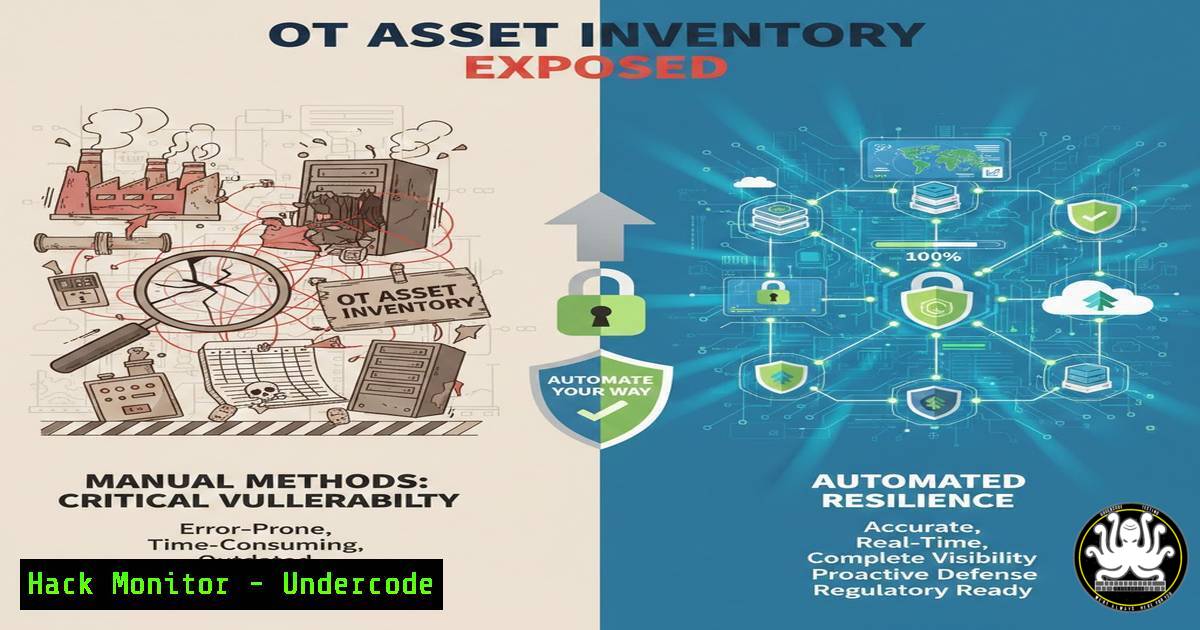
Operational Technology (OT) asset inventory is the non-negotiable bedrock of industrial cybersecurity, yet it remains one of the most misunderstood and poorly executed practices. As highlighted in expert discussions, treating it as a one-time checkbox exercise leaves critical infrastructure dangerously exposed to evolving threats. This article deconstructs the modern approach to OT asset inventory, moving from philosophical commitment to technical execution, and provides actionable guidance on leveraging automation to build a living, accurate, and defensible asset baseline.
Learning Objectives:
- Understand why a sustainable, process-driven OT inventory strategy is superior to a one-off project.
- Evaluate and implement automated discovery tools to eliminate manual inaccuracies and scale effectively.
- Integrate inventory data with operational and cybersecurity workflows for tangible risk reduction.
You Should Know:
1. The Philosophy of Commitment Over Compliance
The foundational shift required is viewing inventory as a continuous lifecycle, not a project with an end date. An outdated inventory is worse than none at all, providing a false sense of security. The initial plan must be sustainable, focusing on assets critical to patching and operations first, as these offer immediate security and reliability benefits. This involves stakeholder alignment with process owners, IT, and cybersecurity to define ownership, update triggers (e.g., change management tickets), and audit schedules. The goal is to create a “lifestyle” driven by specific use cases like vulnerability management, incident response, and lifecycle replacement.
2. The Inevitable Shift to Automated Discovery
Manual inventory is a proven failure point, prone to error, slow, and impossible to maintain at scale. Modern OT networks require automated passive and active discovery tools. As experts note, the cost of comprehensive detail drops to near-zero with automation. Tools like OTbase Snapshot (https://otbase.com/snapshot) are cited as setting the gold standard, providing deep device fingerprinting, including serial numbers and firmware details, without relying on probabilistic guesses. This accurate baseline is critical for reliable CVE mapping and risk assessment.
Step‑by‑step guide to initiating automated discovery:
- Segment a Pilot Zone: Identify a non-critical OT network segment for a proof-of-concept.
- Deploy a Collection Method: For a tool like OTbase, this typically involves deploying a software collector on a mirrored switch port (SPAN) or a hardware appliance to passively analyze network traffic.
- Configure Discovery Parameters: Define IP ranges, exclude certain non-OT traffic, and set the depth of asset interrogation (e.g., collect serial numbers, module lists).
- Run and Validate: Allow the tool to collect data for an operational cycle (e.g., 1-2 weeks). Manually validate findings against known devices in the pilot zone to verify accuracy.
- Analyze the Output: Review the generated inventory for previously unknown devices, misconfigured assets, and unauthorized connections.
3. Leveraging Free Tools for a Quick Baseline
While comprehensive systems require investment, you can start immediately with free analysis tools. EmberOT’s OT PCAP Analyzer (https://www.emberot.com/ot-pcap-analyzer/) is a community tool mentioned by experts. It allows you to gain immediate insights by analyzing packet captures (PCAPs) from your OT network.
Step‑by‑step guide for PCAP analysis with EmberOT:
- Capture Network Traffic: Use a tool like Wireshark or tcpdump on a temporary access point in the OT network. Linux command: `sudo tcpdump -i eth0 -w ot_capture.pcap -c 10000` (captures 10,000 packets from interface eth0).
- Upload the PCAP File: Navigate to the EmberOT analyzer site and upload your `ot_capture.pcap` file.
- Review the Automated Report: The tool will generate a report listing discovered IPs, MAC addresses, suspected device types, protocols (e.g., Modbus, S7comm), and conversation pairs.
- Correlate and Identify: Use this report to cross-check against existing documentation. This fast, free method can reveal rogue devices and provide a foundational asset list to justify further investment in automated tools.
4. Integrating Inventory with Security and Operations
An inventory’s true value is realized when it feeds other systems. Export data in standardized formats (e.g., CSV, JSON) for ingestion into:
Vulnerability Management Platforms: Accurate device fingerprints enable precise CVE matching, moving beyond unreliable “probabilities.”
SIEM/SOAR Systems: Use asset inventory as a context-rich source for alert triage during incidents (e.g., Is this IP a critical PLC or a test laptop?).
Change Management Processes: Configure your inventory tool to trigger alerts or tickets upon detection of new, unauthorized assets, integrating security into operational workflows.
5. Hardening the Inventory System Itself
The inventory system becomes a high-value target. Harden it by:
Network Segmentation: Place the inventory database and management interface on a secure management VLAN, not directly accessible from the OT or IT data networks.
Access Control: Implement strict role-based access control (RBAC). Use service accounts for automated data feeds, not shared credentials.
Logging and Monitoring: Audit all access to the inventory system. On a Linux-hosted database, ensure logging is enabled: sudo auditctl -w /path/to/inventory_database -p war -k ot_asset_db.
Encryption: Ensure data is encrypted at rest (database encryption) and in transit (TLS 1.2+ for all API communications).
What Undercode Say:
- Automation is Non-Optional: The debate is over. The cost and risk of manual OT inventory are untenable. Investment must shift from periodic consulting projects to scalable, automated discovery and maintenance platforms.
- Context is King: An asset list is just data. Its value is unlocked by enriching it with operational context (owner, criticality, location) and integrating it seamlessly with security tools and operational processes to drive automated response.
The expert discussion reveals a maturity gap in the industry. While leaders advocate for comprehensive, automated inventories, many organizations still rely on incomplete, manual methods or are misled by the “inventories” generated as a byproduct of threat detection products, which often lack the device-level detail needed for patching and lifecycle management. The critical analysis is that without a purpose-built, accurate, and maintained OT asset inventory, all subsequent security efforts—vulnerability management, network segmentation, incident response—are built on a foundation of sand.
Prediction:
Within the next 3-5 years, regulatory frameworks (like NERC CIP, EU NIS2) will explicitly mandate not just the existence of an OT asset inventory, but will specify requirements for its accuracy, automation, and freshness (e.g., updates within 24 hours of change). This will force a massive industry catch-up. Furthermore, the integration of AI will move inventory systems from static databases to predictive platforms that can anticipate device failures based on lifecycle data and automatically correlate new vulnerabilities with affected physical processes, fundamentally merging cybersecurity with operational reliability and safety.
▶️ Related Video (70% Match):
🎯Let’s Practice For Free:
IT/Security Reporter URL:
Reported By: Dale Peterson – Hackers Feeds
Extra Hub: Undercode MoN
Basic Verification: Pass ✅


