
Listen to this Post
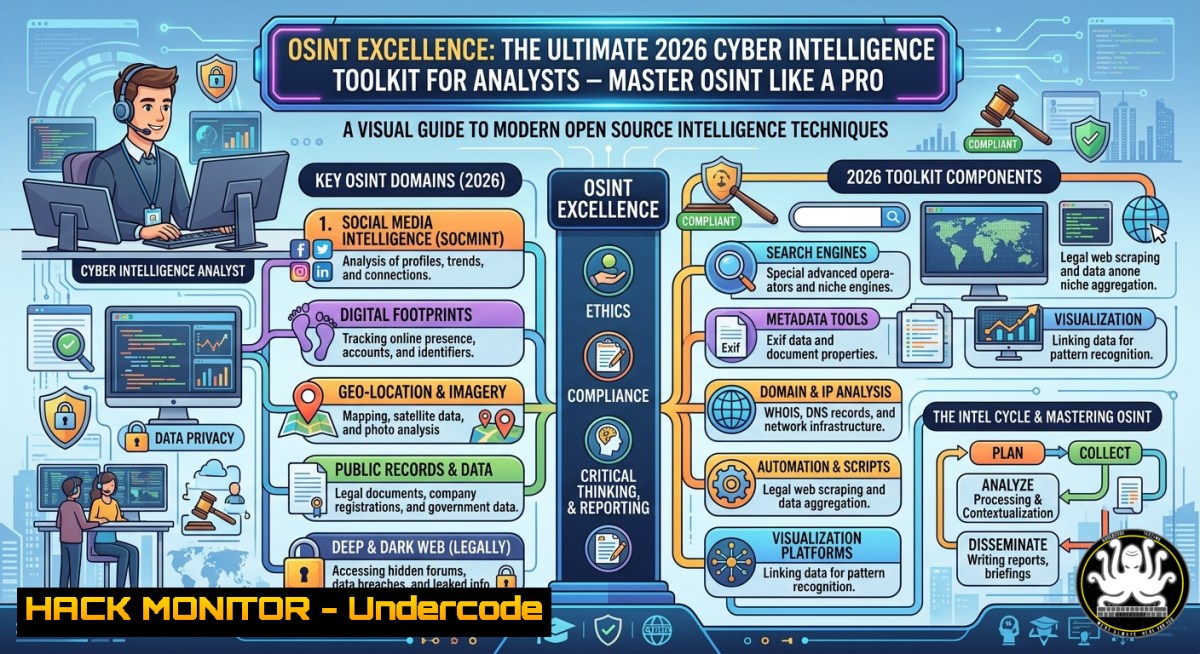
Introduction
Open Source Intelligence (OSINT) is the art and science of collecting, analyzing, and exploiting publicly available data to support cybersecurity investigations, threat hunting, and competitive intelligence. In an era where 90% of attack surface data is publicly accessible, mastering OSINT tools and methodologies has become a core competency for every security analyst, red teamer, and intelligence professional. This article draws inspiration from the collaborative work of industry experts like Heinz D. Schultz, Sina Riedel, and Alex Lozano, whose OSINT Excellence framework sets the standard for modern cyber intelligence training.
Learning Objectives
- Learn to extract and analyze OSINT data using command-line tools (Linux/Windows) and automated frameworks.
- Understand API security assessment techniques and cloud asset discovery for external threat surface mapping.
- Build a repeatable OSINT investigation workflow covering domain intelligence, credential leaks, and metadata exploitation.
You Should Know
- Recon-ng – The Professional OSINT Framework on Linux
Recon-ng is a full-featured reconnaissance framework written in Python, providing a modular interface for web-based OSINT collection. Unlike passive tools, Recon-ng supports API key integration (Shodan, HaveIBeenPwned, GitHub) for enriched results.
Step-by-step guide – Setting up and running a workspace:
bash
Install Recon-ng on Kali Linux or Debian/Ubuntu
sudo apt update && sudo apt install recon-ng -y
Launch the framework
recon-ng
Create a new workspace for an investigation
workspaces create target_osint_investigation
Install required modules
marketplace install recon/domains-hosts/hackertarget
marketplace install recon/contacts-credentials/hibp_breach
Load a module and set options
modules load recon/domains-hosts/hackertarget
options set SOURCE example.com
run
[/bash]
For Windows users without Linux, use WSL2 (Windows Subsystem for Linux) or run Recon-ng via Docker:
bash
Windows PowerShell (Admin) – Install WSL2
wsl –install -d Ubuntu
Then within Ubuntu terminal, follow the Linux commands above
[/bash]
What this does: Automates DNS enumeration, subdomain discovery, and breach credential correlation. The `hackertarget` module uses a free API to return A, AAAA, and MX records. The `hibp_breach` module (requires free API key from HaveIBeenPwned) identifies if a domain’s email addresses appear in known data breaches.
2. TheHarvester – Email and Domain OSINT Automation
TheHarvester is a Python tool for gathering emails, subdomains, hosts, and employee names from public search engines, PGP key servers, and SHODAN.
Step-by-step guide – Installation and usage across platforms:
Linux/macOS:
bash
Clone and install
git clone https://github.com/laramies/theHarvester.git
cd theHarvester
sudo python3 setup.py install
Basic search – use Google, Bing, or Brave
python3 theHarvester.py -d targetcompany.com -b google -l 500 -f output.html
Use multiple sources
python3 theHarvester.py -d targetcompany.com -b google,bing,linkedin -l 1000
[/bash]
Windows (native using Python 3.9+):
bash
Install Python from python.org, then in Command Prompt or PowerShell
git clone https://github.com/laramies/theHarvester.git
cd theHarvester
pip install -r requirements.txt
python theHarvester.py -d targetcompany.com -b bing -l 300
[/bash]
Key security consideration: Rate limiting and API keys are required for most search engines. Use `-s` to start from a specific result number and avoid IP bans. For LinkedIn enumeration, set a `LINKEDIN_COOKIE` environment variable after logging into LinkedIn (legal compliance required – only for authorized testing).
- Metadata Extraction from Public Documents (ExifTool + Metagoofil)
Documents uploaded to company websites, forums, or cloud shares often leak internal paths, usernames, printer names, and software versions. Attackers use this for lateral movement planning.
Step-by-step – Recovering metadata on Linux and Windows:
Linux:
bash
Install exiftool
sudo apt install exiftool -y
Extract all metadata from a PDF or Office file
exiftool -a -u -g1 suspicious_document.pdf
Recursively scan a directory of downloaded files
find ./downloaded_docs -type f -exec exiftool -Author -Creator -LastModifiedBy {} \;
[/bash]
Windows (via exiftool standalone exe):
bash
Download exiftool from https://exiftool.org/exiftool-12.60.zip, extract to C:\Tools
cd C:\Tools
exiftool -a -u -g1 C:\Downloads\report.docx
[/bash]
Metagoofil automates search engine retrieval and metadata extraction:
bash
Install metagoofil2 (Python3 version)
git clone https://github.com/opsdisk/metagoofil
cd metagoofil
pip install -r requirements.txt
Search for PDF/DOC/XLS from target domain and extract user names
python metagoofil.py -d targetcompany.com -t pdf,doc,xls -l 50 -o extracted_metadata
[/bash]
- API Security OSINT – Hunting Exposed Keys and Endpoints
Public GitHub repositories, Pastebin, and JS files leak API keys, JWT secrets, and internal endpoints. Automated secret scanning prevents credential harvesting.
Step-by-step – Using truffleHog and gitGraber:
Linux:
bash
Install truffleHog (Go-based, high performance)
go install github.com/trufflesecurity/trufflehog/v3/cmd/trufflehog@latest
Scan an organization’s public GitHub repos (requires GitHub token)
trufflehog github –org=targetorg –token=ghp_your_token
Scan a single repository for high-entropy strings
trufflehog git https://github.com/victim/repo.git –entropy
Use gitGraber for multi-platform search (GitLab, Bitbucket)
git clone https://github.com/hisxo/gitGraber
cd gitGraber
pip install -r requirements.txt
python3 gitGraber.py -k “api_key” “secret” “password” -q “targetdomain”
[/bash]
Windows (via WSL or Docker):
bash
Docker method (no installation)
docker run -it trufflesecurity/trufflehog:latest github –repo=https://github.com/test/repo
[/bash]
Mitigation tactics: If an exposed key is found, immediately rotate it, check cloud access logs, and implement pre-commit hooks (e.g., detect-secrets) to prevent future commits of credentials.
- Cloud Asset Discovery – Mapping AWS/Azure/GCP Public Exposures
OSINT analysts can discover cloud buckets, load balancers, and serverless functions without authentication using passive DNS and SSL certificate transparency logs.
Step-by-step – Censys and Shodan CLI for cloud hardening:
Linux/Windows (Python-based):
bash
Install Shodan CLI
pip install shodan
shodan init YOUR_API_KEY
Search for exposed AWS S3 buckets with ‘secret’ keyword
shodan search “aws-s3 BucketName” –limit 100 –fields ip_str,hostnames
Find open Azure blob containers
shodan search “azureblob port:443” –fields http.title
Use Censys (requires free account)
pip install censys
censys search “services.service_name: AWS” –index hosts
[/bash]
For DNS-based discovery:
bash
Use dnsrecon for cloud CNAME enumeration
dnsrecon -d target.com -t brt -D /usr/share/wordlists/subdomains.txt | grep -E “amazonaws|azure|googleapis”
[/bash]
Hardening recommendation: Configure bucket policies to deny public listing (s3:ListBucket condition), enable block public access, and continuously monitor using tools like ScubaGear (Microsoft) or Prowler (AWS).
- Vulnerability Exploitation OSINT – Using Public CVEs with Shodan Queries
OSINT helps identify vulnerable internet-facing assets. Combine Shodan with Nmap for targeted verification (authorized testing only).
Step-by-step – Locate and verify Log4j (CVE-2021-44228) exposure:
bash
Shodan search for Log4j vulnerable headers (jndi:ldap)
shodan search “X-Apache-Log4j” –fields ip_str,port,org
Cross-check with Nuclei templating engine
git clone https://github.com/projectdiscovery/nuclei-templates
nuclei -target https://vulnerable-app.com -t cves/2021/CVE-2021-44228.yaml
Mitigation script for Linux servers – patch or set JVM flags
For Apache Tomcat, edit setenv.sh
echo ‘JAVA_OPTS=”$JAVA_OPTS -Dlog4j2.formatMsgNoLookups=true”‘ >> /opt/tomcat/bin/setenv.sh
[/bash]
Windows mitigation for affected apps:
bash
Set environment variable globally
Then restart the Java service
Restart-Service -Name “Tomcat9”
[/bash]
What Undercode Say
- Key Takeaway 1: OSINT is not just about gathering data – it requires rigorous source validation and legal boundaries. The professionals at OSINT Excellence emphasize using frameworks like Recon-ng within authorized scopes (e.g., red team engagements, bug bounties, or defensive monitoring). Failure to comply with search engine ToS or privacy laws can invalidate evidence and lead to liability.
-
Key Takeaway 2: Automation accelerates OSINT but introduces noise. The best analysts combine automated tools (theHarvester, truffleHog) with manual verification – for example, validating leaked API keys by testing them against a sandboxed instance. Alex Lozano’s teaching at UAB highlights that 30% of discovered secrets are false positives due to entropy mishandling. Always correlate findings across ≥3 independent sources.
Analysis: The post’s celebration of “best analysts” and “OSINT Excellence” reflects a growing industry trend: organizations now invest heavily in certified OSINT training rather than ad‑hoc Googling. The integration of AI (mentioned in Alex Lozano’s profile) points toward next‑gen OSINT tools that use LLMs to summarize disparate data points (e.g., linking a Pastebin dump to a GitHub commit by an employee). However, defenders must also adopt OSINT defensively – scanning their own public footprint using the same techniques above to preemptively close leaks.
Prediction
By 2027, OSINT will become a mandatory component of every SOC analyst’s workflow, driven by regulatory pressure (e.g., DORA, NIS2) requiring continuous external asset monitoring. AI‑powered OSINT platforms will automatically correlate breached credentials with active directory logins, enabling real‑time password rotation. Simultaneously, attackers will leverage synthetic identity creation using public data (photos, job histories) for sophisticated spear‑phishing. The winners will be organizations that treat OSINT not as a periodic audit but as a live feed integrated into their SIEM and SOAR. Expect the OSINT Excellence certification model to expand globally, with hands‑on labs replacing multiple‑choice exams.
▶️ Related Video (76% Match):
🎯Let’s Practice For Free:
IT/Security Reporter URL:
Reported By: Heinzdschultz Im – Hackers Feeds
Extra Hub: Undercode MoN
Basic Verification: Pass ✅


