
Listen to this Post
Introduction:
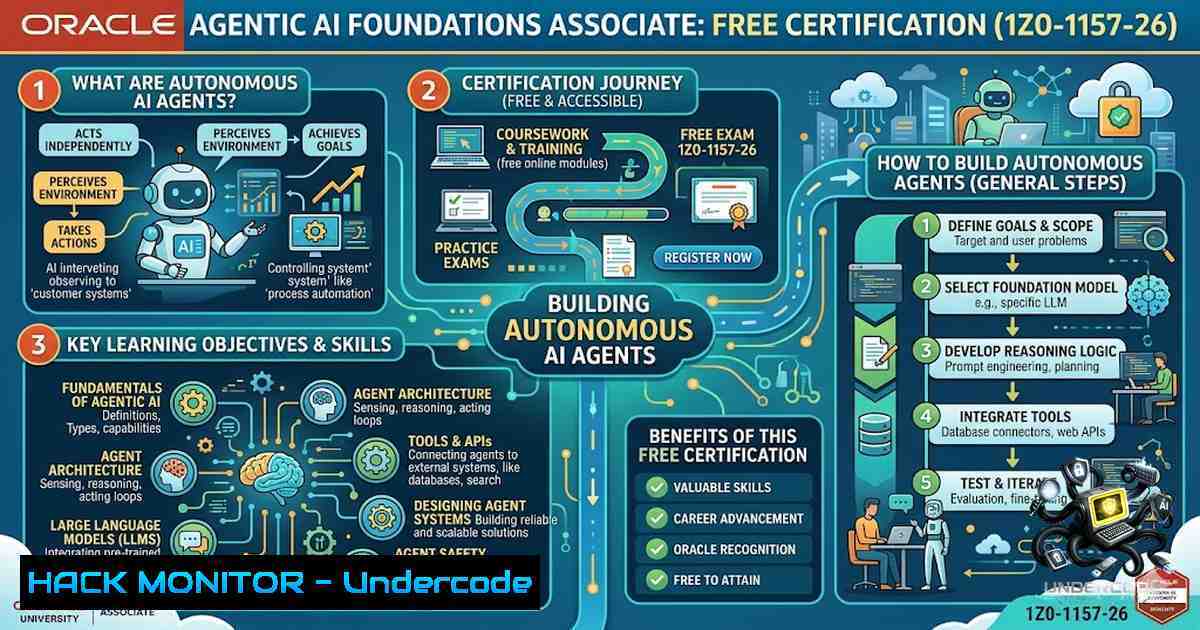
The shift from prompt-based chatbots to goal-directed, autonomous AI agents is fundamentally reshaping software development. Recognizing this paradigm change, Oracle University has launched the Oracle Agentic AI Foundations course and certification—and the exam is completely free. This initiative equips developers, data scientists, and engineers with the essential skills to design, build, and deploy AI agents that can reason, use tools, call APIs, and work iteratively toward specific goals.
Learning Objectives:
- Understand core AI agent concepts, reasoning patterns (Chain-of-Thought and ReAct), and safety guardrails
- Design and build AI agents using LangChain and the LangChain Expression Language (LCEL)
- Implement the Model Context Protocol (MCP) to decouple agents from tool implementations
- Build multi-agent systems using the OpenAI Responses API and Agents SDK
- Deploy agents reliably using the OCI Enterprise AI platform
- Apply Oracle AI Database capabilities (AI Vector Search, Private Agent Factory) for agentic AI
You Should Know:
- What Is Agentic AI and Why It Matters Now
Agentic AI represents a fundamental shift from reactive to proactive artificial intelligence. Unlike traditional LLMs that respond to a single prompt and stop, an agentic AI system works toward a goal: it reasons about what to do next, calls tools and APIs, checks the result, and decides whether to keep going. This “LLM + tools + loop” architecture enables autonomous, iterative problem-solving.
The certification course introduces core reasoning patterns including Chain-of-Thought (breaking down complex problems step-by-step) and ReAct (Reasoning + Acting), which combine reasoning traces with task-specific actions. A layered, defense-in-depth approach to safety and guardrails ensures agents operate within defined boundaries.
Prerequisites for this certification include basic familiarity with LLM concepts, working knowledge of Python, and basic familiarity with Oracle Cloud Infrastructure (OCI). If you’re newer to AI/ML concepts, Oracle recommends starting with the OCI AI Foundations course first.
- LangChain for AI Agents: Building Your First Agent
LangChain has emerged as the leading framework for building LLM-powered applications, and this module provides hands-on experience with the LangChain Expression Language (LCEL). You’ll build your first agent and then go under the hood to understand what a single `agent.invoke()` call actually does: building tool schemas, parsing tool calls, executing functions, and deciding whether another model call is needed.
Understanding the Agent Invocation Flow:
When you call `agent.invoke()`, the following sequence occurs:
1. The agent receives the user input and conversation history
2. It builds tool schemas (defining available tools and their parameters)
3. The LLM reasons about which tools to call (if any)
4. Tool calls are parsed and executed
5. Results are fed back to the LLM
6. The LLM decides whether another iteration is needed
7. Final response is returned to the user
Python Example: Building a Simple LangChain Agent
from langchain.agents import create_react_agent, AgentExecutor
from langchain.tools import Tool
from langchain_openai import ChatOpenAI

Define a simple tool
def multiply(a: int, b: int) -> int:
"""Multiply two numbers."""
return a  b

Create tool
tools = [
Tool(
name="multiply",
func=lambda x: multiply(map(int, x.split())),
description="Multiply two numbers. Input should be two integers separated by space."
)
]

Initialize LLM
llm = ChatOpenAI(model="gpt-4", temperature=0)

Create agent
agent = create_react_agent(llm, tools, prompt)

Create executor
agent_executor = AgentExecutor(agent=agent, tools=tools, verbose=True)

Run the agent
result = agent_executor.invoke({"input": "What is 15 multiplied by 23?"})
print(result["output"])
Understanding this internal mechanics is crucial for debugging agents and moving them to production.
3. Model Context Protocol (MCP): Standardizing Agent-Tool Integration
The Model Context Protocol (MCP) provides a standard way for agents to connect to tools, data, and prompts. This standardization is critical because it decouples agents from tool implementations, enabling interoperability, discovery, and reuse at scale.
The module covers MCP architecture and core components, then guides you through adding an MCP server to your agent—starting with a simple local math server and progressing to a real-world OCI Usage MCP server.
MCP Server Setup (Linux/macOS):
 Install MCP SDK
pip install mcp-sdk

Create a simple MCP server
 server.py
from mcp.server import Server, NotificationOptions
from mcp.server.models import InitializationOptions
import mcp.types as types

Create server instance
server = Server("math-server")

@server.list_tools()
async def handle_list_tools() -> list[types.Tool]:
return [
types.Tool(
name="add",
description="Add two numbers",
inputSchema={
"type": "object",
"properties": {
"a": {"type": "number"},
"b": {"type": "number"}
},
"required": ["a", "b"]
}
)
]

@server.call_tool()
async def handle_call_tool(
name: str, arguments: dict
) -> list[types.TextContent]:
if name == "add":
result = arguments["a"] + arguments["b"]
return [types.TextContent(type="text", text=str(result))]

Run the server
if <strong>name</strong> == "<strong>main</strong>":
server.run()
Windows (PowerShell) Setup:
 Install MCP SDK
pip install mcp-sdk

Run the MCP server
python server.py
- OpenAI Agent Stack: Responses API and Agents SDK
This module covers the OpenAI Agent stack and helps you choose between its components. The Responses API is designed for simpler, single-call use cases, while the Agents SDK handles multi-step logic, multiple agents, guardrails, and tracing.
Key concepts covered include:
- Tools and function calling
- Multi-agent systems and handoffs
- Safety and guardrails
The module culminates in building a multi-agent customer-support system that routes requests to specialized agents.
OpenAI Agents SDK Example:
from agents import Agent, Runner, function_tool

@function_tool
def get_weather(city: str) -> str:
"""Get the current weather for a city."""
 In production, call a weather API
return f"The weather in {city} is sunny and 72°F"

agent = Agent(
name="Weather Assistant",
instructions="You are a helpful assistant that provides weather information.",
tools=[bash]
)

result = await Runner.run(agent, "What's the weather in San Francisco?")
print(result.final_output)
5. Enterprise Deployment with OCI Enterprise AI Platform
Moving agents from development to production requires robust infrastructure. This module focuses on deploying agents reliably using the OCI Enterprise AI platform and OCI Enterprise AI Agents.
Key Enterprise Deployment Considerations:
| Component | Description |
|–|-|
| Hosted Endpoints | Managed endpoints for agent deployment |
| Scaling | Horizontal and vertical scaling capabilities |
| Memory Management | State management and conversation memory |
| Sandboxed Tools | Secure execution environment for tools |
| Logging | Comprehensive logging for debugging and auditing |
| Integrations | Connections to enterprise data sources |
OCI CLI Commands for Agent Deployment:
 Configure OCI CLI
oci setup config

Deploy an agent endpoint
oci ai-agent agent-endpoint create \
--agent-id <agent-id> \
--display-1ame "production-agent" \
--compartment-id <compartment-id>

Monitor agent endpoint status
oci ai-agent agent-endpoint get --agent-endpoint-id <endpoint-id>

List deployed agents
oci ai-agent agent list --compartment-id <compartment-id>
Windows PowerShell Alternative:
 Configure OCI CLI
oci setup config

Deploy an agent endpoint
oci ai-agent agent-endpoint create `
--agent-id <agent-id> `
--display-1ame "production-agent" `
--compartment-id <compartment-id>
6. Agentic AI for Oracle AI Database
The final module addresses integrating agents with data, featuring Oracle AI Vector Search, the Oracle AI Database Private Agent Factory, and the Select AI Agent for agents residing within the database. The Oracle Autonomous AI Database MCP Server demonstrates how agentic capabilities can operate close to data with existing security frameworks.
Oracle AI Vector Search Example:
-- Create a vector table for agent memory
CREATE TABLE agent_memory (
id NUMBER,
content CLOB,
embedding VECTOR(1536)
);

-- Create vector index for similarity search
CREATE VECTOR INDEX agent_memory_idx
ON agent_memory(embedding)
ORGANIZATION NEIGHBOR PARTITIONS;

-- Search for relevant context
SELECT content
FROM agent_memory
WHERE
VECTOR_DISTANCE(embedding,
TO_VECTOR('[0.1, 0.2, ...]'),
COSINE) < 0.3;
Certification Exam Details:
- Exam Code: 1Z0-1157-26
- Format: 40 multiple-choice questions
- Duration: 60 minutes
- Passing Score: 65%
- Cost: FREE
- Score Report: Available in Oracle CertView
How to Get Certified (Step-by-Step):
- Enroll in the Oracle Agentic AI Foundations Learning Path
- Complete all six modules covering agent fundamentals, LangChain, MCP, OpenAI Agent stack, enterprise deployment, and Oracle AI Database
- Finish all skill checks embedded in the course
4. Complete the certification preparation module
- Take the practice exam to assess your readiness
6. Attempt the official certification exam (1Z0-1157-26)
- Pass the exam (65% or higher) and earn your Oracle credential
What Undercode Say:
- Key Takeaway 1: The shift from single-prompt chatbots to autonomous, goal-directed AI agents represents the next major wave of cloud computing. Oracle’s free certification provides a structured, vendor-backed path to acquire these critical skills before the market becomes saturated.
-
Key Takeaway 2: The certification covers the full agentic AI stack—from LangChain and MCP to OpenAI Agents SDK and OCI Enterprise deployment. This comprehensive approach ensures certified professionals understand both the theory and practical implementation of agentic systems.
Analysis:
The Oracle Agentic AI Foundations certification arrives at a pivotal moment in the AI industry. While many professionals are familiar with prompt engineering and basic LLM interactions, the ability to build autonomous, tool-using agents requires a fundamentally different skill set. Oracle’s decision to offer this certification for free strategically positions the company to capture mindshare among developers, data scientists, and cloud architects who will shape the next generation of AI applications.
The curriculum’s coverage of LangChain, MCP, and the OpenAI Agent stack reflects the current industry landscape, where these frameworks and protocols are becoming de facto standards. The inclusion of enterprise deployment considerations—scaling, memory management, security, and logging—addresses the critical gap between prototype and production.
For IT security professionals, the emphasis on defense-in-depth safety and guardrails is particularly noteworthy. As agents gain more autonomy and access to tools and APIs, the security implications become significant. Understanding how to implement proper guardrails and sandboxed tool execution will be essential for secure agent deployment.
The 40-question, 60-minute exam format with a 65% passing score represents a reasonable barrier to entry. The availability of skill checks, exam prep materials, and a practice exam ensures candidates can adequately prepare.
Prediction:
- +1 This free certification will accelerate enterprise adoption of agentic AI by creating a skilled workforce ready to implement autonomous agents across industries.
-
+1 Oracle’s strategic move will likely prompt AWS, Azure, and Google Cloud to launch similar free certifications, benefiting the entire cloud ecosystem.
-
-1 The rapid pace of AI agent advancement means certification content may become outdated quickly, requiring frequent updates and recertification.
-
+1 Organizations will increasingly require agentic AI certifications for roles involving AI development, data science, and cloud architecture.
-
-1 The barrier to entry for agentic AI development may lower too quickly, leading to poorly designed agents with inadequate safety guardrails.
-
+1 MCP standardization, as taught in this certification, will drive interoperability between agents and tools across different vendors and platforms.
-
+1 The integration of AI Vector Search and database-1ative agents will enable more efficient, secure, and data-aware agentic systems.
-
-1 The free certification may initially be viewed as less prestigious than paid alternatives, though Oracle’s brand recognition will mitigate this concern.
-
+1 As agentic AI becomes mainstream, certified professionals will command premium salaries, making this free certification a high-ROI investment of time.
▶️ Related Video (76% Match):
https://www.youtube.com/watch?v=0lFWHhxit5Q
🎯Let’s Practice For Free:
🎓 Live Courses & Certifications:
Join Undercode Academy for Verified Certifications
🚀 Request a Custom Project:
Secure, high-velocity infrastructure and disruptive technological engineering. Contact our engineering team for high-tier development and proprietary systems:
[email protected]
💎 Smart Architecture | 🛡️ Secure by Design | ⭐ Trusted by Thousands
IT/Security Reporter URL:
Reported By: Shahzadms Oracle – Hackers Feeds
Extra Hub: Undercode MoN
Basic Verification: Pass ✅


