
Listen to this Post
Introduction:
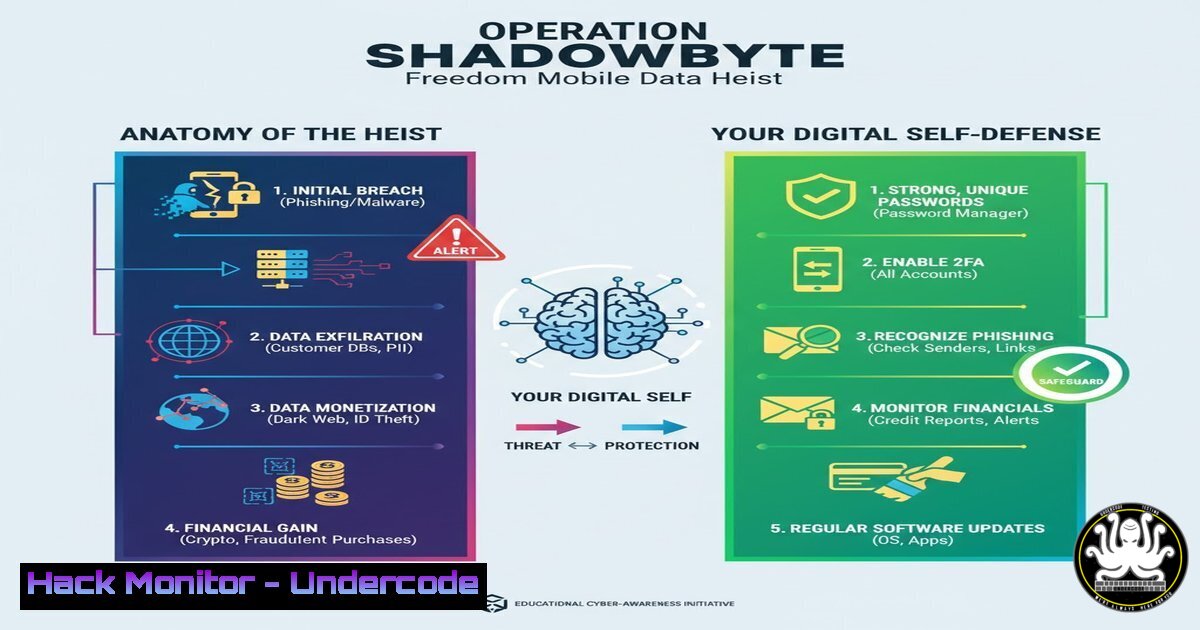
In a staggering display of cyber intrusion, threat actors have compromised the networks servicing Freedom Mobile, harvesting the personal and financial data of over 5,500 users in under a week. This breach underscores a critical vulnerability in mobile carrier infrastructure, where a single point of failure can expose phone numbers, PINs, and credit card data, leading to identity theft and financial fraud. Understanding the technical mechanics of such data harvesting campaigns is essential for both individual defense and enterprise security hardening.
Learning Objectives:
- Understand the attack vectors commonly used in mobile carrier data breaches.
- Learn how to perform digital forensics on personal devices to check for compromise indicators.
- Gain practical knowledge in hardening network traffic and API endpoints against data exfiltration.
You Should Know:
- Reconstituting the Attack Vector: SIM Swapping and API Abuse
The speed of this breach (5,577 victims in six days) suggests an automated process, likely targeting the carrier’s administrative APIs or employee portals rather than individual devices. Attackers often exploit SS7 protocol vulnerabilities or compromise carrier employee credentials to perform bulk data queries.
Step‑by‑step guide: Simulating a Carrier API Query (Educational Use Only)
To understand how attackers extract data, security professionals can use tools like `curl` to test for insecure API endpoints.
 Example: Testing a vulnerable endpoint for data harvesting (Authorization header omitted)
curl -X GET "https://[target-carrier-domain]/api/v1/subscriber/lookup?msisdn=[phone-number]" \
-H "Authorization: Bearer [bash]" \
-H "Content-Type: application/json" \
-o subscriber_data.json

On Linux, use jq to parse the stolen data format
cat subscriber_data.json | jq '.subscriber.name, .subscriber.address, .subscriber.credit_card.last4'
What this does: It simulates how an attacker with a valid (stolen) API token can automate the extraction of PII. Mitigation requires strict rate limiting, IP whitelisting, and OAuth2 with short-lived tokens.
- Digital Forensics: Checking Your Device for IMSI Catchers
Freedom Mobile users are at risk of having their IMSI numbers intercepted via fake cell towers (Stingrays). You can check for anomalies using your phone’s diagnostic codes.
For Android (Linux Kernel):
 Open dialer and enter: 4636 to access testing menu
 Check "Phone information" for:
 - Cell ID changes: If the Cell ID changes rapidly while stationary, you may be connected to a false tower.
 - Signal strength: Unusually strong signal in a low-coverage area is a red flag.

For advanced users, use ADB to pull logs:
adb logcat -b radio -d > radio_logs.txt
grep "IMSI" radio_logs.txt
For iOS (Windows/Mac):
Use the Field Test Mode: Dial 300112345 and press call.
– Look at “Serving Cell Info” -> “TA” (Timing Advance). A high TA value indicates you are far from the legitimate tower, potentially pointing to a relay attack.
3. Hardening DNS and Traffic Against Data Exfiltration
The stolen data (credit cards, PINs) was likely exfiltrated via DNS tunneling or HTTPS. Implementing strict DNS policies can prevent your device from calling home to Command & Control (C2) servers.
On Linux (using systemd-resolved):
 Block known malicious domains (add to /etc/hosts)
echo "0.0.0.0 malicious-c2-server.com" | sudo tee -a /etc/hosts
sudo systemctl restart systemd-resolved

Monitor DNS queries in real-time
sudo tcpdump -i any -n port 53
On Windows (PowerShell as Admin):
 Add a static entry to the hosts file to block a C2 server
Add-Content -Path "C:\Windows\System32\drivers\etc\hosts" -Value "`n0.0.0.0 datasteal-payload.net" -Force

Flush DNS cache to apply changes
ipconfig /flushdns

Monitor active connections for suspicious IPs
netstat -an | findstr "ESTABLISHED"
4. Securing Cloud Infrastructure: The Carrier’s Perspective
For engineers, this breach highlights a failure in cloud security posture management (CSPM). If the data was stored in an S3 bucket or Azure Blob, misconfigurations could lead to leaks.
AWS CLI Command to audit public buckets (Red Team perspective):
 Assuming compromised credentials, list buckets and check ACLs
aws s3api list-buckets --profile compromised_profile

Check if a bucket is public
aws s3api get-bucket-acl --bucket [target-bucket-name] --profile compromised_profile
Defensive Command (Linux/Cloud Shell):
 Use ScoutSuite to audit your own environment
git clone https://github.com/nccgroup/ScoutSuite
cd ScoutSuite
pip install -r requirements.txt
python scout.py aws --user-keys
This generates an HTML report highlighting exposed data stores and overly permissive IAM roles that could lead to breaches like the Freedom Mobile incident.
5. Exploitation and Mitigation: The PIN/PII Goldmine
With Phone numbers and PINs, attackers can perform account takeovers (ATO). Testing your own password manager or MFA setup is crucial.
Using `hydra` to test the strength of a PIN (Password Audit Lab):
Warning: Only use on systems you own.
 Simulate a brute-force attack against a local test server to see how easily a 4-digit PIN can be cracked.
hydra -l [bash] -P /usr/share/wordlists/pin_codes.txt [bash] http-post-form "/login:user=^USER^&pin=^PASS^:F=incorrect"
Mitigation: Enforce MFA. On Linux, set up Google Authenticator for SSH:
sudo apt install libpam-google-authenticator
google-authenticator
 Follow the prompts to set up time-based OTP, then edit /etc/pam.d/sshd
6. Memory Analysis for Malware (Windows)
If users clicked a phishing link related to the “Freedom Mobile” promo mentioned in the comments, they might have malware harvesting locally stored credit cards.
Using PowerShell to check for suspicious processes:
 List processes with network connections
Get-NetTCPConnection | Where-Object {$_.State -eq "Established"} | Format-Table

Check for processes running from temp directories
Get-Process | Where-Object {$_.Path -like "\Temp\"}

Dump process memory (requires admin) for analysis
$process = Get-Process -Name "suspicious_process"
$memoryStream = New-Object System.IO.MemoryStream
$handle = $process.Handle
 Using a tool like ProcDump is better, but this shows the concept.
Write-Host "Check handle for anomalies in Process Hacker."
7. Real-Time Threat Hunting on Linux
To detect if your system is part of a botnet harvesting data (like the one that hit Freedom Mobile), monitor for unusual outbound traffic.
Commands:
 Check all active internet connections
ss -tupn

Monitor outgoing traffic volume per IP (requires iftop)
sudo iftop -i eth0

Check for cron jobs that shouldn't be there (persistence mechanism)
crontab -l
sudo crontab -l
ls -la /etc/cron
What Undercode Say:
- Key Takeaway 1: The Freedom Mobile breach is a textbook example of the “Single Sign-On of Life” risk. When a phone number is compromised, it acts as a skeleton key to banking, social media, and email accounts. Immediate action should be to port out numbers to a different carrier or enable port-out PINs.
- Key Takeaway 2: From a technical standpoint, the incident highlights the failure of “Defense in Depth.” Carriers must isolate PII databases behind API gateways with strict WAF policies and implement real-time anomaly detection for bulk data access, rather than relying on perimeter security alone.
The 5,777 victims represent a fraction of the potential fallout. As we move toward a data-driven future, as noted in the comments, personal information is currency. This attack demonstrates that mobile carriers are currently weak links in the identity verification chain, often prioritizing promotional rollouts over security patches. Users must adopt a zero-trust approach to their mobile provider, treating their phone number as a public credential rather than a private identifier. The lack of immediate public statement from Freedom Mobile’s security team regarding the attack vector suggests either an ongoing investigation or an attempt to downplay the severity, which is a public relations failure compounding the technical one.
Prediction:
This attack will likely escalate into a class-action lawsuit, forcing Canadian telecom regulators to mandate stricter cybersecurity frameworks akin to the NIS2 Directive in Europe. In the next 12 months, expect a surge in biometric authentication (voice and fingerprint) as a replacement for easily-harvested PINs and passwords in the telecommunications sector. Furthermore, we will see the rise of “carrier-hopping” malware that automatically switches device towers to evade detection during the data harvesting phase.
▶️ Related Video (78% Match):
🎯Let’s Practice For Free:
IT/Security Reporter URL:
Reported By: Aalame Freedommobile – Hackers Feeds
Extra Hub: Undercode MoN
Basic Verification: Pass ✅


